travel-decisions
Is Jeju a Bad Fit for Solo Travelers Who Want to Experience Local Seafood and Black Pork Dining?
Solo trip to Jeju and worried about single-portion rules at black pork restaurants? Here is the real friction, the workarounds that work, and who should skip it.
Quick Verdict
Jeju is a reasonable fit for solo culinary travelers who are willing to adapt where and how they eat. It is a poor fit for solo travelers who expect to walk into any traditional black pork BBQ restaurant, sit down alone, and order a normal-sized dinner the way a couple or group would.
The core issue is not availability of good food. Jeju's black pork and seafood are genuinely worth the trip. The issue is restaurant structure: most traditional Korean BBQ houses on the island are built around shared grilling and a two-serving minimum, which was never designed around a table of one.
Choose Jeju as a solo food traveler if:
- You are comfortable eating some meals at market stalls, night markets, or single-portion specialty restaurants instead of sit-down BBQ every time.
- A modest budget bump (paying for two servings occasionally) does not break your trip.
- You can plan around a short list of known solo-friendly spots rather than wandering in cold.
Skip Jeju, or rethink the itinerary, if:
- Your main goal is a leisurely, multi-course grilled black pork dinner as a solo diner, every night, without extra cost or advance research.
- You are not willing to eat at market counters, night markets, or stand-up stalls as a fallback.
- You have a very tight per-meal budget and cannot absorb an occasional two-serving charge.
The rubric focus here is simple: strong fit if you can flex between formats (market, single-tray, occasional splurge); weak fit if you need one consistent sit-down BBQ experience solo, every time, at group prices.
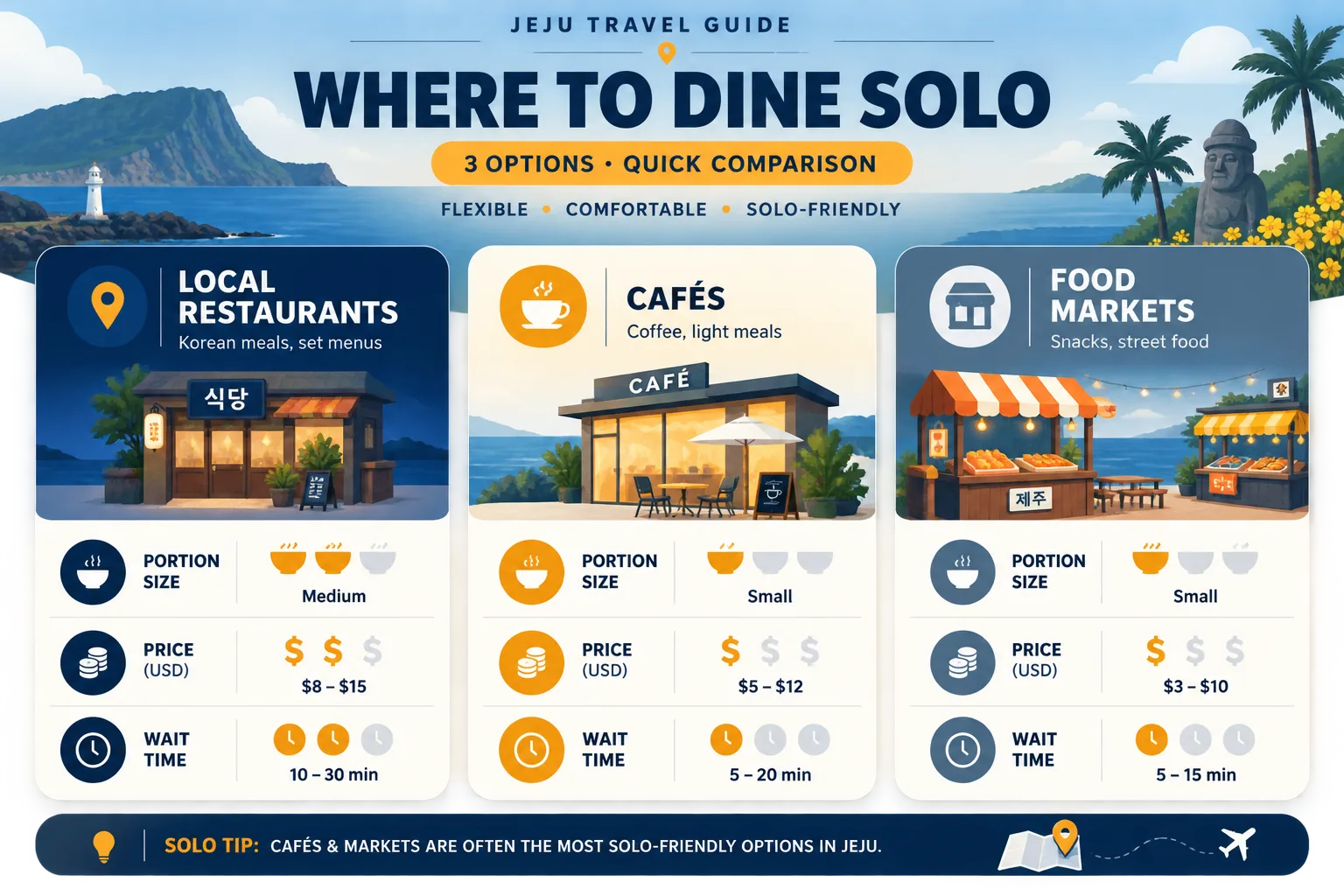 Editorial illustration: A simple comparison table layout on a flat surface showing three dining venue types for solo travelers in Jeju with short labels for portion size.
Main Friction Problem
The friction solo travelers hit in Jeju is not "no good food for one person." It is a mismatch between how black pork restaurants are built to operate and how a single diner wants to eat.
Solo dining restrictions. Traditional Korean BBQ restaurants on Jeju generally require a minimum order of two servings of meat. This is a kitchen-economics decision, not a rule against solo travelers specifically, but the effect is the same: walk in alone, and the standard menu path either turns you away or charges you for food you did not want.
Food waste. Even if a restaurant lets you order two servings and eat what you can, a solo diner is now looking at meat meant for two people. Traditional Korean BBQ is often paired with side dishes, rice, and sometimes a stew, scaled to a shared table. Eating alone means either leaving food behind or overeating to avoid waste, neither of which fits a normal travel meal.
Cost and budget. A single portion of premium Jeju black pork typically runs 20,000 to 30,000 won ($15 to $23). That is a fair price for one person. But the two-serving minimum common at traditional BBQ houses pushes the same solo meal to 40,000 to 60,000 won or more ($30 to $45+), which is a meaningfully different number when you are budgeting daily meals alone rather than splitting a bill with a travel partner.
None of these frictions are unique to Jeju among Korean regional food destinations, but they hit harder here because black pork BBQ is the headline dish and the reason many food travelers book the trip in the first place. If your itinerary assumes an easy, affordable, sit-down version of that dish every night, the friction shows up fast.
Friction Table
The real decision variables are portion structure, price exposure, and how much planning you are willing to do before you are hungry.
| Dining format | Solo-friendly? | Typical cost for one | Main tradeoff |
|---|---|---|---|
| Traditional BBQ house (grill-at-table) | Often no minimum-order friction; many enforce 2-serving minimum | 40,000-60,000+ won if minimum applies | Best atmosphere and cut quality, but highest solo cost and occasional turnaway |
| Single-portion specialty restaurant (e.g. Danbaek) | Yes, built for one | 20,000-30,000 won | Designed for solo diners, but fewer locations, so travel time matters |
| Market butcher + grill fee (e.g. Seomun Market) | Yes, with a small setup step | Meat price plus about 10,000 won table fee | Cheaper and flexible, but requires buying raw meat yourself and finding a grill spot |
| Night market / street stalls (e.g. Dongmun Traditional Market) | Yes, naturally single-serving | Low, per-skewer or per-portion pricing | Fast and solo-normal, but a casual snack, not a full sit-down meal |
| Seafood restaurant with alcohol-purchase requirement (e.g. Inson) | Conditionally yes | Single portion available, but requires an alcoholic drink order | Good single-portion seafood, but the drink requirement adds cost and may not suit non-drinkers |
The pattern is consistent: the more "traditional sit-down BBQ" the format, the more likely you hit a minimum-order wall. The more "market or street" the format, the more naturally it fits a table of one, at the cost of some atmosphere.
Who Will Feel It Most
Not every solo traveler experiences this the same way.
Solo travelers who default to sit-down restaurants. If your normal travel habit is to sit at a table, look at a full menu, and order a plated meal, Jeju's BBQ culture will feel restrictive fast. You will hit the two-serving minimum repeatedly unless you specifically seek out single-portion venues.
Budget-conscious solo travelers. The gap between a 25,000 won single portion and a 50,000 won forced double order is proportionally large on a daily food budget. Travelers tracking costs closely will feel this friction as a real budget problem, not just an inconvenience.
Travelers uncomfortable with market or street dining. If eating from a market stall or buying raw meat at a butcher counter feels less like "real dining" to you, the workarounds that solve the minimum-order problem will feel like a downgrade rather than a solution.
Travelers who feel awkward asking for exceptions. Some solo diners are comfortable asking a restaurant if a single-portion order is possible, or asking staff directly. Travelers who avoid that kind of interaction will default to walking away from restaurants that look like they enforce minimums, narrowing their options further than necessary.
On the other side, travelers who already enjoy market food, are flexible about format, and do not mind occasionally splurging for a full sit-down meal will feel very little friction at all. The mismatch is specific, not universal.
How to Reduce the Friction
Target single-portion restaurants first, not last. Danbaek, with locations in Seongsan-eup (17 Seongsanjungang-ro) and Hamdeok, offers individual trays of grilled pork neck and black pork belly built specifically for one person. Treat this as your primary black pork stop, not a backup plan, and build your itinerary around it rather than discovering it after a frustrating turnaway elsewhere.
Use the market-and-grill-fee route for control over cost. At Seomun Market, you can buy raw black pork directly from a butcher and pay a roughly 10,000 won table setup fee to grill it at a nearby market restaurant. This puts you in control of exactly how much meat you buy, which solves both the food-waste and cost-overrun problems in one move.
Lean on night markets for seafood and casual black pork. Dongmun Traditional Market's night market runs daily from 18:00 to 22:00 and sells single-serving street foods including black pork skewers and pre-sliced raw fish. It is an 8-minute, roughly 1 km walk from Black Pork Street in Jeju City, so it works well as either your main meal or a way to sample the flavor before deciding whether to splurge on a full sit-down version elsewhere.
Check single-portion seafood hours before you go hungry. Inson in Gujwa-eup serves single-portion seafood from 17:00 to 23:00, closed Sundays and Mondays, but requires an alcoholic drink purchase. If you do not drink, factor that into whether this stop makes sense, or budget for a non-alcoholic-adjacent drink order if the menu allows it.
Budget for one intentional two-serving splurge. Rather than treating every BBQ minimum as a problem to avoid, pick one night to accept the 40,000-60,000 won two-serving cost as a planned splurge, the way you might budget for one nicer restaurant meal on any solo trip. This reframes the cost as a choice rather than a forced tax.
Ask before you sit down. Not every restaurant enforces the minimum rigidly, especially outside peak dinner hours. A quick question before being seated, rather than after ordering, saves an awkward exit and lets you move on to a solo-friendly option nearby.
Better Alternatives
If the format mismatch feels like more friction than you want to manage on a trip, a few adjustments change the calculus without abandoning Jeju entirely.
Shift your trip's food focus from BBQ to seafood and market food. Jeju's raw seafood, market stalls, and night market scene are naturally more solo-compatible than tabletop BBQ. A solo itinerary built around Seomun Market, Dongmun night market, and single-portion seafood spots like Inson sidesteps the minimum-order problem almost entirely, while still delivering a strong local food experience.
Travel with at least one companion for BBQ-heavy plans. If a full, unhurried, sit-down black pork BBQ dinner is genuinely the centerpiece of why you are visiting Jeju, traveling with even one other person removes the core friction completely. This is a legitimate reason to reconsider solo travel specifically for this trip, rather than a reason to avoid Jeju.
Consider a different Korean destination if BBQ-for-one is the priority. Larger mainland cities generally have a wider spread of single-portion BBQ restaurants built around solo and single-office-worker dining culture. If eating solo BBQ comfortably every night matters more to you than Jeju's specific coastal and volcanic landscape, a mainland city itinerary may match your dining habits more closely.
Stay near solo-friendly dining clusters rather than scenic isolation. Choosing accommodation in or near Jeju City or Seogwipo, where markets and single-portion restaurants concentrate, reduces how much transit time you spend chasing the few solo-friendly options versus staying in a quieter coastal area where your only nearby restaurant enforces a two-serving minimum.
Decision Checklist
Use this before booking to confirm Jeju fits how you actually want to eat.
- I am willing to eat at least some meals at markets or night markets instead of sit-down restaurants.
- I have identified at least one single-portion restaurant (such as Danbaek) near my planned accommodation.
- I have budgeted for at least one occasion where I may pay for a two-serving minimum.
- I am comfortable asking restaurant staff whether a single-portion order is possible before sitting down.
- I know my accommodation is within reasonable bus access of Jeju City or Seogwipo, where solo-friendly options concentrate.
- My daily food budget has room for the 40,000-60,000 won range on splurge nights, not just the 20,000-30,000 won single-portion range.
- I am not relying on BBQ-for-one as the single centerpiece of the entire trip.
If you can check most of these, Jeju is a workable solo food trip. If several are unchecked, especially the budget and BBQ-centerpiece items, it is worth reconsidering either the itinerary structure or bringing a travel companion for the food-focused parts of the trip.
FAQ
Can a solo traveler eat Jeju black pork at all, or is it really impossible? It is not impossible, but it is not the default experience either. Most traditional Korean BBQ restaurants on Jeju set a two-serving minimum, so a solo diner either pays for two portions or finds one of the venues built for single trays, like Danbaek.
What is the realistic extra cost of solo dining on black pork in Jeju? A single premium portion runs about 20,000 to 30,000 won. If a restaurant enforces the two-serving minimum, the same meal becomes 40,000 to 60,000 won or more, since the kitchen is still grilling for one person.
Is street food a real substitute for a sit-down black pork meal? For seafood, yes, reasonably well. Dongmun Traditional Market's night market runs 18:00 to 22:00 with single-serving black pork skewers and pre-sliced raw fish, which covers the flavor without the minimum-order problem. It will not replicate a plated, grilled tabletop meal.
Do I need a car to reach solo-friendly restaurants like Danbaek or Inson? No, but plan transit time. Jeju has no subway, so you are relying on buses. The 201 blue trunk line connects Jeju City to the east coast for a 1,150 won fare, and Inson in Gujwa-eup and Danbaek's Hamdeok location both sit along that general corridor, though neither is directly on a bus stop, so budget walking time from the nearest stop.
Should I skip Jeju entirely if I am a solo food traveler on a tight budget? Not necessarily. Skip Jeju only if your trip's core purpose is a leisurely, multi-course sit-down black pork dinner every night. If you are flexible about mixing market stalls, single-tray restaurants, and one splurge meal, the budget friction is manageable.