travel-decisions
Is Jeju in Autumn Worth the Higher Flight Prices If Your Main Goal Is Leaf-Peeping?
A direct look at whether Jeju's autumn foliage justifies pricier flights and hotels, with a decision breakdown for leaf-peeping travelers.
Quick Verdict
Yes, if leaf-peeping is genuinely your main goal and you time it around early November. No, if you are chasing a general "pretty island trip" and only loosely interested in foliage, or if you cannot travel outside weekend windows.
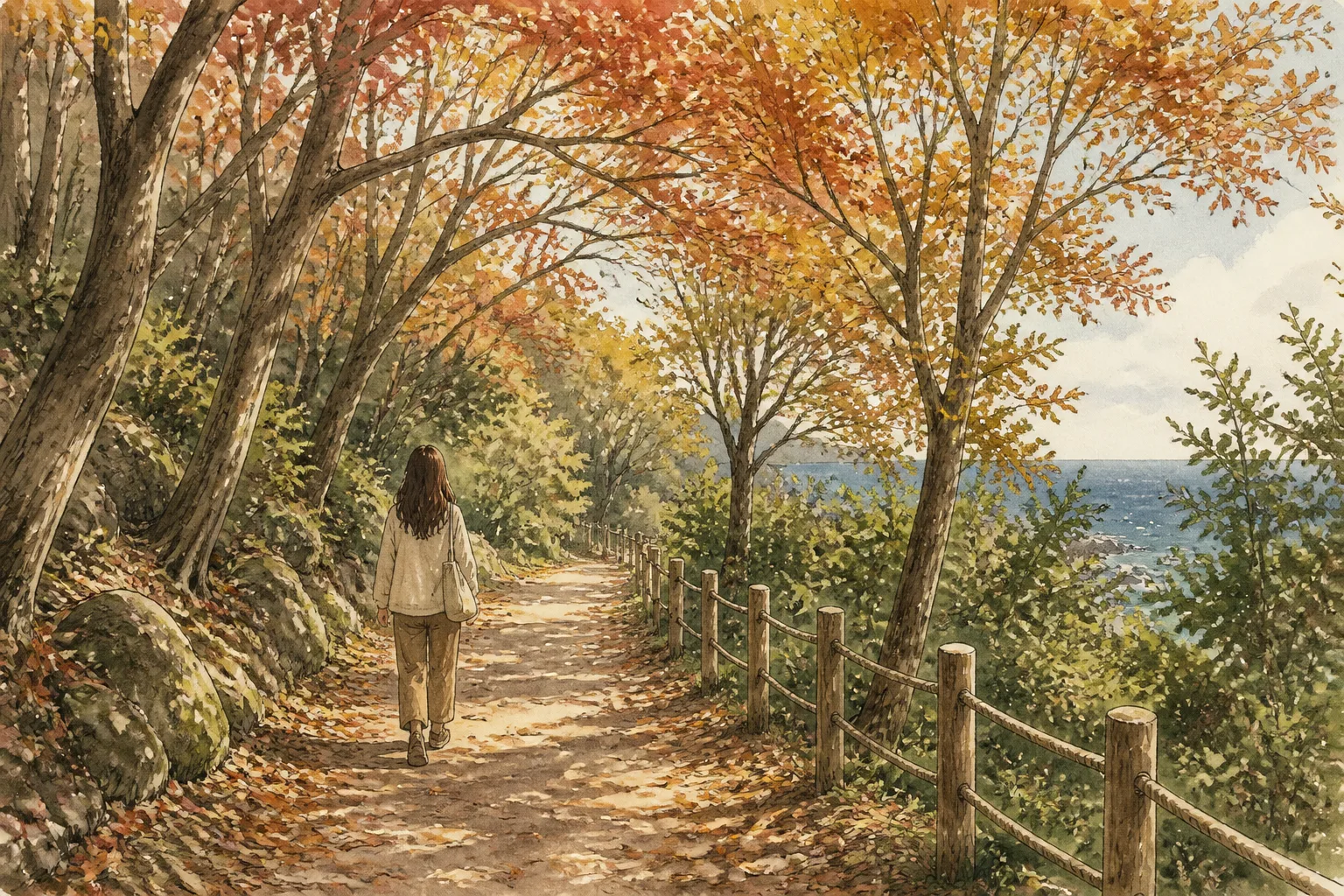
Choose Jeju in autumn if you want a specific kind of color: volcanic crater rims, mid-mountain forest paths, and coastal waterfalls all turning within about a two-week window, with far less crowding than mainland Korea's most famous foliage spots. Skip it, or downgrade your expectations, if you need guaranteed peak color on an exact travel date, if you are hiking-averse, or if a 40 percent flight price jump changes your trip math.
The honest tradeoff: Jeju's foliage season is short, elevation-dependent, and priced at a premium precisely because everyone else figured out the same thing you did. It rewards travelers who can be flexible by a few days and who value scenery enough to pay for it. It punishes travelers locked into fixed weekend dates who expect a guidebook-perfect photo on demand.
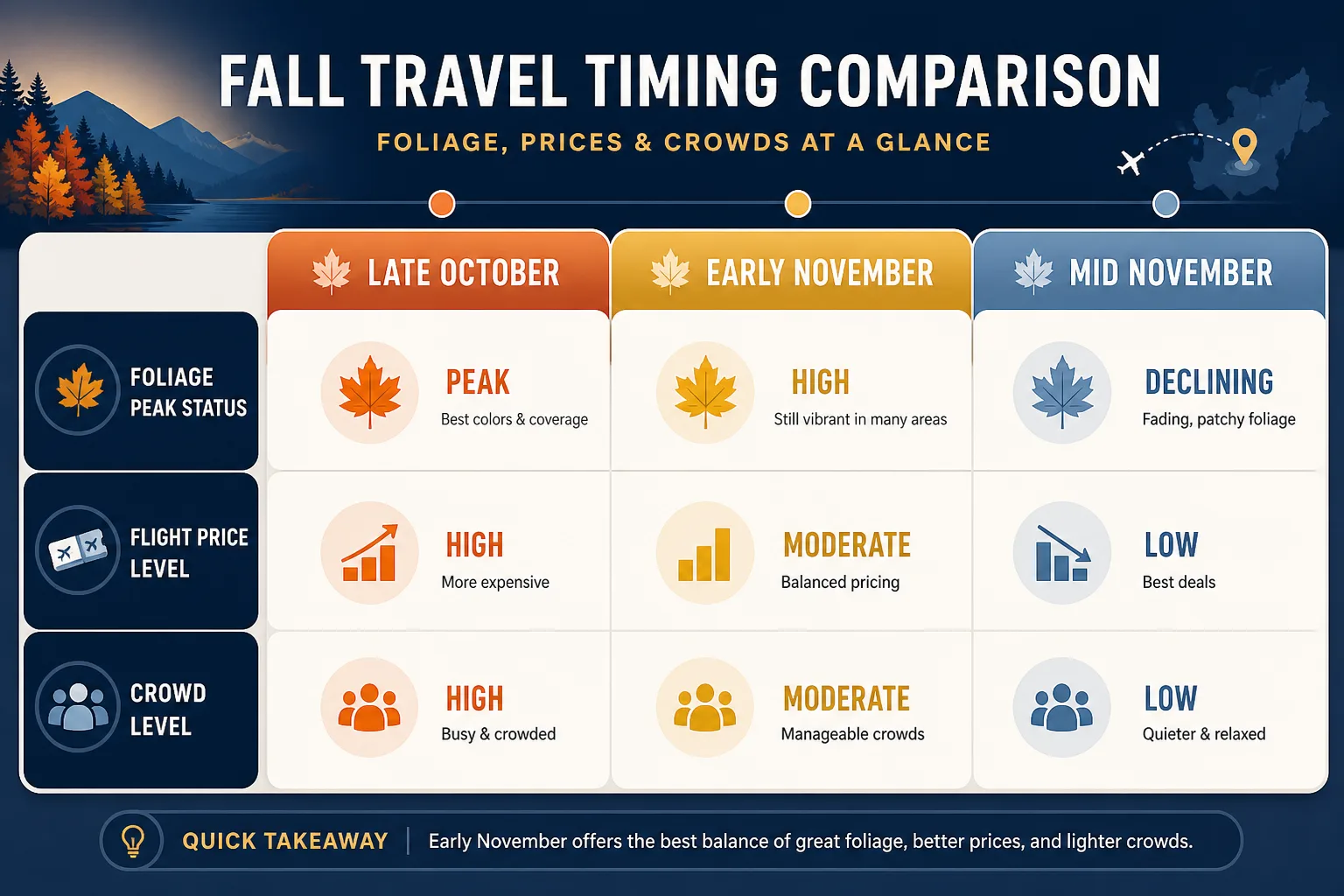 Editorial illustration: A simple comparison layout / data table showing three columns labeled late October.
At a Glance Table
| Decision variable | Late October | Early November | Mid-to-late November |
|---|---|---|---|
| Hallasan summit/upper slope color | At or near peak (around Oct 30) | Fading | Mostly gone |
| Lower forest paths and waterfalls | Still green to early turning | At or near peak (Nov 1-10) | Fading, past best |
| Flight price (round trip, budget carrier) | Rising toward peak-season band | Peak-season band (about 269,400 won) | Starting to ease |
| Hotel rate (3-star, weekday) | Rising | Peak weekday and weekend rates | Easing toward shoulder pricing |
| Crowd level on marked trails | Heavy on weekends | Heaviest overall | Moderate, thinning |
| Trail reservation pressure (Hallasan summit) | High, fills fast | Highest | Lower, more availability |
The core tension is visible in that table: the week that maximizes your odds of seeing color at both high and low elevation is the same week everyone else is also booking, so it is also the priciest and most crowded.
Choose Jeju in Autumn If
Choose it if your itinerary is built around scenery first, not a checklist of landmarks. Jeju's autumn strength is its range: a crater walk at Sangumburi, a short climb up Saebyeol Oreum, and a long forest path like the Cheona trail all deliver different color palettes within a single island, without needing a car for a full week of driving distances the way a mainland foliage tour might.
Choose it if you can shift your trip by three to five days around late October through early November rather than locking into one fixed weekend. That flexibility is what lets you catch either the summit fading into lower-elevation peak, or plan two separate short outings, one for higher ground and one for coastal and mid-mountain color, instead of gambling on a single day.
Choose it if you are comfortable with moderate hiking. The Cheona Forest Path is 10.9 km one-way and takes about 3 hours 40 minutes to walk, and the Hallasan summit round trip is 17.3 to 18 km over 8 to 10 hours. Jeju's best autumn color is not a drive-by view from a car window; a meaningful share of it requires walking to reach.
Choose it if the flight premium is a manageable amount in absolute terms for you. Going from roughly 196,400 won to about 269,400 won round trip is a real increase, but it is still a modestly priced domestic flight compared to many international foliage trips, so the premium may be easier to justify than it first appears.
Choose a Different Season If
Choose a different season, or treat foliage as a bonus rather than the goal, if your travel dates are fixed to a specific weekend months in advance and cannot flex even by a few days. Foliage timing on Jeju is elevation-dependent and weather-sensitive enough that a single locked date is a real gamble.
Choose a different season if you dislike hiking or have limited walking stamina. Several of Jeju's best foliage viewpoints, including the Hallasan summit trails and the Cheona Valley path, involve multi-hour walks with real elevation change, and there is no easy shortcut to see them up close.
Choose a different season if your main goal is actually beaches, canola-flower fields, or cherry blossoms rather than fall color specifically. Jeju's spring season (late March to April) is the island's other peak, with a completely different look and different crowd patterns, and it is a better fit if foliage is not truly the priority.
Choose a different season if minimizing cost matters more than maximizing color quality. Shoulder-season Jeju trips outside the autumn and spring peaks are cheaper on both flights and hotels, and you can still catch some early or late color at the edges of the foliage window without paying the peak premium.
Who Might Regret Choosing Autumn
Travelers who book a single weekend months ahead and expect guidebook-perfect summit color on that exact date are the most likely to feel let down. Foliage timing shifts year to year with temperature and rainfall, and Hallasan's upper slopes can turn earlier or later than the typical late-October window. A rigid one-weekend plan built entirely around peak color has real odds of landing a week too early or too late.
Travelers who dislike crowds but did not plan around that reality will also regret it. Early November is simultaneously the best color window and the peak crowd window on Jeju's most photographed trails and viewpoints. If queueing for a photo spot or sharing a narrow trail with a steady stream of other hikers would ruin the experience for you, autumn's marquee week is the wrong time to go.
Travelers with low hiking tolerance who assumed Jeju's foliage would be mostly viewable from a car or short paved walk may also be disappointed. Some crater rims and lookout points are accessible with minimal walking, but the most talked-about forest color, including the Cheona Valley, requires a multi-hour trail commitment, and the trail can close for up to two days after heavy rain, which is common in autumn.
Who Might Regret Skipping Autumn
Travelers who visit Jeju in deep winter or high summer expecting comparable scenic payoff may regret skipping the foliage window. Jeju's autumn color, particularly the coastal waterfall and mid-mountain combination, is a genuinely distinct look that summer's green canopy or winter's bare branches do not replicate.
Photographers and scenery-focused travelers who chose a cheaper shoulder-season date purely to save money may regret it if the entire trip's purpose was color photography. Saving on the flight premium only pays off if you were not counting on foliage as the centerpiece; if you were, a shoulder-season trip without color risks feeling like a wasted primary objective even if everything else about the trip went fine.
Travelers who assumed "autumn in Korea" is interchangeable and picked a different, more crowded mainland foliage destination instead may also regret it. Jeju's foliage crowds, while real, are generally lighter than the most famous mainland Korean autumn spots, so skipping Jeju specifically to avoid crowds elsewhere can backfire.
Key Friction Comparison: Season Timing vs Crowds
The two frictions that matter most for this decision, season timing and crowds, work against each other rather than independently. The narrower you make your travel window to maximize color odds, the more you concentrate yourself into the same days as every other foliage traveler.
Practical ways to reduce both frictions at once:
- Target the first ten days of November rather than a single date; this window covers both lower forest and coastal peak color per the typical seasonal pattern, giving you more flexibility to shift a day or two based on weather forecasts closer to your trip.
- Book Hallasan summit trail reservations (Seongpanak or Gwaneumsa) the moment the booking window opens on the first day of the preceding month, since these fill quickly during peak foliage weeks.
- If you miss a summit reservation, use the Yeongsil or Eorimok trails instead, but plan to arrive before 8:00 AM for parking, since these trails see the overflow crowd from travelers who could not book the summit.
- Visit marquee viewpoints like Sangumburi or Saebyeol Oreum on a weekday morning rather than a weekend afternoon; crowd density on Jeju's short, popular trails swings heavily by day of week and time of day.
- Build in a rain-day buffer, since the Cheona Valley trail closes for up to two days after heavy rainfall, which is a realistic autumn scenario given the season's weather pattern.
- Choose weekday flight and hotel dates where possible; shifting an arrival or departure off a weekend keeps you closer to the lower end of the roughly 196,400 to 269,400 won flight range and the lower end of the 70 to 138 dollar hotel range.
Neither friction fully disappears. The honest expectation is that you trade a narrower, pricier, more crowded window for meaningfully better odds of good color, not a guarantee of an empty trail with perfect leaves.
Final Recommendation
Go for it if leaf-peeping is your actual primary goal, you can flex your dates by a few days around late October to early November, and you are willing to walk multi-hour trails to reach the best color. The flight and hotel premium is real but not extreme in absolute terms, and Jeju's combination of crater, forest, and coastal color is distinct enough to justify the cost for a traveler who is specifically chasing it.
Reconsider or scale down expectations if your dates are fixed to one weekend, if you have limited hiking tolerance, or if foliage is a secondary interest rather than the main reason for the trip. In those cases, a shoulder-season visit, or a trip built around Jeju's spring flower season instead, will likely deliver better value for what you are actually optimizing for.
There is no version of this decision where the premium disappears. The question is only whether the specific color payoff is worth it for your specific priorities, and for a genuinely foliage-focused traveler with some date flexibility, the answer in this analysis is yes.
FAQ
What is the single best week to see autumn foliage on Jeju?
There is no single perfect week for the whole island. Hallasan's summit and upper slopes typically peak around October 30, while lower forest paths, mid-mountain trails, and coastal waterfalls peak between November 1 and November 10. If you can only pick one week, early November gives you a chance at both fading summit color and peak lower-elevation color, but neither will be at its single best moment.
Are Jeju flights and hotels actually more expensive in autumn than other seasons?
Yes, on the specific dates that overlap peak foliage. Round-trip budget flights from Seoul that run about 196,400 won on a Monday-to-Thursday departure can rise to roughly 269,400 won on peak autumn dates. Hotel rates follow a similar pattern, with 3-star weekday rates of 70 to 110 dollars a night climbing to 117 to 138 dollars on weekends during the same window.
Can I avoid the Jeju autumn price spike and still see good foliage?
Partially. Booking a Monday-to-Thursday flight even within the foliage window keeps you closer to the lower fare band, and staying on weeknights avoids the weekend hotel jump. You will not fully dodge the seasonal premium, but you can trim it by avoiding weekend arrival and departure days.
Do I need a hiking reservation to see Hallasan's autumn colors?
Only for the summit trails. The Seongpanak and Gwaneumsa trails to the Hallasan summit require a free advance online reservation that opens on the first day of the preceding month, and it fills fast during foliage season. The Yeongsil and Eorimok trails do not require a reservation, but you need to arrive before 8:00 AM to get a parking spot near the Yeongsil trailhead.
Is Jeju's autumn foliage worth it if I am on a tight budget?
It depends on what you are optimizing for. If color quality is your top priority, autumn is worth the premium because Jeju's coastal and mid-mountain foliage is genuinely distinct from mainland spots. If you are budget-first and foliage is a nice-to-have, you will get better value visiting Jeju in a shoulder period and treating any color you catch as a bonus rather than the goal.