travel-decisions
Is Hallasan's Winter Hike Worth It If You Fail to Secure a Mountain Entry Permit?
You missed the Hallasan summit permit window. Here is a clear-eyed look at whether Jeju's no-permit winter trails are still worth the trip, or whether you should change your plan.
Strong Opening
You planned around a Hallasan summit hike, and the permit window closed before you got a slot. Seongpanak and Gwaneumsa, the only two trails that reach the actual summit crater, cap entries at 1,000 and 500 hikers a day, and booking opens on the first day of the month before your visit. If you were a day late, a slot short, or simply did not know the system existed, you are now deciding whether the rest of the trip still makes sense.
This is not a small footnote. The summit crater and the frozen crater lake are the reason most people put Hallasan on a Jeju itinerary in the first place. Without a permit, that specific image is off the table. The real question is not "can I still hike Hallasan," because you can. The real question is whether the trail you can actually walk still matches what you came to Jeju for, or whether you will spend a cold, tiring day chasing a smaller version of the thing you wanted and come away disappointed anyway.
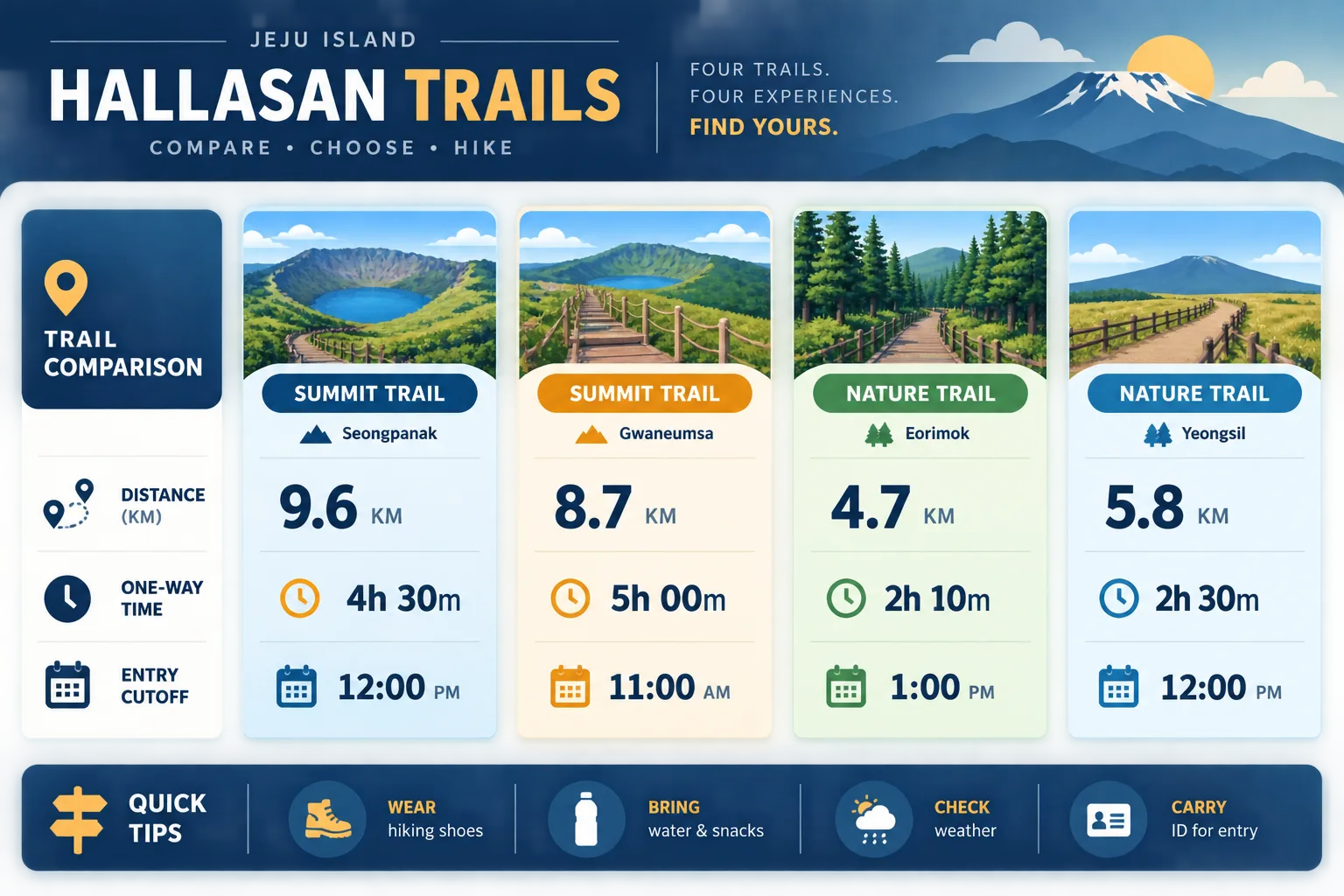 Editorial illustration: A simple comparison table layout on a clean background showing four Hallasan trail names.
Quick Verdict
Yes, a winter Hallasan hike without a summit permit is worth it, but only for a specific kind of traveler. You will not stand at the crater. You will reach a shelter, a ridge junction, or a lower peak, depending on which trail you choose, and the hike itself is still a legitimate winter mountain trail with snow, crampons, and real elevation gain.
Choose the no-permit trail if:
- The hike itself (snow, forest, quiet, physical effort) was always part of the appeal, not just the summit photo
- You can accept a shelter or ridge view as the endpoint instead of the crater
- You are comfortable with strict winter cutoff times and can start early
Skip it and rebook for another season instead if:
- The summit crater and crater lake were the entire reason for the trip
- You are traveling with someone who has low tolerance for "almost but not quite"
- Your schedule is too tight to start hiking before the 10 AM or noon gate cutoffs
Who Will Probably Love It
Hikers who treat the mountain as the destination, not the crater specifically, tend to come away satisfied. The Yeongsil and Eorigmok trails both climb through pine and dwarf bamboo forest to Witse Oreum Shelter, at 3.7 km and 4.7 km respectively, and both continue further to Nambyeok Junction if time and the cutoff allow. That is a real winter hike with meaningful distance and elevation, not a token walk.
Adventure travelers who like a structured, rule-bound day also tend to do well here. Winter Hallasan runs on firm cutoffs (gate closed by noon at Yeongsil and Eorigmok, by 10 AM at Donnaeko, descent from Witse Oreum Shelter starting by 3 PM), and if you like knowing exactly what the day requires rather than winging it, the structure works in your favor rather than against you.
Travelers on a tighter budget or timeline also benefit, since none of the four alternative trails require the advance booking, deposit, or date-locking that the summit permits do. You can decide the night before, check the weather, and go.
Who Might Regret It
If the mental image driving your trip was standing at the crater rim with the frozen lake below, no other trail on Hallasan replaces that. Witse Oreum Shelter and Nambyeok Junction are real, worthwhile viewpoints, but they are not the summit, and no amount of trail length makes up the difference in the specific view you were picturing.
Travelers with a rigid one-day Jeju itinerary are also at risk. If your plan already has a tight afternoon activity booked elsewhere, the winter entry gates (noon at Yeongsil and Eorigmok, 10 AM at Donnaeko) leave very little room for a late start, traffic on the way to the trailhead, or a slow breakfast. Missing the gate means the day is over before the hike begins, and there is no partial credit.
People hiking with a companion who specifically wanted the summit, and who is less flexible about substituting a shelter view, are a common source of trip friction. A hike that feels like a solid consolation to you can feel like a wasted day to them if expectations were not aligned before setting out.
Mistake / Consequence Table
| Decision variable | What happens if you get it wrong | What to do instead |
|---|---|---|
| Assuming any trail reaches the summit | You hike hours toward a shelter or junction expecting a crater view that never comes | Confirm before you go: only Seongpanak and Gwaneumsa reach the summit, and both require the permit |
| Arriving after the entry cutoff | Turned away at the gate with the day's hiking window gone | Plan to reach Yeongsil or Eorigmok before noon, Donnaeko before 10 AM, with buffer for bus timing |
| Skipping crampons | Refused entry or unsafe footing on packed snow and ice | Rent or bring crampons; they are mandatory, not optional, on every winter trail |
| Not carrying food and water | No shops or restaurants exist inside the park or at any shelter | Pack all meals, snacks, and water before leaving your accommodation |
| Choosing Yeongsil for a short visit without checking the access road | An extra 2.5 km, roughly 40 minutes uphill, before the trail itself even starts | Budget the walk from the lower ticket booth to the upper trailhead as part of your total time |
| Ignoring the 3 PM descent rule | Rushed, stressful descent from Witse Oreum Shelter in fading winter light | Treat 3 PM as a hard turnaround time, not a suggestion |
Hidden Friction Points
Weather and season. Winter conditions on Hallasan are not the same as a mild Jeju coastal walk. Trails require mandatory crampons, gates close hours before sunset to keep hikers off the mountain in the dark, and the descent-by-3-PM rule from Witse Oreum Shelter exists because winter daylight runs out fast at elevation. None of this is dangerous if you respect the schedule, but it does mean the trip has a harder stop time than a typical sightseeing day, and there is no flexibility for "just ten more minutes" once the cutoff passes.
Expectation mismatch. This is the friction point that causes the most regret, and it has nothing to do with fitness or weather. It comes from planning a trip around one specific image (the summit crater) and then substituting a different, smaller experience (a shelter or ridge junction) without resetting that expectation first. A hike to Witse Oreum Shelter is a genuinely good day out on its own terms. It becomes a disappointing day only when it is silently compared to the summit hike you originally wanted and comes up short by that measurement.
How to Make It Easier
Reset the goal before you leave your accommodation, not on the trail. Decide explicitly that the destination is the shelter or the ridge junction, not the crater, so the hike is judged against the day you are actually having.
Pick the trail that matches your time budget, not the longest option by default. Eoseungsaengak, at 1.3 km and about 30 minutes one-way from the Eorigmok Visitor Center, is a legitimate short winter walk if your schedule is tight or a companion has lower stamina. Donnaeko, starting from Seogwipo on the island's south side, is the longest single approach at roughly 7 km and 3.5 to 4 hours one-way to Nambyeok Junction, and it also has the earliest cutoff at 10 AM, so it suits an early riser more than a leisurely-morning traveler.
Build in the access-road time. Bus 240 from the Jeju Intercity Bus Terminal stops at both the Eorigmok and Yeongsil entrances, and standard bus fare is about 1,200 KRW payable with a T-money card, which keeps transit cheap and simple. But at Yeongsil specifically, the bus drops you at a lower ticket booth, and it is a further 2.5 km, about 40 minutes uphill in winter conditions, before you reach the actual trailhead. Treat that walk as part of the hike, not a warm-up you can rush through.
Pack as if nothing will be available, because nothing will be. No shops, cafes, or vending machines operate inside the park or at any shelter, so water, snacks, and lunch all need to come with you from town.
Better Alternatives
If the summit crater was truly the non-negotiable part of the trip, the more honest move is to treat this visit as a scouting trip and rebook a future date once you understand the permit system: booking opens on the first day of the month before your intended hike, for either the 1,000-person Seongpanak cap or the 500-person Gwaneumsa cap.
If you still want a big-view, less rule-bound hiking day on Jeju this trip, an oreum (one of Jeju's smaller volcanic cones) makes a reasonable substitute. Oreum trails are shorter, have no permit system, no winter entry gate, and no mandatory crampon check, which suits travelers who want scenery and exercise without the scheduling pressure of the main Hallasan trails.
If the trip is more about the overall Jeju winter atmosphere than about summiting anything, shifting the day's plan toward the coast or a lower-elevation nature walk removes the entry-cutoff stress entirely, and leaves the Hallasan summit as a clean reason to return.
Self-Checklist
Use this before you commit to a winter Hallasan day without a summit permit:
- I have accepted that today's endpoint is a shelter or ridge junction, not the summit crater
- I know which trail matches my time and stamina (Eoseungsaengak for short, Yeongsil or Eorigmok for a half-day, Donnaeko for the longest single approach)
- I know my trail's exact entry cutoff (noon for Yeongsil/Eorigmok, 10 AM for Donnaeko) and have built in transit buffer to beat it
- I have crampons, and I know they are mandatory, not optional
- I have packed all food and water for the day, since nothing is sold inside the park
- I know the 3 PM turnaround rule from Witse Oreum Shelter and will treat it as a hard limit
- Everyone in my group has the same reset expectation about what the hike will and will not include
FAQ
Can I still hike Hallasan in winter without a summit permit? Yes. The Yeongsil, Eorigmok, Donnaeko, and Eoseungsaengak trails do not require the advance permit system that applies to the Seongpanak and Gwaneumsa summit trails. You will not reach the summit crater, but you can still hike a real winter mountain trail up to a shelter or ridge junction.
Why do Seongpanak and Gwaneumsa need permits and the others do not? Seongpanak and Gwaneumsa are the only two trails that continue to the actual summit, and daily hiker numbers on those routes are capped at 1,000 and 500 respectively to manage congestion and trail damage. The other four trails stop below the summit at a shelter, ridge junction, or lower peak, so they are not subject to the same cap.
What is the biggest mistake people make on the no-permit trails? Expecting to reach the summit anyway, or misjudging the entry cutoff times. Arriving at the Yeongsil or Eorigmok gate after noon, or the Donnaeko gate after 10 AM, means you will be turned away regardless of how much daylight looks left.
Do I need crampons even if I only plan to hike partway? Yes. Crampons are mandatory on the winter trails for any distance, not just for hikers going all the way to a shelter. Trail staff check for them, and packed snow or ice can appear within the first kilometer.
Is it worth going to Jeju in winter at all if I cannot get a summit permit? It depends on what you came for. If seeing the actual crater was the entire point, no substitute trail will deliver that and you may regret the trip. If you wanted a real winter hike with snow, quiet forest, and a mountain shelter as the goal, the no-permit trails deliver that without needing a permit at all.