travel-decisions
Is Barcelona Too Tiring for Low-Walking Travelers?
A friction-first decision guide on whether Barcelona suits low-walking, older, or slow travelers, with concrete tradeoffs and alternatives.
Is Barcelona Too Tiring for Low-Walking Travelers?
Quick Verdict
Barcelona can work for low-walking travelers, but only if you plan around the terrain instead of around the bucket list. The honest answer is this: the city is a strong fit if you base in flat Eixample, accept a one-neighborhood-per-day pace, and use accessible buses and metro stations as your default. It is a weak fit if your mental image of Barcelona is the Gothic Quarter at sunset, Park Guell at golden hour, and Sagrada Familia in the same afternoon. That itinerary will hurt.
Choose Barcelona if you want flat, tree-lined blocks, a real cafe culture, and a transit system that mostly meets you halfway. Skip it, or pick a different base city, if you cannot tolerate cobblestones, crowd pressure, summer heat, and the constant small decisions about which station has an elevator.
The Real Friction: Why Barcelona Tires People Out
Barcelona does not exhaust visitors with distance. It exhausts them with surface, slope, and density stacked on top of each other.
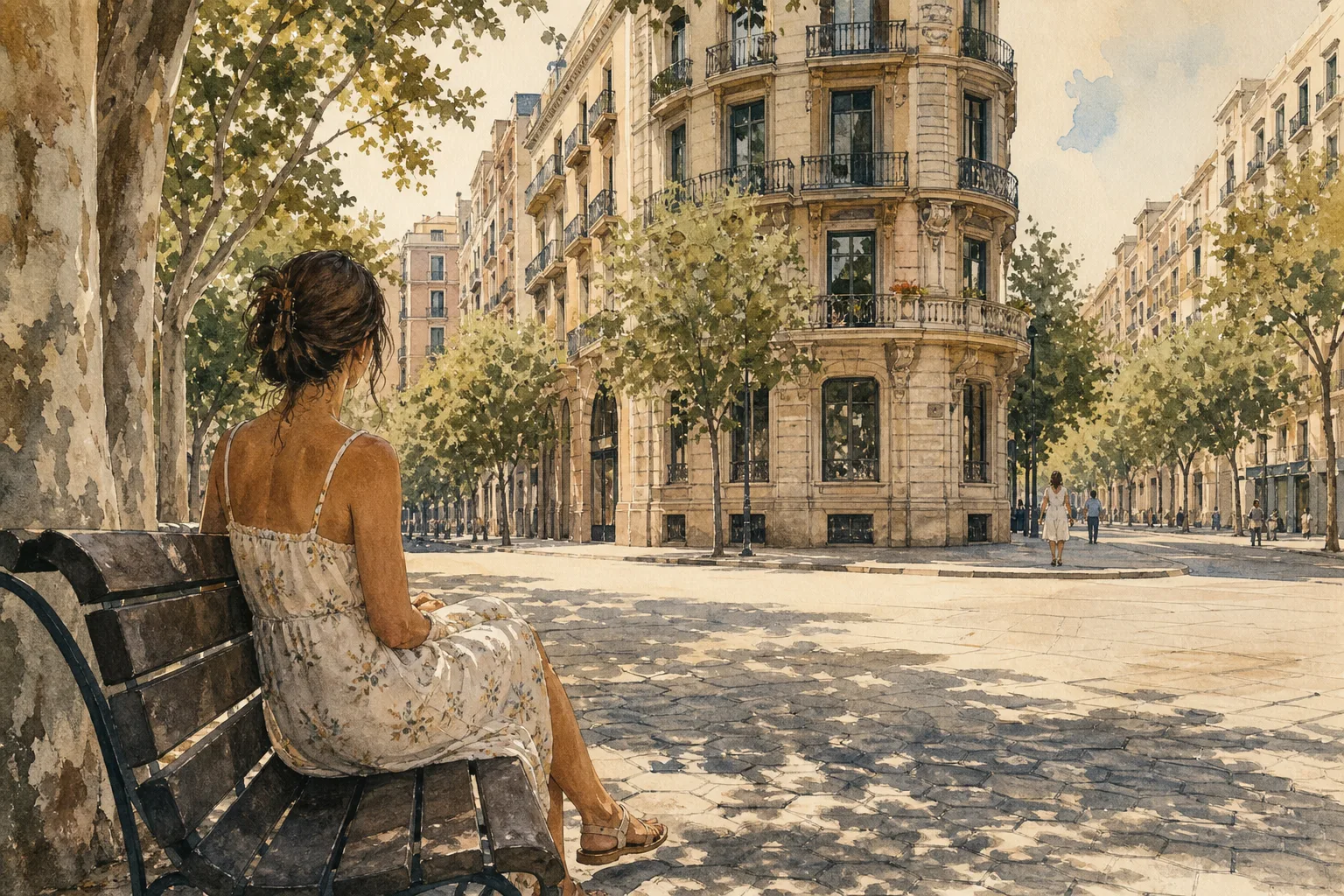
The Eixample district, where most well-located hotels sit, is largely flat with wide sidewalks and a maximum grade of around 2%. That part is genuinely easy. The trouble starts the moment you cross into the older or higher parts of town. The Gothic Quarter has narrow streets, uneven cobblestones, frequent 3 to 6 inch level changes at thresholds and curbs, and some streets that climb at 15 to 20% grades. Park Guell sits on a hillside with uneven terrain, steep paths, and numerous steps. Even the famous walk between Park Guell and Sagrada Familia, about 2.2 to 3.5 km and 30 to 45 minutes, is forgiving in one direction (mostly downhill) and brutal in the other (mostly uphill).
Layer on crowd pressure in high season, when temperatures sit at 25 to 30 degrees Celsius and August adds oppressive humidity, and walking fatigue compounds faster than it would in a cooler, flatter city. Transit stress is the final tax. Buses are 100% accessible, and 156 of 165 metro stations have elevators, which is good. But nine stations are not accessible, including Urquinaona on L1 and L4 and Jaume I on L4, both of which sit exactly where tourists want to get off. That mismatch creates a slow drip of small route changes that wears people down over a week.
Friction Table: Where the Fatigue Actually Comes From
Use this as a planning filter, not a ranking. The point is to see which areas earn their place on a low-walking itinerary and which do not.
| Area or activity | Walking fatigue | Stairs or surface | Crowd pressure | Transit stress |
|---|---|---|---|---|
| Eixample (base neighborhood) | Low. Flat, max ~2% grade, wide sidewalks. | Low. Smooth pavement, easy curbs. | Moderate near Passeig de Gracia. | Low. Multiple accessible metro and bus lines. |
| Gothic Quarter | High. Short distances feel long. | High. Cobbles, 3 to 6 inch level changes, 15 to 20% grade streets. | High in the evenings. | Moderate. Jaume I (L4) is not accessible. |
| Sagrada Familia exterior | Moderate. Long loop around the block. | Low to moderate near the entrance. | Very high in peak season. | Moderate. Timed entry adds standing time. |
| Park Guell | High. Hillside site. | Very high. Steep paths and many steps. | High in the monumental zone. | High. Uphill approach from metro. |
| Barceloneta and beach | Moderate. Long flat promenade. | Low on the promenade, sandy access off it. | High on summer weekends. | Low. Accessible buses cover it well. |
| Montjuic by cable car | Low. Seated transfer. | Low. Cable car is fully adapted for wheelchair users. | Moderate. | Low once you reach the lower station. |
The pattern is clear. Flat plus accessible transit equals a sustainable day. Cobbles, hills, and a missing elevator at the wrong station equal a day that ends early.
Who Will Feel It Most
Three groups should be especially honest with themselves before booking.
Older travelers managing joint pain or balance: the Gothic Quarter's surface changes are the single biggest hazard, more than distance. A 400 meter wander there can be harder than two flat kilometers in Eixample.
Low-stamina travelers who want a full sightseeing list: Barcelona's icons are spread across flat, hilly, and crowded zones. Trying to hit Sagrada Familia, Park Guell, and the Gothic Quarter in the same day is the classic regret pattern. Pick one per day, maximum.
Slow travelers traveling in June through August or September: high season brings the biggest crowds and the 25 to 30 degree heat, with August often adding oppressive humidity. Heat does not just slow you down. It shortens the useful part of the day to morning and late evening, which forces a denser schedule into fewer hours, which causes the fatigue you were trying to avoid.
If you recognize yourself in two of these three, treat Barcelona as a deliberate slow-travel city, not a sightseeing sprint.
How to Reduce the Friction
You can take most of the pain out of Barcelona with a few firm rules.
- Base in Eixample or lower Gracia. Flat blocks and accessible transit do the heavy lifting for you. Expect mid-range hotels here to run roughly 130 to 200 euro per night in peak season, with citywide averages around 110 to 130 euro per night in 2026. Book 3 to 6 months ahead for summer.
- Travel in shoulder season if you can. November is typically the most affordable month for hotels and is dramatically easier on stamina than August.
- Pre-screen every metro station for elevators. Assume Urquinaona (L1, L4) and Jaume I (L4) will not work for you, and route around them by bus or by getting off one stop earlier.
- Default to buses for short hops. The entire fleet is 100% accessible with ramps and designated spaces, which removes the elevator lottery entirely.
- Use the Montjuic Cable Car for the hill day. It is fully adapted for wheelchair users and turns a punishing climb into a seated transfer.
- Visit Park Guell only by taxi or accessible bus drop-off near the monumental zone, see it, and leave. Do not plan to walk down to Sagrada Familia in the same outing.
- Cap walking days at one neighborhood. If you cross more than one Metro line on foot, you have overplanned.
- Build a forced rest block from roughly 14:00 to 17:00 in summer. Heat is a friction multiplier, not a backdrop.
Better Alternatives If Barcelona Is the Wrong Fit
If the friction table already feels like too much, you have better options than forcing Barcelona.
- Valencia for a flatter Spanish city break. You get a similar climate and food culture with a much gentler walking surface and fewer hill detours.
- Seville in shoulder season for an atmosphere-first trip without the hillside icons. Avoid July and August, which are hotter than Barcelona.
- Lisbon only with caution. It is a famous trap for low-walking travelers because of its hills and tram-track cobbles, even though it markets itself as a slow city. If hills are your main issue, Lisbon is worse than Barcelona, not better.
- Bologna or Bordeaux for a small-city alternative with flat historic centers, strong food culture, and short transit rides. These are the cleanest swaps if your core wish was a relaxed European city stay rather than Barcelona specifically.
- A coastal slow-travel base such as Sitges, reached by train from Barcelona, with day trips into the city only on your strongest days. This keeps Barcelona on the trip without making it the daily terrain.
The right alternative depends on which friction is non-negotiable for you: hills, cobbles, heat, or crowds.
Decision Checklist Before You Book
Run this list honestly. If you cannot tick most of these, change the plan, not your stamina.
- My hotel is in flat Eixample or lower Gracia, not the Gothic Quarter or up toward Park Guell.
- I have checked that my nearest metro stations have elevators and have a bus backup if they do not.
- My daily plan covers one neighborhood, not three.
- I have a seated transit option (bus, taxi, or cable car) for every hill or long block.
- I am traveling outside June through August or September, or I have a midday rest window built into every day.
- I have accepted that Park Guell and the Gothic Quarter back streets are short, taxi-assisted visits, not long wanders.
- I booked 3 to 6 months in advance if I am traveling in summer, with a realistic 130 to 200 euro per night peak-season budget for mid-range Eixample hotels.
- I have one true rest day for every two active days.
- My travel companions know the pace and agree to it in writing, not just in theory.
If five or more of these are not realistic, Barcelona will tire you out no matter what guides promise. That is the firm version of the answer.
If you are comparing Spain cities mainly by walking load, read Barcelona vs Madrid for travelers who hate long walking days before choosing the base city.
FAQ
Is Barcelona walkable if I can only do about 3 to 4 km a day? Yes, but only if you base in flat Eixample and treat each day as one neighborhood, not a citywide loop. Skip Park Guell and the Gothic Quarter back streets, and use buses or accessible metro stations for anything beyond about a 15 minute walk.
Are the metro and buses actually usable for someone who avoids stairs? Mostly yes. The entire bus fleet is 100% accessible with ramps and designated spaces, and 156 of 165 metro stations have elevators. The catch is that nine stations, including Urquinaona on L1 and L4 and Jaume I on L4, are not accessible, so check your specific station before you commit to a metro plan.
Should low-walking travelers visit Park Guell at all? Only if you accept that it sits on a hillside with uneven terrain, steep paths, and many steps. If you go, arrive by taxi or accessible bus, see the monumental zone, and leave. Do not try to walk down from Park Guell to Sagrada Familia just because it is 2.2 to 3.5 km and mostly downhill, since the surfaces and curbs still punish tired feet.
When is Barcelona least tiring to visit? Shoulder months outside June through August or September. High season brings the biggest crowds and 25 to 30 degree Celsius heat, and August often adds oppressive humidity, all of which multiply walking fatigue. November is typically the most affordable month for hotels and is far easier on stamina.
Is Barcelona a bad fit if I use a cane or rollator? Not bad, but selective. Eixample sidewalks and accessible buses work well. The Gothic Quarter's cobblestones, 3 to 6 inch level changes, and some 15 to 20% grade streets are a real problem and should be visited briefly by taxi drop-off, not explored on foot for hours.