city-matchups
Barcelona vs Madrid: Which Fits Travelers Who Hate Long Walking Days?
A direct verdict on Barcelona vs Madrid for travelers who tire on long walking days, with a friction-by-friction breakdown of hills, cobblestones, and transit.

Quick Verdict
If long walking days wear you down, choose Madrid as your main base.
Madrid's central tourist core is flatter, its highest-priority sights cluster tightly along the Paseo del Prado, and its buses and an expanding share of metro stations are built for travelers who cannot rely on stamina. Barcelona is rewarding, but its top experiences are physically spread out, the Gothic Quarter is uneven underfoot, and the Park Guell and Montjuic visits both involve real hills.
Choose Madrid if you want shorter walking days, a denser cluster of must-see sights, and a city where one well-placed hotel solves most of your fatigue problem. Do not choose Madrid if your trip is specifically built around Gaudi, the Mediterranean, or a beach base. In that case you are picking Barcelona regardless of walking cost, and the rest of this article will help you plan around the friction.
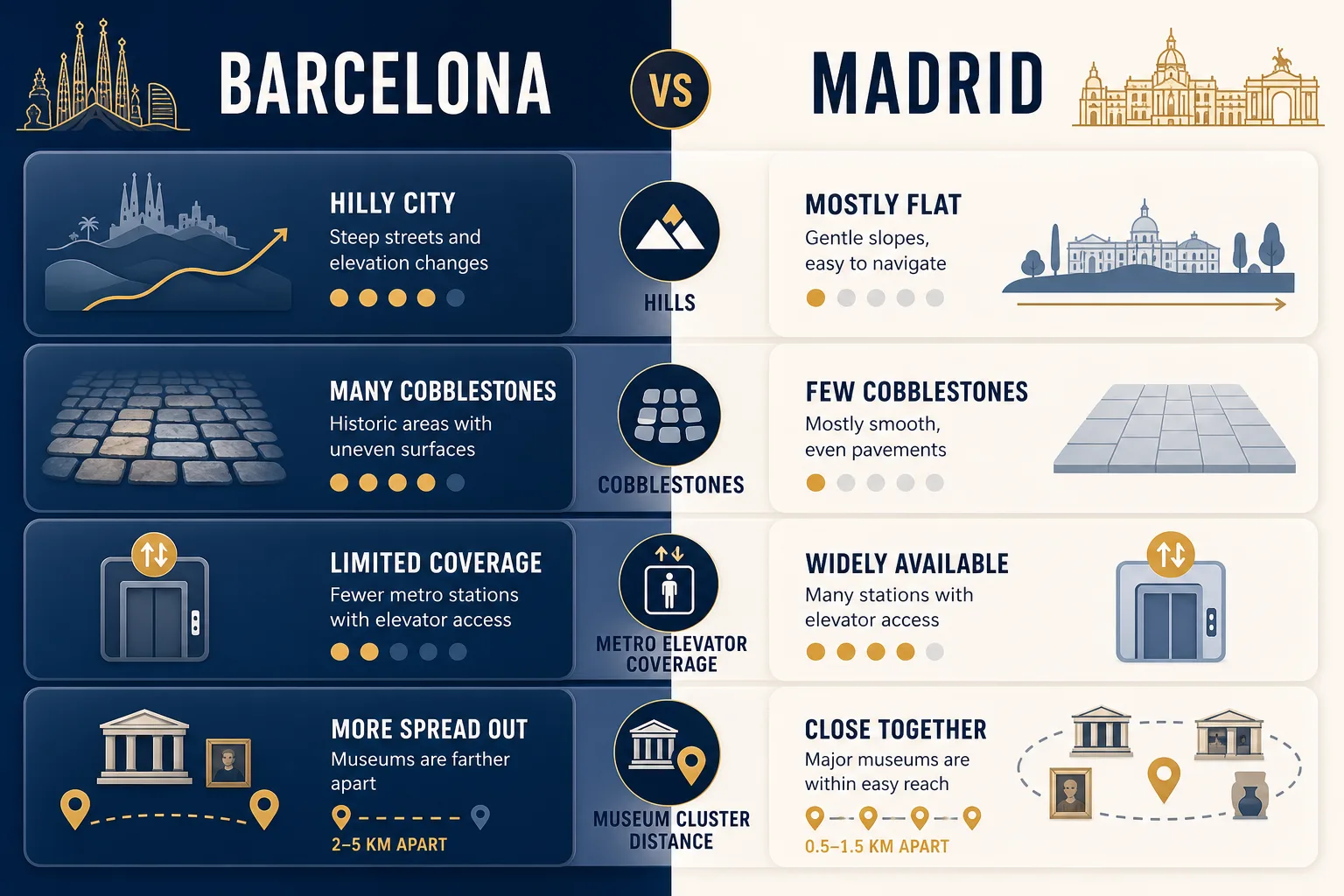 A comparison infographic between Barcelona and Madrid, analyzing walkability factors like hills, cobblestones, metro elevators, and museum distances.
At a Glance
| Decision variable | Barcelona | Madrid |
|---|---|---|
| Central terrain | Mixed, with real hills at Park Guell and Montjuic | Mostly flat in the tourist core |
| Top sights geography | Spread across the city (Sagrada Familia, Park Guell, Gothic Quarter, Montjuic) | Clustered, with the three major museums within a 2.8 km / 30-minute walk |
| Underfoot conditions | Cobblestones and uneven paving in the Gothic Quarter | Smoother pavement on main museum and plaza routes |
| Metro accessibility | ~94% of stations have elevators (full coverage targeted 2027-2030) | Currently around 70% accessible, increasing toward 84% by 2028 |
| Bus accessibility | Good, with ongoing upgrades | All EMT city buses are fully accessible |
| Fatigue source | Hills, distance between sights, summer heat and crowds | Long indoor museum standing time |
| Best low-stamina season | Shoulder seasons; avoid August crowds and heat | Spring (Mar-May) and fall (Sep-Oct), with May and September best |
| 3-star hotel average | ~$126-$199 per night | Comparable range in central districts |
| 5-star hotel average | ~$203-$544 per night | Comparable range in central districts |
Choose Barcelona If
Pick Barcelona despite the walking cost when one of these is true:
- Gaudi is the reason you are going to Spain. Sagrada Familia, Casa Batllo, La Pedrera, and Park Guell are the trip, and no amount of museum density elsewhere replaces them.
- You want the sea. Madrid is landlocked. If a beach afternoon or a coastal dinner is part of how you recover from a tiring morning, Barcelona wins by default.
- You are willing to design the trip around the metro instead of your feet. A metro-heavy plan with a 15-minute walk on each end is realistic for most travelers, especially given the 94% elevator coverage across the network.
- You can travel in shoulder season. Late April to mid-May, or late September to October, avoids the August peak and makes the unavoidable walking far less punishing.
If two or more of those apply, Barcelona is the right call even though it will cost more steps.
Choose Madrid If
Pick Madrid when low walking load matters more than any single landmark:
- Your priority sights are museums, plazas, and food, not architecture you have to chase across the city.
- You want one well-placed hotel to do most of the work. A room near the Paseo del Prado puts the Prado, Thyssen-Bornemisza, and Reina Sofia within a 15-minute walk of each other.
- You expect to use buses as well as the metro. Every EMT city bus is fully accessible, which is a meaningful safety net when stairs or transfers are hard.
- You are traveling in spring or fall, the mildest windows for sustained walking.
- You want predictable, flat routes between meals, sights, and your hotel rather than constant elevation changes.
For most first-time visitors who flagged walking fatigue as their top friction, this is the more honest fit.
Who Might Regret Barcelona
The wrong-fit pattern in Barcelona is the traveler who underestimates how spread out the highlights are. The Sagrada Familia, Park Guell, the Gothic Quarter, and Montjuic are not in walking distance of one another in any low-stamina sense. The classic regret looks like this:
- Booking a hotel in the Gothic Quarter to be "in the heart of things," then discovering the cobblestones aggravate foot or knee pain on day one.
- Trying to walk from Sagrada Familia toward Park Guell on the same day. That route is roughly 2.2 to 3 kilometers, predominantly uphill, and takes most walkers 40 to 45 minutes before any sightseeing begins.
- Visiting in August. Heat, dense crowds, and ongoing congestion around Sagrada Familia (a 15.5 million euro project to widen public space and add a designated photo zone in Placa Gaudi is expected to start in September after April 2025) make the walking days noticeably harder.
- Planning Montjuic on foot. The hill is real. Cable car, funicular, or bus is the sane choice if stamina is limited.
If you cannot reorganize the trip around the metro and shoulder season, the regret is predictable.
Who Might Regret Madrid
Madrid has its own wrong-fit pattern, and it is not about hills:
- The traveler who expected a coastline, a beach day, or Mediterranean atmosphere. Madrid does not provide any of those.
- The traveler who is not actually interested in art museums. The Golden Triangle is the city's main draw for walking-averse visitors precisely because it is tight, indoor, and flat, but spending hours upright on hard museum floors is its own fatigue. If museums bore you, Madrid's flatness will not save the trip.
- The traveler chasing a specific Gaudi or modernist architecture itinerary. That is a Barcelona trip, full stop.
- The traveler who assumed "flatter" meant "no walking." Even in Madrid, an art-and-tapas day can quietly reach 8,000 to 12,000 steps. The terrain is kinder, not weightless.
If those describe you, Madrid will feel like the safe choice that did not deliver what you actually came for.
Key Friction Comparison
This is the section that decides the verdict for most readers. Each row below maps a specific friction point to how the two cities behave in practice.
Spread of top sights. Barcelona's headline experiences are not clustered. Gaudi sites alone require several separate trips across the city, and Park Guell sits well north of the center on elevated ground. Madrid concentrates its top sights along a narrow, walkable corridor anchored by the Paseo del Prado, where the three major museums sit within a 15-minute walk of each other and the full loop covers about 2.8 kilometers.
Underfoot conditions. The Gothic Quarter is atmospheric, but the paving is uneven and the streets are narrow. For travelers with foot, ankle, or knee sensitivity, that is a real and underestimated cost. Madrid's central routes around the museums, Retiro, and Gran Via are smoother and more predictable.
Hills. Park Guell and Montjuic are the two big offenders in Barcelona. Both can be softened by metro, bus, funicular, or cable car, but planning around them adds friction. Central Madrid avoids this problem almost entirely.
Transit as a walking substitute. Barcelona's metro is the workaround, with about 94% of stations equipped with elevators and a target of full accessibility between 2027 and 2030. The Sagrada Familia to Park Guell area can be done in 20 to 25 minutes on the metro plus a 15-minute walk, which beats the uphill slog but does not eliminate it. Madrid's metro accessibility is lower in percentage terms (around 70%, rising toward 84% by 2028 via 103 new lifts), but its fully accessible EMT bus network and flat geometry give you a second reliable option.
Fatigue type. Barcelona's fatigue is mostly outdoor, with hills, distance, and summer heat. Madrid's fatigue is mostly indoor museum time. Outdoor fatigue is harder to control if walking is your specific friction.
Season effect. August in Barcelona compounds every problem above: heat, crowds, and queue times around Sagrada Familia. Madrid's shoulder seasons, particularly May and September, are the gentlest windows for low-stamina travelers anywhere in Spain.
Final Recommendation
For travelers whose primary friction is long walking days, the verdict is Madrid.
The reasoning is structural, not stylistic. Madrid's central tourist geography is flatter, more clustered, and better served by accessible buses, so a single well-placed hotel can carry most of the trip. Barcelona's strongest experiences are physically distributed across hills and uneven streets, and even an optimized metro-first plan still requires real walking on inclines.
Choose Madrid if your trip is about culture, food, plazas, and a manageable daily walking load. Book near the Paseo del Prado, target spring or fall, and you have removed most of the friction before you arrive.
Choose Barcelona only if Gaudi, the Mediterranean, or a coastal base is non-negotiable. In that case, accept that walking will be the cost of the trip, design every day around the metro, avoid August, and skip the idea of walking between Sagrada Familia and Park Guell on the same afternoon.
A Low-Stamina Pre-Trip Checklist
Use this before confirming either city.
- I know whether my priority sights are in one city or the other (Gaudi means Barcelona, Golden Triangle means Madrid).
- I have chosen a hotel within a 10-minute flat walk of the sights I plan to visit most.
- I have checked the season: avoiding August in Barcelona and July in Madrid is the single biggest comfort gain.
- I know whether I will use the metro as a substitute for walking, and I have confirmed my preferred routes have elevator coverage.
- I have planned each day around one or two anchor sights, not a full city loop.
- I have budgeted for taxis between neighborhoods rather than forcing long station transfers.
- I have accepted that even a walking-friendly itinerary in either city will involve 6,000 to 10,000 steps on most days.
FAQ
Is Barcelona really that much hillier than Madrid? Yes, in the parts most visitors care about. Park Guell and Montjuic are genuine hills, and the walk from Sagrada Familia toward Park Guell is roughly 2.2 to 3 kilometers and predominantly uphill, taking most people 40 to 45 minutes on foot. Madrid's central tourist core, especially around the Paseo del Prado and the Golden Triangle of Art, is comparatively flat.
Can I just take the metro everywhere in Barcelona to avoid the hills? Mostly yes, but not entirely. As of 2026, about 94 percent of Barcelona's metro stations have elevators, with full accessibility targeted between 2027 and 2030. The metro between Sagrada Familia and the Park Guell area takes about 20 to 25 minutes, but you still finish with roughly a 15-minute walk that includes some incline. The metro reduces walking, it does not eliminate it.
Is Madrid actually easier on the feet, or just different? Easier for most walking-averse travelers, with one caveat. Central Madrid is flatter, all EMT city buses are fully accessible, and the three major museums of the Golden Triangle sit within a 15-minute walk of each other along a 2.8 kilometer route. The caveat is that Madrid is museum-heavy, so fatigue can come from hours of standing indoors rather than from hills.
When should I avoid these cities if walking is hard for me? Avoid Barcelona in August if you can. May through July, and especially August, are the high season with heat and dense crowds that make slow walking and cobblestone footing harder. For Madrid, spring (March to May) and fall (September and October) are noticeably easier, with May and September the most comfortable for long walking days.
Does picking a hotel near the main sights actually solve the walking problem? It helps more than any other single decision. In Madrid, a hotel near the Paseo del Prado puts the three big museums and flat walking routes within easy reach. In Barcelona, no single hotel location is close to both Gaudi sites and the Gothic Quarter, so you will rely on metro plus short walks regardless. Budget accordingly: 3-star hotels in Barcelona average around 126 to 199 dollars per night, and 5-star options run roughly 203 to 544 dollars per night.