travel-decisions
Is Barcelona Worth It If You Want to Enjoy It More Comfortably?
A traveler-fit guide to deciding whether Barcelona suits a comfort-led, relaxed-pace trip rather than a checklist sprint.

Comfort in Barcelona is not mostly about luxury. It is about how much friction you buy out of the trip before you arrive. A wide-street Eixample hotel, one Gaudi site a day, and an easy airport transfer can make Barcelona feel elegant and low-effort. A cheaper room in the wrong "central" pocket can make the same city feel noisy, uphill, and strangely tiring by lunch.
That is why this article is not asking whether Barcelona is a pleasant city in theory. It is asking whether the cost of doing Barcelona comfortably is worth paying for your travel style. For some travelers, Barcelona is one of the best slow-urban trips in Europe. For others, it is an expensive way to discover that location and stamina matter more than headline appeal.
Quick Verdict
Barcelona is worth it if comfort, mood, and pace matter more to you than squeezing the lowest possible hotel rate. It is a strong fit for couples, slow travelers, and atmosphere-led visitors who choose Eixample or Gracia, accept paying closer to the high-season average of around 233 dollars a night, and plan around late starts.
It is a weak fit if your trip is two days, your top priority is value per night, or you want to be in the middle of nightlife noise. In that case, the city tends to feel expensive without feeling comfortable, because you are paying tourist-zone prices for a generic trendy district instead of paying for calm.
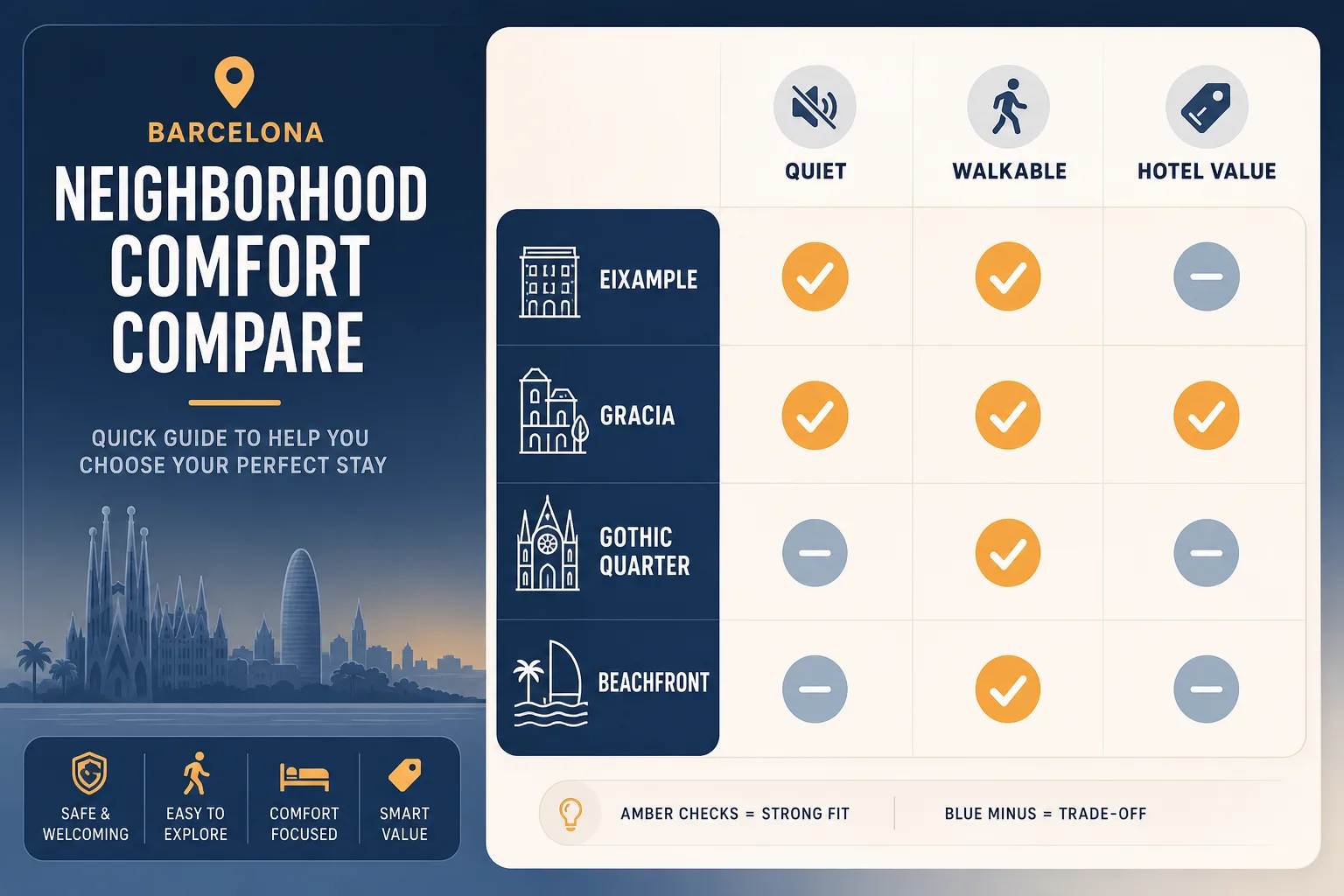 A graphic titled 'Barcelona Neighborhood Comfort Compare' showing a comparison chart of Barcelona neighborhoods (Eixample, Gràcia, Gothic Quarter, Beachfront) based on quietness, walkability, and hotel value.
Traveler Type Table
The decision is less about whether Barcelona is "good" and more about which version of Barcelona you are actually buying. Pace and neighborhood do more work here than season or budget.
| Traveler type | Strong fit in Barcelona? | What makes it comfortable | Where comfort breaks |
|---|---|---|---|
| Comfort-seeking couple | Yes | Eixample base, late breakfasts, short metro hops | Old-town hotels with thin walls and street noise |
| Relaxed-pace / slow traveler | Yes | 5 to 7 nights, one neighborhood as a home base | Trying to "do" Sagrada Familia, Park Guell, and Gothic in one day |
| Atmosphere-first traveler | Yes | Gracia squares, Eixample side streets, beach end of day | Picking a hotel only by price, ending up far from any mood |
| Budget-led value optimizer | Mixed | Off-peak dates, longer stay, apartment rentals | High-season rates near 233 dollars a night feel unjustified |
| First-time landmark sprinter | Mixed | One full day on Gaudi sites, rest of time on neighborhoods | Two-day trip with luggage transfers, almost guaranteed regret |
Best for First-Time Visitors
If this is your first Barcelona trip and comfort matters, treat the city as a 4 to 6 night stay, not a stopover. First-time visitors often underestimate how spread out the headline sights are: walking from Sagrada Familia to Park Guell takes about 30 to 45 minutes and is significantly uphill, while the reverse direction is noticeably easier because it is downhill.
For a comfortable first visit, base in Eixample. The wider streets, modernist facades, and excellent transport links mean you can reach almost everything in 15 to 25 minutes by metro without long uphill walks. You get the postcard architecture as your everyday view, which lowers the pressure to "see things" because you are already inside the set.
Best for Couples
Couples are the clearest yes for Barcelona, on one condition: pick the hotel like the trip depends on it, because it does. Couples who book a cheap room in a generic trendy district often end up paying mid-range prices for a tired room with street noise and a long walk to anything they actually wanted to see.
Eixample suits couples who want elegance and ease (long dinners, slow mornings, a balcony if you can get one). Gracia suits couples who want a quieter, village-like atmosphere with lively neighborhood squares and independent shops, which is closer to a "live here for a week" feel than a vacation-rental block. Either neighborhood gives you the comfort that the brochure version of Barcelona quietly skips.
Best for Slow Travelers
Barcelona rewards slow travel more than almost any other major European city its size, because its character is in the neighborhood rhythm, not in any single monument. A slow traveler who stays 7 nights in one apartment will end the trip with a stronger sense of place than a sprinter who stayed 3 nights and saw every Gaudi site.
A comfort-led slow itinerary looks like this:
- 2 days of unhurried Eixample wandering, one Gaudi site per day at most
- 2 days based around Gracia squares, independent shops, and long lunches
- 1 day at the beach end of the city, late start, no plan after sunset
- 1 day reserved on purpose for nothing, which is the day most travelers cut
The single biggest upgrade for slow travelers is a Hola Barcelona Travel Card, which covers unlimited metro, bus, tram, FGC urban rail, and Rodalies (Zone 1) including the airport transfer. It removes the small daily friction of buying tickets, which is exactly the kind of friction that erodes a relaxed trip.
Best for Low-Stress Travelers
Low-stress travelers do best when the arrival and the base are both decided in advance, with no scrambling on day one. From Barcelona-El Prat:
- Aerobus to Placa Catalunya: about 35 minutes, 12.25 euros one way or 18.50 round trip (valid 15 days)
- Taxi to the city center: 25 to 35 minutes, around 35 to 40 euros
- Renfe train from Terminal 2: about 18 minutes to Sants or Passeig de Gracia, 4.60 euros
- Metro L9 Sud: 50 to 60 minutes with at least one transfer, 5.15 euros
For a comfort-led arrival with luggage, the Aerobus or a taxi clearly win. The Metro L9 Sud is the cheapest non-train option but trades that saving for transfers and walking, which is the opposite of what a low-stress traveler is buying. The TMB bus network is 100 percent accessible with low floors, ramps, dedicated spaces, and audio and visual announcements, which makes daily city moves easier for travelers who want to avoid stairs.
Comfort checklist before you book:
- Hotel is in Eixample or Gracia, not just near a metro line by name
- At least 4 nights, ideally 5 to 7
- Arrival plan written down (Aerobus, taxi, or Renfe; not "we will figure it out")
- No more than one Gaudi site per day on the rough plan
- One full day with nothing scheduled
Common Mismatches
The comfort mismatch here is rarely about disliking Barcelona itself. It is about paying for the wrong stress profile.
- The "short trip, cheap room, still comfortable somehow" traveler. They book two nights, choose a "central" hotel by map radius, and spend half the trip navigating noise, luggage drag, and cross-city jumps. The city feels overrated because the plan stripped out the exact slack a comfort-led trip needs.
- The "if rates are high, comfort should be automatic" traveler. They pay around 233 dollars a night in high season and feel cheated when the room is still small, loud, or awkwardly placed. Barcelona's price spike buys access and season pressure, not guaranteed calm. Comfort still has to be chosen through neighborhood and trip shape.
- The atmosphere traveler who lands in a generic trendy district, finds the same chain bars they could see in any European capital, and never reaches Gracia or quiet Eixample.
- The couple who books inside the Gothic Quarter for the romance of it, then cannot sleep because the alleys carry noise all night.
- The landmark sprinter who treats Sagrada Familia, Park Guell, and the Gothic Quarter as one day, underestimates the uphill walk, and ends day one too tired to enjoy day two.
If any of those sound like the trip you are about to book, the answer is not "skip Barcelona." The answer is to change the base, the length, or the pace.
Final Match Recommendation
Barcelona is worth it for travelers who want to enjoy it more comfortably, with three specific moves:
- Base in Eixample for balance, or Gracia for a quieter local feel. Treat the Gothic Quarter as a place to walk, not to sleep.
- Stay at least 4 nights, ideally 5 to 7, and resist scheduling more than one major Gaudi site per day.
- Pay for arrival comfort with the Aerobus or a taxi, and pay for daily comfort with a Hola Barcelona Travel Card.
It is not worth it, in the comfort sense, for a 2-day stop with a cheap room in a trendy district during peak summer. That version of the trip is the one most likely to feel like paying more without getting a better experience.
If your priority is mood, slow mornings, and a city that earns its reputation after day three, Barcelona is a clear yes. If your priority is the lowest possible nightly rate, almost any Spanish city further inland will treat your budget better.
FAQ
Is Barcelona worth it for a 3-day trip if I want it to feel relaxed? Three days is the floor, and only if you stay in Eixample, skip at least one famous Gaudi site on purpose, and do not try to add a day trip. Four to five nights is where the comfort version of Barcelona actually starts.
Are wider Eixample streets really more comfortable than the Gothic Quarter? Yes, in a daily-use sense. Eixample has wider sidewalks and is easier with luggage, strollers, or tired feet. The Gothic Quarter is largely free of rough cobblestones and is walkable, but it is denser, louder, and more crowded, which is exactly what a comfort-led traveler is trying to avoid for a hotel base.
Is high-season Barcelona still worth it if hotel prices spike? It can be, but only if you accept what you are paying for. Average nightly rates climbing from about 125 dollars off-peak to around 233 dollars in high season are buying you the season, not a better room. Lock in the neighborhood first, then the price, not the other way around.
Is Park Guell worth the walk if I want a comfortable day? If you plan it as a downhill day (start near Park Guell and walk down toward Sagrada Familia, which is the easier direction) it can fit a comfortable pace. Doing it uphill in summer heat is the most common comfort mistake first-time visitors make.
Is Barcelona a good choice for an older or mobility-aware traveler? It can be, with the right base. The TMB bus network is 100 percent accessible with low floors, ramps, and audio and visual announcements, which makes it the most comfortable everyday transport. Combined with an Eixample hotel and a downhill approach to Park Guell, Barcelona handles a slower body better than its reputation suggests.