travel-decisions
Is Barcelona a Bad Fit for Travelers Who Want Slow Mornings and Late Starts?
A calm, decision-focused read on whether Barcelona suits travelers who refuse to set a 7 a.m. alarm, and the specific conditions that make it work.
Barcelona only feels like an easy city for slow mornings if you separate two decisions that travelers often blur together: waking up late and planning late. The first one fits the city better than people think. The second one is where Barcelona starts punishing you. A noon coffee, a lazy lunch, and one long evening walk can work beautifully here. Trying to make your headline sight choices at 10:30 a.m. in peak season usually does not.
This article is not about whether Barcelona has a late-night culture. It is about whether a traveler who wants soft starts, low morning pressure, and flexible afternoons can still get the best of the city without turning the trip into a booking-calendar fight. The answer depends much more on timed-entry behavior, season, and hotel base than on any personality label.
Quick Verdict
Barcelona is not a bad fit for travelers who want slow mornings and late starts, but it is a conditional one. The city itself rewards late, unhurried wandering. The trap is that its most famous sights run on mandatory timed entry and sell out for the cooler, less crowded slots first, which quietly pushes late risers into hot, crowded midday windows.
Strong fit if you are willing to book the two or three big-ticket sights well in advance, treat them as one anchor per day, and let the rest of the day stay loose. Weak fit if you refuse to book anything ahead, expect to "decide in the morning," and arrive in July or August expecting a calm city.
In short: Barcelona is friendly to slow travelers, but hostile to slow planners.
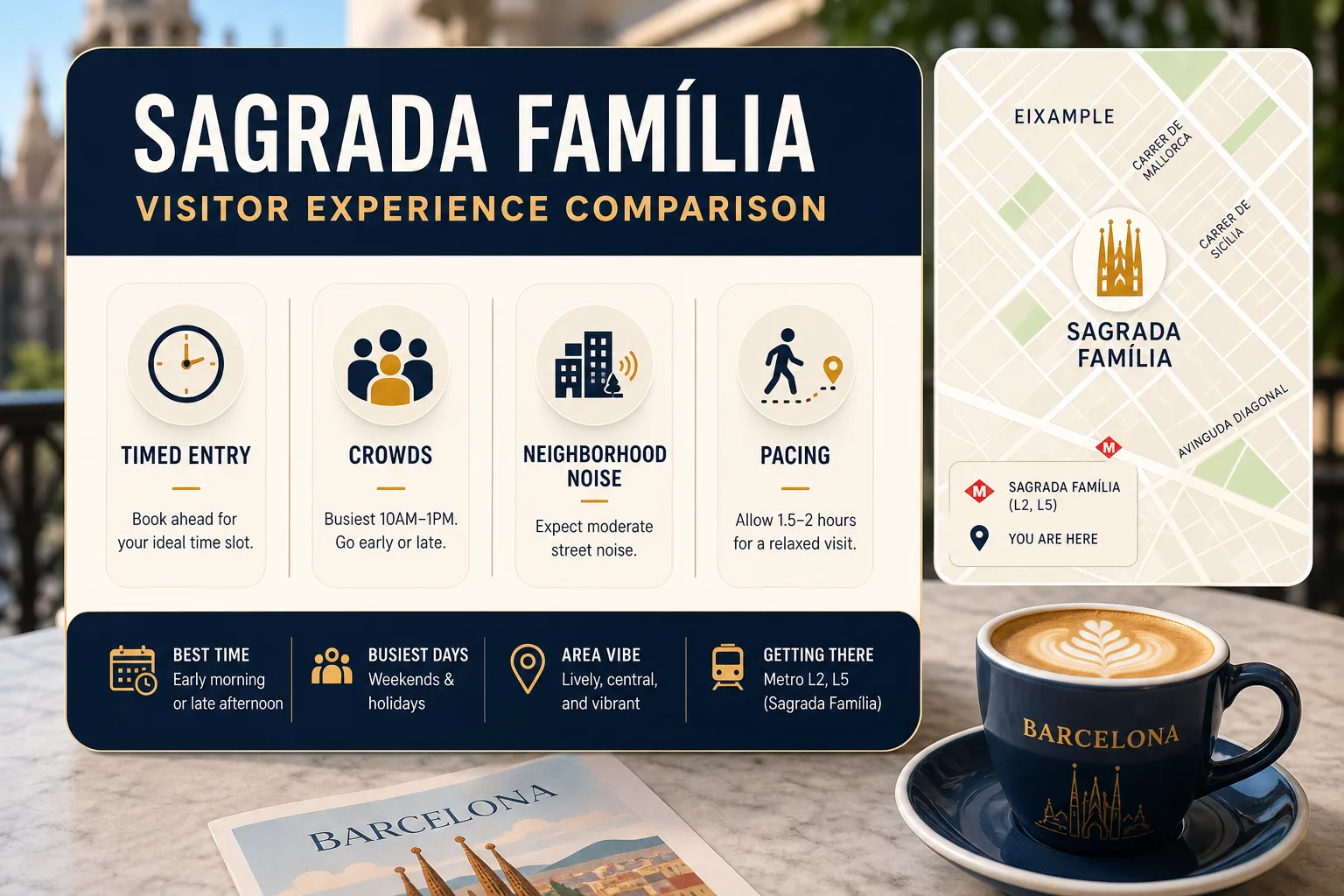 An infographic comparison card for visiting the Sagrada Família sits on a table next to a Barcelona coffee cup.
Traveler Type Table
This table is built around the real decisions a late-starting traveler has to make in Barcelona, not generic city facts.
| Decision variable | What it means for a late riser | Tradeoff |
|---|---|---|
| Timed entry at top sights | Sagrada Familia, Park Guell, and the Picasso Museum all need booking ahead. Late morning and afternoon slots exist, but they go after the early ones. | You keep your late start only if you book early. |
| Crowds by time of day | The Barri Gotic is quiet in the morning but fills quickly after 9 a.m. | A 10 or 11 a.m. start lands you directly in the densest crowd window. |
| Season | Peak season is July, August, and September, with August especially busy as locals leave town. Shoulder months are calmer. | A slow morning in August feels different from one in late September. |
| Neighborhood noise | Barceloneta is noisy in the evenings and dirty in the mornings due to its restaurant and club density. | Wrong base undoes the slow-morning premise. |
| Walking distances | From Placa de Catalunya it is about 20 minutes on foot to Parc de la Ciutadella, 20 minutes to Casa Mila, and 35 minutes to the Sagrada Familia. La Rambla is roughly 2 kilometers and about an hour casual walk. | Easy to keep a slow pace if your hotel is central. |
| Late-night transit | Metro runs 5 a.m. to midnight Monday to Thursday, until 2 a.m. Friday, 24 hours Saturday. | Late starts and late dinners are well supported, especially on weekends. |
| Accommodation type | Short-term rental taxes have doubled to up to 12.50 euros per night, and Barcelona plans to phase rentals out by 2028. Luxury hotel tax rises to up to 12 euros per person per night from April 1, 2026. | Hotels are more stable but the tax is rising. |
Best for First-Time Visitors
If this is your first trip and you want slow mornings, Barcelona can absolutely work, but the planning has to flip. Instead of trying to "see everything," pick two anchor sights for the week, not per day. For a first-timer, that usually means Sagrada Familia plus one of Park Guell or the Picasso Museum.
Book Sagrada Familia as soon as your dates are fixed. Official sales currently open roughly two months ahead, and the most convenient summer and tower slots can disappear well before the trip. Pick a late morning or early afternoon entry, not a 9 a.m. one. Around that anchor, leave the rest of the day genuinely open. A first-time visitor who plans like a slow traveler tends to enjoy Barcelona far more than one who plans like a checklist tourist and then drifts.
The risk for first-timers specifically is expectation mismatch. The feed version of Barcelona is empty Gothic lanes and quiet rooftops. The real version, especially after 9 a.m. in the Barri Gotic, is much busier. Knowing that in advance is the difference between disappointment and a calm trip.
Best for Couples
Couples are arguably the best-matched group here, with one caveat. The city's strengths line up well with how most couples actually want to travel: long lunches, walkable distances, neighborhood wandering, and a strong dinner culture that does not punish you for showing up late.
The caveat is that couples often disagree about how much to pre-book. One partner wants spontaneity, the other wants a guaranteed Sagrada Familia entry. In Barcelona, the spontaneous partner has to give a little. Pre-booking two or three things is the price of admission for keeping the other five days unstructured.
A practical couple's pattern that works:
- One anchor sight per two days, booked ahead, in a late morning slot.
- Long, slow lunch nearby.
- Afternoon walk in a single neighborhood, not a cross-city sprint.
- Dinner reserved only if it is somewhere specific; otherwise walk in.
- Use the metro after midnight on Friday and 24-hour service on Saturday rather than rushing home.
Best for Slow Travelers
This is the core audience for the city, and the honest answer is that Barcelona is built for slow travelers, but only if they are also slightly organized ones.
What rewards a slow pace here:
- Compact center where most things are inside a 20 to 35 minute walk from Placa de Catalunya.
- A 2 kilometer Rambla you can casually stroll for an hour without ticking any box.
- Neighborhoods like Gracia and the upper Eixample that reward repeat visits over a single sweep.
- A dinner culture that fits people who eat late and start late.
What punishes it:
- Timed entry quietly pushes you toward a schedule even if your trip is otherwise loose.
- Peak summer crowds and heat erase a lot of the calm that drew you here.
- A poorly chosen base, particularly Barceloneta, undermines the morning quiet you wanted.
The fix is mostly seasonal and locational. The shoulder seasons of March to April and September to October offer moderate temperatures and smaller, more manageable crowds, which is when slow travel here actually feels slow.
Best for Low-Stress Travelers
Low-stress travelers who also happen to be late risers should treat Barcelona as a "two decisions" city: where you sleep, and what you book ahead. Get those right and the daily stress is genuinely low.
Use this short pre-trip checklist:
- Pick a central but residential base (upper Eixample or Gracia), not Barceloneta.
- Book Sagrada Familia as soon as your dates are fixed, especially if you care about summer or tower slots.
- Book Park Guell in advance through the official site rather than assuming you can sort it out on the day.
- Book Picasso Museum one to two weeks ahead on summer weekends, when paid timed slots can sell out.
- Choose late morning or afternoon entry slots, not early ones.
- Travel in shoulder season if you can.
- Budget for the rising tourist tax: up to 12 euros per person per night at luxury hotels from April 1, 2026, projected to reach 15 euros by 2029.
- Prefer hotels over short-term rentals, given the doubled rental tax and 2028 phase-out plan.
That is genuinely all the structure a low-stress trip here needs.
Common Mismatches
This is where slow-morning travelers misread Barcelona. The problem is usually not pace tolerance. It is planning style.
- The "I wake late and also decide late" traveler. Same-day Sagrada Familia entry in summer is unrealistic, and Park Guell's Monumental Zone is capped at 1,400 visitors per hour and often needs days of lead time. Barcelona is forgiving about sleeping in, not about leaving every anchor decision to the same day.
- The "I want empty Gothic lanes at brunch time" traveler. The Barri Gotic is quiet only in its early-morning window. By 10 or 11 a.m., a late riser is walking straight into the exact crowd density they were hoping to avoid.
- The "Barceloneta sounds fun" traveler who also wants calm mornings. The neighborhood is noisy in the evenings and dirty in the mornings due to the density of restaurants and clubs, which is the opposite of a slow start.
- The August traveler expecting a "real local" Barcelona. August is especially busy because many locals leave town, so the city is at its most touristed and least local exactly when many people choose to visit.
- The "I will save money on a short-term rental" traveler. Short-term rental taxes have doubled to up to 12.50 euros per night, and rentals are being phased out by 2028. The savings story is shrinking.
If you recognize yourself in two or more of these, Barcelona is not the problem. The plan is.
Final Match Recommendation
Choose Barcelona for slow mornings and late starts if:
- You can pre-book two or three anchor sights, in late morning or afternoon slots, weeks ahead.
- You can travel in shoulder season, ideally late March to April or September to October.
- You will base yourself somewhere central but residential, and explicitly avoid Barceloneta as your home base.
- You accept that "slow" here means unhurried inside a lightly structured day, not zero structure.
Skip Barcelona, or push it to a different trip, if:
- You refuse to book anything in advance.
- You can only travel in July, August, or early September and expect calm streets.
- You want a city where you can wake up at 10 a.m., walk out, and find the headline sight half empty with no plan.
- Your idea of slow travel is incompatible with any timed entry at all.
For the right traveler, Barcelona is one of the most forgiving slow-morning cities in Europe. For the wrong one, it is a daily fight with a booking calendar.
FAQ
Is Barcelona really worse for late risers than other European cities? Not inherently. The difference is the density of mandatory timed entries at its top sights. Cities without that constraint let you drift in whenever. Barcelona rewards late starts only if you have pre-booked the anchors.
Can I still see Sagrada Familia if I refuse to wake up early? Yes. Sagrada Familia uses timed entry, and you can choose a late morning or afternoon slot if you book early enough. The real requirement is planning ahead, not waking up early.
Which neighborhoods fit a slow-morning traveler best? Central but residential areas such as the upper Eixample or Gracia tend to fit. The clearest mismatch is Barceloneta, which is noisy in the evenings and dirty in the mornings due to its density of restaurants and clubs.
When is the best time of year to visit Barcelona for a slow pace? The shoulder seasons of March to April and September to October offer moderate temperatures and smaller, more manageable crowds. July, August, and September are peak, and August is especially intense.
Is late-night transit reliable if I start and end my days late? Yes. The metro runs from 5 a.m. to midnight Monday to Thursday, until 2 a.m. on Fridays, and 24 hours on Saturdays. Late starts and late dinners are well supported, particularly on weekends.
Will the new tourist taxes change my planning? They will not change whether you go, but they should change where you sleep. From April 1, 2026, luxury hotel tax rises to up to 12 euros per person per night, projected to reach 15 euros by 2029. Short-term rental taxes have doubled to up to 12.50 euros per night, and rentals are being phased out by 2028. Hotels are the more stable choice for now.