city-matchups
Prague vs. Vienna: Which is Easier to Navigate for a Stress-Free First Trip?
A direct comparison of Prague and Vienna for first-time Central Europe travelers, focused on airport arrival, transit stations, hotel location, and walking fatigue.

Quick Verdict
If your main goal is a stress-free first trip with minimal transit confusion, choose Vienna.
Vienna wins on the exact factors that make a first trip stressful: a direct, fast, clearly priced airport train, a flatter city center that's easier on tired legs, and a transit pass system that's simpler to reason about after a long flight. Prague is not a bad choice, and it rewards travelers who don't mind a bit more legwork in exchange for a more compact, walkable Old Town. But "compact and walkable" also means steep cobblestones and an airport with no direct rail link, which adds friction exactly when a first-time visitor is least equipped to handle it.
Choose Vienna if: you want the fewest possible decisions between landing and reaching your hotel, you're traveling with limited stamina or joint concerns, or this is your first trip to the region and you'd rather not troubleshoot a foreign ticket machine on hour one.
Choose Prague instead if: you're comfortable with one extra transfer step at the airport, you don't mind uneven cobblestone streets, and your priority is a smaller historic core you can mostly explore on foot once you've checked in.
This is not a verdict on which city is more beautiful or more "worth it." It's a verdict on which city creates fewer logistics headaches for someone who wants to land, get to the hotel, and start actually enjoying the trip.
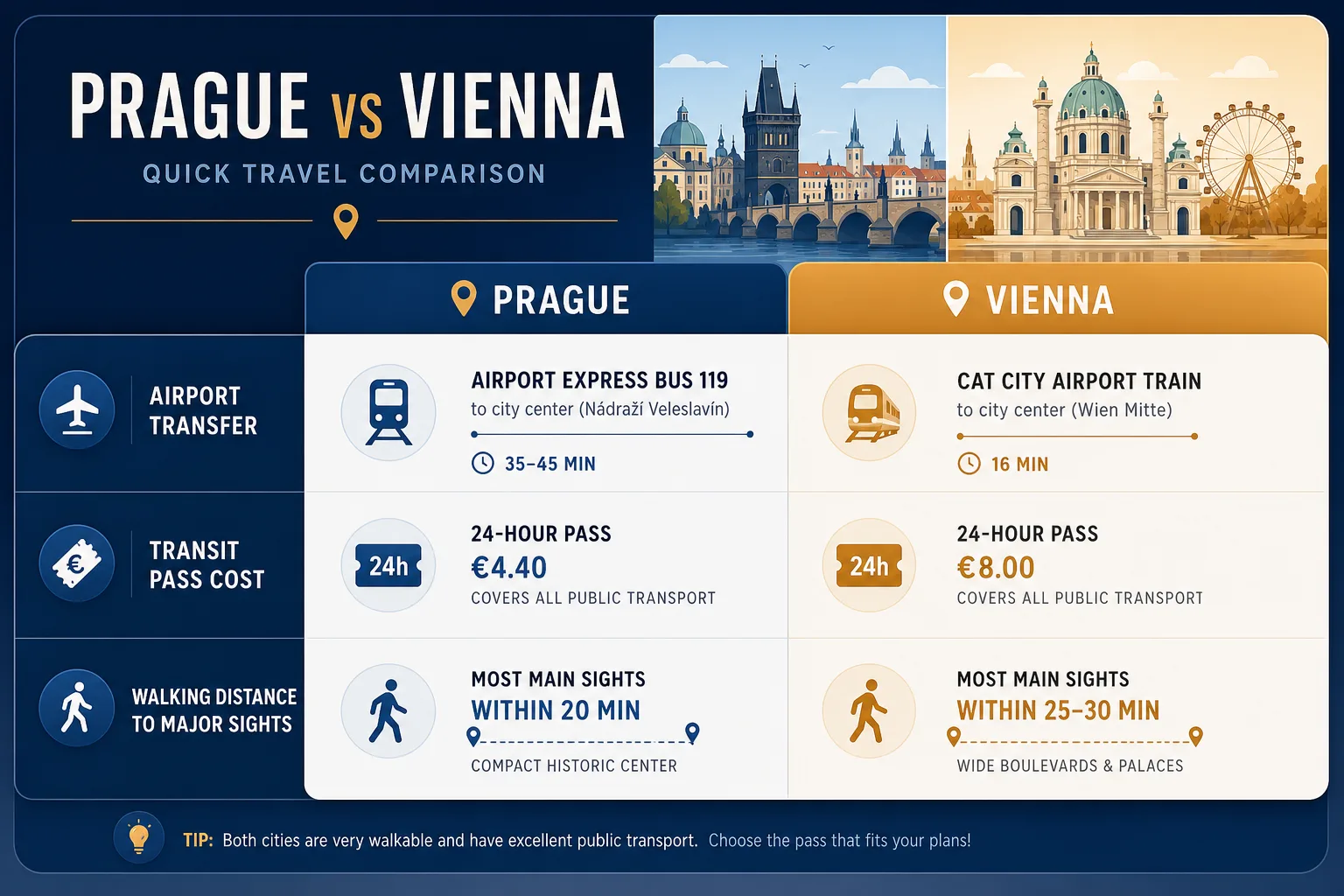 Airport transfer, transit pass cost, and walking distance side by side.
At a Glance Table
The variables that actually determine whether your first day feels smooth or exhausting: how you get from the airport, how the transit pass works, and how much walking the city center demands.
| Decision variable | Prague | Vienna |
|---|---|---|
| Airport to city center | No direct train or metro; Trolleybus 59 to Nadrazi Veleslavin metro (50 CZK paper / 46 CZK app transfer ticket), or Airport Express bus direct to Prague Main Station for 200 CZK (city tickets not valid) | Direct rail both ways: S7 S-Bahn to Wien Mitte in 25 min, or Railjet to Wien Hauptbahnhof in 15 min, both about 4.40 to 5.20 euros; CAT premium option at 14.90 euros one way |
| Transit pass simplicity | Mixed system: paper tickets, PID Litacka app, separate airport bus fare | Single day pass (10.20 euros) or weekly pass (25.20 euros digital / 28.90 euros paper) covering the whole city |
| Center walkability | Compact but hilly; steep cobblestones on routes like Nerudova toward the Castle | Flatter core; reaching Schonbrunn still needs U4 plus a 7-10 minute walk |
| Fare evasion risk if confused | 1,200 CZK on-the-spot fine | 135 euro fine |
| 2026 disruption to plan around | Petrin Funicular closed until Sept 2026; no e-scooters/bikes on metro since Jan 1, 2026 | Praterstern-Hauptbahnhof S-Bahn trunk closes Sept 2026 to Oct 2027 |
| Best for | Travelers okay with one extra transfer and some uphill walking | Travelers wanting the fewest transit decisions and flatter walking |
The pattern across every row is the same: Prague asks you to absorb one more unfamiliar step (a bus-to-metro transfer, a separate airport fare, steeper terrain), while Vienna keeps each step closer to what a first-time visitor already expects from a European rail system.
Recommendation by traveler type
Skim this table first if you already know your travel style. It maps specific traveler patterns to a city, based on the behavior that actually predicts stress on day one, not on generic taste.
| Traveler pattern | Pick | Why |
|---|---|---|
| Low stamina / joint pain, tires on long walking days | Vienna | Flatter core; no forced steep-cobblestone climb like the Prague Castle approach |
| First-timer with zero Central Europe experience | Vienna | One direct airport train, one pass type; fewer decisions while jet-lagged |
| Budget-conscious, comfortable using a transit app | Prague | Lower absolute transit costs (50 CZK transfer fare) if you use PID Litacka correctly |
| Traveling with a stroller or heavy luggage | Vienna | Direct S-Bahn/Railjet avoids a bus-to-metro transfer with bags in tow |
| Wants a dense, walkable old town over transit efficiency | Prague | Compact historic core rewards exploring on foot once you've checked in |
| Only has 3 to 4 days and cannot lose time to logistics | Vienna | Predictable transit and direct airport rail protect a tight schedule |
| Confident solo traveler who enjoys figuring out local systems | Prague | Extra transfer step and mixed fare system are a minor cost, not a blocker |
| Traveling between September 2026 and October 2027 | Check Vienna's reroutes first | Praterstern-Hauptbahnhof S-Bahn closure may affect hotel-to-airport routing |
Choose Prague If
Prague makes sense when you're willing to trade a slightly more complicated airport transfer for a historic core you can explore almost entirely on foot once you've settled in. If you're the kind of traveler who enjoys getting mildly lost in a walkable old town and doesn't mind checking a bus number before checking a map, Prague's tradeoffs won't feel like tradeoffs at all.
It also suits travelers who are comfortable using a transit app (the PID Litacka app lowers the paper-ticket price and simplifies the Trolleybus 59 connection) and who don't need everything to be resolved before they leave home. If you've traveled internationally before and know how to read a metro map even when the signage is in an unfamiliar language, the extra step at the airport is a minor inconvenience rather than a source of real stress.
Prague also fits travelers prioritizing cost. The city is generally less expensive for accommodation and food, and even with the added complexity, the actual transit costs (50 CZK for a transfer ticket) are lower in absolute terms than Vienna's equivalents, once converted.
Bottom line for Prague: pick it if you are a confident, budget-led, or slower-paced traveler who does not mind one extra transfer step and some uphill cobblestones in exchange for a denser, more walkable old town.
Choose Vienna If
Vienna is the better call if your top priority is arriving, getting to your hotel, and starting your trip without troubleshooting anything. The direct S7 or Railjet connection means you're not deciphering a bus-to-metro transfer while jet-lagged; you get on one train and get off near your hotel.
It also suits travelers with limited walking tolerance or joint concerns. Vienna's center is comparatively flat, and while reaching sights like Schonbrunn Palace still involves a metro ride and a short walk, you're not managing steep, uneven cobblestones the way you are on the approach to Prague Castle. If a full day of sightseeing already tires you out, removing the terrain difficulty matters more than it sounds.
Finally, Vienna fits travelers who want predictable costs. A single day pass at 10.20 euros or a weekly pass around 25 to 29 euros covers the whole system, including airport-adjacent stations, without a separate fare structure to track.
Bottom line for Vienna: pick it if you are a first-timer, low-stamina, or short-on-time traveler who wants the fewest transit decisions and the flattest walking routes.
Who Might Regret A (Prague)
Travelers most likely to regret choosing Prague are those who assumed "compact old city" meant "easy city." The historic core's charm comes with real physical friction: the walk from Charles Bridge up to Prague Castle is a genuine uphill trek of 1 to 1.5 km on steep, uneven cobblestones, not a casual stroll. Anyone with limited stamina, mobility concerns, or small children in a stroller will find this route more tiring than photos suggest.
The specific disappointment risk: arriving jet-lagged, expecting a straightforward "airport to hotel" trip, and instead having to identify the correct trolleybus, validate a separate transfer ticket, and transfer again to reach a hotel that felt closer on the map than it does on foot. Travelers who skip researching this in advance sometimes end up overpaying for a taxi out of pure fatigue, which erases any of the cost savings Prague otherwise offers.
Who Might Regret B (Vienna)
Travelers most likely to regret Vienna are those hoping for a dense, wander-and-discover old town experience within a five-minute radius of everything. Vienna's key sights are more spread out, and while the transit system handles the distance efficiently, it does mean more time on trains and platforms rather than pure walking exploration. If your idea of a great first trip is stumbling onto charming streets without consulting a transit map, Vienna's more spread-out, transit-dependent layout can feel less spontaneous.
The specific disappointment risk: travelers who book a hotel based on price alone, away from a direct S-Bahn or U-Bahn line, can end up with a daily commute that undercuts the "easy navigation" reputation Vienna is chosen for in the first place. The upcoming Praterstern-Hauptbahnhof S-Bahn closure (September 2026 to October 2027) is also worth flagging: if your hotel or itinerary depends on that specific trunk line, you'll want to double-check your rerouted options before you travel.
Key Friction Comparison
Transit and station complexity
Prague's system mixes paper tickets, an app (PID Litacka), and a separate fare for the airport bus, which means three different pricing logics to hold in your head on day one. Vienna simplifies this to essentially one pass type per trip length: a 10.20 euro day pass or a 25.20 to 28.90 euro weekly pass that covers the whole network, including onward travel from most airport-adjacent stations. For a first-time visitor, fewer fare systems means fewer chances to buy the wrong ticket and fewer chances to get flagged for evasion, which carries a 1,200 CZK on-the-spot fine in Prague versus 135 euros in Vienna.
Airport arrival
This is the sharpest contrast between the two cities. Vienna offers a genuinely direct rail connection: the S7 S-Bahn reaches Wien Mitte in 25 minutes, and the Railjet reaches Wien Hauptbahnhof in just 15 minutes, both for roughly 4.40 to 5.20 euros. There's also a premium City Airport Train option at 14.90 euros one way that lets travelers on select airlines check baggage early. Prague, by contrast, has no direct train or metro from Vaclav Havel Airport at all. You either take Trolleybus 59 to Nadrazi Veleslavin metro station on a 50 CZK (or 46 CZK app) transfer ticket, or pay 200 CZK for the dedicated Airport Express bus straight to Prague Main Station, and city transit tickets are not valid on that express service. For a traveler managing luggage and jet lag, that's a meaningfully bigger cognitive load.
Hotel location risk
In both cities, the safest strategy is booking near a rail or metro line rather than chasing the lowest nightly rate. In Prague, that typically means staying near a metro line (A, B, or C) rather than deep in a quiet residential pocket that looks close to Old Town on a map but requires an awkward tram transfer. In Vienna, it means checking proximity to a U-Bahn or S-Bahn stop, and, starting September 2026, confirming whether your route depends on the Praterstern-Hauptbahnhof trunk line that will be under modernization through October 2027.
Walking fatigue
Prague's historic core is more physically demanding than it appears in photos. The climb from Charles Bridge to Prague Castle covers 1 to 1.5 km of steep, uneven cobblestones on streets like Nerudova, and there's currently no funicular shortcut since Prague's Petrin Funicular has been closed since late 2024 and isn't set to reopen until September 2026. Vienna's center is flatter and generally easier on the legs, though outlying sights like Schonbrunn Palace still require a metro ride plus a 7-to-10-minute walk. For travelers prioritizing low stamina demands, Vienna's terrain is the more forgiving choice, even if the city itself covers more total ground.
Final Recommendation
For a first-time visitor whose main goal is a low-stress, low-friction trip, Vienna is the stronger starting point. The direct airport rail link, simpler day and week passes, and flatter city center all reduce the number of unfamiliar decisions you have to make while jet-lagged, which is where most first-trip stress actually comes from.
Choose Vienna if you want the fewest transit surprises, you have limited walking stamina, or you'd rather spend your first hours settling into your hotel than figuring out a bus-to-metro transfer.
Choose Prague if you're comfortable with one extra airport transfer step, you don't mind uphill cobblestones, and a smaller, denser historic core outweighs the convenience gap.
Neither city requires advanced planning skills to enjoy. But if minimizing friction is genuinely the deciding factor, Vienna's infrastructure does more of the work for you, and that is the difference that matters most on a first trip.
Quick self-check before you book
- Can I comfortably manage steep, uneven cobblestone streets for 15-20 minutes uphill? (If no, lean Vienna)
- Do I want a single transit pass rather than mixing paper tickets, an app, and a separate airport fare? (If yes, lean Vienna)
- Am I comfortable identifying the right bus and validating a transfer ticket while jet-lagged? (If yes, Prague is manageable)
- Is a smaller, more walkable historic core more important to me than a flatter, more spread-out layout? (If yes, lean Prague)
- Will my trip fall between September 2026 and October 2027, when Vienna's S-Bahn trunk line is under modernization? (If yes, double-check your route before booking a hotel)
FAQ
Is Prague or Vienna easier for a first-time visitor with no local language skills? Vienna is easier on this specific point. Its transit system uses a simpler pass structure and better airport rail integration, and English signage is broadly consistent across the network. Prague is still manageable, but its airport has no direct train link, which adds one more unfamiliar step right when you are most jet-lagged.
Which city has the easier airport transfer, Prague or Vienna? Vienna. The S7 S-Bahn reaches Wien Mitte in 25 minutes and the Railjet reaches Wien Hauptbahnhof in 15 minutes, both for roughly 4.40 to 5.20 euros. Prague has no direct train or metro from Vaclav Havel Airport; you take Trolleybus 59 to a metro station on a 50 CZK transfer ticket, or pay 200 CZK for the dedicated Airport Express bus to the main station.
Is walking in Prague harder than walking in Vienna? Yes, in the historic core. Prague's Old Town and Castle district involve steep, uneven cobblestones, including the well-known uphill climb on Nerudova street toward Prague Castle. Vienna's city center is comparatively flat, though reaching Schonbrunn Palace still requires a metro ride plus a short walk.
Do I need a car or can I rely fully on public transit in either city? Neither city requires a car, and a car would be a liability in both historic cores. Vienna's transit passes (a 10.20 euro day pass or a 25.20 to 28.90 euro weekly pass) are simpler to reason about than Prague's mix of paper tickets, app-based fares, and separate airport bus pricing.
Which city is better if I only have three or four days and want minimal logistics stress? Vienna. Its transit network is more predictable, its airport connections are direct, and its center is flatter, which matters more when your time budget is tight and you cannot afford a lost hour figuring out a ticket machine.
Are there any upcoming changes that could make Vienna or Prague more complicated to navigate in 2026? Yes. Vienna's S-Bahn trunk line between Praterstern and Hauptbahnhof closes for modernization from September 2026 to October 2027, which will reroute some local trains. Prague's Petrin Funicular has been closed since late 2024 and is due to reopen in September 2026, and Prague also banned e-scooters and bikes on the metro (battery removed only) as of January 1, 2026.