city-matchups
Busan vs Jeju: Which Coastal Destination is Safer for Travelers Who Refuse to Rent a Car?
A direct comparison of Busan and Jeju for travelers without a car, covering transit cost, safety, and station complexity to settle which coastal city actually works car-free.
Quick Verdict
Busan wins. If you refuse to rent a car, Busan is the safer and more workable coastal destination, full stop. Its subway removes most of the guesswork that trips up non-drivers, its neighborhoods cluster tightly around stations, and its daily costs are easy to predict before you land.
Choose Busan if you are a solo backpacker, a first-time visitor to Korea, or a budget traveler who wants predictable transit without ever touching a steering wheel. Choose Jeju only if you specifically want its volcanic landscapes and oreum trails, and you are willing to accept longer bus transfers and extra caution around remote paths in exchange.
Do not choose Jeju if your trip is short, if you dislike waiting on infrequent buses, or if you planned to explore isolated trails alone. Jeju rewards slow, flexible travelers. It punishes anyone trying to run a tight, checklist-style itinerary without a car.
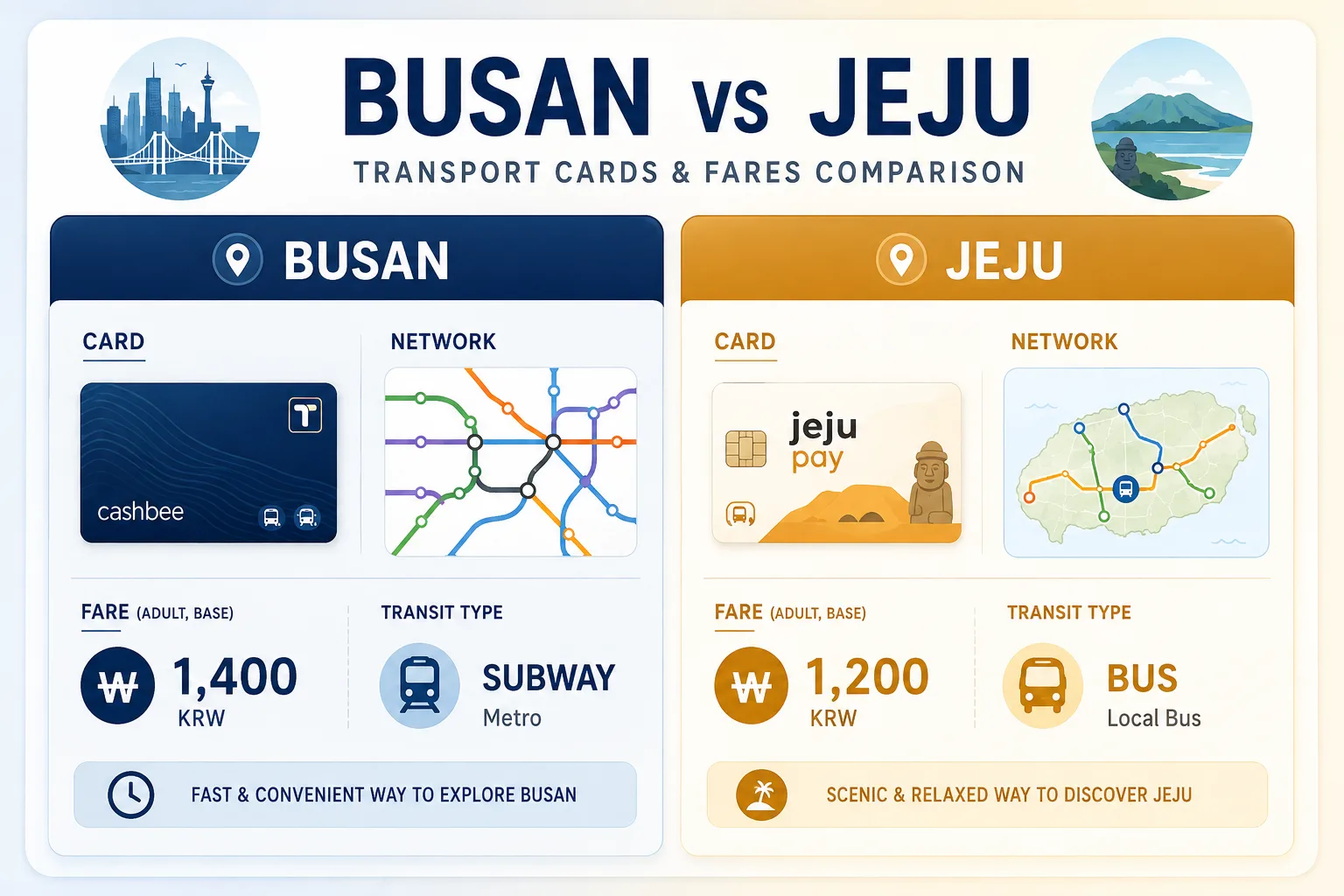 Busan runs on rail-first fares; Jeju runs on bus-first fares
At a Glance Table
The two cities solve the "no car" problem in opposite ways. Busan builds around a subway spine; Jeju has no rail at all and depends entirely on buses and taxis stretched across a much larger island.
| Traveler Type | Busan Fit | Jeju Fit | Verdict |
|---|---|---|---|
| Budget-conscious wanderer (budget_value) | KRW 6,000 day pass covers Lines 1-4; predictable KRW 5,000-10,000/day total | Lower base fares (KRW 1,150-1,200) but longer routes push riders onto pricier KRW 2,000-3,000 Red Express buses | Busan |
| Low-stress planner (low_stress) | Same fare, same frequency, every day; T-money or WOWPASS removes card guesswork | No fixed schedule backbone; cross-island transfers require buffer time you must plan yourself | Busan |
| Style/photo-led solo traveler (style_trend) | Station-adjacent neighborhoods (Seomyeon, Haeundae) keep night walks short and lit | Scenic payoff is higher, but solo photo stops on remote trails now carry an active safety warning | Jeju, with caution |
| Decision Variable | Busan | Jeju |
|---|---|---|
| Core transit mode | 4-line subway plus buses | Buses and taxis only, no rail |
| Base fare (card) | KRW 1,600 to 1,800 | KRW 1,150 to 1,200 (Blue Bus); KRW 2,000 to 3,000 (Red Express) |
| 1-day unlimited pass | KRW 6,000 (Lines 1-4) | KRW 12,000 (City Tour Bus) |
| Foreign card acceptance | Poor at subway gantries; needs T-money, WOWPASS, or app QR | Good; contactless Visa and ZeroPay accepted on buses |
| Typical inter-attraction travel time | Minutes via subway between hubs | 1+ hour for cross-island routes (for example, Jeju City to Seongsan Ilchulbong) |
| Daily car-free cost estimate | KRW 5,000 to 10,000 | Varies more; higher if using Red Express or taxis often |
| Safety consideration | Dense, station-adjacent neighborhoods | Location-dependent; recent guidance against solo remote-trail walking |
| Best hotel base | Seomyeon or Haeundae (Line 2) | Within walking distance of Jeju City Bus Terminal |
Choose Busan If
Choose Busan if you want a coastal trip where transit failure is rare. The subway connects Haeundae, Seomyeon, Nampo-dong, and the airport corridor without forcing you to time your day around a single bus.
Busan also suits you if you are new to Korea and want a lower-friction learning curve. Once you load a T-money card or a Visit Busan Pass, the subway behaves the same way every day: same fares, same frequency, no schedule surprises.
Budget-conscious travelers should lean Busan too. Between the KRW 6,000 day pass and guesthouse rates starting around 15 dollars a night, a full week of coastal sightseeing stays affordable without ever needing a rental counter.
Choose Jeju If
Choose Jeju if your goal is landscape, not logistics, and you are willing to trade travel speed for scenery. Jeju's volcanic coastline, oreums, and canola fields are not replicated anywhere else in Korea, and no subway could serve that kind of spread-out terrain anyway.
Jeju also fits you if your itinerary has slack built in. If you are comfortable spending an hour or more getting from Jeju City to Seongsan Ilchulbong, and you treat that transit time as part of the trip rather than dead time, the island still works well without a car.
Pick Jeju too if paying with a foreign card matters more to you than fast transfers. Its buses take contactless Visa and QR payments directly, which is simpler day to day than juggling a Korean transit card in Busan.
Who Might Regret Busan
Some travelers will find Busan too urban for what they wanted from a coastal trip. If you came to Korea specifically for open volcanic landscapes, quiet trails, or a slower island rhythm, Busan's subway-and-skyline experience will feel like a city trip that happens to have a beach.
Travelers expecting the same low-friction card payments they get on Jeju buses will also be caught off guard. Discovering at the gantry that your Visa card does not tap through is a common early frustration, and it forces an extra stop at a convenience store or kiosk before your first ride.
Who Might Regret Jeju
Travelers with a short trip window are the most likely to regret choosing Jeju without a car. If you have two or three days and a list of five or six attractions, the hour-plus travel times between sights will eat most of your schedule, and you will see less than you planned.
Solo travelers who enjoy wandering unmarked paths should also reconsider. Recent local guidance following the recovery of a missing traveler in Hallim-eup specifically discourages walking alone on remote paths, oreums, or isolated Olle Trail sections, which narrows how freely a solo non-driver can explore Jeju's most scenic areas.
Key Friction Comparison
Transit and Station Complexity
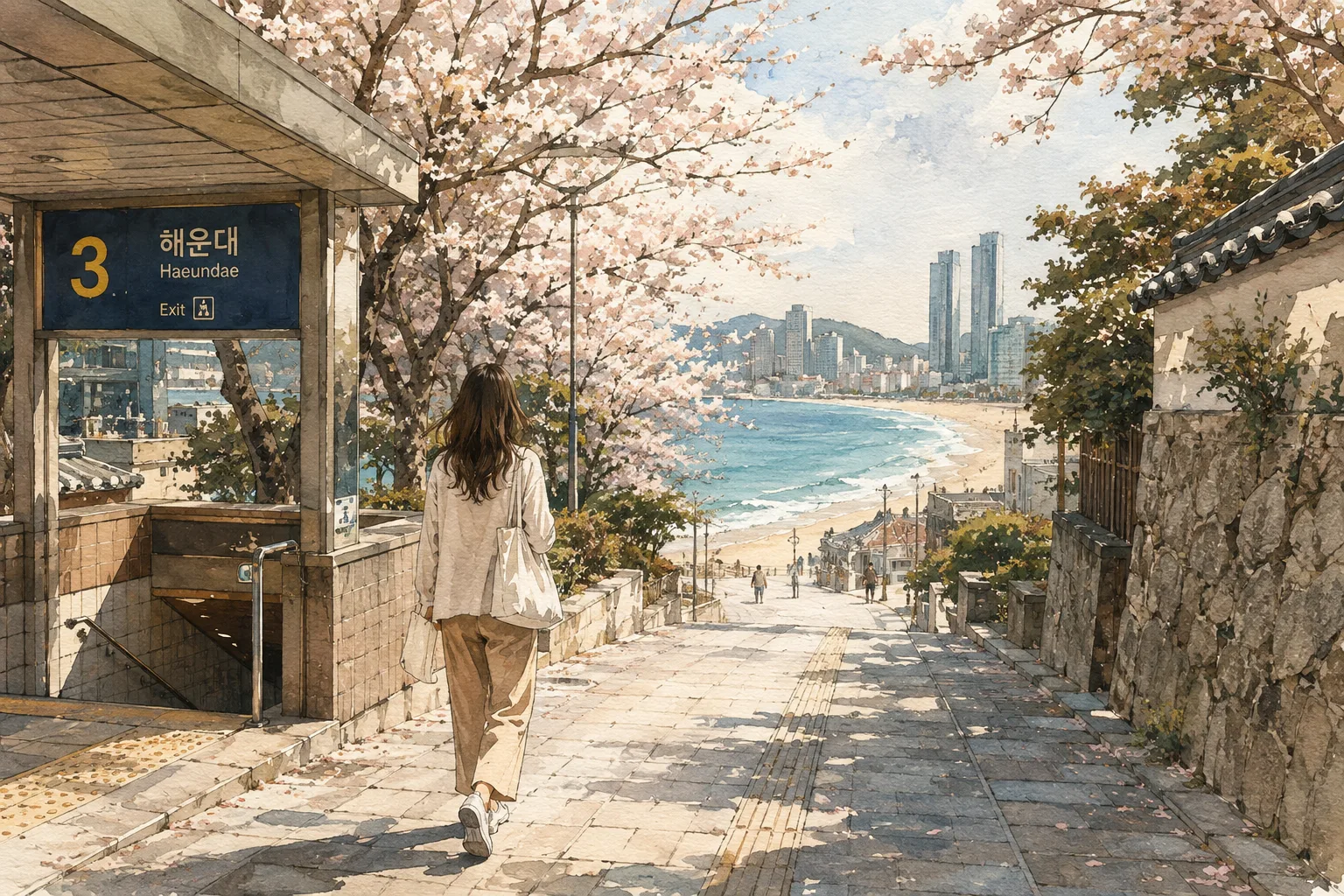
Busan's subway is the simpler system to learn. Four lines cover the areas most car-free travelers care about, and the walk from a station to a landmark is usually short: Haeundae Station's Exit 3 or 5 to Haeundae Beach is only 700 meters, about 5 to 8 minutes on foot.
Jeju has no equivalent backbone. Every transfer point, including the walk from the downtown Jeju Bus Terminal to Dongmun Traditional Market (3 kilometers), requires another bus ride rather than a short walk. That adds planning overhead every time you move between neighborhoods.
Cost and Budget
Busan is cheaper for daily movement and easier to estimate. A car-free day of metro and local buses typically runs KRW 5,000 to 10,000, and the KRW 6,000 unlimited day pass caps your risk if you plan to move around a lot.
Jeju's base bus fares are actually lower per ride, KRW 1,150 to 1,200 on Blue Buses, but longer distances mean more rides and more use of the pricier KRW 2,000 to 3,000 Red Express routes. A traveler who underestimates Jeju's scale can end up spending more than expected on buses and taxis combined.
Hotel Location Risk
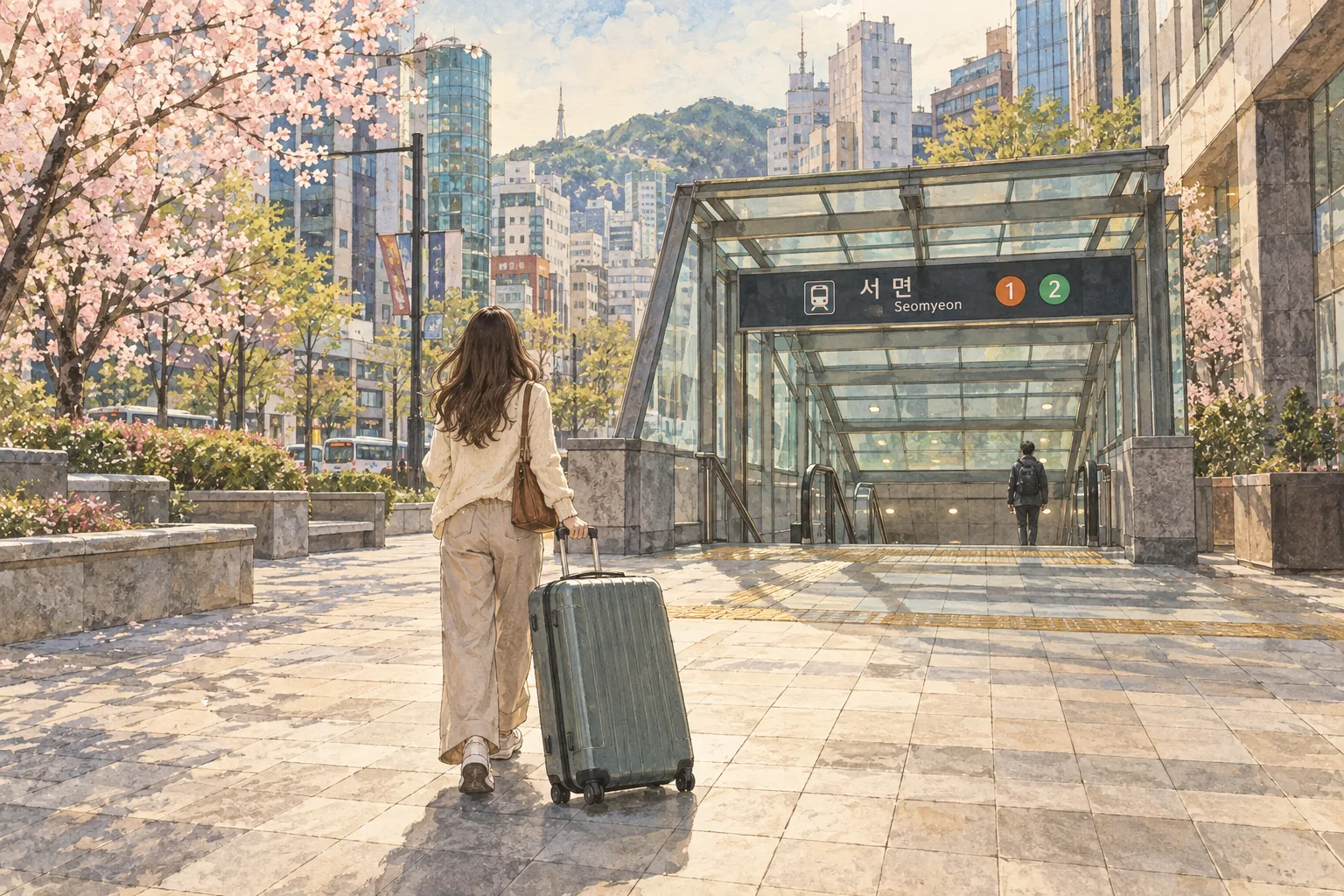
In Busan, book near Seomyeon or Haeundae Station, both on Line 2. Seomyeon sits at a major transfer point between Line 1 and Line 2, so a guesthouse there keeps almost every part of the city within one transfer. Haeundae puts you a short walk from the beach and still on the subway line, which matters more than shaving a few dollars off the nightly rate by staying further out.
In Jeju, the safer play is staying within walking distance of the Jeju City Bus Terminal, since most express and intercity routes originate there. A hotel that looks cheaper near a rural beach or a remote oreum can strand you on a single infrequent bus line, turning a short evening trip into a long wait in the dark.
Safety
Busan's density works in a non-driver's favor here too. Staying near a subway line usually means staying near lit streets and other people late at night, which reduces the isolation risk that worries many solo travelers.
Jeju's safety profile depends heavily on where you go. The island's 19,000-plus CCTV cameras and 2,764 emergency bells show real investment in public safety infrastructure, but that coverage is strongest in towns and weakest on remote trails, which is exactly where recent guidance now advises against walking alone.
Final Recommendation
Pick Busan if you are a non-driving traveler who wants predictable transit, lower daily costs, and a safety profile that does not depend heavily on location choice. Solo backpackers, first-time visitors, and budget-conscious travelers all benefit most from Busan's subway-first structure.
Pick Jeju only if you specifically want its volcanic landscapes and oreum trails, you have a flexible schedule that can absorb long bus transfers, and you are willing to avoid remote paths when traveling alone. If none of those conditions apply, Busan is the safer default for a car-free coastal trip.
Do not split the difference by assuming you can "wing it" without a car on Jeju during a short trip. The island's scale punishes loose planning far more than Busan's does, and that gap is the core reason this comparison does not end in a tie.
FAQ
Is Busan or Jeju easier for a tourist with no driver's license? Busan is easier. It has a four-line subway system that reaches most major coastal and downtown areas directly, so you never depend on bus schedules alone. Jeju has no rail system at all, so every trip without a car runs through buses or taxis.
Can I get around Jeju entirely by public bus? Yes, but plan for longer travel times. Jeju's Blue and Red Express buses cover the island, but a trip like Jeju City to Seongsan Ilchulbong takes over an hour even on the faster express route. Without a car, Jeju works better for travelers with flexible schedules than for tight-day itineraries.
Do foreign credit cards work on public transit in Busan and Jeju? Jeju is more foreign-card-friendly. Its public buses accept contactless international Visa cards and QR payments directly. Busan's subway gantries generally do not accept foreign Visa or Mastercard taps, so you need a T-money card, WOWPASS, a Visit Busan Pass, or the Busan Metro App QR code.
Is it safe to walk alone at night in Busan compared to Jeju? Busan's dense urban layout and subway-adjacent neighborhoods make late-night solo walking more predictable, since you are rarely far from a staffed station or a lit commercial street. Jeju's safety picture is more location-dependent, and recent guidance after a missing-traveler case in Hallim-eup specifically warns against walking alone on remote paths, oreums, or isolated Olle Trail sections.
Which city is cheaper for a car-free budget traveler, Busan or Jeju? Busan is generally cheaper for daily movement. A car-free traveler can cover Busan for roughly 5,000 to 10,000 won a day combining metro and local buses, plus budget guesthouses from about 15 to 40 dollars a night. Jeju's bus fares are workable, but longer distances between attractions mean you ride more, and for a full day of hopping between sights, tour buses or taxis often stack up the cost.
Where should a car-free traveler book a hotel in each city? In Busan, book near Seomyeon or Haeundae Station on Line 2, both of which put you inside a subway-first neighborhood with a station entrance a short walk from most guesthouses. In Jeju, stay within a few blocks of the Jeju City Bus Terminal, since almost every intercity and express route originates there, and a hotel outside that radius can strand you waiting on a single infrequent line.