where-to-stay
Where to Stay in Kyoto on a First Trip If You Want Less Walking and Easy Temple Access
A decision-led Kyoto hotel area guide for first-timers who want less walking, fewer bus transfers, and faster temple access. Compares Kyoto Station, Karasuma Oike, and Shijo-Kawaramachi by real friction.
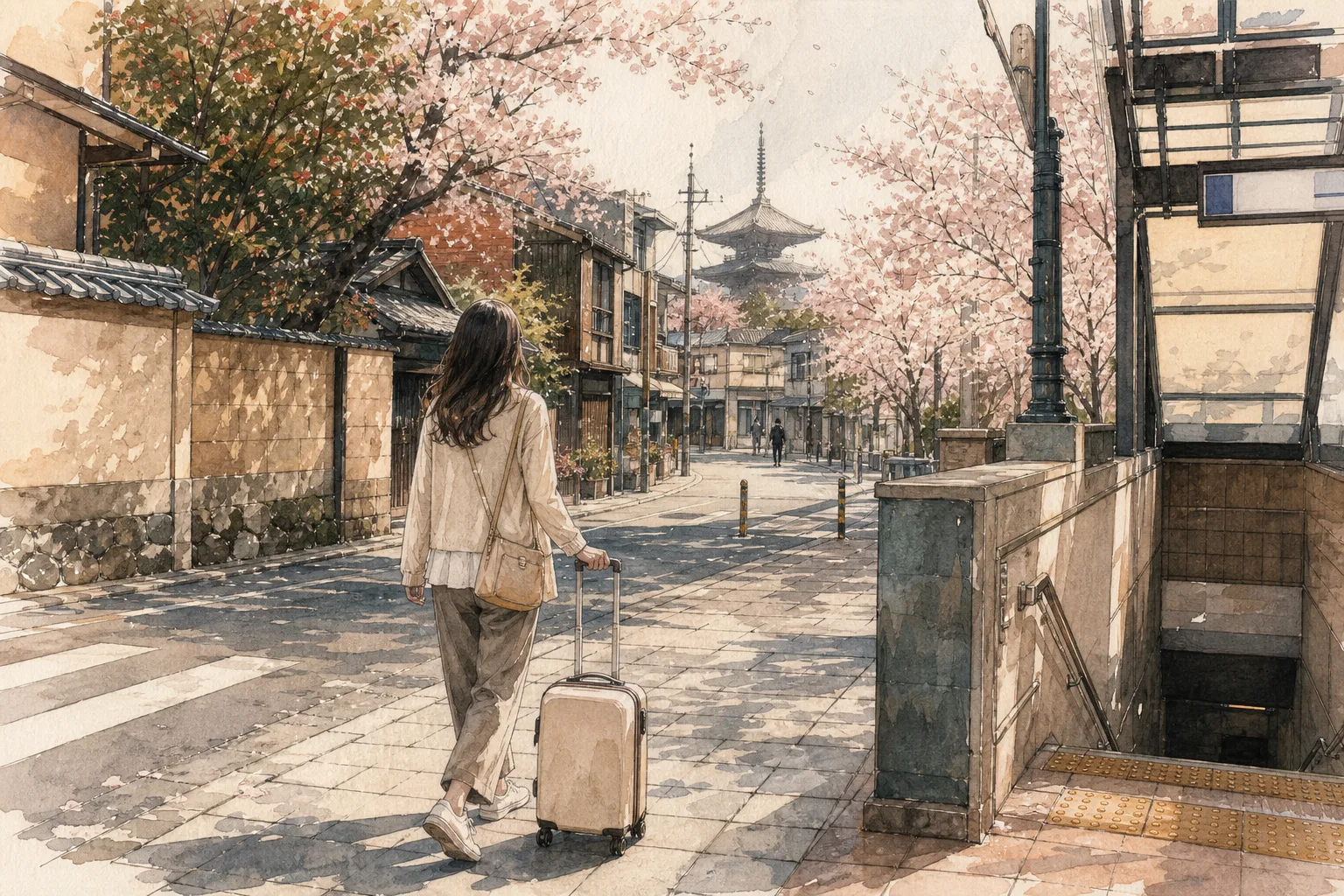
Choosing a Kyoto base sounds simple until you realize that the city's temples are spread across hills, riversides, and outer districts, and that the cheap bus pass most older guides relied on no longer exists. This guide is for first-time visitors who want the hotel location itself to reduce daily walking, not add to it. The core mistake here is choosing for postcard mood first and only later discovering that every temple day starts with a bus problem or an uphill problem.
Quick Answer
If you want less walking and easy temple access on a first Kyoto trip, base yourself in one of three areas, in this order of friction:
- Lowest friction with luggage and arrival day: near Kyoto Station. Direct JR lines to Fushimi Inari (5 minutes) and Arashiyama (about 15 minutes), and on weekends and holidays the EX100/EX101 Express Bus reaches Gojozaka (for Kiyomizu-dera) in about 10 minutes.
- Lowest daily walking once you settle in: near Karasuma Oike Station. It is the sole transfer point between the Karasuma and Tozai subway lines, so you can reach Nijo Castle in 2 minutes and Marutamachi (Imperial Palace) in 2 minutes without a bus.
- Best evening atmosphere with central access: Shijo-Kawaramachi, just west of the Kamo River. More walking on arrival day, but dinner, Gion, and Yasaka Shrine are on foot.
Who should not pick these: travelers who specifically want a ryokan experience in Higashiyama or Arashiyama and accept longer transit on day trips. That is a different decision problem from "less walking, easy temples."
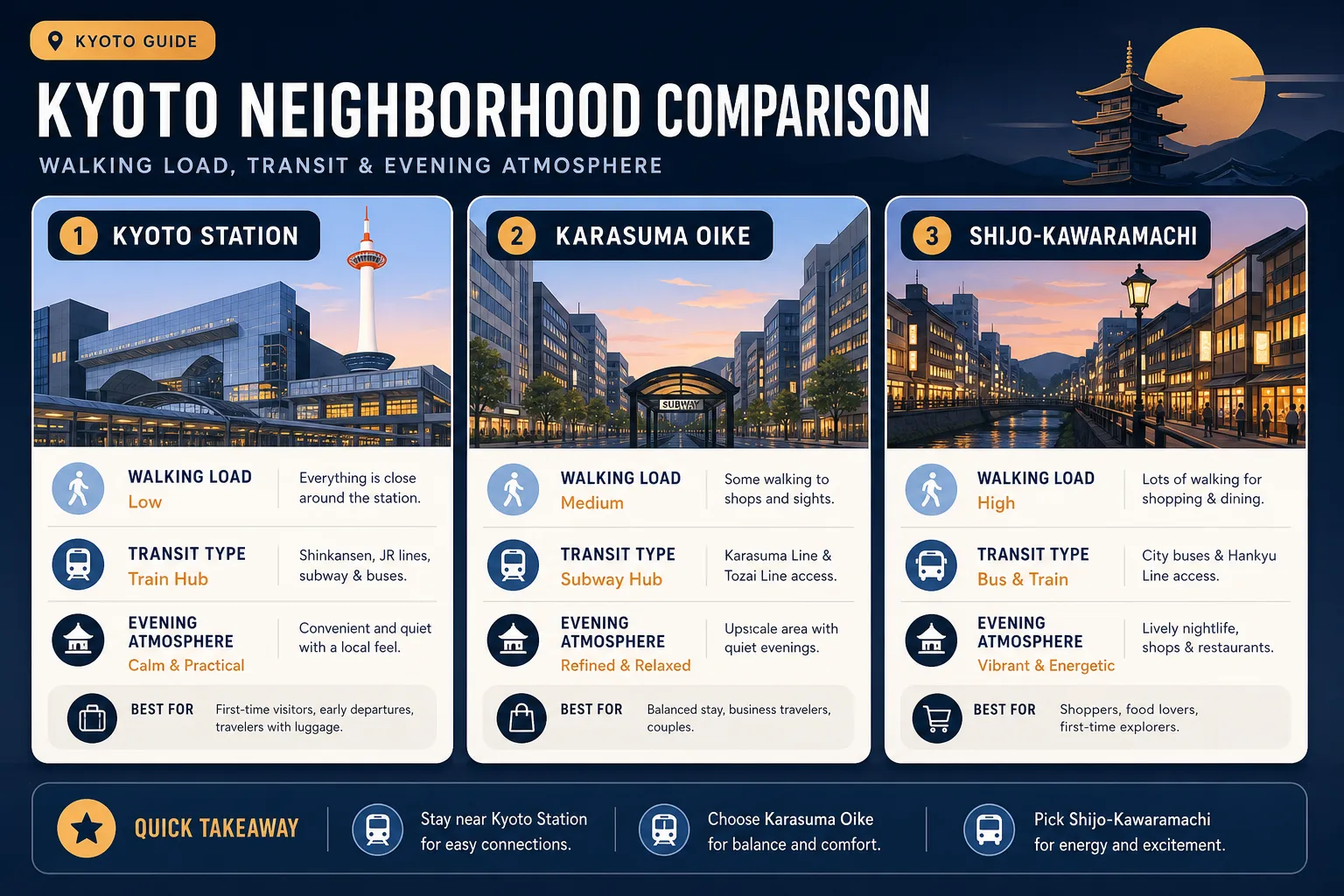 An infographic comparing Kyoto Station, Karasuma Oike, and Shijo-Kawaramachi based on walking load, transit, and atmosphere.
Hotel Location Risk Summary
The risks first-timers underestimate in Kyoto are not about safety. They are about friction that compounds across a 3 to 5 day trip.
- Bus dependence risk: Kyoto's flat-rate bus-only one-day pass (700 yen) was permanently retired in March 2024. The replacement Subway and Bus One-Day Pass is 1,100 yen, so a bus-only strategy is now more expensive and less flexible.
- Luggage risk on buses: Kyoto city bus drivers may refuse boarding to passengers carrying large suitcases or oversized backpacks. If your hotel is bus-only from Kyoto Station, arrival day can go badly.
- Uphill walking risk: Higashiyama temples (Kiyomizu-dera, Kodai-ji, Yasaka Pagoda area) involve real inclines on stone-paved streets. Staying inside Higashiyama saves transit but adds daily uphill walking.
- Transfer stress risk: Kyoto's two subway lines only meet at Karasuma Oike Station. A base far from either line forces you onto buses.
- Evening tradeoff risk: Kyoto Station is convenient but the area around it becomes quiet and corporate at night. Shijo-Kawaramachi is lively but adds 10 to 15 minutes of walking with luggage on day one.
The common regret pattern is simple: travelers book inside the most atmospheric-looking district, then spend the rest of the trip paying for that choice in bus rides, slopes, and tired feet.
Best Areas at a Glance
| Area | Walking load | Main transit | Temple access strength | Evening feel | Best for |
|---|---|---|---|---|---|
| Kyoto Station | Low on arrival, moderate daily | JR lines, subway, express bus on weekends | Fushimi Inari (5 min JR), Arashiyama (about 15 min JR), Kiyomizu-dera via EX100/101 in about 10 min on weekends/holidays | Quiet, functional | Short trips, heavy luggage, JR Pass holders |
| Karasuma Oike | Lowest daily walking | Both subway lines meet here | Nijo Castle (2 min Tozai), Imperial Palace area (2 min Karasuma) | Calm, residential-business mix | Low-stamina travelers, 4+ day trips |
| Shijo-Kawaramachi | Moderate, mostly flat | Hankyu, Keihan, buses, walkable to Gion | Walkable to Yasaka Shrine, Gion, riverside; bus or short walk to Kiyomizu uphill | Lively, dinner-friendly | Culture-focused travelers who want evenings out |
| Higashiyama (inside the temple district) | High, with hills | Buses, some walking to stations | On foot to Kiyomizu, Kodai-ji, Yasaka | Atmospheric but very quiet late | Ryokan-focused trips, not low-walking trips |
The first three rows are the realistic shortlist for the "less walking, easy temples" decision. Higashiyama is included only to flag it as a common mismatch.
Best Area by Traveler Type
First-time visitors with a JR Pass or limited days. Stay near Kyoto Station. You get direct JR access to Fushimi Inari Taisha (5 minutes to JR Inari Station, which exits directly at the shrine's flat entrance) and to Saga-Arashiyama for the Bamboo Grove (about 15 minutes on the JR San-in/Sagano Line). On weekends and national holidays, the EX100 and EX101 Express Buses run from Kyoto Station to Gojozaka in about 10 minutes for 500 yen, making Kiyomizu-dera a low-effort half day.
Low-walking and low-stamina travelers. Stay near Karasuma Oike Station. Because it is the only transfer between the Karasuma (north-south) and Tozai (east-west) lines, almost every major central sight is one short subway ride away: Nijo Castle is 2 minutes west on the Tozai Line, and Marutamachi (for the Imperial Palace) is 2 minutes north on the Karasuma Line. You can plan a trip with very few bus rides, which avoids the luggage and crowding risk on city buses.
Culture-focused travelers who want evenings in Gion and along the river. Stay near Shijo-Kawaramachi, located just west of the Kamo River. You can walk to Gion, Pontocho, and Yasaka Shrine after dinner without any transit. Daytime temple access still works: subway and Keihan lines are close, and Kiyomizu-dera is a manageable bus ride or a longer uphill walk.
Areas to Be Careful With
Some popular-sounding choices create more friction, not less, for this specific decision.
- Deep Higashiyama (near Kiyomizu-dera or Kodai-ji). Beautiful, but you will walk uphill daily, drag luggage over stone slopes on arrival, and rely on buses for anything outside the district. Good for a ryokan night, not for a first-trip base if walking is a concern.
- Arashiyama as a base. Lovely mornings, but you will spend 15 minutes on JR every time you want to reach central Kyoto, and bus connections back at night thin out.
- Bus-only neighborhoods north or west of the center. Without subway or JR access, every day starts with a bus that may refuse you on arrival day if your suitcase is large.
- Anything marketed as "near a famous temple" but far from a station. Check the actual walking time to the nearest subway or JR station, not the temple.
Budget vs Convenience Tradeoff
The honest tradeoff in Kyoto is not luxury versus budget. It is transit friction versus nightly rate.
- A modest hotel near Kyoto Station often costs less than a comparable room in Shijo-Kawaramachi and saves you from buying transit passes on arrival and departure days.
- A mid-range hotel near Karasuma Oike usually costs more per night but cuts daily transit time. Over a 4 to 5 day trip, that time savings often outweighs the price gap, especially if you would otherwise pay 1,100 yen per person per day for the Subway and Bus One-Day Pass.
- A hotel in Shijo-Kawaramachi typically costs the most for equivalent quality, but you save on dinner-time transit and gain walkable evenings.
A rough rule: if your trip is 3 nights or fewer, optimize for arrival-day ease and pick Kyoto Station. If it is 4 nights or more, the daily walking savings of Karasuma Oike or the evening walkability of Shijo-Kawaramachi tend to pay off.
You can sanity-check the math with our travel budget calculator before locking in a booking.
Hotel Location Checklist
Before you book, run the hotel through these checks. If it fails more than two, keep looking.
- Within 7 minutes walking of a subway station (Karasuma or Tozai line) or a JR station.
- Reachable from Kyoto Station without a city bus on arrival day.
- No stairs-only route between the hotel and the nearest station, if luggage or stamina is a concern.
- At least one major temple or shrine reachable by a single train or subway ride, not a bus transfer.
- Dinner options within 10 minutes walking, so you do not need transit at night.
- If the hotel relies on a bus stop, that bus is not one where drivers commonly turn away large suitcases.
- If you plan to use the Subway and Bus One-Day Pass (1,100 yen adult, 550 yen child), the hotel sits on a line the pass covers.
For a structured version you can save, see the hotel location checklist tool.
Final Recommendation
For most first-time visitors who want less walking and easy temple access:
- Pick Kyoto Station if your trip is short, your luggage is heavy, you have a JR Pass, or you are arriving tired and want zero arrival-day friction. Accept a quieter evening atmosphere.
- Pick Karasuma Oike if your priority is the lowest possible daily walking load across a longer trip and you are comfortable taking the subway. Accept slightly higher nightly rates and a calmer neighborhood.
- Pick Shijo-Kawaramachi if walkable evenings in Gion and along the Kamo River are part of why you are coming to Kyoto, and you can handle a moderate walk with luggage on day one.
Do not pick deep Higashiyama, Arashiyama, or bus-only outer neighborhoods as a first-trip base if reducing walking and transit stress is your actual goal. They are good choices for different decisions.
FAQ
Is staying near Kyoto Station a good idea for a first trip? Yes, if your priority is luggage ease, JR access to Fushimi Inari (5 minutes) and Arashiyama (about 15 minutes), and weekend or holiday access to Kiyomizu-dera via the EX100/EX101 Express Bus in about 10 minutes for 500 yen. It is less ideal if you want to walk to dinner in a traditional neighborhood at night.
Will I really need to ride city buses a lot? Less than older guides suggest, if you base near a subway or JR line. The flat-rate bus-only one-day pass (700 yen) was permanently retired in March 2024, and bus drivers may refuse boarding to passengers with large suitcases or oversized backpacks. A transit-first base reduces this risk.
Is Karasuma Oike too quiet for a first trip? It is quieter than Shijo-Kawaramachi at night, but it is the sole transfer station between Kyoto's two subway lines. That makes it the single best base for reducing daily walking, with Nijo Castle 2 minutes west on the Tozai Line and the Imperial Palace area 2 minutes north on the Karasuma Line.
Should I buy the Subway and Bus One-Day Pass? It costs 1,100 yen for adults and 550 yen for children. It pays off quickly on days that combine subway hops with one or two bus rides. If you stay near Kyoto Station and use JR to reach Fushimi Inari or Arashiyama, you may not need it every day.
Can I stay in Higashiyama and still have a low-walking trip? Usually no. Higashiyama is atmospheric, but the temple district involves uphill stone-paved streets, and most non-Higashiyama sights require a bus. It works for one ryokan night, not as a low-walking base for the whole trip.