travel-decisions
Is Kyoto Too Tiring for Low-Walking Travelers?
A friction-first read on whether Kyoto fits low-walking travelers, with a clear table of which sights drain stamina and which feel manageable.
Quick Verdict
Kyoto is not automatically too tiring for low-walking travelers, but the default tourist route is. If you arrive, follow a typical "Higashiyama plus Kiyomizu plus full Fushimi Inari climb" day, and rely on buses in peak season, you will end the trip wrecked.
Choose Kyoto if you are willing to base near Kyoto Station, cut the climb-heavy sights, and accept that you are trading a checklist for a calmer pace. Skip Kyoto, or shorten it to one or two nights, if your trip depends on doing every famous temple, walking long Higashiyama loops, or visiting in peak cherry-blossom or autumn weeks without a flexible schedule.
Strong fit: low-stamina travelers who care about atmosphere, mostly flat sights, and quiet mornings. Weak fit: travelers who want to "see all of Kyoto" in two or three days on foot.
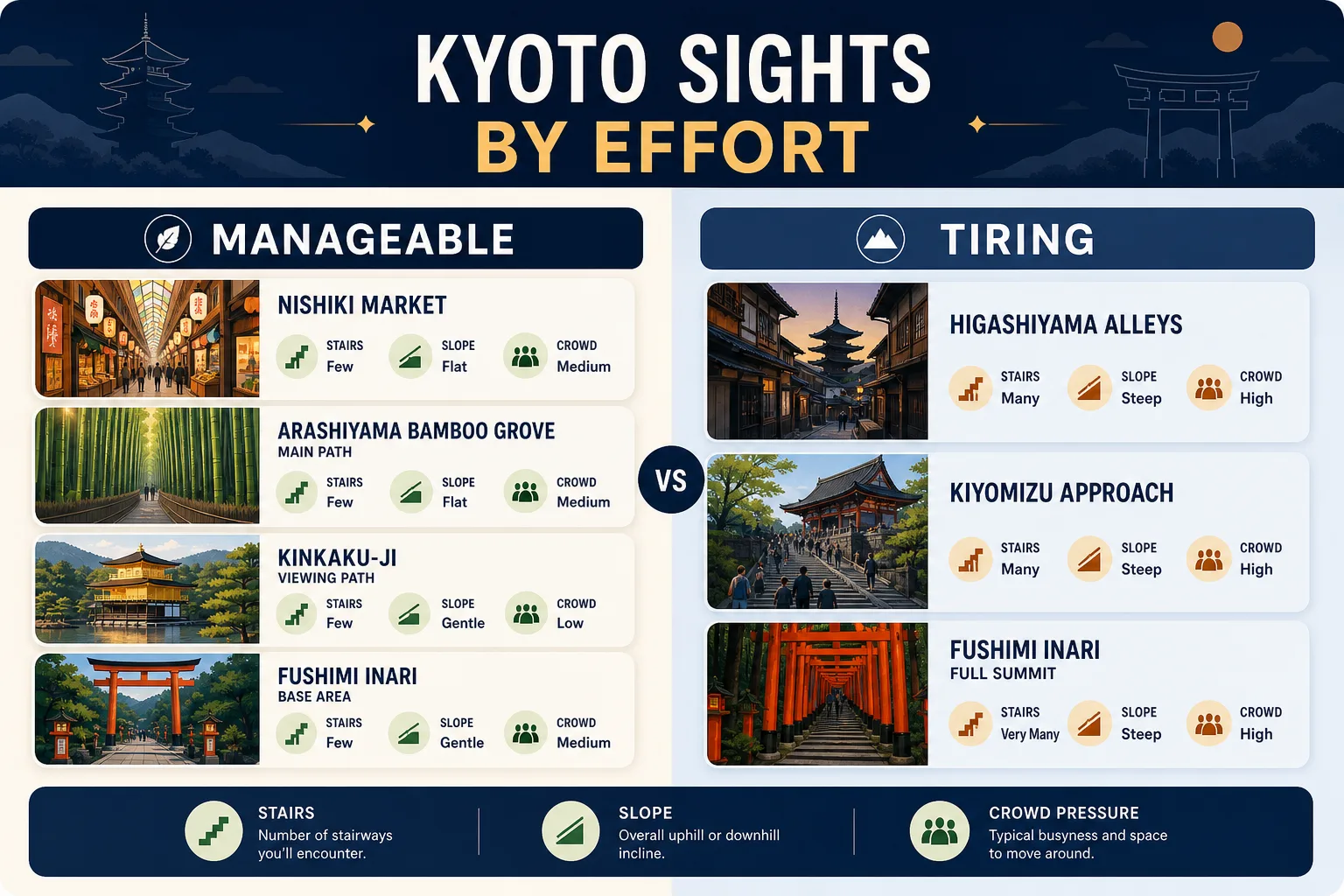 An infographic titled 'Kyoto Sights by Effort' comparing manageable and tiring destinations based on stairs, slope, and crowd levels.
The Main Friction Problem
The friction in Kyoto is not one thing. It is four things stacked on the same day.
Walking fatigue is the obvious one. Kyoto's most photographed areas are spread out, and the gaps between them are often longer than they look on a map. A single "easy" sightseeing day can mean several kilometers of cumulative walking once you add station transfers, temple grounds, and the walk from the bus stop.
Stairs and slopes are the hidden one. Higashiyama ward is hilly and challenging even for manual wheelchair users. The approach streets to Kiyomizu-dera climb steadily. The full Fushimi Inari trail up Mount Inari uses steep stone steps and is not wheelchair-passable. Many "must see" lists quietly assume you can handle all of this.
Crowd pressure multiplies both. Higashiyama and Gion alleys are often narrow and overwhelmingly crowded. In peak weeks, you do not walk at your pace; you walk at the crowd's pace, which for a low-stamina traveler is worse than walking faster on an empty street.
Transit stress closes the loop. Buses are accessible in design but unpredictable in practice during peak hours. The subway is reliable but only reaches part of what tourists want to see. Plan badly and you spend the day standing, waiting, and re-routing instead of resting.
Friction Table
Use this as a sight-by-sight read on where the effort actually lives.
| Sight or area | Walking effort | Stairs or slopes | Crowd pressure | Transit stress | Verdict for low-walking travelers |
|---|---|---|---|---|---|
| Kyoto Station area (base) | Low | Step-free hub | Busy but wide | Lowest in Kyoto | Best base |
| Nishiki Market | Low | Mostly barrier-free | High at lunch | 4 minutes, 220 yen from Kyoto Station on the Karasuma Line to Shijo | Manageable if you go off-peak |
| Arashiyama Bamboo Grove (main path) | Low to moderate | Mostly flat, some gentle slopes on a roughly 500 meter paved or compacted gravel path | High midday | Longer ride from central Kyoto | Manageable with timing |
| Kinkaku-ji (Golden Pavilion) | Low on the viewing path | Packed gravel path is accessible; the adjacent garden has steps | High | Bus-dependent | Manageable if you skip the garden loop |
| Fushimi Inari (base only) | Low | Base precinct generally accessible | High at the entrance | 5 minute JR Nara Line ride from Kyoto Station; 60 to 90 minutes typical | Manageable |
| Fushimi Inari (full summit climb) | High | Steep stone steps, not wheelchair-passable | Thins out higher up | Same as above | Skip |
| Kiyomizu-dera | Moderate if routed correctly | Dedicated wheelchair route via Chawanzaka, ramps, accessible restrooms; hill-top location | High on approach streets | A wheelchair-accessible taxi is recommended to reach the temple | Doable with a taxi up |
| Higashiyama and Gion alleys | High over a day | Hilly, narrow alleys | Overwhelmingly crowded in peak weeks | Bus drop-offs can be far from the alleys | Cut or limit to one short loop |
The pattern is clear: the "flat and famous" sights are doable. The "hilly and famous" sights are where Kyoto stops being a calm trip.
Who Will Feel It Most
Three traveler profiles tend to underestimate Kyoto.
Older travelers used to walking on flat city sidewalks often assume Higashiyama will be "a bit hilly." It is more than that. Uneven stone, slopes, and crowd density combine in a way that European old-town walking does not prepare you for.
Slow travelers who hate rushing get squeezed by the bus system in peak season. When buses skip stops because they are full, the slow pace you wanted becomes forced waiting, not chosen rest.
First-time visitors with a tight itinerary feel it the most. Two or three days is enough time to enjoy Kyoto only if you accept cuts. Trying to do Kinkaku-ji, Arashiyama, Fushimi Inari summit, Higashiyama, Gion, and Kiyomizu in that window is what produces the "Kyoto destroyed my legs" reviews.
If two of those three describe you, treat Kyoto as a careful pick, not an automatic one.
How to Reduce the Friction
You can keep Kyoto on the trip if you adjust the structure.
Cut walking fatigue by basing at Kyoto Station. It is the easiest place for low-walking travelers to stay, with step-free access to JR lines, the Karasuma subway, Kintetsu, and the city bus terminal. Build the day as one outbound trip and one return, not a loop across the city.
Cut stairs by choosing which sights you do at full depth. Visit Fushimi Inari at the base for 60 to 90 minutes and skip the summit climb. See Kinkaku-ji from the accessible viewing path and skip the stepped garden loop. For Kiyomizu-dera, use the Chawanzaka wheelchair route and take a wheelchair-accessible taxi up rather than walking the approach.
Cut crowd pressure with timing. Hit Nishiki Market outside lunch hours. Visit Arashiyama's roughly 500 meter bamboo path early. Avoid Higashiyama on weekend afternoons in peak season, when the alleys stop being a walk and become a queue.
Cut transit stress by preferring the subway where it fits. Both the Karasuma and Tozai lines are barrier-free, with platform-to-street accessible routes and elevators at every station. They reach fewer tourist sites than the bus network, which is the tradeoff, but they do not strand you. Where a sight is bus-only or hill-top, take a taxi instead of a packed bus. As of late 2025, nearly 97.4% of the Kyoto City Bus fleet is low-floor and wheelchair-accessible, and a single ride is 220 yen, but accessibility on paper does not help if the driver refuses boarding because the bus is full.
Rest is part of the plan, not a sign of failure. One sight before lunch, a long lunch, one sight after, hotel by late afternoon. That is a realistic Kyoto day for a low-stamina traveler.
Better Alternatives
If the adjustments above feel like too much compromise, redirect rather than force the trip.
- Tokyo as a base, Kyoto as a day trip. You get more flat, well-signed, elevator-equipped neighborhoods, and you can visit Kyoto for one focused day instead of three exhausting ones.
- Kanazawa instead of Kyoto. Smaller, calmer, with traditional districts that are easier to walk in a single short loop and fewer hill-top temples.
- Nara as a primary stop. Most major sights cluster in one park, with shorter distances between them and fewer narrow alley bottlenecks than Gion.
- Osaka for food-led travelers. Flatter overall, dense transit, and you can still day-trip into Kyoto for one or two sights.
None of these are "Kyoto with the hard parts removed." They are different trips. But they are the honest alternatives when the friction stack in Kyoto does not match the traveler.
Decision Checklist
Run through this before you book. If you cannot answer yes to most of these, shorten or replace Kyoto.
- I am willing to base near Kyoto Station rather than in Higashiyama or Gion.
- I accept skipping the full Fushimi Inari summit climb.
- I am ready to use a taxi for hill-top sights like Kiyomizu-dera instead of walking up.
- I am avoiding peak cherry-blossom and autumn foliage weeks, or I have schedule flexibility if I am not.
- I plan no more than two main sights per day and a real rest block in the afternoon.
- I will use the Karasuma or Tozai subway where it fits, instead of betting the day on buses.
- I have checked that my hotel is step-free from the station entrance to the room, not just close on a map.
- I am comfortable cutting at least one famous sight from my list if a day goes long.
If three or more of these are uncomfortable, Kyoto is likely too tiring for the trip you actually want.
FAQ
Is two days in Kyoto enough for a low-walking traveler? Two days is the realistic ceiling, not the floor. One day for a flat route (Kyoto Station area, Nishiki Market, Kinkaku-ji viewing path) and one day for a single focused sight (Fushimi Inari base, or Kiyomizu-dera by accessible taxi route). Three days only helps if you use the extra day to rest, not to add sights.
Should I rent a wheelchair or mobility scooter in Kyoto? If long walking days are unrealistic for you, yes, at least for the temple days. Just remember that Higashiyama alleys and the Fushimi Inari summit are not wheelchair-passable, so the rental shifts what you can do, it does not unlock everything.
Are taxis a reasonable backup in Kyoto? Yes, especially for hill-top sights and for getting back to the hotel when buses are full. For Kiyomizu-dera specifically, a wheelchair-accessible taxi is the recommended way up. Treat taxis as a planned cost, not an emergency.
Is Arashiyama worth it if I cannot walk far? The main bamboo path is roughly 500 meters, mostly paved or compacted gravel, and largely flat with some gentle slopes. That part is reasonable. The wider Arashiyama area adds bridges, slopes, and longer walks, so keep your visit tight: bamboo path, one nearby sight, and back.
Can I do Kyoto without using the bus system at all? Mostly, yes, if you accept the tradeoff. The subway covers fewer tourist sites, but it is barrier-free with elevators at every station. Combine subway rides with short taxi hops to hill-top sights, and you can skip the bus crowd-pressure problem entirely. You will see less, but you will finish each day intact, which is the point.