travel-decisions
Should You Skip Akihabara If You Are Not Into Anime or Gaming?
If anime, retro games, and electronics culture do not excite you, Akihabara is usually a half day you cannot get back in Tokyo. Here is how to decide cleanly.
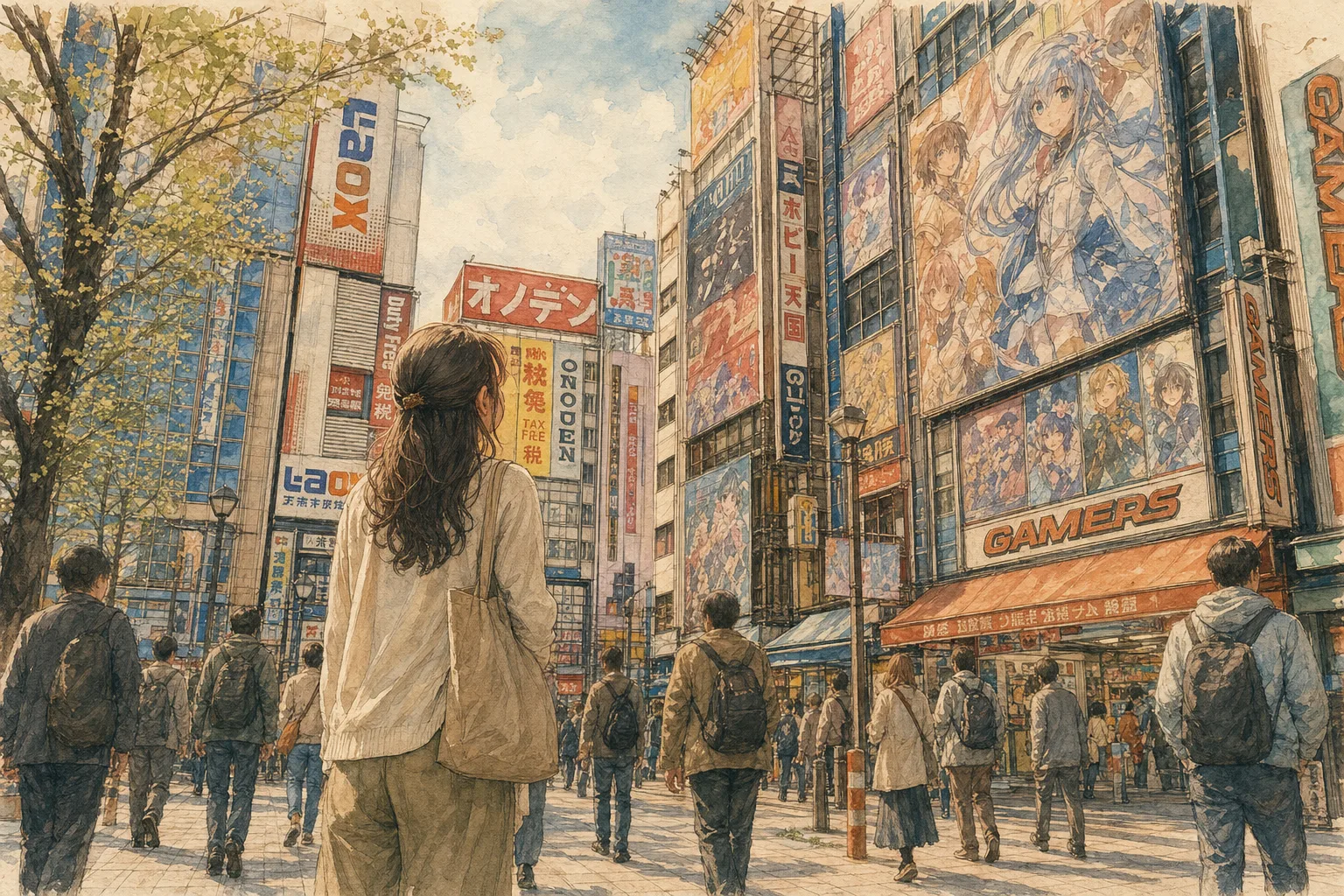
Akihabara shows up on almost every Tokyo first-timer itinerary, usually with a vague label like "must-see" or "Tokyo energy." That framing hides the real question. Akihabara is not a general sightseeing neighborhood. It is a themed district built around anime, manga, retro games, idol culture, and consumer electronics. If those things do not interest you, you are not visiting a neutral landmark. You are spending half a day inside someone else's hobby.
This guide is for travelers who keep seeing Akihabara on lists and quietly suspect it is not for them. The honest answer is usually that the suspicion is right, but there is a clean way to confirm it before you commit the time.
Quick Verdict
Skip Akihabara, or cap it at 30 minutes, if you do not actively enjoy at least one of: anime and manga, video games (especially retro and arcade), figure or trading card collecting, consumer electronics culture, or dense neon-and-noise streetscapes.
Keep Akihabara on your itinerary if you are curious about Japanese pop culture as a system, you collect anything in those categories, you want a sensory-overload street experience for its own sake, or you are traveling with someone who genuinely cares.
Tokyo has too many strong neighborhoods to spend half a day in one that does not match you. Saying no to Akihabara is not skipping Tokyo. It is choosing Tokyo more carefully.
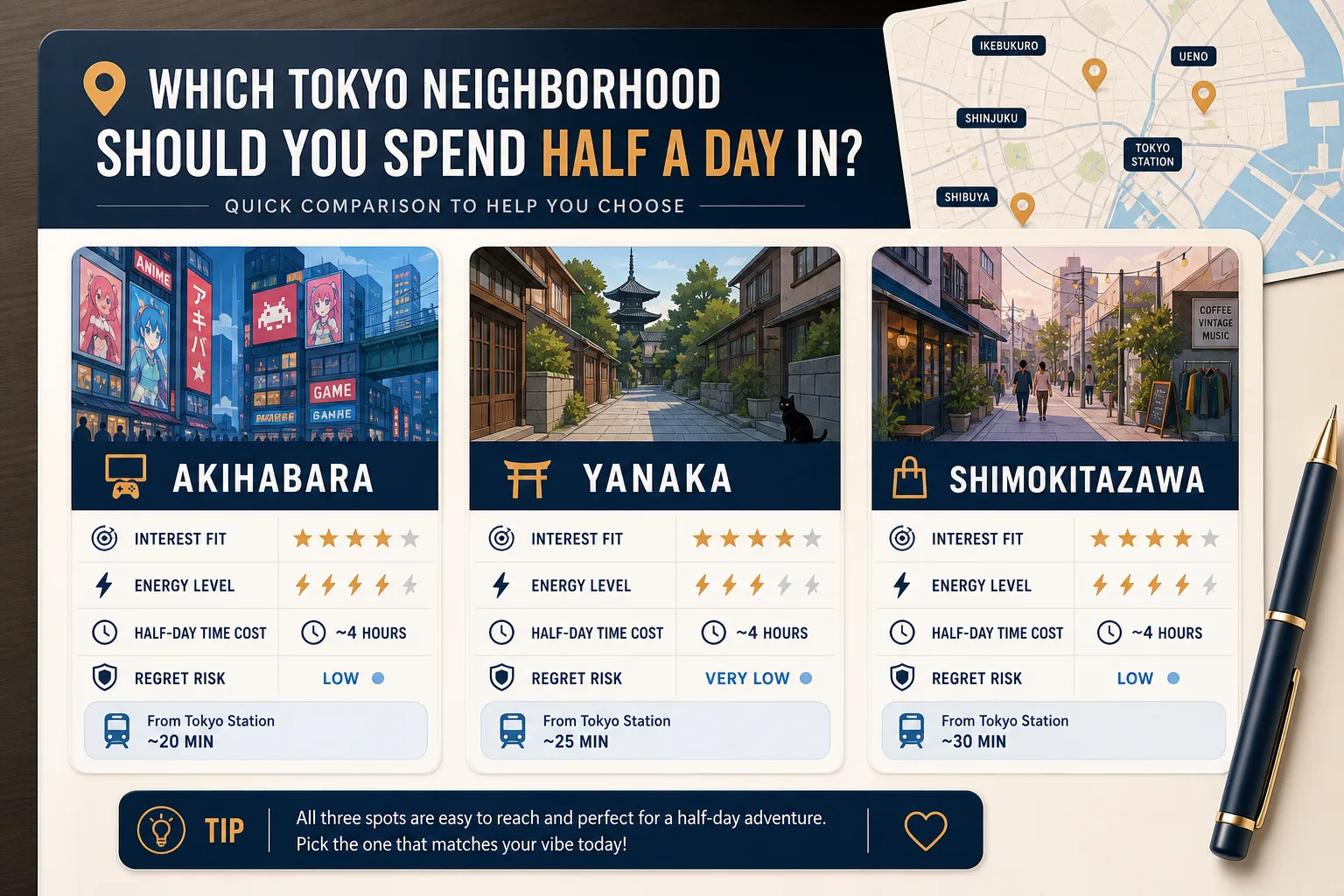 An infographic comparing Tokyo neighborhoods Akihabara, Yanaka, and Shimokitazawa based on key travel metrics.
Who Will Probably Love It
Akihabara rewards a specific traveler. You will likely enjoy a real visit, not just a walk-through, if you fit one of these patterns:
- You already watch anime or read manga and want to see flagship stores, character cafes, and themed floors.
- You play or collect video games, especially older consoles, arcade cabinets, or Japan-only releases.
- You buy figures, gachapon, trading cards, or doujinshi and want the deep inventory that does not exist outside Japan.
- You work in or study electronics, components, or DIY hardware and want to walk the small parts shops near the back streets.
- You actively enjoy maximalist urban sensory environments: stacked signage, layered audio, tight crowds, bright color.
If two or more of those apply, give Akihabara a real block of time, three to five hours, and plan specific stops instead of wandering.
Who Might Regret It
The travelers who most often leave Akihabara disappointed share a few traits. Be honest with yourself about whether any of these describe you.
- You came because it was on a list, not because anything specific draws you in.
- You prefer slow neighborhoods, quiet streets, food-led walks, gardens, temples, or design and craft shopping.
- Loud music, dense crowds, and aggressive promotional signage drain you fast.
- You do not plan to buy anything, and window shopping inside hobby stores feels awkward to you.
- You are already running a tight Tokyo itinerary and considering cutting time from Yanaka, Shimokitazawa, a museum, or a day trip to fit Akihabara in.
The specific disappointment pattern is predictable: you arrive, the station exit is overwhelming, you walk one or two blocks, peek into a multi-floor store, feel out of place, and leave within 40 minutes wondering why you came. Then the rest of the day feels compressed because you spent the travel time and mental energy anyway.
Mistake and Consequence Table
These are the real decision variables, not generic facts about the district.
| Decision you make | What actually happens | Better move |
|---|---|---|
| Block a full half day because a list said so | You usually lose three to four hours once you count the train ride, station re-orientation, one big store, and the reset time before the next stop | Cap the visit at 30 minutes or cut it entirely |
| Go at night for the neon, with no shop plan | You get one good photo of the main strip, then stand around in peak noise and foot traffic with no reason to stay | Treat it as a 20-minute photo stop after dinner nearby |
| Add a maid cafe for novelty | You pay a cover plus drink minimums for a performative experience you may find uncomfortable | Skip unless you are specifically curious and comfortable with that energy |
| Bring a sensory-sensitive traveler "just to see" | They hit overload within 15 minutes and the rest of the day suffers | Split up, or pick a calmer neighborhood together |
| Cut Yanaka, Kagurazaka, or a museum to fit Akihabara | You trade a high-fit experience for a low-fit one | Protect the high-fit stop, drop Akihabara |
Hidden Friction Points
The friction in Akihabara is not obvious from photos, which is why list-driven itineraries keep recommending it.
Half-day opportunity cost. Tokyo neighborhoods are far apart in practical terms. Adding Akihabara usually means one less stop somewhere else, plus 30 to 60 minutes of transit and reorientation. The cost is rarely just "an hour in Akihabara." It is closer to a half day once you count the trip there, the walk around, and the recovery time.
From a few common first-timer bases, the stop is rarely as frictionless as the map makes it look. From Tokyo Station the district is easy enough to test quickly. From Asakusa or Ueno, it is still a deliberate neighborhood swap. From Shinjuku or Shibuya, it becomes much harder to justify unless Akihabara is one of the day's main goals, because you are usually spending one more platform change plus one more station exit sequence just to test a neighborhood you may leave in 20 minutes.
Sensory overload. The exits at Akihabara Station drop you straight into stacked signage, looping store jingles, idol music from sidewalk speakers, and street-level handouts. For travelers who like calm, this is not a slow build. It is immediate. Many people need to leave within 20 minutes, which makes the time investment worse, not better.
Crowded shop floors. The famous multi-floor stores are narrow, vertically stacked, and packed on weekends and holidays. Aisles are tight, staff are busy, and you are visibly in the way if you are not shopping. This is fine if you came to buy. It is uncomfortable if you came to "look around."
That is why named store fit matters. Radio Kaikan, figure-heavy buildings, retro game floors, and hobby chains only pay off if you already know what category you want. If you do not, even a flagship store can feel like ten escalators of visual noise instead of a highlight.
Generic itinerary pressure. Most Tokyo lists treat Akihabara as interchangeable with Shibuya, Shinjuku, and Asakusa. It is not. Shibuya and Shinjuku work for almost any traveler because they are mixed-use. Akihabara is themed. Generic lists do not flag that difference, so first-timers keep it in by default.
How to Make It Easier
If you are still on the fence, here is how to reduce the cost of being wrong.
- Use the 30-minute test. Plan Akihabara as a short stop between two other things, not as a destination. Exit at Akihabara Electric Town, walk the main strip once, look into one large store, leave. If you want to stay, stay. If you want to leave, you already built the exit into the plan.
- Choose the easier rail approach. If you are already on the Yamanote loop, Akihabara is easy to test. If reaching it means changing from a subway to JR just for this one stop, treat that transfer as part of the cost instead of pretending the district is "on the way."
- Go on a weekday, late morning. Crowds are lighter, music is quieter, and shop staff are less aggressive. Weekends and main-road pedestrian afternoons are the worst case for non-fans.
- Pair it with somewhere calm nearby. Combine a short Akihabara walk with Kanda Myojin shrine, the quieter streets of Ochanomizu, or a slow lunch toward Yushima. This protects you from the sensory drop.
- Decide your one specific question before you go. For example: "I want to see one figure shop floor" or "I want one photo of the neon strip." Without a specific question, you will wander, and wandering is where the regret comes from.
- Skip the cafes if you are unsure. Maid cafes, themed cafes, and character cafes are commitments of time and money built around enthusiasm. If you do not have the enthusiasm, they amplify the mismatch.
Not sure which neighborhoods match how you actually travel? The travel personality quiz maps your preferences to neighborhood styles, which makes Tokyo planning much faster than working from a generic list.
If your real planning problem is broader than Akihabara, start with Where to Stay in Tokyo for a First Trip If You Want Low Station Stress or Is Tokyo Worth It If You Travel for Atmosphere, Not Checklists?. Those two guides usually tell you faster whether Akihabara belongs in your version of Tokyo at all.
If you are choosing between city mood, not just one district, Tokyo vs Osaka: Which Is Easier for a Low-Stress First Trip to Japan? gives a better top-level answer than trying to solve the whole question through Akihabara.
Better Alternatives
If you cut Akihabara, do not just delete the time. Replace it with a neighborhood that fits how you actually want to travel.
| If you wanted | Try instead | Why it fits better |
|---|---|---|
| Tokyo "energy" and crowds | Shibuya or Shinjuku | Mixed-use, works for any interest, not themed around one hobby |
| Quirky shopping and street culture | Shimokitazawa or Koenji | Vintage clothing, small record shops, indie cafes, walkable |
| A sense of old Tokyo | Yanaka, Nezu, or Kagurazaka | Low-rise streets, temples, craft shops, slower pace |
| Design, craft, and bookshops | Daikanyama, Nakameguro, Jimbocho | Calmer streets, strong food and coffee, browsing without pressure |
| Pop culture without the intensity | Nakano Broadway | Similar hobby retail in a single building, lower sensory load |
Nakano Broadway is worth flagging specifically. If you are mildly curious about anime, figure, and collector culture but do not want the street-level chaos of Akihabara, Nakano gives you most of the retail in one calmer indoor complex.
Self-Checklist Before You Decide
Run through this list honestly. If you answer no to most of them, skip Akihabara or cap it at 30 minutes.
- I can name at least one anime, game, or franchise I would actively look for there.
- I am comfortable spending money in hobby shops, or I genuinely enjoy browsing without buying.
- I tolerate loud, layered street noise for at least an hour without getting drained.
- I am not cutting time from a higher-fit Tokyo neighborhood to make Akihabara fit.
- I would be happy treating the stop as a 20 to 30 minute walk-through if it does not click.
If you answered yes to four or five, keep Akihabara and plan it on purpose. If you answered yes to two or three, use the 30-minute test. If you answered yes to zero or one, skip it and spend the time elsewhere.
FAQ
Is Akihabara worth visiting if I am not into anime or gaming? For most non-anime travelers, no. The neighborhood is built around anime, manga, retro games, idol culture, and electronics. Without real interest in at least one of those, you are mostly walking through loud retail space aimed at someone else.
Can I just walk through Akihabara for 30 minutes to see it? Yes, and that is often the best compromise. Exit at Electric Town, walk the main strip once, look into one large store, and leave. That gives you the visual context without paying the full half-day cost.
Is Akihabara better at night or during the day? Night is more dramatic because of the lights, but the crowd pressure and noise are also higher. If you are unsure, weekday late morning is the easier test case. If you only want one photo of the lit-up street, go after dark and keep it brief.
What should I do with the time if I skip Akihabara? Use it on a better-fit neighborhood. Yanaka works for slow walking and old Tokyo atmosphere, Shimokitazawa works for vintage and cafe time, and Kiyosumi or Kagurazaka are stronger choices for a calmer urban day.
Is a maid cafe reason enough to go if I am otherwise not interested? Only if you are specifically curious about that format and comfortable with a performative, high-energy setting. It is not a neutral cultural stop, and many novelty-only visitors regret spending both time and money there.
Editorial Basis
Reviewed by Trip Persona Editorial Team on 2026-06-09 for first-time Tokyo itinerary fit, district-level opportunity cost, and low-stress routing decisions.