travel-decisions
Is Tokyo Worth It in Early December If You Want Illuminations Without Holiday Crowds?
A decision guide for couples and photo-led travelers weighing Tokyo in early December: crisp dry air, free illuminations, and a real shot at calm weekday viewing before the Christmas rush.
Quick Verdict
Yes, Tokyo in early December is worth it if your specific goal is illuminations without the holiday crush. The window roughly from late November through the second week of December gives you the same major light displays that run until December 25, but on calmer weekday evenings and at lower hotel pressure than the Christmas-week peak.
Choose this trip if you are a couple or a photo-led traveler who can move on weekdays, tolerates 3 to 16 C (37 to 60 F) with mostly dry weather, and treats evenings as the main event. Skip it if you need warm weather, cherry blossoms, long daylight for sightseeing, or you can only travel on weekends close to Christmas. In that case the lights are still there, but the crowd you came to avoid is there too.
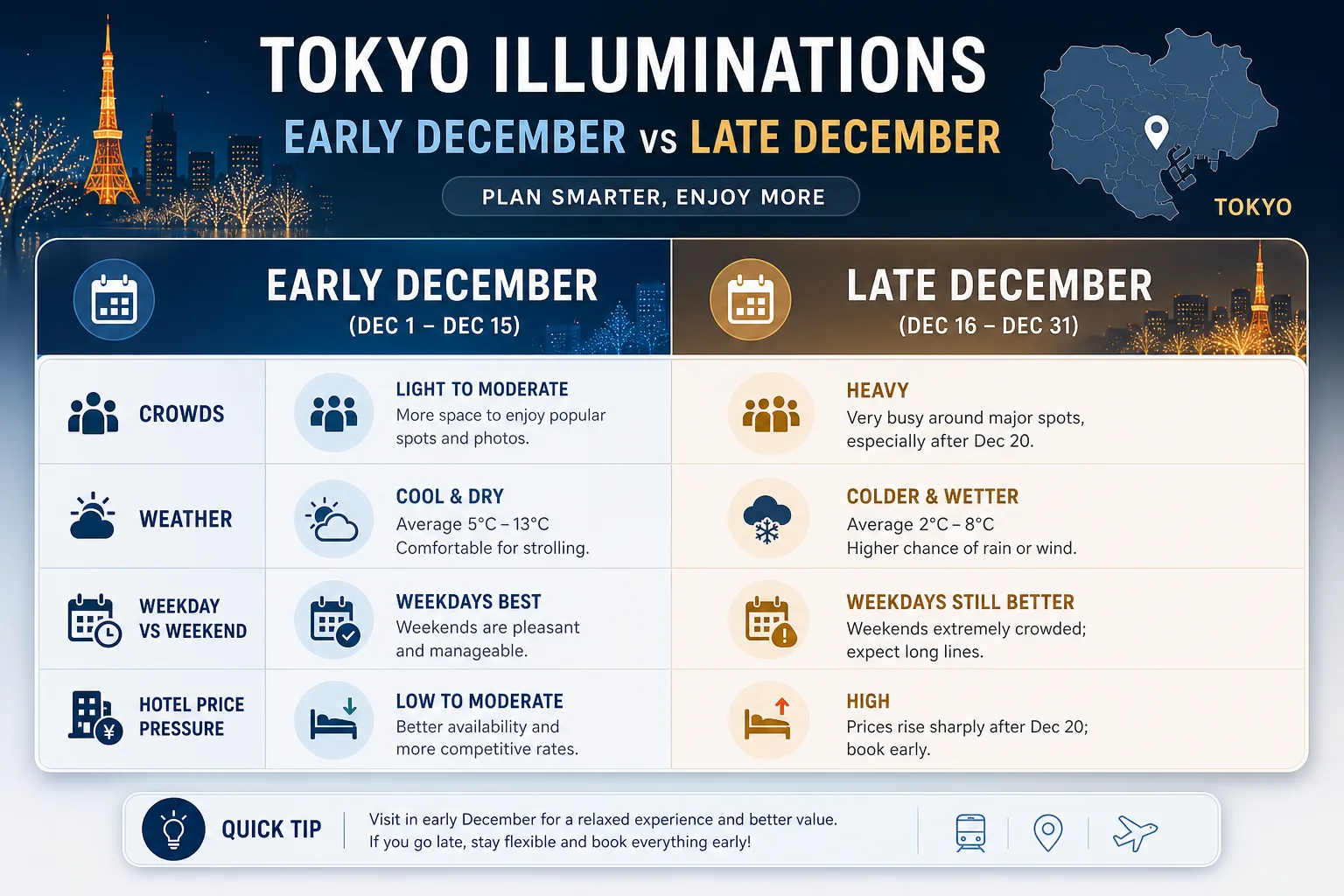 An infographic table comparing travel conditions in Tokyo between early December and late December across metrics like crowds, weather, and prices.
At a Glance Table
This is the comparison most readers actually need: early December versus the late-December peak, on the variables that change the trip.
| Variable | Early December (roughly Dec 1 to Dec 14) | Late December (Dec 20 to Dec 25) |
|---|---|---|
| Crowd density at illuminations | Light to moderate on weekdays | Heavy, especially evenings and weekends |
| Weather | 9 to 16 C day, 3 to 5 C night, dry | Similar temperatures, similar dryness |
| Daylight | Sunset near 16:30, long evening window | Same short daylight |
| Lights status | Marunouchi, Midtown, Roppongi Hills, Shibuya Blue Cave all running | All running, plus Christmas Market peak |
| Hotel price pressure | Moderate. Business districts often stay near baseline weekday winter rates, roughly 18,000 to 28,000 yen for a solid mid-range double in Marunouchi, Shimbashi, or Akasaka. | High. The same class of room commonly climbs into the 24,000 to 40,000 yen range in the Christmas-week window, with premium properties and Saturday nights moving higher. |
| Best photo conditions | Blue hour 16:30 to 17:30, few people in frame | Lights on, but crowded foregrounds |
| Risk of disappointment | Low if you expect winter, not holiday energy | Low if you expect crowds, not calm |
Two operational anchors to keep in mind. Tokyo Midtown's Midtown Christmas event runs November 13 to December 25, 2025, with lights on from 17:00 to 23:00. Roppongi Hills' Keyakizaka Illumination runs November 4 to December 25, 2025, on the same 17:00 to 23:00 schedule, and the two areas are within a 20-minute walk of each other, which makes them a natural single-evening pairing.
Choose Early December If
Pick the early-December window if any of the following is true for your trip.
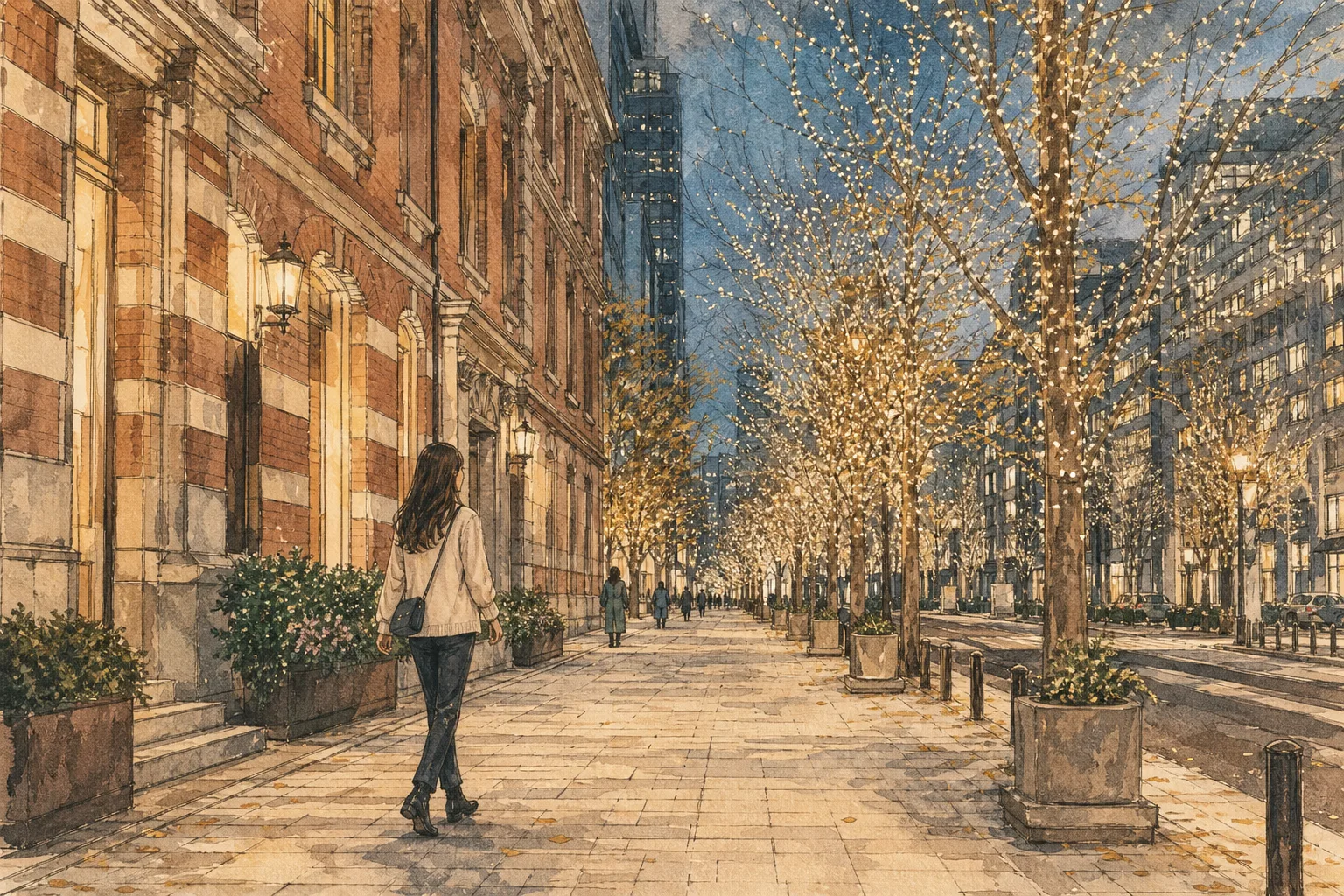
- You are traveling as a couple and want the lights to feel like a shared evening, not a queue. Weekday arrivals at Marunouchi Nakadori, which lights a 1.2 km stretch from November 13, 2025 through February 15, 2026 (16:00 to 23:00, until midnight in December), give you a long, walkable avenue with room to stop and shoot.
- You are photo-led and care about blue hour. Arriving just before lights-on, typically between 16:00 and 17:00, gets you the soft sky plus the lit trees, with thinner foregrounds than later in the month.
- You want a low-stress evening rhythm: late lunch, golden-hour walk, dinner reservation at a normal time, lights afterward. Early December weekdays still allow this. Late December weekends do not.
- You are okay with cold but dry conditions. December is one of Tokyo's driest months, with minimal rainfall and only a small chance of snow, which is friendlier to long outdoor walks than the damp cold in many other major cities.
Choose Late December (or Skip) If
Pick the later window, or skip the trip, if any of the following is true.
- Your only available dates are December 20 to 25, and you are weekend-locked. You will see the same lights, but you will see them through people. That is not the trip the early-December window is built for.
- You want the full Tokyo Christmas Market atmosphere with food stalls and music. That peaks closer to Christmas, especially on weekends, and tolerating that density is part of the experience.
- You are combining the trip with New Year traditions (Shogatsu, hatsumode shrine visits). In that case anchor the trip around December 28 to January 3, accept holiday crowds, and treat illuminations as a bonus rather than the headline.
- You cannot move evenings on weekdays. The whole crowd-avoidance thesis depends on weekday arrivals before 17:00. Without that, the early-December advantage shrinks.
Who Might Regret Early December
The wrong-fit reader is not the one who dislikes Tokyo. It is the one who quietly wanted a different trip.
- Travelers who pictured a warm or shoulder-season Tokyo. Early December is genuinely cold at night, and outdoor dinners, rooftop bars, and long park afternoons are not the right plan.
- Sakura-first travelers. There are no blossoms, the ginkgo peak has mostly passed, and the city is visually a winter city. If your mental image of Tokyo is pink, this window will feel off, no matter how good the lights are.
- Daylight-heavy itineraries. Sunset is early and daylight is short, so museum-and-neighborhood days have to end earlier than in spring or autumn. Travelers who want long walking days and only secondary evenings will feel rushed.
- First-timers trying to do everything. If this is your only Tokyo trip and you want Senso-ji, teamLab, Shibuya, day trips, and illuminations, the illumination angle becomes one item among ten, and the early-December reasoning gets diluted.
Who Might Regret Late December
The mirror risk is real too.
- Crowd-averse couples who booked Christmas week expecting calm. Shibuya Blue Cave, an 800-meter display, can pull around 2 million visitors across the December run, and the heaviest pressure lands in the final ten days. If you came specifically to avoid that, you will not.
- Photo-led travelers who need clean foregrounds. Late-December evenings give you the lights, but most frames will include strangers. That is acceptable for some styles and ruinous for others.
- Budget-sensitive travelers. Hotel rates around Christmas Eve and the weekends leading into it spike harder than early-month rates. A mid-range double that sits around 18,000 to 28,000 yen on an early-December weekday can easily land closer to 24,000 to 40,000 yen in the Christmas-week window, and restaurant availability tightens on top of that.
- Travelers who wanted a quiet, romantic anniversary feel. Late December in central Tokyo reads more like a city-wide date night than a private one.
Key Friction Comparison
The three friction points that decide this trip are weather, crowds, and time pressure. Each is manageable, but only if you plan around it.
Weather. Early December daytime sits around 9 to 16 C (48 to 60 F), with nights at 3 to 5 C (37 to 41 F). It is one of Tokyo's driest months, with a small chance of snow. Practical move: a real wool or down coat, a scarf, gloves you can use a phone in, and shoes you can stand in for two hours. Treat one evening as your illumination evening and do not over-schedule the day before it.
Crowds. The honest rule is weekday plus early arrival. Visit on Monday through Wednesday and arrive just before lights-on, typically between 16:00 and 17:00. At Shibuya Blue Cave, which is about a 10-minute (roughly 1 km, 12-minute) walk from Shibuya Station's Hachiko Exit, arriving before full dark is the difference between a walkable lane and a slow shuffle. At the Tokyo Christmas Market, weekday afternoons are noticeably calmer than weekend evenings.
Time pressure. Daylight is short, so build the day backward from sunset. Sample shape: late breakfast, one daytime neighborhood, an early-ish dinner reservation around 17:30 to 18:00, then illumination walking from roughly 19:00 to 21:00. Pair Roppongi Hills and Tokyo Midtown in one evening since they are within a 20-minute walk. Save Marunouchi for a separate night so you can take the full 1.2 km stretch without rushing.
Quick decision checklist before you book:
- At least two of my Tokyo evenings fall on Monday through Thursday.
- I am willing to arrive at illumination areas by 17:00, not 19:00.
- I am okay with cold, dry weather and short daylight.
- I do not need cherry blossoms, warm terraces, or long daylight sightseeing.
- My hotel is within roughly 15 minutes by train of either Marunouchi, Roppongi, or Shibuya.
Three or more checked, early December fits. Two or fewer, reconsider the window.
Final Recommendation
For couples and photo-leaning travelers whose specific goal is illuminations without the holiday crush, early December in Tokyo is one of the more honest yes answers in the seasonal-decision category. You get the same headline displays, with calmer weekday evenings, dry conditions, and softer hotel pricing than the Christmas-week peak. The tradeoff, which is the cold, short daylight, and lack of seasonal flora, is predictable and easy to plan around.
Do not choose this window if you are weekend-locked into the last ten days of December, if you wanted a warm or sakura-flavored Tokyo, or if illuminations are only one item on a long first-timer checklist. In those cases the trip is still possible, but the reason you came (calm lights) will not survive contact with the calendar. If your dates and your traveler profile both line up with the early-December weekday pattern described above, book it with reasonable confidence; if only one of them does, move the trip rather than force the window.
FAQ
How cold does it actually feel in Tokyo in early December? Daytime highs sit around 9 to 16 C (48 to 60 F) and nights drop to roughly 3 to 5 C (37 to 41 F). It is dry rather than damp, so a wool coat, a scarf, and warm shoes are usually enough for two to three hours of outdoor illumination walking.
Are early December weekdays really less crowded than the week before Christmas? Yes, noticeably. Early December weekdays draw mostly local after-work visitors, while the last ten days before Christmas pull domestic day-trippers, date-night crowds, and tourists onto the same streets, especially at Shibuya Blue Cave and the Tokyo Christmas Market.
Do you have to pay to see the main Tokyo illuminations? Most major displays such as Marunouchi Nakadori, Roppongi Hills Keyakizaka, Tokyo Midtown, and Shibuya Blue Cave are free to walk through. You only pay if you choose a paid observation deck, an ice rink, or a ticketed garden viewing.
What is the single best night to go if I only have one? A Monday, Tuesday, or Wednesday in the first two weeks of December, arriving at the lighting area between 16:30 and 17:00. You get the lights-on moment, blue hour photos, and dinner seating before the post-work surge fills the sidewalks.
Is early December a bad time for couples who also want cherry blossoms or warm-weather vibes? Yes. Early December is cold, leafless, and built around evening light. If your trip identity is sakura, terraces, or long daylight, push the trip to late March or April instead and skip the illumination angle.