where-to-stay
Should You Stay Near Tokyo Station on a First Trip If You Want Easier Airport and Shinkansen Access?
A decision-focused area guide for first-time Tokyo visitors weighing Tokyo Station's premium price against its airport and Shinkansen convenience.

Tokyo Station is one of the easiest places in Japan to arrive at and leave from. It is also one of the most expensive, most office-heavy, and most navigation-heavy neighborhoods you can pick as a first-time base. This guide is about whether that tradeoff is worth it for your specific trip.
Quick Answer
Stay near Tokyo Station if at least one of these is true:
- You are taking a Shinkansen out of Tokyo during your trip (to Kyoto, Hakone, Nagano, Sendai, etc.).
- You arrive at or depart from Narita and want the airport limousine bus or Narita Express to drop you within walking distance of your hotel.
- Your trip is short, you are jet-lagged, and you want the cleanest possible first night with minimal transfers.
- You are a businesslike planner who values predictability over neighborhood character.
Pick a different base if any of these is true:
- You want late-night food, bars, or street-level energy near your hotel.
- Your budget is tight and you want a normal mid-range room rate.
- You are flying only through Haneda (Shinagawa or central west-side hubs are usually better).
- You want one small, walkable station you can learn in a day.
If you are unsure, work through our hotel location checklist before booking.
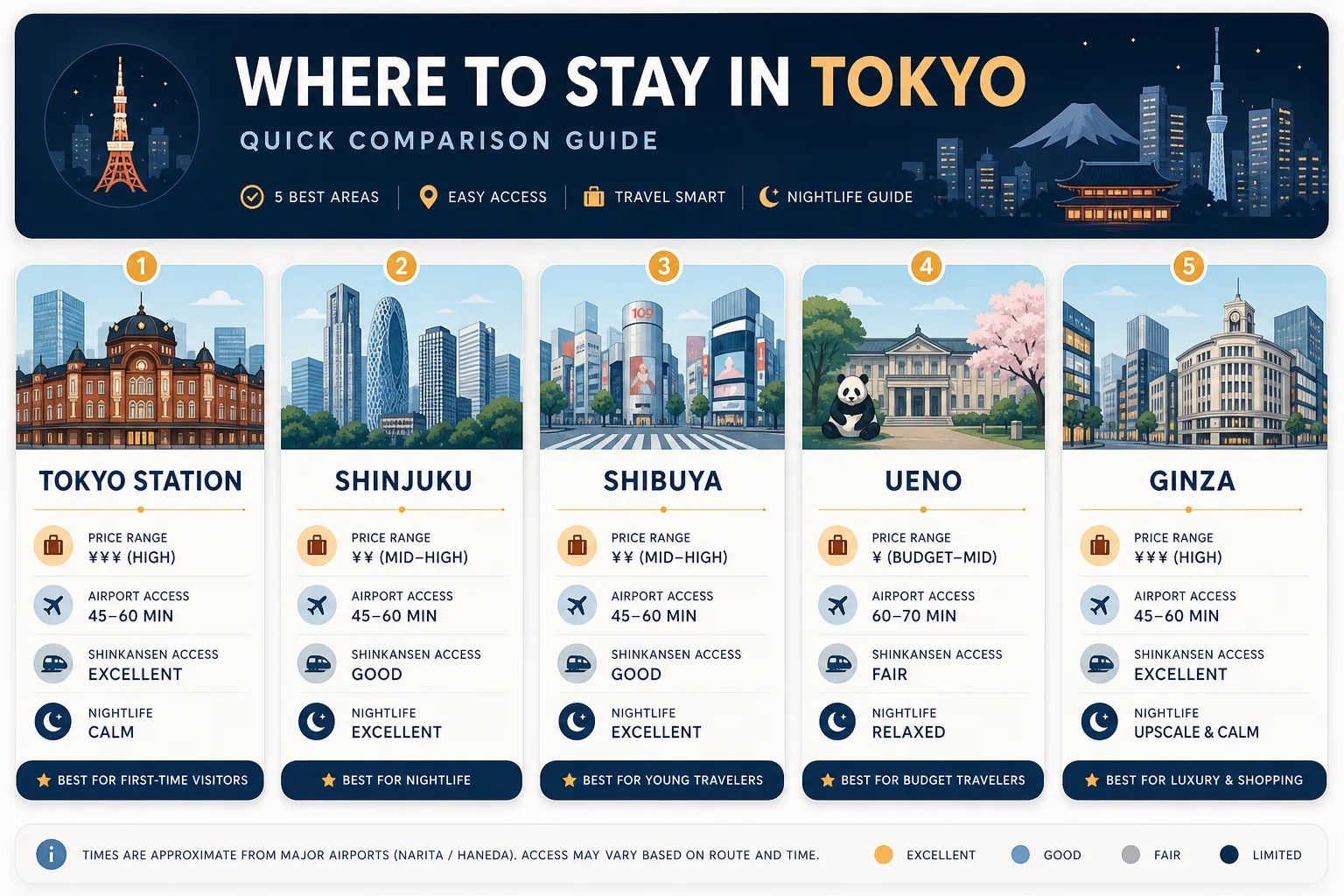 An infographic comparing five Tokyo neighborhoods including Tokyo Station and Shinjuku on price, airport access, and Shinkansen connectivity.
Hotel Location Risk Summary
The risks around Tokyo Station are specific, not vague. Knowing them up front avoids the most common regrets.
| Risk | What it actually looks like |
|---|---|
| Station scale | The complex spans Marunouchi, Yaesu, and underground Keiyo line platforms. A wrong exit can add 10 minutes of indoor walking with luggage. |
| Price floor | Mid-range rooms here often run 30 to 60 percent higher than equivalent rooms in Ueno or east Shinjuku. |
| Nightlife gap | The Marunouchi side is quiet after 9 p.m. Most restaurants close earlier than in Shibuya or Shinjuku. |
| Wrong-airport mismatch | Optimized for Narita and Shinkansen. Less ideal as a Haneda base than Shinagawa. |
| Repetitive vibe | The area is office towers and luxury retail. First-time visitors hoping for "Tokyo character" often feel underwhelmed. |
Best Areas at a Glance
Here is how Tokyo Station compares to the four bases most first-time visitors also consider.
| Area | Nightly price feel | Airport access | Shinkansen access | Nightlife and food | Best for |
|---|---|---|---|---|---|
| Tokyo Station | High | Strong (Narita) | Excellent | Weak after 9 p.m. | Train-heavy, low-stress arrivals |
| Shinjuku | Medium to high | Strong (both) | Good (via transfer) | Excellent | Energy, food, late nights |
| Shibuya | High | Medium | Good (via transfer) | Excellent | Younger travelers, shopping |
| Ueno | Low to medium | Strong (Keisei to Narita) | Good (via transfer) | Casual, lively | Budget, classic Tokyo feel |
| Ginza | Very high | Strong (limousine bus) | Good (one stop) | Upscale, ends early | Luxury, quiet evenings |
The deciding question is usually: are you actually using the Shinkansen, or just imagining you might? If the answer is "just imagining," the premium for Tokyo Station rarely pays off.
Best Area by Traveler Type
First-time visitors with no Shinkansen plans
Skip Tokyo Station. Ueno or east Shinjuku gives you better food at street level, cheaper rooms, and a station you can actually learn. You can still reach Tokyo Station in 5 to 15 minutes by train when you want to see it.
Shinkansen travelers (Kyoto, Hakone, Nagano)
Tokyo Station is the right answer. Rolling a suitcase from a Marunouchi or Yaesu hotel to the Shinkansen gate in under 15 minutes is a real quality-of-life gain on a departure morning.
Businesslike planners
If you value predictable transfers, English signage, and clean indoor walkways over neighborhood texture, Tokyo Station fits. The premium buys you reliability.
Low-stress arrival planners (Narita arrivals)
Strong fit. The airport limousine bus stops directly at major hotels here, and the Narita Express terminates inside the station. After a long flight, this is one of the lowest-friction landing points in the city.
Haneda-only travelers
Tokyo Station is not the obvious choice. Shinagawa is faster on the Keikyu line, and Hamamatsucho works for the monorail. Use Tokyo Station only if you have other strong reasons to be central.
Areas to Be Careful With
A few specific mismatch patterns come up again and again.
- The "we just want to walk around at night" traveler. Walking around the Marunouchi side at 10 p.m. is a quiet, almost empty experience. If you came to Tokyo for buzz, you will resent the hotel choice within two nights.
- The budget-conscious traveler who booked Tokyo Station for "convenience." The nightly rate difference over a week often covers an extra day of activities. Convenience is real but not free.
- The Yaesu-versus-Marunouchi mixup. These two sides of the station feel like different neighborhoods. Yaesu is busier and more casual; Marunouchi is upscale and quiet. Read your hotel's exit recommendation before booking.
- The Keiyo line trap. If you plan to visit Tokyo Disney, the Keiyo line platform is a long indoor walk (often 10 minutes) from the main concourse. A Tokyo Station hotel is not actually a shortcut to Disney.
- The "I will sleep off jet lag here, then move" plan. Splitting a short trip across two hotels usually costs more time and money than picking one slightly imperfect base.
Budget vs Convenience Tradeoff
The honest math on Tokyo Station looks like this:
- You pay roughly 5,000 to 15,000 yen more per night than for a comparable room in Ueno or Asakusa.
- In return, you save about 30 to 60 minutes of transfer time on arrival day, and similar time on a Shinkansen departure day.
- Over a 5-night trip with one Shinkansen day, that premium can be worth it.
- Over a 5-night trip with no Shinkansen and a Haneda return, it usually is not.
Run your specific numbers in the travel budget calculator before you commit. Travelers tend to underestimate how much the nightly difference compounds.
Hotel Location Checklist
Before booking near Tokyo Station, confirm each of these:
- You have at least one Shinkansen trip or one Narita transfer planned.
- You checked which side (Marunouchi or Yaesu) your hotel exits to.
- You confirmed the walk from your hotel's nearest exit is under 10 minutes.
- You are okay with quiet streets after 9 p.m. near your hotel.
- You compared the same dates against one Ueno or east Shinjuku hotel for price.
- You confirmed your airport is Narita, or that you have a separate plan for Haneda transfers.
- You are not planning to use the Keiyo line daily (Disney trips, Maihama area).
If you cannot check most of these, the area is probably not your best base.
Final Recommendation
Choose Tokyo Station if you are a Shinkansen user, a Narita arrival, a businesslike planner, or someone who wants the lowest-stress first night possible and is willing to pay for it. The convenience is real and not exaggerated.
Choose somewhere else if you want nightlife at your doorstep, a tighter budget, a Haneda-friendly base, or a neighborhood that feels distinctly like Tokyo rather than a polished business district. Shinjuku, Ueno, and Shinagawa each beat Tokyo Station for a different one of those needs.
The mistake is not picking Tokyo Station. The mistake is picking it for the wrong reason, usually a vague sense that "central is better." Central is better only when your specific reasons match the area's specific strengths, and for Tokyo Station that list is short and precise.
FAQ
Is Tokyo Station a good base if I am only in Tokyo for three nights? Only if at least one of those days involves a Shinkansen trip or an early airport departure. For a pure sightseeing stay, Shinjuku or Ueno gives you more food, lower prices, and shorter walks to your hotel after a long day.
Is the walk inside Tokyo Station really that bad with luggage? The station itself is large, but if you book a hotel on the Marunouchi or Yaesu side and use that exit, you usually walk five to ten minutes above ground with your suitcase. The pain comes from transferring between Shinkansen, Marunouchi line, and Keiyo line platforms, which can mean ten minutes of indoor walking.
Is Tokyo Station better than Shinagawa for airport access? For Haneda, Shinagawa is faster and cheaper via the Keikyu line. For Narita, Tokyo Station is competitive thanks to the Narita Express and the airport limousine bus stop right at the station. Pick by which airport you use.
Will I miss out on nightlife if I stay near Tokyo Station? Yes. After about 9 p.m. the Marunouchi side becomes a quiet office district. You will need to take a 10 to 20 minute train ride to Shibuya, Shinjuku, or Roppongi to find late-night bars and casual eating streets.
Is a capsule or budget hotel near Tokyo Station realistic? There are a few budget options on the Yaesu side, but most rooms here are business-tier or luxury, and prices stay high even off-peak. If budget is the priority, Ueno, Asakusa, or the east side of Shinjuku will give you more room for the same money.