travel-decisions
Is Vienna a Good First Trip for Travelers Who Want Easy Logistics?
A decision-focused look at whether Vienna fits first-time visitors, low-stress planners, and couples who want simple transit, predictable hotel locations, and low daily navigation stress.
Quick Verdict
Vienna is a strong fit for a first international trip if your main priority is avoiding logistics stress: it has a compact, walkable historic core, a short and predictable airport transfer, and transit fares that are simple to understand once you know the current rules. It is a weaker fit if you want spontaneous, unplanned days, since two of its top sights now require advance timed-entry bookings, and part of the S-Bahn network is under long-term construction that affects airport train routing.
Choose Vienna for your first trip if:
- You want a single, predictable way to get from the airport to your hotel
- You would rather book museum tickets ahead of time than risk a sold-out day
- You want a city center small enough to walk between major sights
- You are traveling as a couple and want to minimize daily "what do we do now" friction
Look elsewhere if:
- You want to wing it with zero advance bookings
- You want a city where nightlife and spontaneity matter more than order
- You are highly sensitive to construction disruptions and want zero chance of a rerouted transit trip
- You want a budget trip with low-cost lodging as the default, not the exception
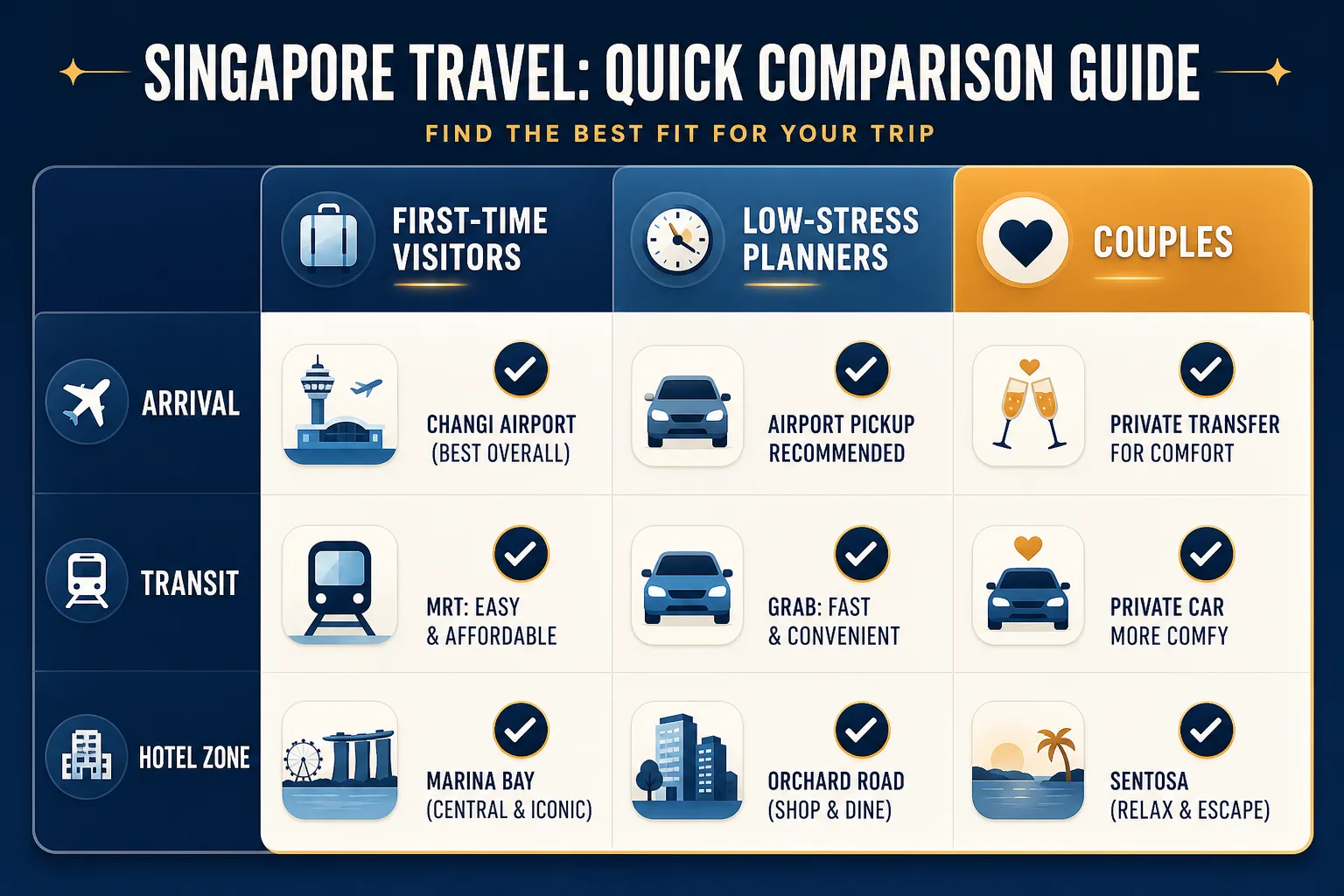 How different traveler types score Vienna's logistics tradeoffs.
Traveler Type Table
Vienna's logistics profile is not uniformly easy or hard. It depends on what kind of friction actually bothers you. The table below breaks down the real variables that decide fit, rather than generic "why visit Vienna" facts.
| Decision variable | First-time visitors | Low-stress planners | Couples | Slow travelers |
|---|---|---|---|---|
| Airport arrival | Strong fit: one direct 15-minute train to the main station removes the hardest part of day one | Strong fit: the fixed-fare private transfer or the train both avoid pricing surprises | Strong fit: shared decision is simple since there is really only one obvious choice | Neutral: efficient arrival doesn't matter much if the goal is unhurried travel |
| Daily navigation | Strong fit: flat, pedestrianized center keeps wrong turns low-stakes | Strong fit: fewer transit lines to track than sprawling capitals | Strong fit: less time spent negotiating routes, more time deciding together what to see | Mixed: a very walkable core can feel almost too structured for wanderers |
| Hotel location risk | Moderate: staying near Stephansplatz or the 1st-9th districts keeps you close to everything | Strong fit: a central district booking removes most guesswork | Strong fit: one good location decision covers both partners' needs | Moderate: slow travelers may prefer a quieter, less central base, which reintroduces some transit planning |
| Advance booking requirement | Moderate friction: Schonbrunn and the Belvedere need timed slots booked ahead | Moderate friction: this cuts against a fully improvised trip | Low friction: couples usually plan together anyway | Higher friction: booking ahead conflicts with a slower, less scheduled style |
| Transit rule changes | Moderate friction: 2026 fare and pass changes require reading current rules once before travel | Low friction once briefed: rules are simple, just need a five-minute check | Low friction: shared briefing takes minutes | Low friction: slower travelers have time to sort out tickets without pressure |
The pattern across the table is consistent: Vienna is easiest for travelers who are comfortable doing a small amount of upfront planning in exchange for a much calmer trip once they land. It is a weaker fit for anyone who wants zero planning and full spontaneity.
Best for First-Time Visitors
First-time visitors typically carry two anxieties: getting from the airport without a mistake, and not knowing which neighborhood keeps them close to what they actually want to see. Vienna addresses both directly. The airport sits about 18 kilometers from the center, and the BB Railjet covers that distance in 15 minutes for a fixed fare, which is a far simpler decision than comparing multiple bus and train options in some other capitals.
Once in the city, the geography does a lot of the planning for you. Stephansplatz sits a flat 10-minute walk from both Hofburg Palace and the Vienna State Opera, and the U1 subway line connects Favoriten near the main train station to Stephansplatz in under five minutes. That means a first-time visitor who books a hotel anywhere near the 1st through 9th districts is rarely more than a short walk or one subway stop from the core sights.
The one piece of homework a first-timer should not skip: Schonbrunn Palace and the Upper Belvedere both require advance timed-entry bookings, since day-of tickets regularly sell out. This is not a spontaneity-friendly city for its two marquee sights, so a first-time visitor who books tickets before departure will have a noticeably calmer trip than one who plans to buy on arrival.
Best for Couples
Couples on a first trip together often lose time and patience to logistics disagreements rather than actual sightseeing disagreements. Vienna reduces the number of decisions a couple has to make jointly under time pressure. There is essentially one clear airport transfer choice (the train, or a fixed-rate private transfer if you prefer not to manage luggage on a platform), one compact hotel zone worth targeting, and a small, well-connected transit network instead of a sprawling one.
This matters more for couples than it sounds. A couple that spends less energy on "which way did we come from the station" and "is this the right ticket" has more energy left for the actual shared experience, which is usually the point of the trip. Vienna's flat, walkable core between Stephansplatz, the Hofburg, and the Opera also makes it easy for a couple to split up for an hour and reconverge without a complicated meeting-point negotiation.
Where couples should plan slightly ahead together: booking Schonbrunn or Belvedere slots as a shared task before the trip, and agreeing on a hotel in or near the central districts rather than a cheaper option farther out, since the average room price of roughly 260 euros a night reflects a lot of central, well-located inventory rather than only luxury properties.
Best for Slow Travelers
Slow travelers are the traveler type where Vienna's fit is most conditional. If your idea of a good trip is wandering without a schedule, discovering a neighborhood cafe by accident, and deciding each morning what the day will look like, Vienna's advance-booking requirements for its two top sights work against that style. You can still slow-travel around Vienna, but you will likely be building your loose schedule around two fixed appointments rather than zero.
That said, Vienna's calm pace outside the major sights can genuinely suit a slow traveler who wants order without chaos. The city is not built for constant motion or crowd-fighting the way some hyper-dense capitals are, and its manageable size means a slow traveler can cover the center on foot over several unhurried days rather than needing to plan complex cross-town routes. The honest fit statement is this: Vienna suits a slow traveler who wants a calm, well-run city to wander in, but not a slow traveler who wants to avoid all advance planning entirely.
Best for Low-Stress Travelers
This is the traveler type Vienna serves most directly. Low-stress planners want predictability more than discovery, and Vienna's logistics are unusually predictable for a major European capital. The airport transfer has one clear best option. The transit fare structure, while it changed in 2026 with the discontinuation of the old 48/72-hour tourist passes, is now simpler: a flat set of prices for single tickets, a 24-hour pass, and a 7-day pass, with digital tickets skipping the physical validation step entirely.
The main task for a low-stress planner is a short pre-trip briefing rather than in-the-moment problem solving: know that paper tickets need validation at a blue stamping box and digital ones do not, know the fixed airport train fare, and know that Schonbrunn and Belvedere need booked slots. Handle those three things before departure, and the actual trip involves very little real-time decision-making.
One caveat worth flagging honestly: a construction-driven service change affecting the central S-Bahn line runs from September 2026 through late October 2027, which forces some airport train services to terminate early and replaces certain express train services with buses. A low-stress planner traveling during that window should confirm the current airport transfer routing shortly before the trip rather than assuming the pre-2026 setup still applies everywhere.
Common Mismatches
Not every traveler who considers Vienna for a first trip is actually a good match for it, and the mismatches tend to follow a few predictable patterns.
The spontaneity-seeker. Travelers who want to decide each day's plan that morning, with no advance bookings, will find Vienna's must-book sights (Schonbrunn, the Belvedere) genuinely constraining. The disappointment here is not that Vienna is hard, it is that it quietly requires more advance commitment than travelers expect from a "just wander and see" style trip.
The budget-first traveler. With average hotel rates around 260 euros a night and 3-star options still running 90 to 160 euros, Vienna is not a naturally cheap base. A traveler optimizing primarily for low cost may find the value equation weaker than in cities with cheaper central lodging, unless they travel in the January-to-March low season.
The nightlife-and-energy seeker. Vienna's reputation and pace lean toward measured, classical, and orderly rather than loud or spontaneous. A traveler expecting a high-energy first trip may find the city's calm pace reads as underwhelming rather than relaxing, which is a mismatch in expectation rather than a flaw in the city.
The traveler who skips the pre-trip checklist. Anyone who arrives without checking the 2026 fare changes, the temporary S-Bahn construction disruption, or the advance-booking requirement for major palaces is likely to hit friction that a five-minute check would have prevented. This is less a city mismatch and more a preparation mismatch, but it produces the same regret.
Final Match Recommendation
Vienna earns its "easy logistics" reputation, but the ease is conditional on a small amount of upfront homework, not on pure spontaneity. The city is genuinely one of the more forgiving options for a first international trip if you are the kind of traveler who would rather spend fifteen minutes before departure locking in an airport transfer plan, a hotel in the central districts, and two museum time slots, in exchange for a trip with very few in-the-moment logistics decisions.
Choose Vienna if you are a first-time visitor, a low-stress planner, or a couple who wants a compact, walkable center, a single clear airport transfer option, and a transit system that is simple once briefed.
Skip Vienna, or plan around its constraints, if you are a committed spontaneity-first traveler, a strict budget traveler prioritizing the cheapest possible lodging, or someone who wants a high-energy trip over a calm, orderly one. Slow travelers can still do well here, but should expect to build their loose schedule around two fixed advance-booked appointments rather than none.
FAQ
Is Vienna easier to navigate than other major European capitals for a first trip? Vienna's core is smaller and more walkable than cities like Paris or Rome, and its transit system uses fewer overlapping lines. The main practical advantage is that most first-trip landmarks sit within a compact, flat, pedestrianized center reachable from a handful of subway stops, which reduces daily decision-making compared to sprawling capitals.
Do I need to book anything in advance for a low-stress Vienna trip? Yes, for the two most-visited sites. Schonbrunn Palace and the Upper Belvedere require advance timed-entry booking, since day-of tickets regularly sell out. Booking these before departure is one of the simplest ways to avoid a stressful, unplanned scramble once you arrive.
What is the simplest way to get from the airport into Vienna? The BB Railjet runs non-stop from the airport terminal to Vienna Main Station in 15 minutes for a fixed fare, which is the most predictable option for a first-time visitor. A private transfer at a flat rate is a reasonable alternative if you prefer not to manage luggage on a train platform, though it costs more than the train and about the same as a metered taxi.
Does Vienna work well for a couple's first trip together, or is it better suited to solo travelers? Vienna works well for couples specifically because it removes friction rather than requiring negotiation. Its compact center and predictable transit mean couples spend less time coordinating logistics and more time making shared decisions about pace, museums, and meals, which is a common source of tension on a first trip together.
Is Vienna a bad choice if I want a slower, less-planned kind of trip? Not necessarily, but the fit is different. Vienna rewards travelers who like a calm, well-organized day more than travelers who want to wander without any structure. A slow traveler can still enjoy Vienna, but the city's appeal leans toward organized ease rather than spontaneous discovery.