travel-decisions
Is Tokyo Too Overwhelming for a Multigenerational Family Trip with Toddlers and Seniors?
A practical fit check for families bringing both strollers and senior relatives to Tokyo, covering stations, crowds, and where the trip actually breaks down.
Quick Verdict
Tokyo is a strong fit for a multigenerational trip if your group can move in short, planned bursts and someone in the family is willing to own the logistics. It is a weak fit if you were hoping for a loose, wander-as-you-go itinerary, because Tokyo does not forgive improvisation the way a smaller city might.
The city itself is not the problem. Tokyo has flat station approaches in some areas, step-free access at most stations, and stroller rental services built for exactly this situation. The problem is stacking: a toddler's nap schedule, a senior relative's walking limit, and Tokyo's own rush-hour crowding all compete for the same few hours of the day. Families who plan around that stacking do well. Families who assume "it's a big modern city, it'll be fine" tend to hit a wall around day two.
Choose Tokyo if: at least one adult in your group is comfortable pre-planning routes and timing, your senior relative can walk for 15 to 20 minutes at a stretch with rest stops, and you are willing to spend slightly more on a larger room and a proper stroller rental.
Skip or reconsider Tokyo if: your senior relative uses a wheelchair or cannot manage any stairs (station elevators exist but are not guaranteed to be near you), your group wants to move together as one unit all day, or your trip window is short enough that you cannot build in slow mornings.
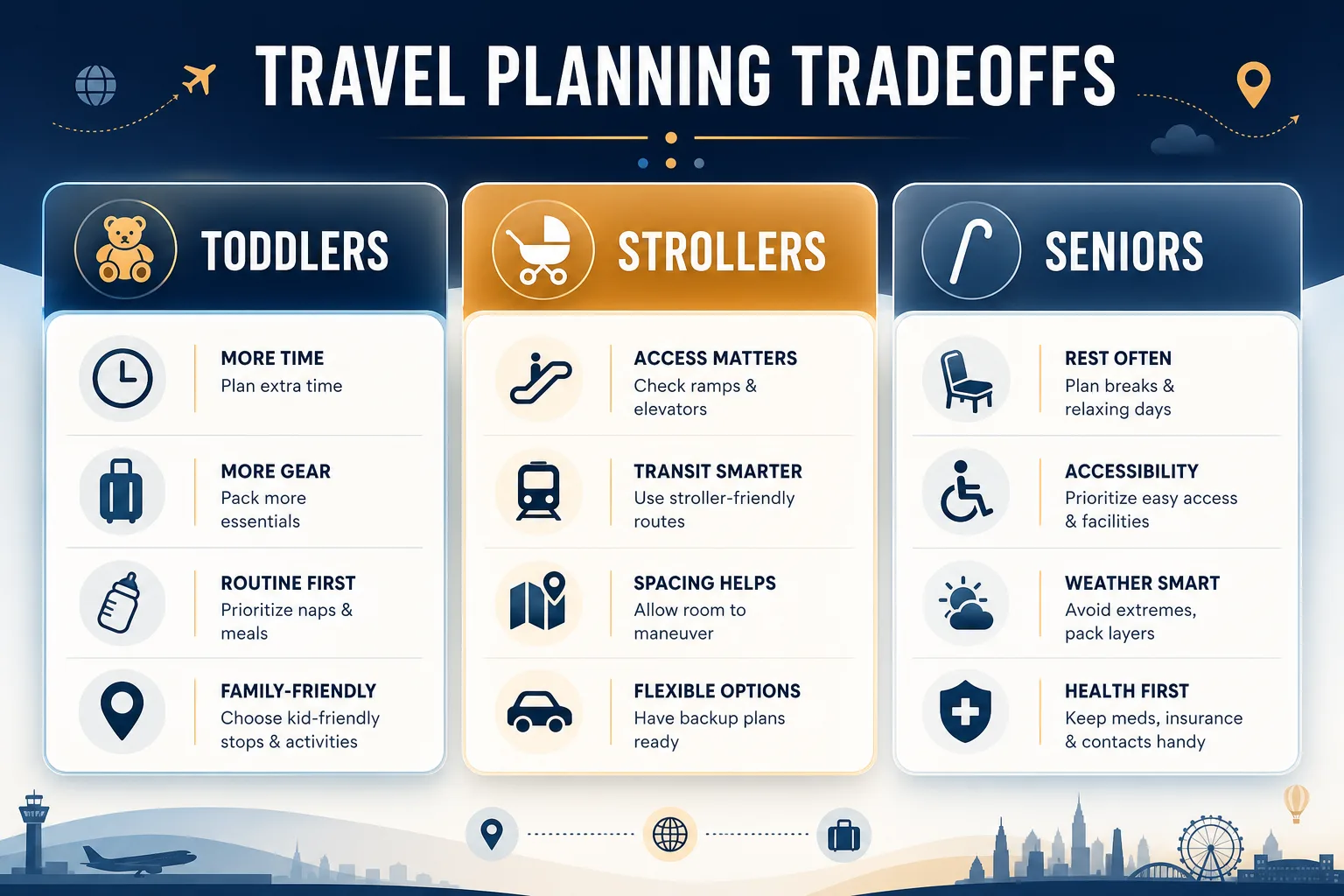 Editorial illustration: A simple decision table or comparison layout on a clean surface showing three labeled columns for toddlers.
Traveler Type Table
The friction in this trip does not come from Tokyo being "too big" in the abstract. It comes from three different traveler profiles inside one itinerary, each with a different failure point.
| Traveler group | Main constraint | What actually breaks the day | Workaround that helps |
|---|---|---|---|
| Toddlers / stroller users | Ticket gate width (55 to 59 cm) blocks full-sized strollers | Getting stuck folding a stroller at a gate while holding a toddler | Rent a gate-sized stroller (from around 250 yen for the first hour, capped near 1,500 yen per 12 hours) instead of bringing your own |
| Senior travelers | Limited continuous walking distance and stair tolerance | Long unplanned walks between exits and attractions, or hunting for the one elevator on the platform | Choose routes with known short walks, like the 5-minute flat walk from Ueno Station's Park Exit to Ueno Zoo |
| Multigenerational family as a whole | Rush-hour crowding, 7:30 to 9:30 AM and 5:00 to 7:00 PM | Trying to move the whole group through peak transit at the same time everyone else is commuting | Anchor outings to mid-morning to mid-afternoon, well outside both rush windows |
The pattern across all three rows is the same: Tokyo has real accommodations for each need, but they only help if you route around the known friction points in advance rather than discovering them mid-trip.
Best for First-Time Visitors
If this is your family's first trip to Tokyo, the multigenerational mix actually simplifies your decision more than it complicates it. You are not going to attempt a packed, landmark-a-day itinerary anyway, because you cannot move a stroller and a senior relative at that pace. That constraint pushes you naturally toward a first-timer-friendly approach: pick two or three anchor areas, stay near one of them, and accept that you will see less of Tokyo than a solo backpacker would.
Where this goes wrong for first-timers is underestimating station complexity. Shinjuku Station alone handles over 3 million passengers a day and has more than 200 exits. A first-time visitor managing a toddler and a senior relative at the same time should not be improvising a route through Shinjuku on the fly. Pick your base station in advance, know your exit, and treat station-heavy days as the ones that need the most buffer time, not the least.
Best for Couples
A childless or grandchild-free couple visiting Tokyo has enormous flexibility: last-minute route changes, late nights, spontaneous detours. None of that applies once toddlers and seniors are part of the group, and pretending otherwise is where multigenerational trips go sideways.
The honest way to think about this: your trip will run on the senior relative's stamina and the toddler's schedule, not on what a typical Tokyo itinerary for a couple would look like. That is not a downgrade, it is a different trip. Couples optimize for coverage; multigenerational families should optimize for a few outings done comfortably rather than many done in a rush. If part of your group is picturing a couple's-pace trip, align expectations before you land, not on day one.
Best for Slow Travelers
This is where Tokyo fits your group best. A slow-travel mindset, fewer stops per day, more downtime, no forced checklist, matches almost exactly what a toddler-and-senior mix requires anyway. You are not fighting the city's pace against your family's pace; for once, they line up.
Practically, this means treating a single neighborhood as a half-day destination rather than a quick stop. Walking from Shibuya's South Ticket Exit to Shibuya Scramble Square takes about 5 minutes, which sounds trivial, but build in real time on either side for a stroller maneuver, a rest break, or a bathroom stop. Slow travelers who already expect unhurried mornings and short outings will find Tokyo far less overwhelming than the city's reputation suggests.
Best for Low-Stress Travelers
Low-stress travelers who want a mostly-planned, businesslike trip with minimal surprises are well served by Tokyo, provided the plan accounts for the toddler-and-senior mix specifically, not just a generic Tokyo itinerary.
The lowest-stress version of this trip looks like: a home base within a short walk of a major station (around 9 minutes from Shinjuku's East Exit to a central hotel like Citadines Central Shinjuku, for comparison), one or two outings per day rather than three or four, and buses used deliberately when stroller access matters, since Tokyo city buses allow open strollers except when the bus is crowded, a wheelchair user is aboard, or two strollers are already secured. None of that requires improvisation. It requires deciding the plan before you land and sticking to it, which is exactly what low-stress travelers already prefer to do.
Common Mismatches
Certain family patterns run into real trouble in Tokyo, and it is worth naming them plainly rather than softening the warning.
- Families expecting to "figure it out day by day": Tokyo's station complexity and rush-hour windows punish improvisation. A senior relative stuck mid-transfer during evening rush is a genuinely bad experience, not just an inconvenience.
- Groups with a senior who cannot manage any stairs: station elevators exist at roughly 90% of stations, but often just one per platform, and it may not be near your entry point. If mobility is severely limited, this is a real risk factor, not a minor annoyance.
- Families who book the cheapest room available: a budget business hotel room at 7,000 to 12,000 yen a night is compact enough that an open stroller may not fit, which means folding and unfolding it constantly inside your own hotel room, every single day.
- Anyone expecting to see pandas at Ueno Zoo: as of January 2026 there are no giant pandas in Japan at all, following the pandas' return to China. If that was a planned centerpiece for the grandchildren, adjust expectations now, not at the gate.
- Groups that try to move everywhere as one unit: forcing a toddler's nap schedule and a senior's rest needs to align with everyone else's pace all day, every day, is the fastest way to make the whole group tired and irritable by the third day.
Final Match Recommendation
Choose Tokyo for this trip if your family can commit to planning routes in advance, accepts a slower daily pace than a typical Tokyo itinerary, and has the budget flexibility to book a larger room and a proper stroller rental instead of defaulting to the cheapest options. Under those conditions, Tokyo's infrastructure, step-free stations, stroller-friendly buses, rental services built for exactly this need, works in your favor rather than against you.
Do not choose Tokyo, or at least reconsider the itinerary heavily, if your senior relative has severe mobility limits that make elevator-hunting or long station walks genuinely risky, if your group wants a spontaneous rather than planned trip, or if your trip window is too short to build in the slow mornings and short outings this mix requires. In that case, a smaller, flatter city with simpler transit may serve your family better than Tokyo's scale.
The honest bottom line: Tokyo is not too overwhelming for multigenerational families in general. It can be too overwhelming for a specific family that plans it like a couple's trip and hopes toddlers and seniors will just keep up.
FAQ
Is Tokyo harder for toddlers or for seniors on a multigenerational trip? Usually the seniors, not the toddlers. Strollers have workarounds (rental services, buses, elevators), but a senior relative with limited stamina has no equivalent shortcut once the day's walking adds up. Toddlers nap and recover; tired seniors often do not bounce back the same day.
Can we bring our own stroller instead of renting one in Tokyo? You can, but standard train ticket gates are only 55 to 59 cm wide, which does not fit most full-sized strollers. You would need to fold it at every gate, which is slow and awkward with a senior relative also in tow. A rental umbrella-style stroller sized for gates is usually easier for multigenerational groups.
Do we need to avoid the subway entirely with strollers and seniors? No, but you should avoid it during weekday rush hours, 7:30 to 9:30 AM and 5:00 to 7:00 PM. Outside those windows, about 90% of stations have step-free access, though often just one elevator per platform, so build in extra time to find it rather than assuming it is near the stairs.
What is the single biggest planning mistake multigenerational families make in Tokyo? Booking a cheap, compact hotel room to save money. Budget business hotel rooms often lack floor space for an open stroller and put three generations in one cramped room. The bigger cost saver is actually a slightly larger aparthotel unit that keeps everyone from getting on each other's nerves by day three.
Should we split the group instead of doing everything together in Tokyo? For at least part of most days, yes. Pairing one adult with the stroller and toddler while another adult takes it slower with the senior relative, then meeting at a fixed low-stress point, reduces the number of times the whole group has to move at the pace of its slowest and fastest members simultaneously.