travel-decisions
Is Tokyo a Bad Choice for Solo Travelers Who Need Social Interaction?
A direct fit check for solo travelers who thrive on conversation and company: where Tokyo delivers social contact, where it isolates you, and how to tell which one you'll get.
Quick Verdict
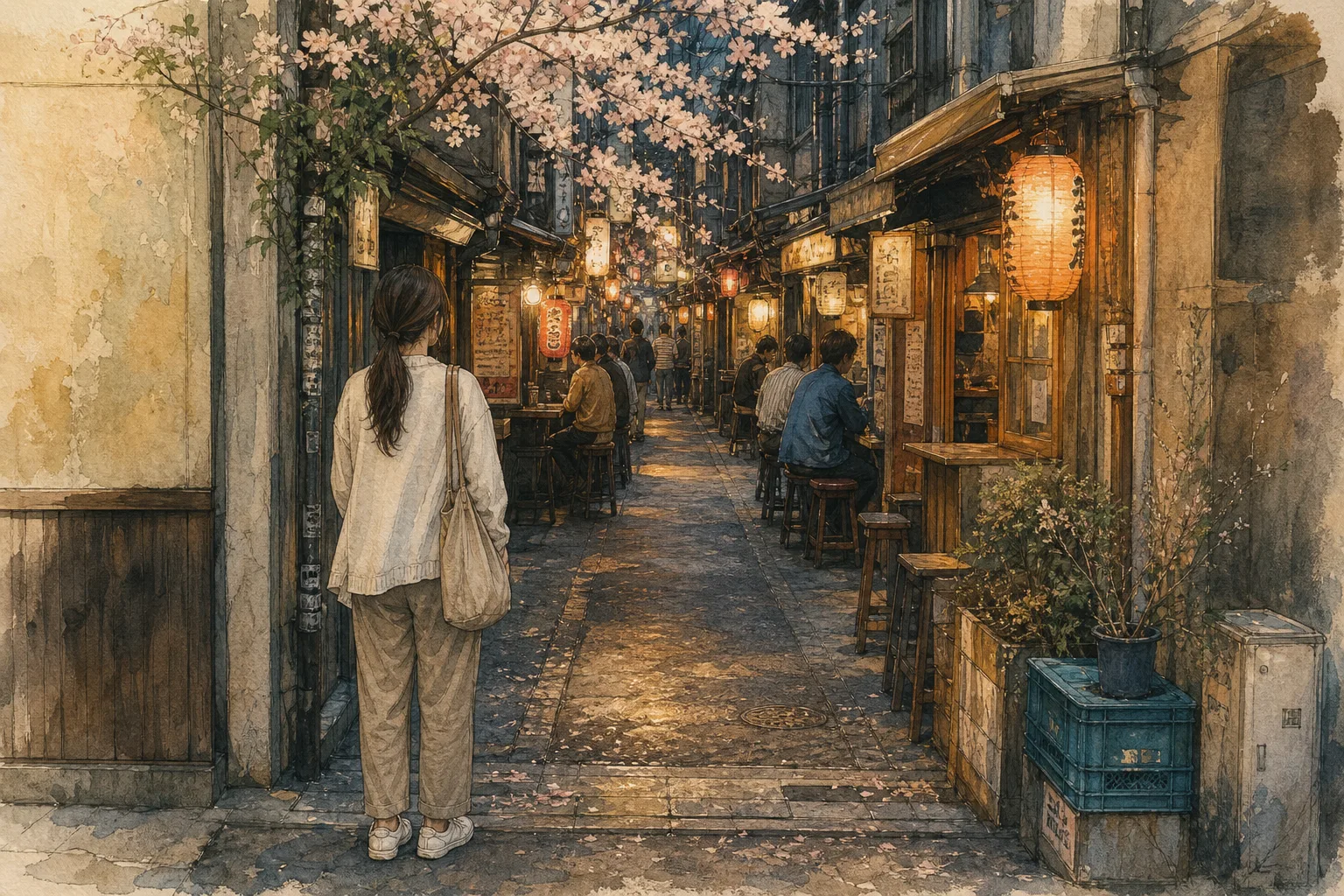
Tokyo is not a bad choice for social solo travelers, but it is a bad choice if you expect social contact to happen passively. The city's default mode is quiet: trains are silent, sidewalks don't invite small talk, and solo dining is built around counters facing a wall, not tables where a stranger might sit down and chat. If you need conversation to find you, Tokyo will feel like the loneliest city you've ever visited.
If you're willing to walk into a specific kind of small venue on purpose, Tokyo flips completely. Standing bars, six-seat counter restaurants, and social hostels are built for exactly the kind of short, easy conversation an extroverted solo traveler wants. The fit isn't about your personality type in the abstract. It's about whether you'll actually seek out those venues or wait for the city to come to you.
Choose Tokyo if: you're comfortable walking into a tiny bar alone, you don't mind that most contact starts at a counter rather than a table, and you're willing to research 2 to 3 specific social spots before you land.
Skip Tokyo, or budget-adjust your expectations, if: you want social contact to happen organically on the street, in cafes, or through casual chat with strangers in transit, because that layer of Tokyo life mostly doesn't exist for visitors.
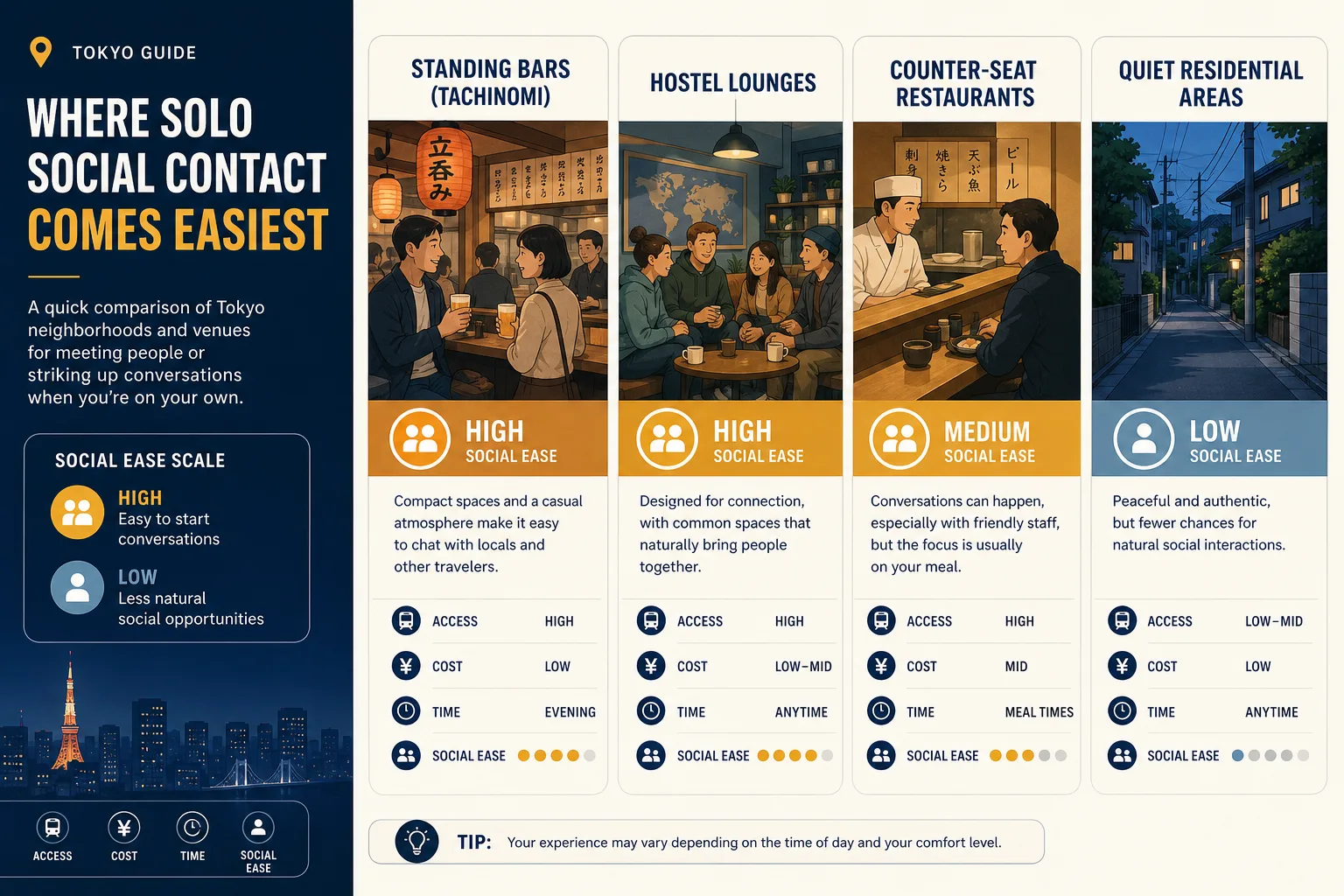 Editorial illustration: A simple data comparison layout with short labeled columns contrasting Tokyo neighborhoods and venues for solo social contact: standing bars.
Traveler Type Table
The real decision variable isn't "is Tokyo social," it's "does this specific traveler's habit match how Tokyo delivers social contact." Tokyo concentrates social interaction into a small number of formats rather than spreading it across daily life the way some backpacker-heavy destinations do.
| Traveler habit | How Tokyo handles it | Tradeoff |
|---|---|---|
| Wants to chat with strangers on the street or on trains | Doesn't happen; public reserve is the norm, not rudeness | Adjust expectations, don't take it personally |
| Wants social contact over dinner | Counter-seat restaurants and standing bars deliver this reliably | Requires seeking out the right venue type, not just any restaurant |
| Wants a built-in social base at the hotel | Social hostels with a bar/lounge work well; standard hotels do not | Room choice becomes a social-strategy decision, not just a budget one |
| Wants low-effort, ambient social atmosphere | Golden Gai and Nonbei Yokocho supply this in concentrated pockets | Only works within a few specific neighborhoods, not citywide |
| Wants daytime social contact while sightseeing | Weak; sightseeing in Tokyo is largely a solitary, crowd-adjacent activity | Save social energy for evenings, not daytime touring |
For solo_travelers, this table matters because Tokyo rewards a plan-ahead approach over a wander-and-see approach. For social_extroverts specifically, the risk isn't that Tokyo has no social outlets, it's assuming the outlets are everywhere when they're actually clustered in a handful of neighborhoods and venue types.
Best for First-Time Visitors
A first-time visitor who is also a social extrovert should treat their first two nights as a deliberate social test, not a wait-and-see experiment. Landing in Tokyo and hoping conversation happens naturally, the way it might in a European hostel town, sets up disappointment fast: the city's default texture is quiet, orderly, and self-contained.
The fix is specific and low-effort. Golden Gai, a cluster of tiny bars a 5-to-7-minute walk from JR Shinjuku Station's East Exit (or 3-to-5 minutes from Shinjuku-sanchome Subway Station), is built for exactly this. Most bars seat only 5 to 10 people and charge a 500 to 1,000 seating fee, which functions as a soft filter: everyone in the room chose to be there for the same reason, and the physical closeness makes conversation with strangers normal rather than awkward.
For solo_travelers on a first trip, this is the highest-value low-effort move in the city. For social_extroverts, it directly answers the fear driving the whole decision: proof, in the first 48 hours, that Tokyo has a social layer once you know where to look.
Best for Couples
Solo travelers sometimes worry that Tokyo's small-bar social scene is really a couples' or friend-group scene that excludes a person traveling alone. That worry is largely backwards. Venues like Golden Gai and Shibuya's Nonbei Yokocho, a 1-to-2-minute walk from Shibuya Station and about a minute from Shibuya Scramble Crossing, are physically built around 5-to-10-seat counters, which structurally favor solo patrons and small groups over parties of four or more who can't easily fit.
A couple visiting these same bars will often end up talking to a solo traveler simply because the seating forces proximity. For a solo social_extrovert, this means you're not competing with couples for social oxygen in these spaces, you're often the easiest person in the room to strike up a conversation with, precisely because you're alone and approachable.
The mismatch case is different: a couple hoping for a deeply social solo-style trip together will get a diluted version of this dynamic, since two people at a counter read as a closed unit to other patrons. That's a couples' fit issue, not a solo traveler one, but it's worth naming so solo readers don't assume the counter-bar strategy requires companionship to work.
Best for Slow Travelers
A slow traveler who also wants social contact should treat Shimokitazawa as their base-mood neighborhood rather than a day-trip curiosity. It's a 7-minute train ride from Shinjuku Station on the Odakyu Line, close enough to stay connected to the city's transit spine but far enough to have its own unhurried, cafe-and-live-music character.
This matters for social_extroverts specifically because slow travel and social travel can conflict: rushing between landmarks leaves no time to sit still long enough for conversation to develop. Shimokitazawa's bars and cafes reward lingering, which is exactly the pace a slow traveler already prefers. The same applies to Golden Gai after dark: it's not a checklist stop, it's a place to stay for two or three drinks and let conversation build over time.
Solo_travelers who try to fit these neighborhoods into a rushed itinerary usually get a shallower version of the social payoff. The venues work because you stay, not because you visit.
Best for Low-Stress Travelers
Low-stress travelers want predictability, and predictability is actually where Tokyo's social scene performs best for solo extroverts. Unlike destinations where meeting people depends on unpredictable hostel-lobby energy or a lucky tour-group seating chart, Tokyo's social venues are consistent and bookable in advance: you know roughly what a Golden Gai bar counter will feel like before you arrive, and social hostels with a lounge or bar, such as options in the Kuramae area (a 2-minute walk from Kuramae Subway Station), reliably deliver a similar structure night after night.
For a low-stress social_extrovert, this predictability is a genuine advantage over destinations where "the social scene" is really just luck. The stress point instead becomes budget planning: Kuramae-area lodging tends to run cheaper than Shinjuku or Shibuya, since Tokyo's east side (Ueno, Asakusa, Kuramae) is consistently priced lower than the western hubs, so a low-stress, cost-aware solo traveler can choose a social hostel base without paying a premium for it.
Where low-stress travelers can trip up: assuming any hostel will do. A dorm-only hostel with no common bar or lounge offers little more social structure than a hotel room, regardless of price.
Common Mismatches
The disappointment pattern is consistent enough to name directly. Solo social extroverts who regret choosing Tokyo almost always fall into one of these patterns:
- The wander-and-hope traveler: expects conversation to happen from casual proximity, the way it might on a hostel patio or a beach town main street. Tokyo's public spaces don't work that way, and this traveler ends up eating alone every night without realizing venue choice, not personality, was the problem.
- The daytime-only planner: schedules sightseeing all day and has no evening plan. Tokyo's crowds at major sights (Shibuya Crossing, Senso-ji, Shinjuku) are dense and transactional, not social, so a day built entirely around landmarks produces zero real conversation.
- The single-neighborhood assumption: visits one area, decides Tokyo "isn't social," and never tries Golden Gai, Nonbei Yokocho, or a social hostel elsewhere in the city. Since October 2024, Shibuya Ward has also banned public street drinking near the station from 6 p.m. to 5 a.m., which removed a casual outdoor social layer some travelers used to rely on around Shibuya specifically, making indoor small-bar venues even more central to the plan.
- The budget-hostel-without-research traveler: books the cheapest dorm bed available, which can be a good value at roughly 3,000 to 5,000 a night, without checking whether it has a common lounge or bar. Cheap and social are not the same filter.
Each of these is an expectation_mismatch problem, not a Tokyo problem: the city delivers real social contact, but only through specific formats that have to be chosen on purpose.
Final Match Recommendation
Tokyo is a strong fit for a solo, socially motivated traveler who is willing to treat social contact as something to plan for, the same way they'd plan a must-see museum visit. That means picking at least one small-bar neighborhood (Golden Gai, Nonbei Yokocho, or Shimokitazawa), choosing lodging with an actual social space if a hostel is in budget, and accepting that daytime hours will likely be quieter and more solitary than evenings.
Tokyo is a weak fit for a solo traveler who wants social energy to be ambient and low-effort, the kind that comes from sitting in a hostel courtyard or striking up chat on a walking street. That traveler will read Tokyo as cold and isolating, and the read isn't wrong given how they're using the city, it's just a mismatch between expectation and format.
Strong fit if: you'll actively seek out counter-seat bars, small-format restaurants, or a lounge-style hostel, and you're fine with contact starting through a shared physical setup rather than open-ended small talk.
Weak fit if: you need social contact to be effortless and constant throughout the day, in which case a destination with a stronger backpacker-circuit culture will serve that need more directly than Tokyo can.
Social Fit Checklist Before You Book
- I've picked at least one small-bar neighborhood (Golden Gai, Nonbei Yokocho, or Shimokitazawa) to visit on my first or second night
- My lodging has an actual shared social space, not just a bed, if I'm counting on it for contact
- I've budgeted 500 to 1,000 per bar for seating fees as a normal cost of the social-bar format, not a scam
- I've accepted that daytime sightseeing will likely be solitary, and planned my social energy for evenings
- I know my base neighborhood's distance from at least one social-bar area, so an evening out isn't a long transit slog
FAQ
Is Tokyo actually lonely for solo travelers? It can be, but not because the city lacks social spaces. It's lonely if you stick to sightseeing during the day and eat at your hotel or convenience store at night. It stops being lonely once you route yourself through standing bars, hostel common rooms, and counter-seat restaurants, where brief conversation is normal and expected.
Do Japanese people talk to strangers in Tokyo? Not usually on the street or on trains, and that reserve is often mistaken for coldness. In dedicated social venues, such as small standing bars or Golden Gai-style counters, conversation with strangers, including staff and other patrons, is a normal part of the format.
Are hostels a reliable way to meet people in Tokyo? Social-format hostels with a bar or lounge, particularly in areas like Kuramae, are the most reliable structured option. A hostel with only a dorm room and no common space will not deliver much social contact on its own.
Which Tokyo neighborhoods are best for solo social travelers? Shinjuku's Golden Gai area and Shibuya's Nonbei Yokocho are built around small shared-counter bars where solo conversation is the norm. Shimokitazawa, a short train ride from Shinjuku, adds a slower, more casual social scene through its cafes and live-music bars.
Will a solo extrovert regret choosing Tokyo over a more overtly social destination? Only if they expect ambient, unplanned social contact the way they might get it in a hostel-town backpacker circuit. Tokyo delivers social contact through specific, bookable, plannable venues rather than atmosphere alone, so the regret risk comes from not planning those stops in advance, not from the city itself.