travel-decisions
Is Spring or Fall Better for Rome If You Want Fewer Crowds and Less Walking Stress?
A careful, friction-first comparison of spring and fall in Rome for travelers who want fewer crowds, less queue fatigue, and a kinder walking load.
Rome in spring and Rome in fall are not the same trip. They share mild weather on paper, but the day-to-day friction, especially crowd density, queue rules, and how much your legs hurt by 4 p.m., is meaningfully different. This guide compares them through that lens.
Quick Verdict
If your top priority is fewer crowds and less walking stress, early-to-mid October is the stronger pick for most travelers. It tends to be drier than November, cooler than late spring, and slightly calmer than April or May once school holidays and Easter travel taper off.
Choose spring (late March to early April, or the first half of May) if you want longer daylight, blooming gardens, and you are willing to trade extra crowd density for that atmosphere.
Avoid both seasons if you need genuinely empty sights. Rome's official high-season windows are April to June and September to October, so neither shoulder is quiet. Truly low-crowd Rome is January, February, and early March, with weather tradeoffs.
Who should choose fall: crowd-sensitive travelers, anyone with limited walking stamina, first-timers who plan to walk between major sites. Who should choose spring: travelers who want gardens, golden-hour photos, and longer evenings, and who can tolerate denser queues at the Vatican and Colosseum.
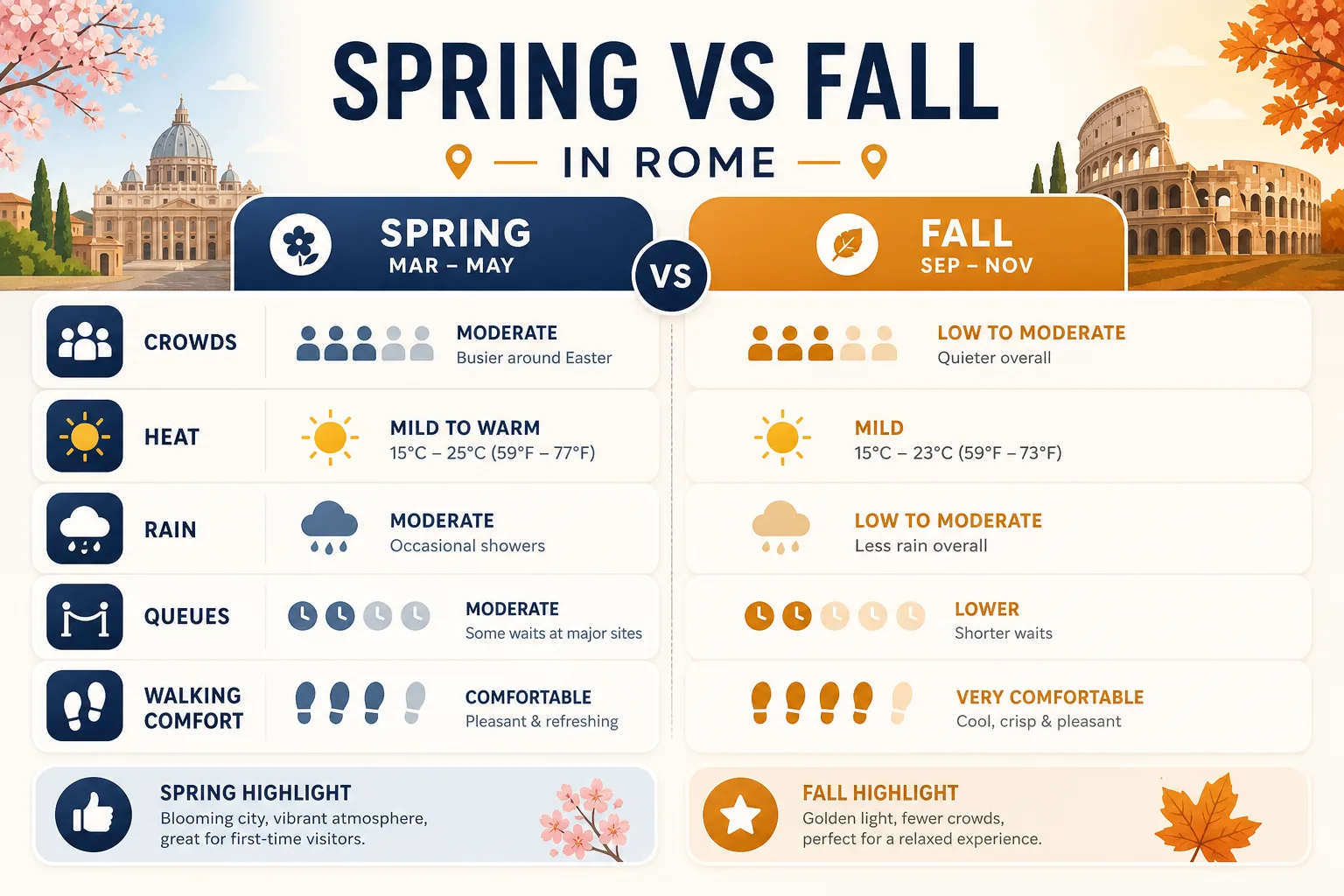 A comparison infographic of Spring versus Fall in Rome, evaluating crowds, weather, queues, and walking comfort.
The Real Friction You Are Actually Solving
The honest problem is not "what is the weather like." It is the stack of small frictions that compound across a 4 to 6 day trip:
- Crowd pressure. Both shoulder seasons are inside Rome's two peak windows. Lines at the Vatican Museums, Colosseum, and St. Peter's regularly run long even on weekdays.
- Queue fatigue. New 2026 rules add friction even for pre-booked travelers. Colosseum tickets must match your passport from May 4, 2026, and the Pantheon's name-change window is locked at 72 hours before entry. Mistakes cost time you cannot get back.
- Heat vs rain tradeoff. May averages highs of 23 to 24 C with 6 to 10 rainy days. November is the wettest month, with about 110 mm of rain across 9 to 15 rainy days. April sits in between at 19 to 20 C with 8 to 13 rainy days. October usually lands in a sweet spot.
- Walking stamina. Rome rewards walking, but punishes it too. Colosseum to Vatican Museums is about 4 km and 50 to 60 minutes on foot. Add cobblestones, sun, and queue standing, and a "short" sightseeing day easily becomes 15,000 steps.
- Hotel price spikes. Both windows are peak pricing. Mid-range hotels run 150 to 220 euros per night and boutique or luxury stays 300 to 500+ euros. Spring tends to spike harder around Easter and early May.
One useful 2026 detail: the Catholic Holy Year (Jubilee of Hope) ended on January 6, 2026. That removed roughly 30 million extra pilgrims compared with 2025, which slightly eases pressure at the Vatican and central basilicas, though it does not turn Rome into a quiet city.
Friction Table: Spring vs Fall in Rome
| Friction factor | Spring (April to mid-May) | Fall (mid-Sept to late Oct) |
|---|---|---|
| Crowd density at top sights | High, peaks around Easter and early May | High, but eases through late October |
| Queue length at Vatican / Colosseum | Long, especially mornings | Long but slightly shorter on weekdays after mid-October |
| Daytime temperature | 19 to 24 C, warming fast | 18 to 24 C, cooling gradually |
| Rain risk | 8 to 13 rainy days in April, 6 to 10 in May | Lower in early Oct, rising sharply by November (about 110 mm) |
| Heat stress while walking | Noticeable by mid-May afternoons | Mild, manageable for most travelers |
| Daylight for late walks | Longer, sunset past 8 p.m. by May | Shorter, sunset around 6 to 6:30 p.m. in late October |
| Hotel price pressure | Highest around Easter and May 1 | High but steadier, often softer in late October |
| Cobblestone risk after rain | Moderate | Moderate in October, higher in November |
| Best for low-stamina travelers | Average | Better |
Who Will Feel the Difference Most
Crowd-sensitive travelers. Late October usually feels less compressed than April or early May. Vatican and Colosseum mornings remain dense, but Trastevere, the Forum, and the Pantheon area breathe more in fall evenings.
Low-walking or low-stamina travelers. Fall wins clearly. Cooler air means you can walk shorter segments more often without the dehydration tax. Spring is workable, but May afternoons start to push heat strain, especially on open sites like the Forum and Palatine with little shade.
First-time visitors covering the classic loop. Both seasons work. Fall gives you a kinder physical pace, spring gives you longer evenings to extend a day if you have energy.
Photographers and garden lovers. Spring is genuinely better. Villa Borghese, the Orange Garden, and the Spanish Steps look their best in April and early May.
Budget-sensitive travelers. Late October typically prices a touch lower than late April or early May, especially mid-week. Avoid Easter week in spring and any long weekend in either season.
How to Reduce the Friction (Either Season)
These steps matter more than picking the perfect week.
- Pre-book every major site with timed entry. Vatican Museums, Colosseum, Borghese Gallery. Check name and passport details before paying, since the Colosseum requires ID match from May 4, 2026.
- Front-load mornings. Start at 8 to 8:30 a.m. at one major site, then switch to neighborhoods by midday when queues and heat both spike.
- Plan one indoor anchor per day. Useful in spring rain and fall rain alike. Examples: Capitoline Museums, Palazzo Doria Pamphilj, Ara Pacis.
- Use transit instead of pride-walking. A single integrated BIT ticket is 1.50 euros and lasts 100 minutes across bus, metro, and tram. Two or three rides a day prevent the 15,000-step collapse.
- Check metro hours. In 2026, Metro Lines A and B have intermittent early closures at 21:00 on select weeknights and full weekend suspensions with MA1 or MA2 bus replacements. Confirm before planning a late dinner across town.
- Use Metro C if helpful. The newly opened Colosseo-Fori Imperiali and Porta Metronia stations include underground archaeological displays and add a useful east-side connection.
- Budget for new fees. From February 2, 2026, non-residents pay 2 euros to access the lower steps of the Trevi Fountain, capped at 400 people at a time. From July 1, 2026, Pantheon entry rises to 7 euros.
- Stay central. A walkable base near Monti, Pigna, or Campo de Fiori cuts daily walking distance more than any seasonal advantage.
Better Alternatives If Neither Shoulder Fits
If your real priority is "as few crowds as possible," shoulder season is not your answer. Consider:
- Late January to early March. Lowest crowds of the year. Cooler temperatures and shorter days, but most major sites are uncrowded and hotel prices drop noticeably.
- Mid-November (excluding holiday weekends). Rainy, but you trade weather for genuinely thinner queues. Pair with heavy indoor itineraries.
- Late August into the first week of September. A specific window where many locals are still away and incoming tourism has not fully ramped, but heat is the tradeoff.
If your real priority is "least walking stress," consider basing somewhere with strong transit access and shortening the trip to 3 to 4 focused days instead of 6 sprawling ones.
Pre-Booking Decision Checklist
Use this before you lock dates and hotels.
- I have checked whether my travel week overlaps Easter, May 1, or an Italian long weekend.
- I have decided which season's tradeoff I prefer: longer daylight (spring) or cooler walking (fall).
- I have a hotel within 20 minutes walking of at least two major sights.
- I have pre-booked Vatican Museums and Colosseum with names matching ID exactly.
- I have noted the 72-hour name-change limit on Pantheon tickets after July 1, 2026.
- I have budgeted the 2 euro Trevi lower-steps fee if I want that view.
- I have at least one indoor backup per day in case of rain.
- I have checked 2026 metro evening and weekend closures for my travel dates.
- I have planned no more than one cross-city walking transfer per day.
- I have a transit plan using 1.50 euro BIT tickets, not all walking.
FAQ
Is spring or fall less crowded in Rome? Neither is quiet. Both April to June and September to October are official high-season windows. Late September and the second half of October tend to feel slightly calmer than April and May, especially around the Vatican, because school and Easter travel taper off.
Which shoulder season is easier on walking stamina? Early-to-mid October is usually the most forgiving. Daytime temperatures are mild and evenings are still walkable, so a 4 km route like the Colosseum to the Vatican Museums (50 to 60 minutes on foot) is achievable without midday heat exhaustion.
How bad is rain in Rome during fall? October is manageable. November is Rome's wettest month, averaging about 110 mm of rain across 9 to 15 rainy days. If you travel late fall, plan indoor anchors and waterproof shoes, because wet cobblestones add real walking stress.
Are there new rules in 2026 that affect shoulder-season visits? Yes. From February 2, 2026, non-residents pay a 2 euro fee to access the lower steps of the Trevi Fountain, capped at 400 people at a time. From July 1, 2026, Pantheon entry rises to 7 euros with a strict 72-hour name-change window. From May 4, 2026, Colosseum tickets must match your passport or ID, and physical tickets are sold only at the main Colosseum Square office.
Is it worth choosing spring just for the gardens and longer evenings? For some travelers, yes. If photography, Villa Borghese in bloom, or long post-dinner walks are central to your trip, spring delivers something fall cannot. Just accept that you will trade some queue and heat comfort for it.
Can I avoid both peak shoulders and still get decent weather? Partially. Late March and the first week of November sit just outside the heaviest crowds, with cooler or wetter weather as the price. They work if you are flexible and indoor-friendly.