travel-decisions
Is Rome in March Worth It If You Want Milder Weather and Fewer Peak-Season Crowds?
A careful look at whether Rome in March delivers the milder weather and lighter crowds you want, including the 2025 Jubilee effect, Easter risk, and booking timing.

Quick Verdict
Rome in March is worth it if your top priorities are milder weather than winter, noticeably lighter crowds than late spring or summer, and a slower pace at major sights. It is a weaker choice if you need reliable sunshine, want every fountain and monument in pristine condition, or are traveling during a Jubilee year or an Easter that lands in March.
Choose March if you are a first-time visitor who wants the major sights without summer-level queues, a low-stress planner who wants room to breathe in piazzas, or an atmosphere-first traveler who likes soft light and quieter mornings.
Skip March if you are set on warm-weather cafe culture, if your only available dates cluster around Easter, or if you have low tolerance for rainy days mid-trip.
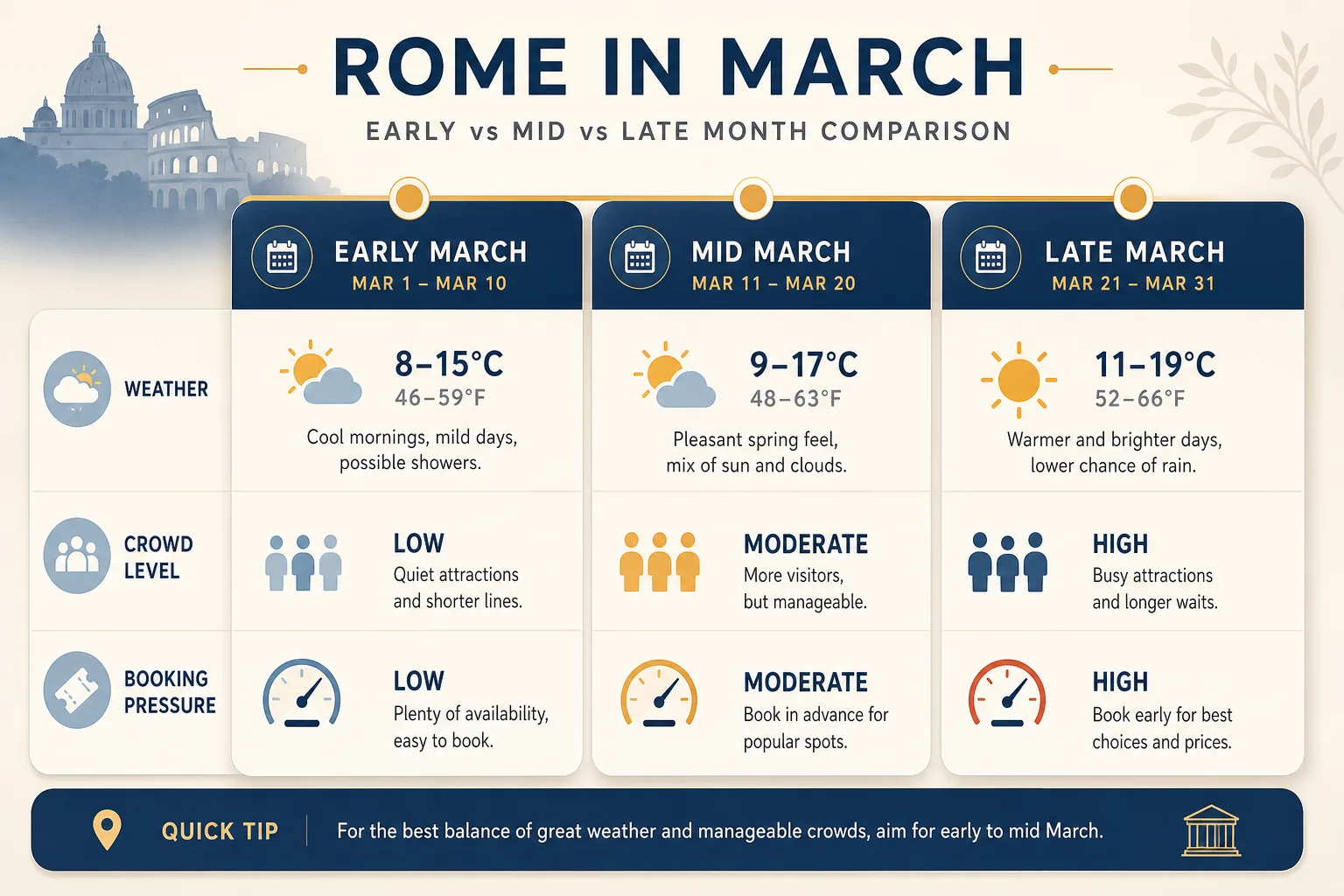 An infographic comparing weather, crowd levels, and booking pressure across early, mid, and late March in Rome.
The Real Friction With March in Rome
The honest tension in March is not weather versus crowds in isolation. It is three overlapping uncertainties that interact.
Weather uncertainty is the first. March averages around 12 C (53 F), with highs climbing from roughly 14 C early in the month to about 17 C by the end. That is genuinely mild for sightseeing, but it is also a transitional month: a sunny 18 C afternoon and a cold, wet 9 C morning can sit inside the same week. You cannot pack for one Rome in March; you have to pack for two.
Crowd pressure is the second, and it is less linear than guides suggest. March is a shoulder or low season in most years, but two factors override that. Easter, when it falls in March, brings heavy crowds for about two weeks around the holiday, concentrated at Vatican City and central basilicas. And the 2025 Jubilee Year, which runs from December 24, 2024 through January 6, 2026, is projected to draw an additional 32 million pilgrims and could roughly double normal visitor numbers in Rome. A "quiet" March can become a busy one fast.
Booking timing is the third. Because demand swings sharply around Easter and Jubilee events, the difference between booking eight weeks out and two weeks out is not just price. It is whether you get a hotel inside the historic center at all, and whether you get reasonable Vatican and Colosseum time slots. Treat March as shoulder season for pricing logic, not for booking laziness.
Friction Table: How March Tradeoffs Shift Week by Week
The right way to read March is in three windows, not as a single block. The table below focuses on the decision variables that actually change your trip.
| Window | Typical weather | Crowd pressure | Booking pressure | Best for |
|---|---|---|---|---|
| Early March (1-10) | Coolest, daily highs around 14 C, higher rain risk | Lowest of the month outside Jubilee years | Moderate, more hotel choice | Crowd-sensitive travelers, slow mornings, museum days |
| Mid March (11-20) | Mild, highs around 15-16 C, mixed sun and showers | Low to moderate, rising if Easter is near | Rises sharply if Easter falls in late March | Balanced sightseeing, first-timers wanting a calmer pace |
| Late March (21-31) | Mildest, highs around 17 C, longer daylight | Moderate to high if Easter falls in this window | High around Easter, otherwise moderate | Travelers who want warmer weather and accept some crowds |
Two overlays matter on top of this table. If you are traveling during a Jubilee period, shift every "crowd pressure" cell up one level. If Easter falls in March on your dates, the late-March window stops behaving like shoulder season at all.
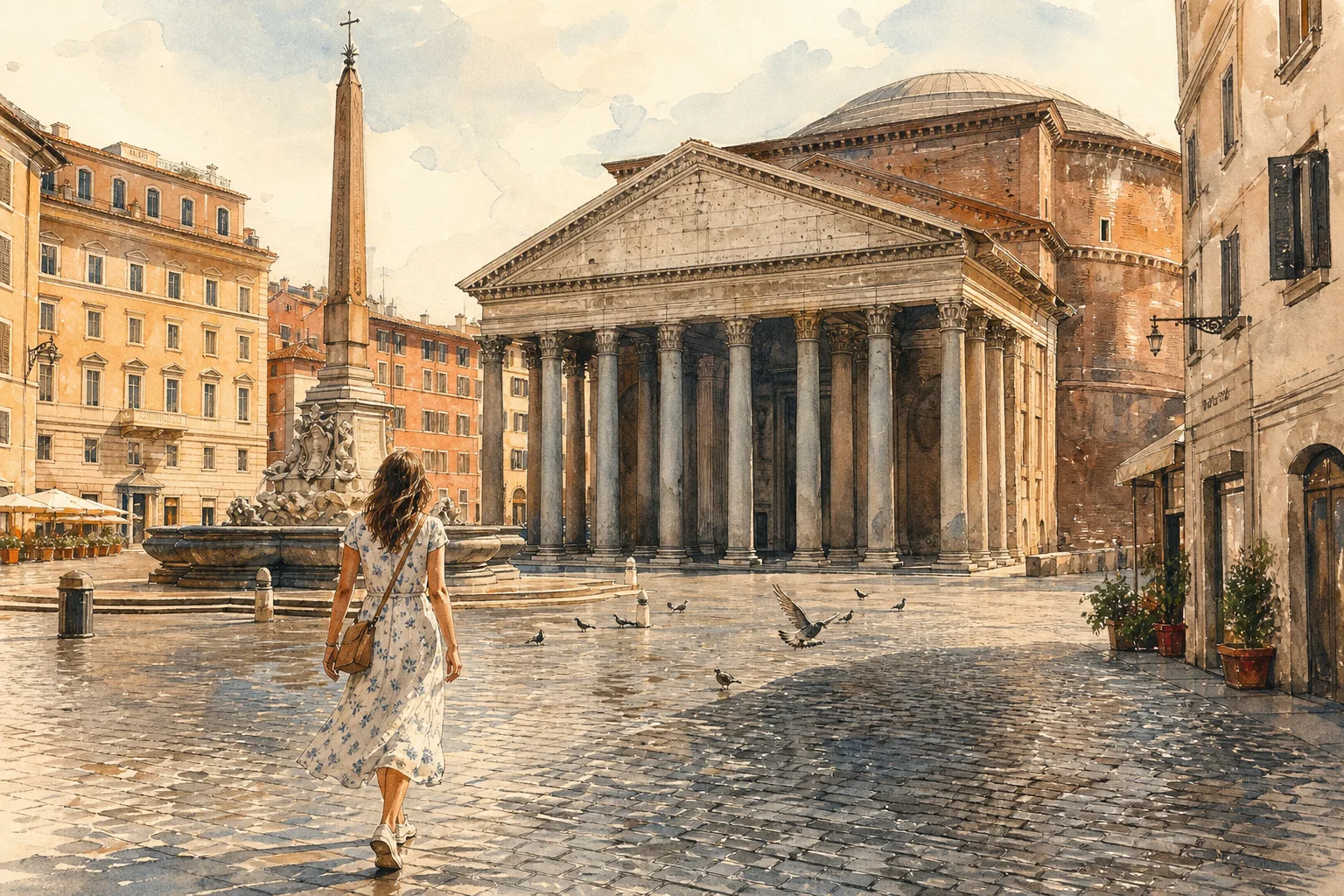
Specific sight conditions also belong in the tradeoff. As of late 2024, the fountains at Piazza Navona and at Piazza della Rotonda in front of the Pantheon were boarded up and dry for repairs, and the main altar inside St. Peter's Basilica is under renovation while the basilica stays open. Broader construction and public works continued across Rome through 2024 into 2025. None of this is a dealbreaker, but it changes what "seeing Rome" looks like in photos.
Who Will Feel the March Tradeoffs Most
Not every traveler is affected equally by the same March in Rome.
First-time visitors feel it twice. They benefit most from lighter crowds at the Colosseum, Vatican Museums, and Trevi Fountain, but they are also the most sensitive to construction-covered landmarks because they came for the canonical view. If your mental image of Rome is built from summer photos, March will look and feel different.
Crowd-sensitive travelers are the clearest winners in a non-Jubilee, non-Easter March. Piazzas breathe. Restaurant reservations are easier. The Trevi Fountain, even under the new visitor management system that caps access at around 400 people at a time and applies a symbolic 2 euro fee for non-residents, is more workable than in summer.
Low-stress planners benefit from the calmer pace but should be cautious about weather-driven schedule changes. A rainy day can compress your itinerary, especially if you bought timed Vatican tickets that you cannot easily move.
Style and atmosphere-first travelers get the best light of any month outside autumn, but should accept that outdoor cafe culture is not in full swing. Evenings are cool.
Travelers with low stamina or mobility concerns should weigh that a typical active sightseeing day in Rome involves 10 to 18 km of walking, or 15,000 to 25,000 steps, and even the route from the Colosseum to the Vatican Museums is almost 4 km and nearly an hour on foot. March's cooler weather actually helps here, but cobblestones and rain do not.
How to Reduce the Friction
You cannot remove March's uncertainty, but you can shrink it.
For weather uncertainty, plan your itinerary in two layers. Keep outdoor-heavy days (Forum, Palatine, Appian Way, Trastevere wandering) flexible, and slot indoor anchors (Vatican Museums, Borghese Gallery, Capitoline Museums) on days you can move. Pack a waterproof shell, layers you can peel, and shoes that handle wet cobblestones.
For crowd pressure, time-shift rather than skip. Major sights are quietest at opening and in the last 90 minutes before closing. Book timed entries for the Colosseum and Vatican Museums in advance, and treat the Trevi Fountain as a short visit at off-peak hours given the new access cap.
For booking timing, check whether Easter falls in March on your year before you commit. If it does, either book lodging eight to twelve weeks ahead or pivot to early March. For Jubilee-era trips, treat hotel availability as the binding constraint, not price.
For transit friction, use Rome's public transport intentionally. Single fare tickets are valid for 100 minutes across all public transport at 1.50 euro, with a noted possible increase to 2.00 euro from July 1, 2024. Validate every ticket on boarding; the fine for an unvalidated ticket is 54.90 euro if paid within five days. A cheap ticket becomes expensive fast if you forget this.
Better Alternatives If March Does Not Fit You
If the March profile does not match your priorities, the alternatives are clearer than people assume.
Choose late October or early November instead if you want shoulder-season crowds with more stable warmth and fewer rainy days. The light is also excellent.
Choose January or early February if your top priority is the absolute lowest crowds and you are willing to accept colder, wetter weather and shorter days. Outside a Jubilee, this is the quietest Rome gets.
Choose mid May or September if your priority is reliable warm weather and you can tolerate moderate crowds. These months sit between March's unpredictability and the summer crush.
Avoid late March specifically when Easter falls there, unless you actively want to be in Rome for Holy Week. In that case, you are choosing a religious-tourism trip, not a quiet-shoulder trip, and you should plan accordingly.
Decision Checklist Before You Book March
Run through these checks before locking in dates.
- Confirm whether Easter falls in March on your travel year, and how close your dates are to it.
- Check whether your dates fall inside a Jubilee or similar large religious event window.
- Decide which is more important to you: milder weather or lighter crowds. March favors crowds over weather certainty.
- Book Colosseum and Vatican Museums timed entries before booking flights if your window is tight.
- Plan two indoor backup anchors per outdoor sightseeing day.
- Confirm hotel location supports walking-heavy days, since you may cover 10 to 18 km a day on foot.
- Accept that some fountains and interiors may be under repair, and adjust your shot list mentally.
- Pack for a 9 C rainy morning and an 18 C sunny afternoon in the same trip.
- Build in one fully unscheduled half-day to absorb weather surprises.
- Re-check transit fare and validation rules close to your trip, since single-ticket pricing has shifted recently.
If most of these check out cleanly, March in Rome is likely a good fit. If three or more raise real concern, an alternative month will probably serve you better.
FAQ
The frontmatter FAQs above cover the most common remaining questions about crowds, weather, Jubilee impact, advance booking, and first-time fit. Use them as the final gut-check before committing to March dates.