travel-decisions
Is Seville a Good First Trip for Travelers Who Want Easy Logistics?
A decision-led look at whether Seville fits first-time visitors who want short transfers, walkable days, and low planning stress.

Quick Verdict
Seville is a strong first trip if your main priority is easy logistics. The arrival from the airport is short and predictable, the historic center is genuinely walkable, and the daily navigation load is lower than in Madrid, Barcelona, or most large European capitals.
It is a weak fit if you want a major-capital checklist of world-famous museums, a beach-adjacent base, or peak-summer comfort. Seville rewards travelers who want a compact city and short days, not those who want maximum landmark density or cool weather.
Choose Seville if you are a first-time visitor, a low-stress planner, or a couple who wants to walk to dinner instead of plan a transit route. Skip it if you measure trip success by capital-city scale or by checking off a long must-see list.
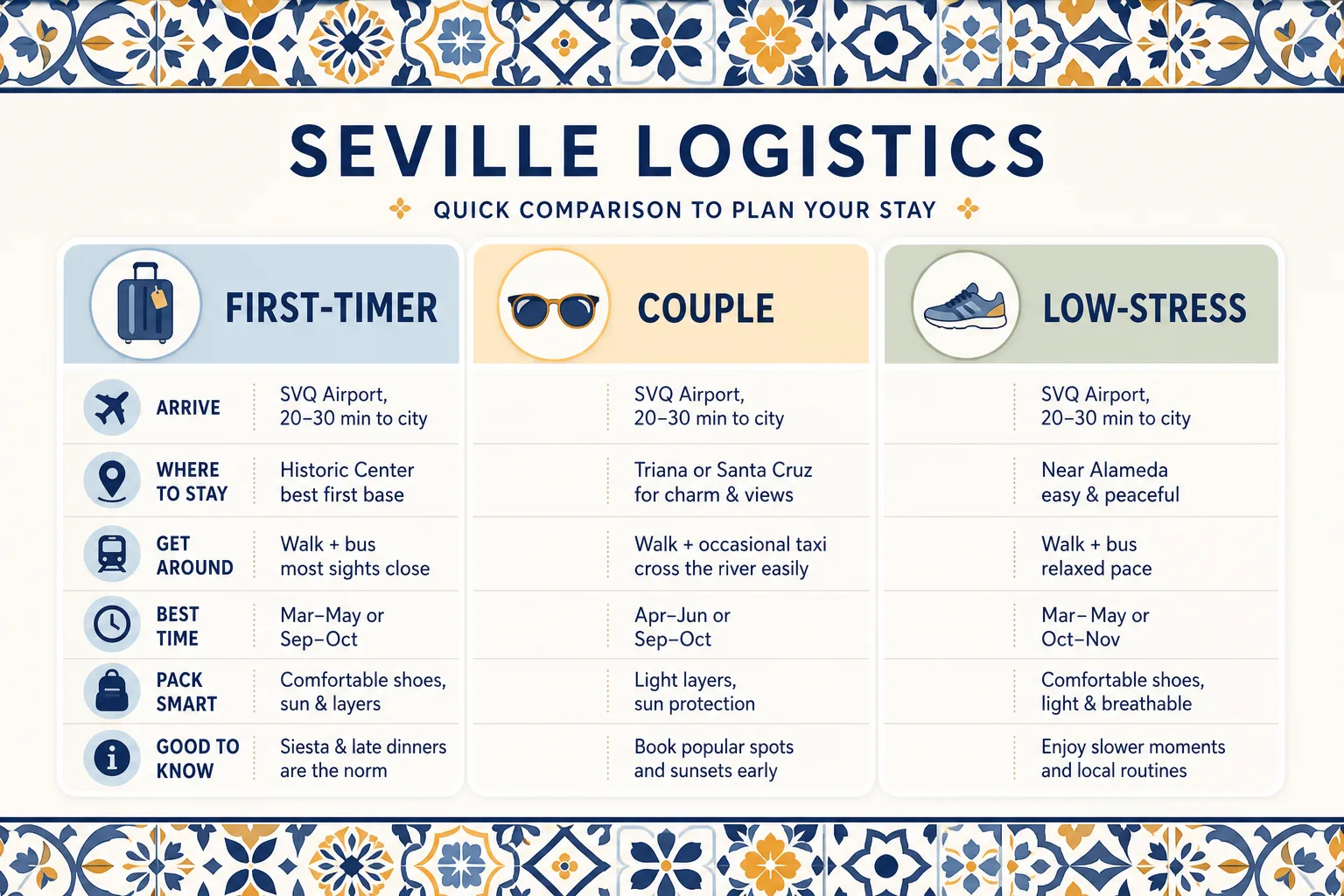 An infographic titled 'Seville Logistics' comparing travel tips for first-timers, couples, and low-stress travelers.
Traveler Type Table
The decision is less about whether Seville is "good" and more about which friction points it removes for you. The table below maps Seville's actual logistics against the traveler types most affected by them.
| Traveler type | What Seville removes | What Seville does not remove | Fit |
|---|---|---|---|
| First-time visitor | Airport transfer guesswork (fixed 23 to 25 euro taxi or 4 euro EA bus); short walking distances between top sights | Language friction outside tourist zones; choosing a season that suits you | Strong |
| Low-stress planner | Need to learn a metro map; long transit days; complex hotel-to-sight routing | Heat-driven fatigue in July and August | Strong |
| Couple | Need to taxi to dinner; choosing between "near the sights" and "near a station" | Quiet, off-the-grid mood in peak season | Strong |
| Slow traveler | Pressure to cover ground; reliance on transit | A wide range of day-trip variety inside the city itself | Moderate |
| Big-city checklist traveler | n/a | Major-capital landmark density | Weak |
| Beach-and-city combo | n/a | Coastal access without a separate trip leg | Weak |
The friction Seville removes is concrete: a 25 to 30 minute walk from Santa Justa train station to the historic center, a 10 to 15 minute walk between the Cathedral and Metropol Parasol, and a single airport bus that runs every 15 to 30 minutes. If those are the parts of a trip that usually drain you, Seville is doing real work for you.
Best for First-Time Visitors
First-time visitors to Europe usually underestimate two things: how much energy daily navigation eats, and how often a poorly placed hotel turns into a 30-minute schlep each direction. Seville quietly defuses both.
The airport is close enough that you do not need a train transfer at all. The EA bus drops you near the center for 4 euros, and a taxi is a flat 23 euros on weekday daytimes or 25 euros at night and weekends, so there is no meter anxiety. From Santa Justa train station, you can walk to the historic center in 25 to 30 minutes or take an 8 to 10 euro taxi.
Once you are in, the city is compact in a way that is unusual for Europe. Hoppa's 2025 research named Seville the most walkable city in Europe, with major landmarks reachable along a roughly 2 km route. For a first-time traveler, that means fewer decisions per day, which is the real currency of low-stress travel.
The catch: first-time visitors who expect a Paris- or Rome-scale museum lineup will feel the city is "small." That is the correct read. Seville is dense in atmosphere, not in monuments. Choose it because you want a manageable first trip, not because you want a capital.
Best for Couples
Couples often want two things that fight each other: a hotel near the sights, and somewhere they can walk to dinner without planning. Seville is one of the few European cities where both are the same answer.
Stay anywhere between the Cathedral and Metropol Parasol (about 800 meters apart, 10 to 15 minutes on foot) and you can walk to almost every dinner, viewpoint, and evening stroll without checking a transit app. The 1.5 km walk to the Triana Bridge, about 15 to 20 minutes, makes a natural evening route.
Couples also benefit from the fixed taxi fares on arrival. There is no "which of us figures out the train" tension at the airport, which is a surprisingly common first-trip flashpoint.
Where it gets weaker: couples who want a varied multi-city trip should not over-weight Seville. It is a great anchor for three to four nights, not a base for a two-week itinerary.
Best for Slow Travelers
Slow travelers, the kind who collect mood over a checklist, get a moderate fit here. The walkability is real, and the lack of transit pressure helps. You can spend a morning walking 1.5 km along the river to Triana and feel like you used the day well.
The honest tradeoff: Seville is not a city with endless distinct neighborhoods to slowly rotate through. After four or five days, slow travelers often want a change of scene. If your slow-travel style is "settle in for two weeks," Seville works better as a base for day trips than as a standalone stay.
For slow travelers who prefer one or two activities per day and long meals between, the city's compactness is a gift, not a limitation.
Best for Low-Stress Travelers
Low-stress travelers, by which we mean people who want a businesslike, predictable trip without constant micro-decisions, are the clearest fit for Seville.
A short low-stress checklist this city actually delivers on:
- Fixed, predictable airport transfer (4 euro bus or 23 to 25 euro taxi)
- Walkable center; no need to learn a metro
- Short distances between major sights (Cathedral to Metropol Parasol about 800 m)
- Optional cheap transit if needed (single bus or tram ride 1.40 euros, one-day pass 5 euros)
- Free first 30 minutes on the SEVici bike-share if you want a low-effort alternative to walking
- One main train station (Santa Justa) with a 25 to 30 minute walk or 8 to 10 euro taxi to the center
What it does not solve: the heat. Low-stress travel collapses fast in 40 degree afternoons. If you are heat-sensitive, the easy-logistics advantage is undone by July and August. Aim for March to early June, or October.
Common Mismatches
Three patterns reliably lead to disappointment in Seville, even though the logistics are good.
The capital-scale checklist traveler. If your idea of a successful first European trip is the Louvre, the Vatican, and a long list of marquee museums, Seville will feel thin. The city is dense in atmosphere but light in blockbuster institutions.
The peak-comfort summer traveler. July hotel rates are among the lowest of the year (averaging 100 to 145 USD per night), but the heat regularly makes midday walking unpleasant. Travelers who booked for the price often discover the walkability advantage disappears between 1 PM and 7 PM.
The "cheap is the goal" planner who books in the wrong month. February and April hotel rates can swing dramatically, with April peaks up to 426 USD per night around major events. A traveler who picks dates by airfare alone, without checking event calendars, can end up paying capital-city prices for a small-city trip.
If you recognize yourself in one of these, the issue is not Seville. It is that you were optimizing for a different decision than easy logistics.
Final Match Recommendation
Choose Seville as your first trip if all three of these are true:
- You value short transfers and walkable days more than landmark density.
- You can travel in March to early June or October, not midsummer.
- You are willing to anchor in one compact city for three to five nights rather than chase a multi-city sprint.
Skip Seville, or push it to a later trip, if you want a capital-scale itinerary, a beach-and-city combo, or you can only travel in peak summer and you are heat-sensitive.
For first-time visitors, low-stress planners, and couples who fit the above, Seville is one of the cleanest "easy logistics" picks in Europe. The numbers (4 euro airport bus, 23 to 25 euro fixed taxi, 800 m between top sights, 25 to 30 minute station walk) are not just trivia; they are the friction points that usually decide whether a first trip feels manageable or exhausting.
FAQ
Is Seville easy to reach from the airport without a rental car? Yes. The EA airport bus runs every 15 to 30 minutes from 5:20 AM to 1:00 AM for 4 euros one-way, and a fixed-fare taxi is 23 euros on weekday daytimes or 25 euros at night and weekends. Neither option requires transfers.
Can I see most of central Seville on foot? For most first-time itineraries, yes. Hoppa's 2025 research named Seville the most walkable city in Europe, with major landmarks reachable along a roughly 2 km route. The Cathedral to Metropol Parasol is about 800 meters, and the Cathedral to the Triana Bridge is about 1.5 km, around 15 to 20 minutes.
Is Seville a good first trip for nervous or low-stress travelers? It is one of the lower-friction first trips in Europe. A compact center, fixed taxi fares from the airport, and short walking distances reduce the most common stress points: arrival, daily navigation, and hotel mislocation.
When is the worst time to visit Seville for easy logistics? Mid-summer heat and Holy Week in spring both raise friction. Hotel prices peak around April (up to 426 USD per night) and February (around 295 USD), while July averages 100 to 145 USD but brings extreme heat that makes walking days harder.
Do I need to learn the public transit system? Usually not. The MetroCentro tram only runs a 1.4 km route through the center, and most first-time travelers cover the city on foot. If you do use buses or the tram, single rides cost 1.40 euros and a one-day pass is 5 euros with a 1.50 euro refundable deposit.