travel-decisions
Is Seoul Autumn Foliage Season Worth the Palace Crowds and Surge Accommodation Pricing?
A decision-first look at whether Seoul's late October to mid-November foliage peak is worth the palace crowds and hotel surge pricing, with a friction-by-friction breakdown for photographers, couples, and budget travelers.
Quick Verdict
Seoul's autumn foliage peak, roughly late October through mid-November, is worth it if a small number of specific palace photos or a short, color-focused trip is the actual goal, and if the traveler is willing to pay a real premium and plan around crowds. It is not worth it for travelers who want a relaxed, unhurried trip, who are watching a tight budget, or who assume they can wing hotel bookings a week or two out.
Choose the peak window if the priority is seeing maple color at its most saturated against palace architecture, timing is flexible enough to target weekdays, and the travel budget has room for hotel rates that run 30 to 50 percent above baseline on weekends. Skip it, or shift to a shoulder week, if the trip is meant to be low-stress, if a fixed nightly budget matters more than peak color, or if the only available dates fall on a weekend during the two or three heaviest weeks.
This is a timing decision, not a yes-or-no decision about visiting Seoul at all. The real question is which week inside (or just outside) the autumn window fits the traveler's tolerance for crowds and cost, not whether autumn is a good season for Seoul in general.
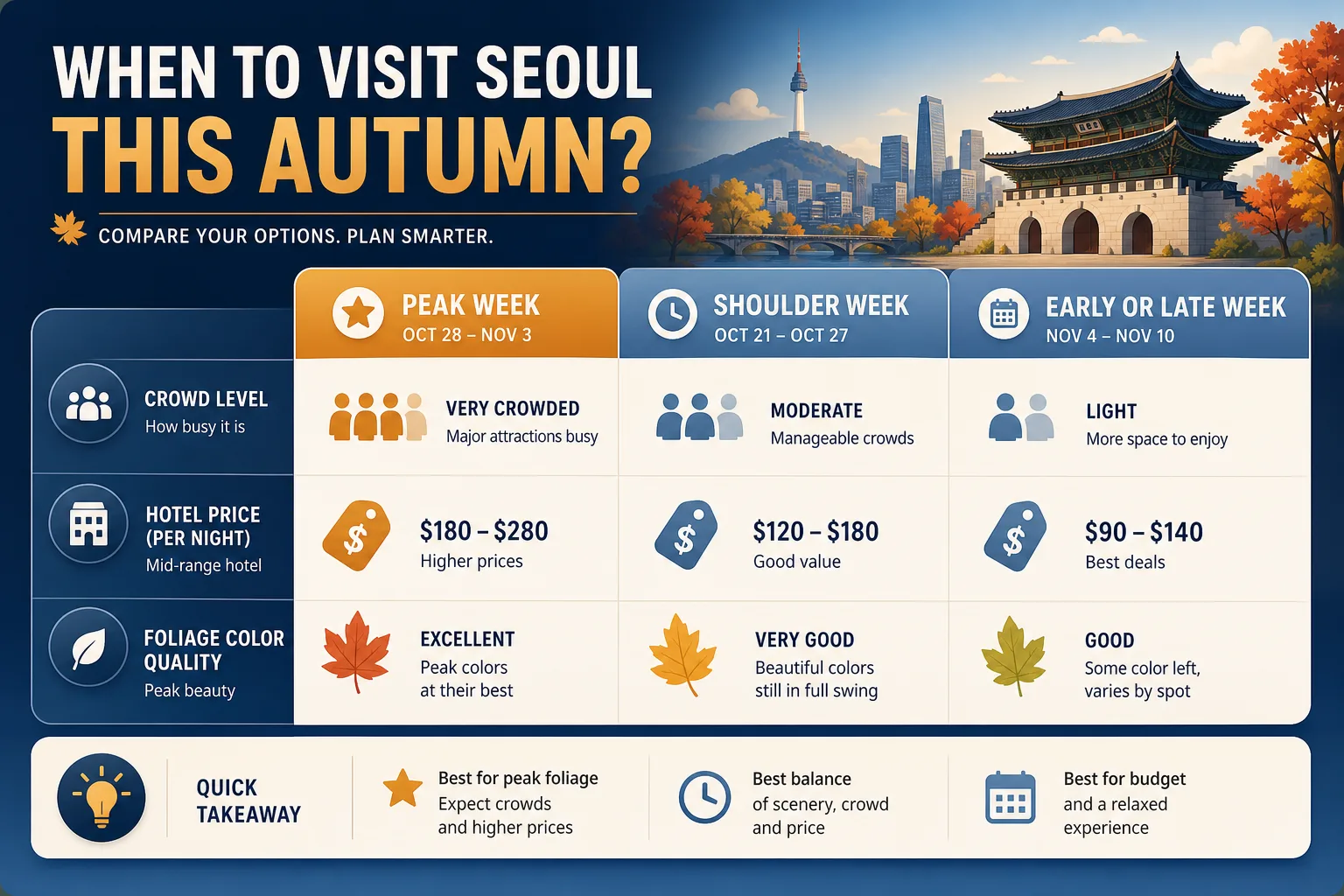 Editorial illustration: A simple decision comparison layout with three labeled columns: Peak Week.
At a Glance Table
| Decision variable | Peak weeks (roughly late Oct to early Nov) | Shoulder weeks (mid-to-late Nov, or a few weeks before peak) |
|---|---|---|
| Foliage color | Most saturated, especially at palace grounds and mountainside parks | Still present but more variable; some trees past peak, others just turning |
| Palace crowd level | Heaviest of the year at Gyeongbokgung and Changdeokgung, worse on weekends | Noticeably thinner, especially on weekday mornings |
| Hotel rates (Myeongdong/Insadong mid-range) | $70 to $130 base, plus 30 to 50 percent weekend surge | Closer to base rate, especially midweek |
| Secret Garden booking difficulty | Slots fill within hours of the 10:00 AM KST release, 6 days out | Same booking system, but slots go less quickly |
| Best fit traveler | Photographers and short-stay visitors with flexible weekday dates | Budget-conscious travelers, couples wanting a calmer pace, first-time Seoul visitors combining foliage with other sightseeing |
| Regret risk | Overpaying for a weekend trip with limited payoff if weather clouds the color | Missing the most vivid color if the shoulder week runs too early or too late |
The tradeoff is not just crowds versus cost. It is also about how much the visual difference between peak and shoulder color actually matters to the specific trip, since a week on either side of the true peak can still look strong in photos while costing and crowding noticeably less.
Choose Peak Season If
Choose the late October to mid-November window if the trip has a narrow, specific purpose: getting palace foliage photos at their best, attending a one-time event like Gyeongbokgung's autumn night viewing, or combining Seoul with a longer Korea itinerary where these are the only available dates. Photographers optimizing for maple color density against traditional architecture get the clearest payoff from peak timing, since color intensity at palace grounds tends to be genuinely better in the core two-to-three-week window than a week or two earlier or later.
This window also makes sense for travelers who can shift specific days rather than the whole trip. Landing in Seoul during peak season but scheduling palace visits for weekday mornings captures most of the color benefit while sidestepping the worst of the weekend crowd surge. Couples with flexible work schedules, retirees, and remote workers are better positioned for this than travelers locked into weekend-only availability.
Peak season is also the right call if a specific limited-access experience is the anchor of the trip. Gyeongbokgung's 2026 autumn night viewing runs September 2 to October 2 from 7:00 PM to 9:30 PM, and the Changdeokgung Secret Garden's cap of 100 visitors per time slot means booking around a target date is part of the plan either way. If one of these is already the reason for the trip, absorbing the surrounding crowd and price friction is a reasonable tradeoff.
Choose a Shoulder Window If
Choose a window a week or two before or after the tightest peak if the trip priority is a calmer overall experience rather than the single most saturated color. Budget-conscious travelers get the clearest benefit here: mid-range hotel rates in Myeongdong and Insadong that would carry a 30 to 50 percent weekend surge during peak weeks are far more likely to sit closer to their $70 to $130 base range just outside that window, especially on weeknights.
This also suits travelers who want to see palaces without fighting for sightlines. Gyeongbokgung and Changdeokgung both see their heaviest annual foot traffic during the two or three sharpest peak weeks, and that crowding compounds with weekend timing. A shoulder-week weekday visit to either palace is a meaningfully different experience in terms of pacing, photo space, and how rushed the grounds feel.
Shoulder timing is also the more forgiving choice for anyone combining foliage with other Seoul sightseeing rather than treating it as the singular goal. If palace color is one stop among many rather than the reason for the trip, a slightly less vivid but far less crowded and less expensive week usually delivers better overall trip satisfaction than squeezing everything around the tightest color window.
Who Might Regret Peak Season
Travelers who book peak-week weekend dates without flexibility are the most likely to regret it. If the only available nights are a Friday and Saturday in late October or early November, expect the full 30 to 50 percent hotel surge on top of already-elevated base rates, plus the heaviest palace crowds of the year, with no ability to shift to a calmer weekday.
Budget travelers who assume "autumn in Seoul" is a fixed, moderate cost are also at risk. The surge is not a minor uptick. A $90 weeknight room can become well over $120 on a peak weekend, and that gap compounds across a multi-night stay. Anyone booking late, within a week or two of the trip, is especially exposed, since the cheaper rooms in popular areas sell out first and what remains is disproportionately at the surge end.
There is also a weather-dependent disappointment risk specific to peak timing. Foliage color still depends on temperature patterns each year, so a trip locked into a single peak week can still land on an off year where color is muted or a storm strips leaves early. Paying the full crowd-and-price premium for a payoff that is ultimately weather-dependent is a real risk worth naming rather than assuming peak dates guarantee peak color.
Who Might Regret a Shoulder Window
Photographers and travelers whose entire trip purpose is capturing peak-saturation foliage are the ones most likely to regret shifting too far into the shoulder. Color intensity genuinely drops off outside the core two-to-three-week window, and a trip planned two or three weeks early can arrive to still-green trees, while one planned too late can arrive after leaves have dropped, especially in an unusually cold or windy year.
Travelers anchoring their trip to a specific limited-run event also risk a mismatch if they shift dates without checking the calendar first. Gyeongbokgung's autumn night viewing runs on fixed September to October dates, so shifting later into a "shoulder" window in search of lower prices or thinner crowds can mean missing that specific experience entirely rather than trading it for a similar one.
There is also a subtler regret risk for first-time Seoul visitors who deliberately avoid peak weeks expecting a dramatically different experience but find the difference smaller than expected at popular sites. Changdeokgung's Secret Garden, for instance, is capped at 100 visitors per slot year-round, so its crowd control comes from the booking system itself more than from the calendar week chosen.
Key Friction Comparison
Crowds. Palace crowding in Seoul is driven by both season and day of week, and the two compound rather than substitute for each other. Weekend afternoons during the sharpest two or three peak weeks are the single worst combination at Gyeongbokgung and Changdeokgung. Weekday mornings, even within the peak window, are consistently calmer. The Secret Garden's structural cap of 100 people per slot (50 released online, 50 sold on-site) is the most reliable crowd control of any site covered here, but that same cap means popular slots can sell out within the booking window regardless of season.
Cost and budget. The 30 to 50 percent weekend hotel surge in Myeongdong and Insadong during October and November is the clearest financial friction point in this decision. It is worth noting that under a revised Public Health Control Act enforcement rule effective July 14, 2026, Seoul lodging businesses are now required to post rates online and at the front desk, with a five-day business suspension penalty for a first-time violation. That should make surge pricing more transparent and easier to compare across properties than in past seasons, but it does not reduce the surge itself. Palace admission fees stay low regardless of season (Gyeongbokgung 3,000 KRW, Changdeokgung 3,000 KRW plus 5,000 KRW for the Secret Garden, Deoksugung 1,000 KRW), so accommodation, not entry tickets, is where the real budget swing happens.
Time pressure. Short trips face the sharpest version of this tradeoff because there is no room to wait out a bad-weather day or a sold-out booking slot. The Secret Garden's online release, exactly 10:00 AM KST six days before the visit date, means travelers on a short, fixed itinerary need to plan that single booking window in advance rather than treating it as something to sort out after arrival. Travelers with more flexible, longer stays can simply shift a palace visit to the next clear weekday morning if a booking or weather issue comes up; travelers on a 3 or 4 day trip generally cannot.
Quick friction checklist before booking:
- Confirm whether the trip's core goal is peak color specifically, or autumn atmosphere in general
- Check whether travel dates can shift to weekdays even if the overall trip window cannot move
- Compare posted hotel rates for the same nights a week before and after the target dates
- If targeting the Secret Garden, confirm the exact date six days out and be ready at 10:00 AM KST for booking release
- Check Gyeongbokgung and Changdeokgung closure days (Tuesday and Monday respectively) against the planned itinerary
- Decide in advance whether a cloudy or early-drop foliage year changes the plan, since color is not guaranteed on any fixed date
Final Recommendation
Book the peak window deliberately, not by default. If palace foliage photography or a specific event like Gyeongbokgung's night viewing is the actual reason for the trip, the late October to mid-November peak is worth the crowd and price friction, provided the itinerary can favor weekdays and the budget has been sized around the realistic surge rather than base-season rates.
For most other travelers, especially those balancing cost, a calmer pace, or a first Seoul visit that includes more than just foliage, a shoulder week just before or after the tightest peak is the more reliable choice. It trades a modest amount of color saturation for meaningfully lower hotel costs and thinner palace crowds, and it removes the weather-dependent risk of a single peak week disappointing.
Neither choice is universally correct. The decision should follow from what the trip is actually optimizing for: a specific visual payoff worth paying and queuing for, or a calmer, better-value trip where slightly less vivid color is an acceptable tradeoff.
FAQ
When exactly does Seoul's autumn foliage peak? Peak color typically runs from late October through mid-November, though the exact week shifts year to year with temperature. Palace grounds and mountainside parks usually color first in late October, with some maples holding into the third week of November in sheltered spots.
Do hotel prices really spike that much during foliage season? Yes. Mid-range hotels in Myeongdong and Insadong that run $70 to $130 a night in shoulder months routinely add 30 to 50 percent on October and November weekends. Weeknight rates rise less sharply, so a weekday check-in inside the same peak window can still be meaningfully cheaper.
Is it worth paying the surge price just for a few days of peak color? It depends on what you are optimizing for. If specific palace foliage photos are the goal, a short peak-window trip timed to weekdays is usually worth the premium. If you want a calmer, cheaper trip and are open to slightly less saturated color, a shoulder-week visit is the better value.
Can I avoid the worst of the palace crowds without missing peak color? Partially. Weekday mornings right after opening are consistently calmer than weekend afternoons at every palace in this guide. Gyeongbokgung's evening viewing session and Changdeokgung's Secret Garden, which caps entry at 100 people per slot, both spread out visitor density better than standard daytime palace admission.
Which palace is the best autumn foliage pick if I only have time for one? Changdeokgung's Secret Garden gives the most controlled, less crowded experience because of its 100-person cap per time slot, though it requires booking six days ahead. Gyeongbokgung has the most dramatic scale and a dedicated autumn night session, but draws the largest daytime crowds of the three.