travel-decisions
Should You Use Seoul as a Base or Change Hotels During the Trip?
A practical decision guide for choosing one Seoul hotel base versus switching hotels mid-trip, based on luggage, transfers, and pace.
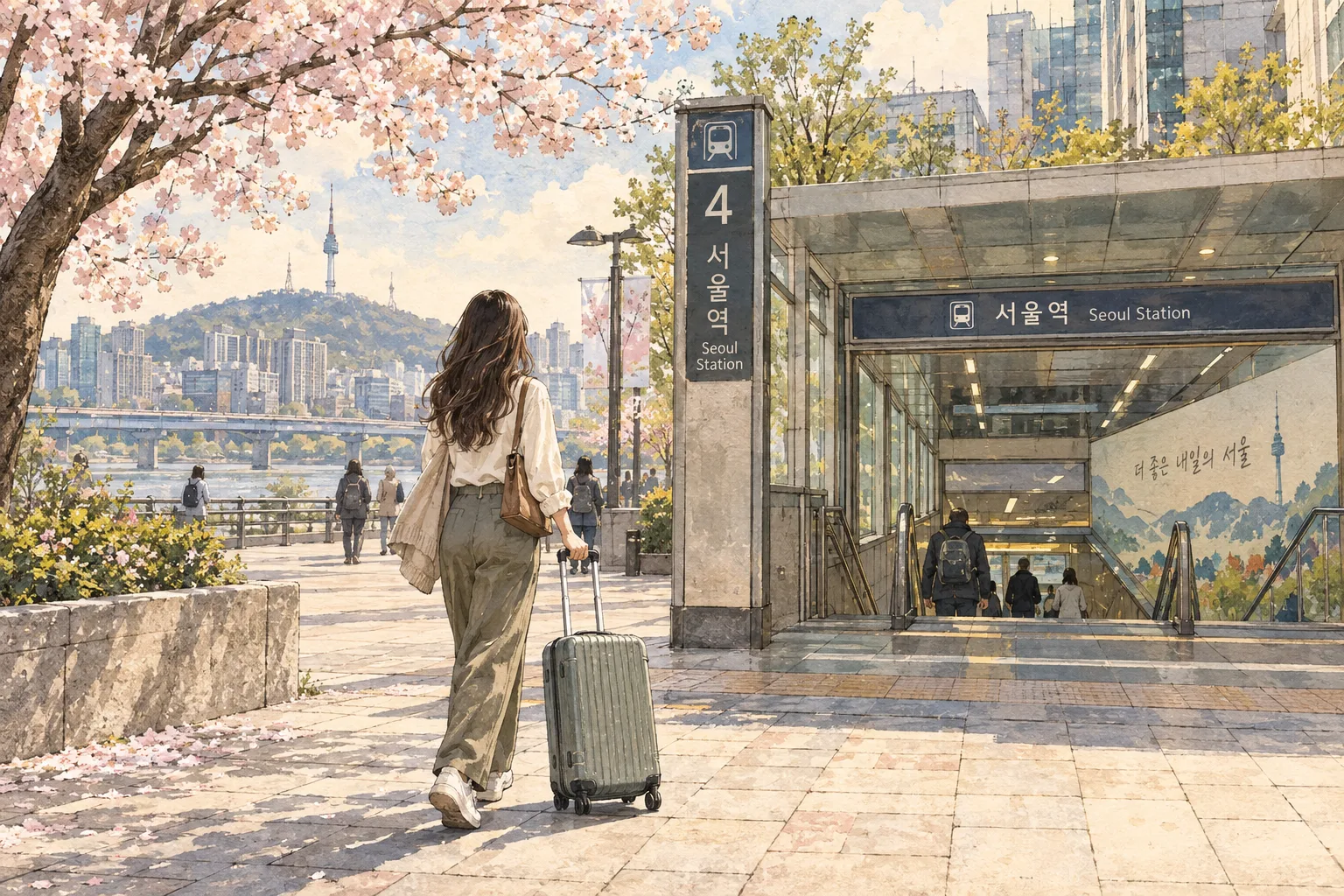
Strong Opening
Moving hotels mid-trip sounds efficient on paper. In practice, it often costs more time than it saves, especially in a city where the subway map does most of the work for you.
Seoul is compact enough, and its transit network dense enough, that switching hotels rarely buys you the proximity gain travelers expect. The real cost shows up in packing, checkout lines, luggage on stairs, and the mental tax of re-orienting in a new neighborhood halfway through your trip. This is the decision worth making before you book, not after you are standing in a station with two suitcases and no elevator in sight.
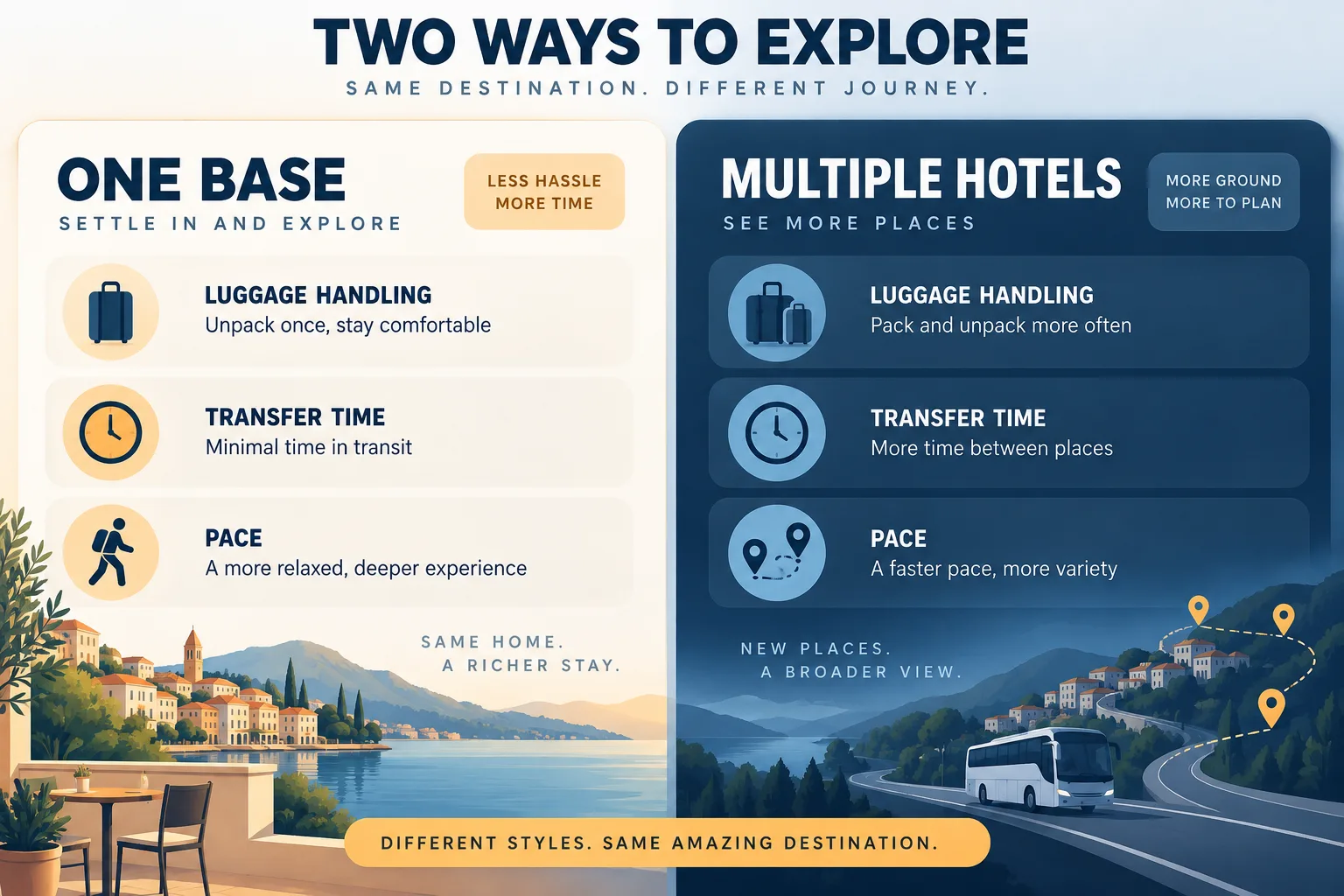 Editorial illustration: A simple two-column comparison layout labeled 'One Base' and 'Multiple Hotels'.
Quick Verdict
Stay in one Seoul hotel for most trips. Change hotels only if you have a genuine reason tied to a specific event, a very long stay, or a side trip outside Seoul.
A single well-located base works for slow travelers, couples, and anyone who wants a low-stress trip without daily re-planning. It also works for most first-time visitors, since Seoul's subway lines reach almost every major district from a central point.
Changing hotels makes sense in narrower cases: a multi-city itinerary that includes Busan or another region, a trip long enough that one neighborhood would feel repetitive, or a specific reason to be near a concert venue or event on one particular night. Outside those cases, moving hotels adds friction without adding much payoff.
Who Will Probably Love It
Slow travelers get the most out of a single Seoul base. Waking up in the same room every day removes a layer of decision fatigue, and it leaves more energy for the city itself rather than logistics.
Couples traveling together also do well with one base. Splitting the trip into segments means renegotiating priorities each time you move, which is its own kind of friction on a shared vacation.
Low-stress planners, people who want a mostly settled itinerary with a few flexible days, benefit the most. A single hotel means you can leave in the morning without fully packing, come back mid-afternoon to rest, and go out again that evening. That flexibility disappears the moment your bags need to be somewhere else by a fixed time.
Who Might Regret It
Travelers with a rigid multi-neighborhood checklist sometimes regret the single-base choice, but usually for the wrong reason. They assume proximity to a landmark saves meaningful time, when in most cases the subway gap is 15 to 25 minutes either way.
The disappointment risk is different: travelers who insist on changing hotels every 2 to 3 nights without a specific reason often regret the switching itself. The friction is not one bad hotel choice. It is the repeated cost of checkout, luggage handling, and re-learning a new block, paid three or four times over a single trip.
Travelers doing a genuine multi-city loop, Seoul then Busan then back, are a different case. They are not really choosing between "base" and "move" within Seoul. They are adding an unavoidable second hotel for a second city, which is a separate decision from the one this article addresses.
Mistake / Consequence Table
| Decision variable | One Seoul base | Changing hotels mid-trip |
|---|---|---|
| Luggage handling | Packed once, unpacked once | Repacked and moved 1 to 3 extra times |
| Transfer time cost | Zero extra transfers beyond daily sightseeing | 20 to 45 minutes per move, plus wait and walk time |
| Access to sights | Most areas reachable in 15 to 25 minutes by subway | Marginal time savings, often under 10 minutes net |
| Cost impact | Stable nightly rate, easier to book midweek discounts | Extra fares, possible weekend rate spikes on move days |
| Mental load | Low; same room, same routine | Higher; new checkout and check-in logistics each move |
| Best fit | Slow travelers, couples, low-stress planners | Multi-city loops, long stays split by region, event-specific nights |
Hidden Friction Points
Luggage difficulty. Seoul's stations were not all built with wheeled suitcases in mind. Euljiro 3-ga Station's Exits 1 through 10 rely mainly on concrete stairs, with no elevators or escalators, so a mid-trip hotel change through that station means carrying bags up flights of stairs.
Train transfer stress. Some transfers are more involved than they look on a map. At Seoul Station, the AREX airport line platforms sit on the B7 floor underground, and reaching local subway Lines 1 or 4 means moving up to the B3 or B2 floor first. Jongno 3-ga Station connects three subway lines through 16 separate exits, which is easy to navigate empty-handed but disorienting with luggage and a checkout deadline.
Time compression. A hotel move eats a half-day you did not plan to lose. Checkout, transit, check-in, and settling into a new room can easily take 2 to 3 hours once you count waiting and walking, time that would otherwise go toward the trip itself.
Hotel switching fatigue. The cost is not just physical. Each move means re-learning where the nearest convenience store, subway exit, and coffee shop are. For a 5 to 7 night trip, doing this twice or three times adds up to real fatigue by the final days.
How to Make It Easier
If you do need to change hotels, a few choices reduce the friction significantly.
- Use a same-day luggage delivery service instead of carrying bags through transfers. Seoul Metro's T-Luggage service moves bags between stations or to Incheon Airport the same day, for roughly 17,000 to 31,000 won on weekdays and 25,000 to 45,000 won on weekends.
- If you only need a few hours of buffer rather than a full delivery, T-Luggage's manned storage counters are open daily from 10:00 AM to 10:00 PM (9:00 AM at Seoul Station) and charge 3,000 to 13,000 won on weekdays for up to 4 hours.
- Book hotel moves on a Monday or Tuesday rather than a Friday or Saturday. Weekend nights are consistently the most expensive time to book in Seoul, so a mid-week move avoids compounding a rate spike on top of the transfer cost.
- Choose stations with elevator access for the transfer day specifically, and avoid routing bags through exit-only stairwell stations like Euljiro 3-ga when a bag-friendly alternative exists.
- If your itinerary includes the Climate Card tourist pass, note that a multi-day pass (5,000 won for 1 day up to 20,000 won for 7 days) covers the extra transit trips a hotel move adds, so the added fares do not stack up separately.
Better Alternatives
If your real goal is being closer to different parts of the city on different days, a single central base usually solves that without a second hotel. Myeongdong and Hongdae both work well as anchor points: a direct Line 2 ride between them runs 13 to 24 minutes, and the AREX train covers Seoul Station to Hongdae in about 14 minutes. Either one puts most of the city within a half-hour reach.
If your itinerary genuinely spans two cities, treat that as two separate one-base trips rather than a Seoul-internal hotel swap. A Busan leg reached by KTX, roughly 2 hours 15 minutes to 2 hours 40 minutes each way, deserves its own hotel and its own pace, not a rushed overnight squeezed between Seoul stays.
If budget is the real driver behind wanting to switch hotels, look at booking a mid-week stay instead of moving. Mid-range 3-to-4-star hotels in Myeongdong or Hongdae run $80 to $150 a night, with budget guesthouses closer to $35 to $60, and Monday or Tuesday rates are consistently the cheapest days to book regardless of neighborhood.
Self-Checklist
Use this before deciding to split your Seoul stay across hotels.
- My total trip length is 5 nights or fewer, which favors a single base.
- I have not identified a specific event or venue that requires being in one neighborhood for one night only.
- My itinerary does not include a separate city (Busan, Jeonju, etc.) that would need its own hotel anyway.
- I have checked that my chosen base is within 25 minutes by subway of my top three planned areas.
- I am comfortable handling luggage through at least one stairs-only station exit if my hotel move is unavoidable.
- I have priced a mid-week move (Monday or Tuesday) instead of a weekend one, if a move is truly necessary.
- I have considered T-Luggage delivery or storage instead of hand-carrying bags between hotels.
FAQ
Is it cheaper to change hotels during a Seoul trip? Not usually, once you count time and effort. Room rates do not drop enough from switching to offset the extra transit fares, luggage handling, and lost hours. The exception is a genuine side trip, like a Busan overnight on the KTX, where a second hotel is unavoidable anyway.
How many nights should I stay in one Seoul hotel before it feels wasteful to move? If your total trip is 5 nights or fewer, one base is almost always simpler. For trips of 7 nights or more, a single well-located base still works for most travelers, since Seoul's subway network reaches nearly everywhere from one point.
Does staying in Myeongdong or Hongdae cover both sides of Seoul well enough? Both work as a single base for most itineraries. A direct Line 2 ride between them takes 13 to 24 minutes, and the AREX train links Seoul Station to Hongdae in 14 minutes, so neither area leaves you isolated.
What if my Seoul trip includes a day trip to Busan or another city? That is a legitimate reason to add a second hotel, not a base-versus-move question in the Seoul sense. The KTX to Busan takes roughly 2 hours 15 minutes to 2 hours 40 minutes, so an overnight there makes more sense than a same-day round trip.
Can I use luggage delivery instead of carrying bags between hotels? Yes, and it removes most of the physical friction if you do decide to move. Seoul Metro's T-Luggage service delivers same-day between stations or to Incheon Airport for roughly 17,000 to 45,000 won depending on the day, with manned counters open 10 AM to 10 PM.