travel-decisions
Is Osaka a Bad Fit If You Have Strict Gluten-Free or Vegetarian Dietary Needs?
A practical fit check for celiacs, vegans, and vegetarians deciding whether Osaka's food-first culture works with strict dietary restrictions, or creates constant friction.
Strong Opening
Here is the decision this article answers: should you book Osaka if you are celiac, strictly gluten-free, vegan, or vegetarian, or should you pick a city where the local food already matches your diet? The honest answer is not "Osaka is fine" or "Osaka is impossible." It is: Osaka is a workable choice only if you accept extra planning, extra cost, and a smaller list of restaurants than a flexible eater gets, and it is the wrong choice if you were hoping for spontaneous, low-effort eating.
Osaka calls itself "kuidaore," the city where you eat until you drop. That reputation is built on takoyaki batter, okonomiyaki flour, soy-sauce-glazed skewers, and dashi stock that shows up in almost everything from miso soup to the "vegetable" side dish you assumed was safe. For a flexible eater, that is the entire appeal. For someone managing celiac disease, a strict gluten intolerance, or a firm vegan or vegetarian diet, it is a city where the default answer to "can I eat this" is often no, and where the burden of finding out falls entirely on you.
This is not a reason to cancel a trip automatically. It is a reason to decide clearly, before you book, whether you are the kind of traveler who can work around that friction or the kind who will spend the week frustrated and hungry. The difference comes down to how much planning you are willing to do and how much budget you are willing to add for safety, which is exactly what the rest of this article helps you decide.
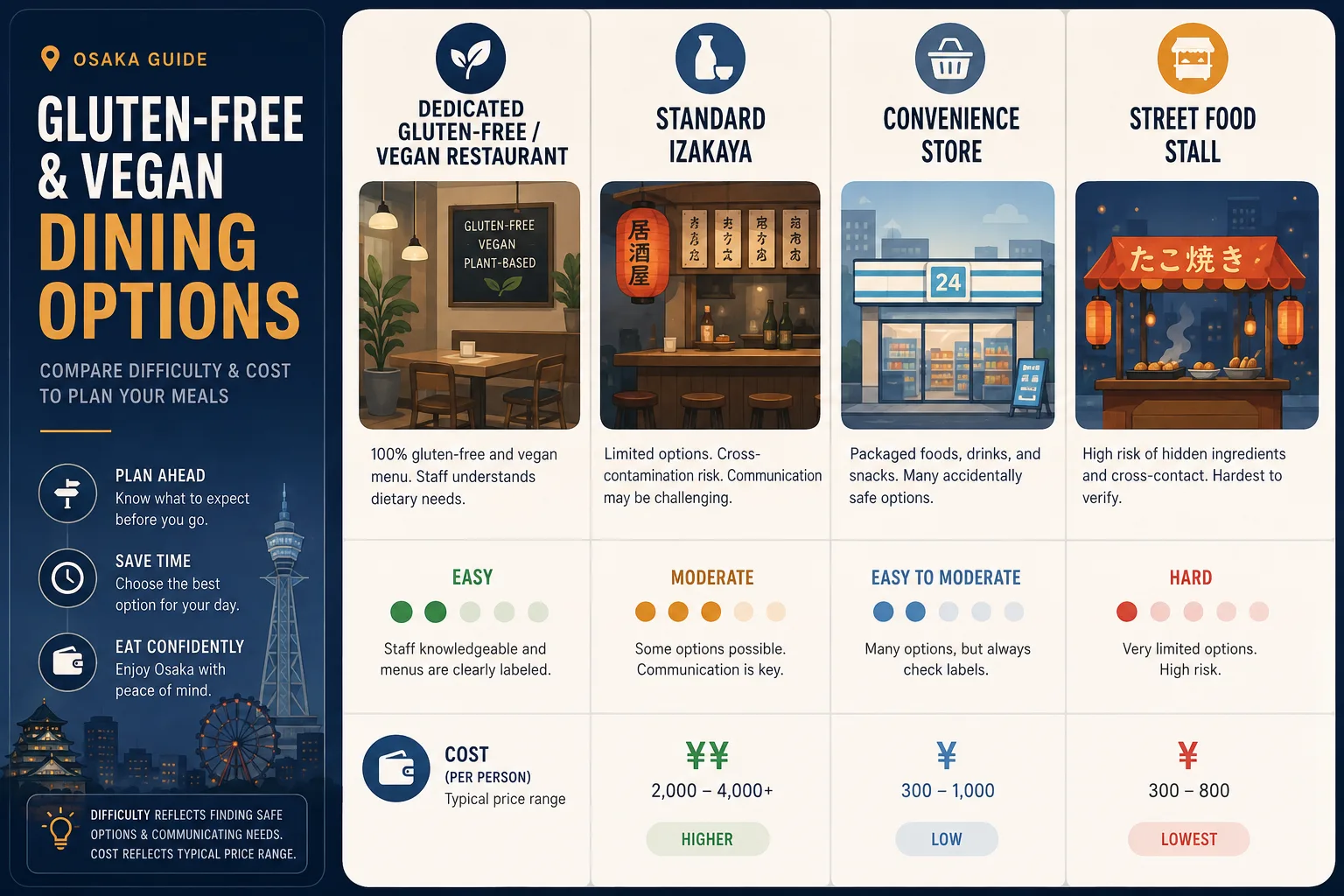 Editorial illustration: A simple decision-table style layout comparing Osaka dining situations (dedicated gluten-free/vegan restaurant.
Quick Verdict
Osaka is a workable but effortful destination for strict gluten-free or vegetarian travelers. It is not an easy one, and it is not a city to book on the assumption that "food capital" means "safe for me."
Book Osaka if: you are willing to research and pre-verify restaurants before you arrive, you can accept a smaller, curated list of safe places instead of spontaneous eating, and you are okay paying a premium for dedicated gluten-free or vegan kitchens.
Do not book Osaka, or postpone it, if: you want to wander into random restaurants and order casually, you have zero tolerance for cross-contamination risk in shared kitchens, or you are not willing to budget extra time and money specifically for food logistics.
If your idea of a food trip is spontaneous street-stall grazing through Dotonbori, Osaka's dietary reality will clash hard with that expectation, and you will likely regret the booking. If your idea of a food trip is a short list of vetted restaurants visited deliberately, Osaka can work well.
Who Will Probably Love It
Strict dietary travelers who do well in Osaka share a few habits. They research before landing rather than improvising on the ground. They are comfortable eating the same handful of trusted restaurants more than once instead of chasing novelty every meal. They treat dietary safety as a planning project, not an inconvenience, and they build slack into each day for the extra 10 to 20 minutes it takes to walk to a verified spot instead of the nearest option.
Travelers who specifically want a curated, quality-over-quantity food experience also do well here. Dedicated spots like Shojin Sushi Minamo, a fully gluten-free and vegan restaurant two minutes from Shinsaibashi Station, or Osaka Engine, another fully gluten-free and vegan kitchen near Sakaisuji Honmachi Station, deliver a genuinely reliable meal without the constant "is this safe" negotiation. If you would rather have three excellent, worry-free meals a week than ten mediocre gambles, Osaka rewards that approach.
Budget-conscious travelers who are still willing to pay a food-specific premium also fit reasonably well, as long as they know that premium is coming and plan for it rather than being surprised by it mid-trip.
Who Might Regret It
The clearest regret pattern is the traveler who books Osaka expecting the food-city reputation to mean easy, abundant options in every direction, then discovers that reputation was built around ingredients they cannot eat. Okonomiyaki batter, takoyaki batter, most soba and ramen broths, and the soy-sauce-and-dashi backbone of Japanese home cooking are gluten-containing, fish-based, or both, by default.
A second regret pattern shows up in travelers who assume "vegetable dish" or "salad" automatically means vegetarian-safe. Dashi stock, which frequently contains bonito fish flakes, is used as a base seasoning far beyond soup, showing up in simmered vegetables, dressings, and sauces where there is no visible fish on the plate. Without asking directly, a strict vegetarian can eat fish-based broth without ever knowing it.
A third pattern is the traveler who expects convenience stores to be a safe backup. Convenience store onigiri and many grab-and-go items commonly use soy sauce or fish-based dashi in the rice seasoning or fillings, so treating them as a reliable fallback meal is a specific and common source of disappointment. If your trip planning assumes "worst case, I'll just grab a rice ball," that assumption does not hold in Osaka.
Travelers who dislike repetition also tend to regret the trip, since the realistic strategy is returning to a short list of trusted restaurants rather than sampling widely.
Mistake / Consequence Table
| Assumption going in | What actually happens | Consequence |
|---|---|---|
| "Vegetable dishes are automatically vegetarian" | Many use dashi stock, which is often fish-based | Accidental non-vegetarian meal, or a long clarifying conversation every time |
| "I'll just eat at convenience stores if needed" | Onigiri and prepared foods frequently contain soy sauce or fish dashi | No reliable low-effort fallback meal exists |
| "Soba is a safe gluten-free noodle" | Traditional soba is often wheat-blended, and gluten-free modification can cost extra, as at Genji Soba's 200 yen surcharge | Extra cost and menu-by-menu verification needed even at soba shops |
| "One dedicated gluten-free restaurant is enough for the whole trip" | Options like Shojin Sushi Minamo and Osaka Engine are excellent but few in number | Repeat visits to the same restaurants, less food variety than a flexible eater gets |
| "Okonomiyaki bars with vegan options are fully safe for celiacs" | Some, like OKO - Fun Okonomiyaki Bar, are vegan-friendly but not a dedicated gluten-free kitchen | Cross-contamination risk remains even where a vegan item exists on the menu |
Hidden Friction Points
The biggest hidden friction is an expectation mismatch: Osaka markets itself as Japan's food capital, and most travel content celebrates that with zero mention of how batter-based, soy-sauce-based, and dashi-based the signature dishes are. A traveler who arrives expecting "food capital" to translate into "easy for me" is setting up a mismatch that shows up meal by meal, not as one bad day but as a low-grade daily stressor.
The second hidden friction is cost. Meeting strict dietary needs safely in Osaka is not free. Dedicated allergen-free restaurants like Comeconoco Gluten-Free Laboratory & Cafe, where standard lunch sets run 1,100 to 1,144 yen before tax, are reasonably priced individually, but modification surcharges add up, such as the 200 yen gluten-free adjustment at Genji Soba, and options like Paprika Shokudo Vegan's Vegan Soy Meat Burger set run 1,380 yen for the burger alone, with chips as a separate 580 yen add-on. None of these are extreme prices on their own, but stacked across a multi-day trip, plus the taxis or extra transit time to reach verified restaurants instead of the nearest option, the real food cost runs noticeably above what a flexible eater budgets for the same days.
A less obvious friction is time. Verifying a restaurant before you go, whether through research or an on-site conversation with staff, takes time you were not planning to spend on logistics during a vacation. Multiply that by every meal, and dietary management becomes a quiet but real drain on trip energy that does not show up until you are living it.
How to Make It Easier
The single biggest fix for expectation mismatch is resetting your mental model before you land: Osaka's food fame is built on dishes that are structurally hard for your diet, so plan around a curated shortlist rather than expecting spontaneous safety anywhere you walk into. Build your trip itinerary around a small number of pre-verified restaurants and treat everything else as unlikely to work without direct questions to staff.
For cost, budget a specific daily food allowance that is higher than what a flexible traveler would need, and treat that gap as the real price of eating safely rather than an unexpected overrun. Knowing in advance that a gluten-free-adjusted bowl of soba costs more than the standard version, or that a dedicated vegan burger set runs close to 2,000 yen with sides, lets you plan instead of react.
Geography also reduces friction. Several of the more reliable options cluster around central, well-connected areas: Shojin Sushi Minamo and OKO Takoyaki near Shinsaibashi and Namba, and Osaka Engine near Sakaisuji Honmachi and Honmachi. Since the Midosuji subway line connects Umeda to Shinsaibashi and Namba in under 10 minutes, staying centrally near this line shortens the daily walk or ride to your safe-eating shortlist and cuts the time cost of dietary planning significantly compared to staying farther out.
Finally, carry a translation card or phone app that clearly states your restrictions in Japanese, covering gluten, soy sauce, dashi, and animal products specifically, not just a general "vegetarian" label, since the more specific version reduces the back-and-forth at each restaurant.
Better Alternatives
If the core issue is that you want spontaneous, low-effort eating without constant menu investigation, two specific alternatives solve that better than Osaka does. Kyoto, less than 30 minutes away by train, has a much deeper tradition of shojin ryori, the Buddhist temple cuisine built specifically around vegetables, tofu, and grains with no meat, fish, or fish-based dashi by design rather than by special request. That structural difference means a vegetarian or vegan traveler can walk into a shojin ryori restaurant in Kyoto with far less negotiation than a typical Osaka restaurant requires. If your restriction is vegetarian or vegan rather than gluten, Kyoto is the more forgiving Japan option without leaving the region.
If gluten is your primary restriction rather than animal products, Taipei is worth comparing directly against Osaka. Taiwanese street food and home cooking lean on rice, rice noodles, and naturally plant-forward vegetable dishes at a much higher baseline rate than Japanese cooking, which reduces how often wheat shows up as a hidden default ingredient in batters and noodles. Taipei will not solve every gluten question either, but the starting point is friendlier than Osaka's wheat-and-soy-sauce backbone.
If the core issue is budget, specifically not wanting to pay a premium for dedicated allergen-free kitchens, both Kyoto and Taipei reduce that premium because more of the baseline menu already fits your diet, rather than requiring a separate dedicated kitchen or a modification surcharge.
If you still want Osaka specifically, whether for the broader trip, the city itself, or a connecting flight, the realistic path is not avoiding it but budgeting more trip-planning time and money for food than you would for a typical destination, and treating Kyoto as an easy add-on day trip for the meals that need to be simple.
Self-Checklist
Use this before you book, not after you arrive:
- I am willing to research and pre-verify restaurants before the trip, not just on arrival
- I have identified at least 5 to 7 confirmed safe restaurants for a week-long stay
- I have budgeted extra money specifically for dietary-safe meals, above a flexible eater's food budget
- I understand convenience stores are not a reliable backup meal source for my restrictions
- I am comfortable asking detailed questions about dashi, soy sauce, and animal-based stock at every unfamiliar restaurant
- I am okay eating at the same trusted restaurants more than once during the trip
- I am staying, or plan to stay, near central transit lines to shorten travel time to verified restaurants
- I have a translation card or app ready that names my specific restrictions, not just a general diet label
If you checked most of these, Osaka is a manageable, if effortful, choice. If several are unchecked, book Kyoto or Taipei instead, or expect the trip to produce daily frustration rather than the food-city experience you are picturing.
FAQ
Is Osaka harder than Tokyo for gluten-free or vegetarian travelers? Both cities share the same core problem: soy sauce and dashi (often fish-based) run through most Japanese cooking, so neither is naturally easy. Osaka has fewer dedicated allergen-free restaurants than Tokyo, but its dining is more concentrated in walkable districts like Shinsaibashi and Namba, which can make targeted searching faster if you plan routes around known safe spots.
Can I just eat at convenience stores if I run out of options? Not safely for strict needs. Convenience store onigiri and many prepared foods commonly use soy sauce or fish-based dashi in the seasoning or filling, so they are not a reliable gluten-free or vegetarian fallback. Treat convenience stores as a snack source for pre-verified items only, not a daily meal plan.
Are there enough 100% gluten-free and vegan restaurants to build a full trip around? There are a small but real handful, including Shojin Sushi Minamo and Osaka Engine, both fully gluten-free and vegan. That is enough to anchor a few meals a week, but not enough to cover every meal without gaps, so you will still need backup plans for most days.
Does eating safely in Osaka cost more than a normal food budget? Yes, plan for a premium. Dedicated allergen-free kitchens and modification surcharges push meal costs above what a flexible eater would pay for the same quality, and you will likely spend more time and money on research, taxis to verified restaurants, and pre-trip stocked snacks.
Should I bring my own snacks and translation cards to Osaka? Yes. A stocked bag of safe snacks and a printed or app-based allergy translation card covering gluten, soy sauce, dashi, and animal products are close to mandatory for strict travelers, since menu English and staff allergen awareness vary widely by restaurant type.