travel-decisions
Is Osaka a Bad Fit If You Get Sensory Overload from Crowded Street-Food Districts?
If Dotonbori's crowds and noise sound draining rather than fun, here is how to tell whether Osaka still works for you and how to travel it on your own terms.
Quick Verdict
Osaka is not automatically a bad fit if you get sensory overload, but it is a bad fit if your plan is to spend most of your trip in Dotonbori at night.
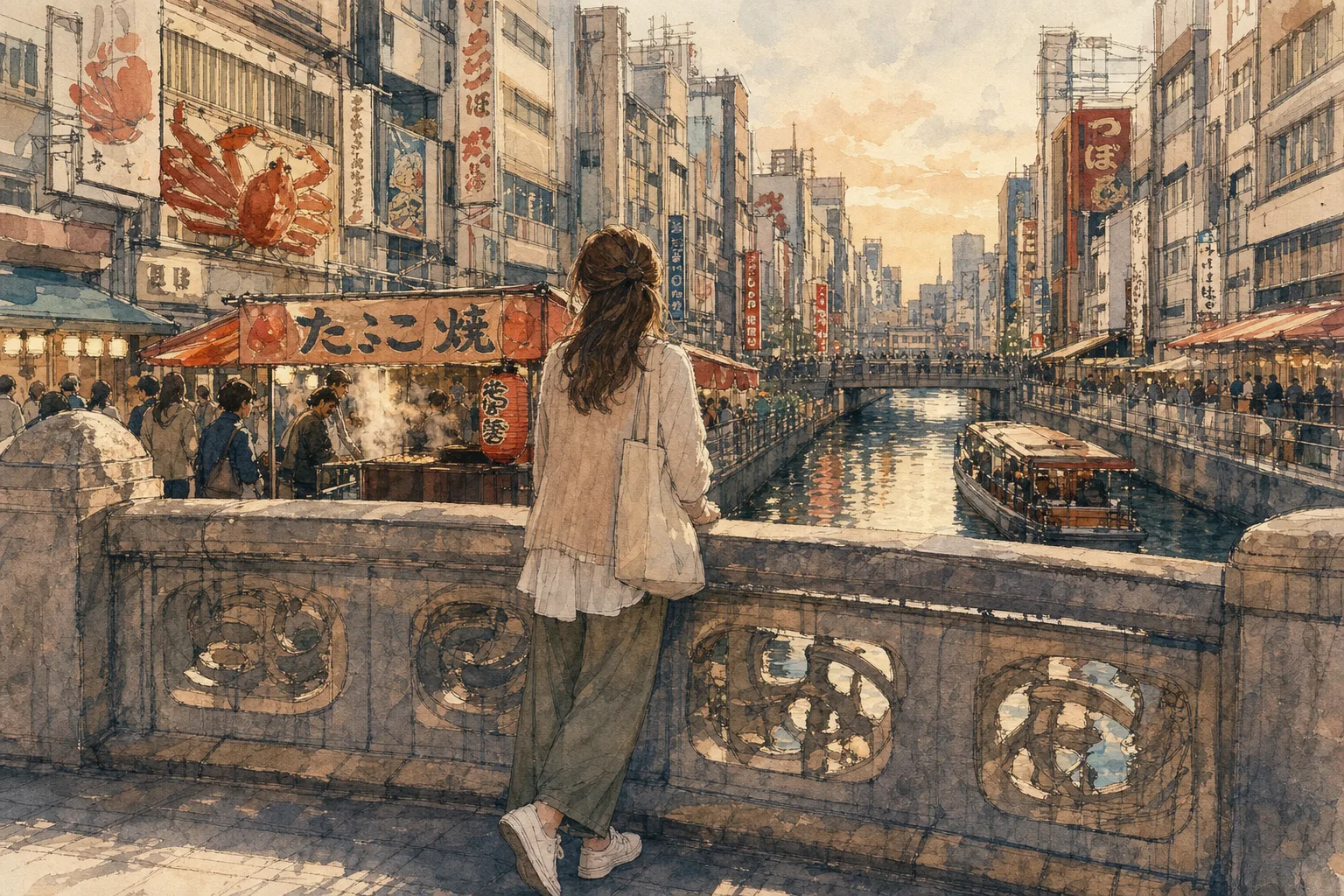
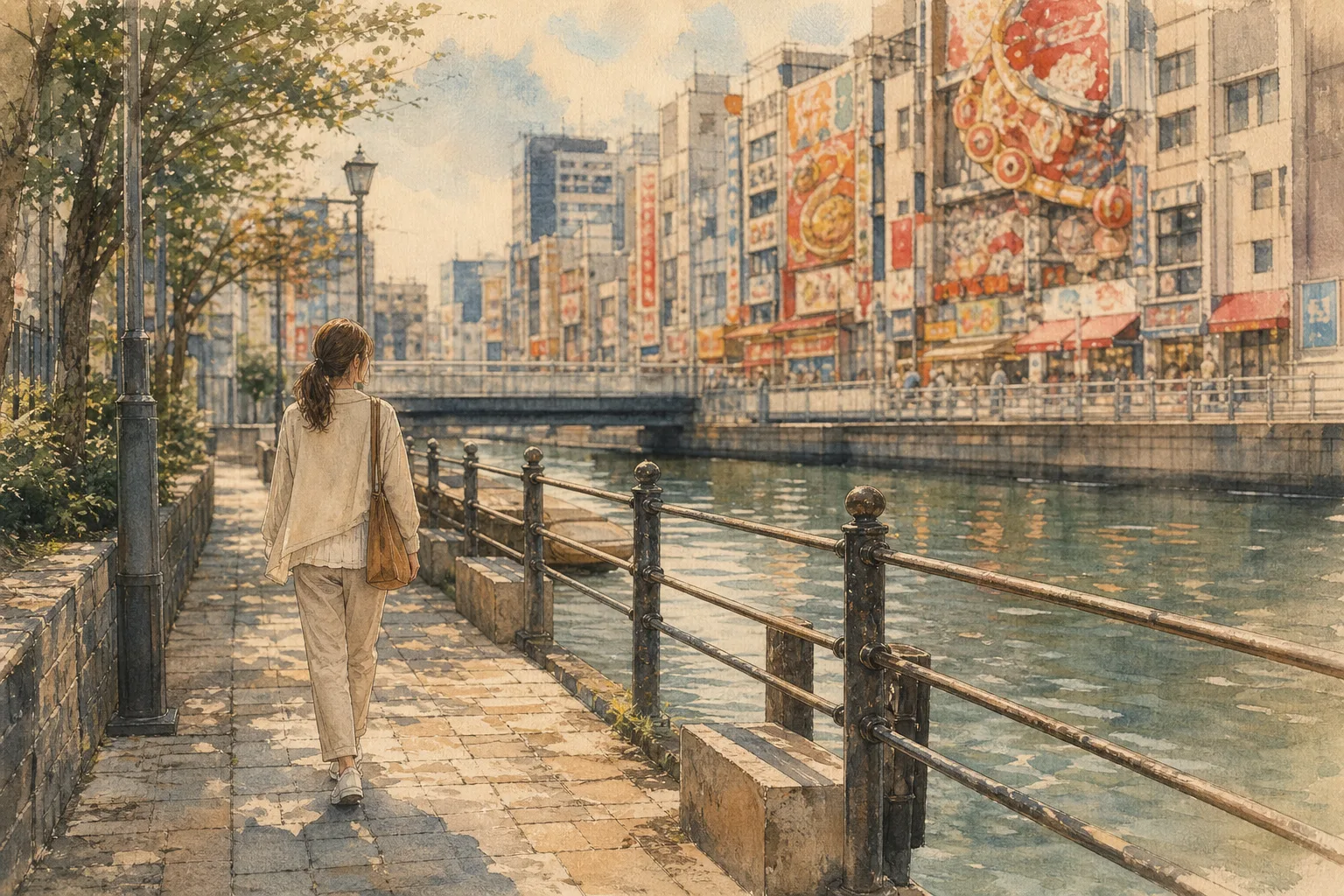
The problem is not Osaka as a city. It is one specific, heavily marketed strip of it. Dotonbori's canal-side street-food core is loud, bright, and dense with people, especially after 6:00 PM, and it is the image most travelers picture when they think "Osaka." If that image is the whole reason you are hesitating, you are reacting to one neighborhood, not the destination.
Choose Osaka if you are willing to treat Dotonbori as an optional, time-boxed visit rather than the center of your trip, and if you are comfortable building your base and your daily rhythm around quieter districts. Skip Osaka, or shorten your time there, if your trip only makes sense to you as a dense food-crawl through the busiest strip at peak hours, since that specific experience is genuinely taxing for anyone sensitive to noise, crowding, or visual stimulation.
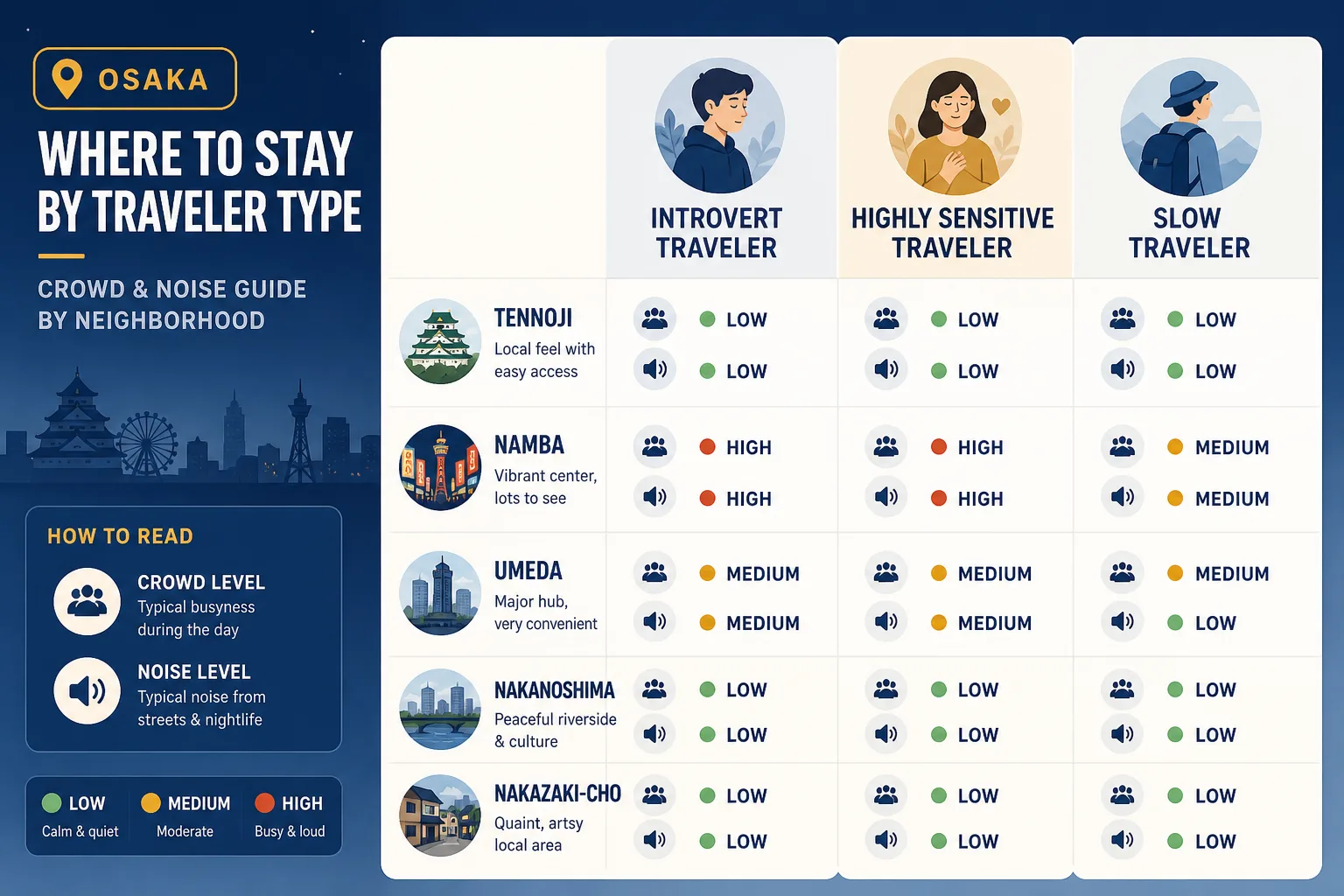 Editorial illustration: A simple comparison table graphic laid out on a flat surface or screen showing three traveler type labels (introvert.
Traveler Type Table
The real decision variable is not "Osaka: yes or no." It is which parts of Osaka you plan to spend time in, at what hours, and how you structure movement between them. Three traveler profiles hit this differently.
| Traveler type | What drains them in Osaka | What works instead |
|---|---|---|
| Introvert | Sustained exposure to dense crowds and constant social stimulation, even without direct noise sensitivity | Solo daytime walks, one planned social/food block per day, hotel away from the main strip |
| Highly sensitive traveler | Combined noise, light, and crowd density; Dotonbori's neon and packed sidewalks at night are close to worst-case sensory conditions | Daytime Dotonbori visits (before 6:00 PM) or skipping it, canal parks, less-hyped food streets |
| Slow traveler | Itineraries built around checklist-style hopping between famous spots, which forces repeated re-entry into crowds | Fewer neighborhoods per day, longer stays in each, built-in downtime between outings |
The tradeoff across all three is the same shape: Osaka's famous version costs sensory energy, and its quieter version costs a bit of research and willingness to skip the postcard shot. Neither is wrong, but only one matches a sensory-sensitive traveler's actual limits.
Best for First-Time Visitors
A first-time visitor to Osaka who also identifies as an introvert, highly sensitive traveler, or slow traveler should not plan their first exposure to the city around Dotonbori at 8:00 PM. That combination, first impressions plus peak crowd density plus unfamiliar navigation, is close to a worst-case introduction.
A better first-timer sequence: arrive, settle into a neighborhood away from the main entertainment strip, and treat Dotonbori as a short, deliberate visit on your own terms rather than your welcome mat to the city. Going before 6:00 PM lets you see the canal, the signage, and the general atmosphere without the crush of people that builds later. You get the visual landmark without paying the full sensory cost.
This matters more for first-timers specifically because you have no baseline yet for how Osaka feels day to day. Slow travelers benefit from resisting the urge to "see everything" on day one; highly sensitive travelers benefit from not front-loading their most stimulating experience before they have recovered from travel fatigue; introverts benefit from having at least one low-interaction day banked before tackling a crowd-heavy one.
Best for Couples
Couples traveling together have an advantage sensory-sensitive solo travelers do not: you can trade off who scouts ahead, and you can leave a crowded spot together without negotiating with a group. That makes Osaka a reasonably strong fit for a couple where one or both partners are introverts or highly sensitive travelers, as long as you agree in advance on an exit plan rather than deciding in the moment while overstimulated.
Practically, this means picking a hotel location that lets you retreat quickly. A base near a quieter station with a short, direct ride into the busier core, rather than a hotel deep inside the entertainment district, gives a couple the option to leave Dotonbori after 30-40 minutes without a long walk through more crowds to get out. It also means agreeing that street food will be eaten standing at the stall, as local etiquette expects, which naturally paces the visit into short stops rather than one long crowded crawl.
Slow-traveling couples do well here because Osaka rewards a lower-key pace. A couple who wants two or three unhurried days, with one deliberately quiet day worked in, gets more out of the city than a couple trying to cover Dotonbori, Shinsekai, and a theme park in 48 hours.
Best for Slow Travelers
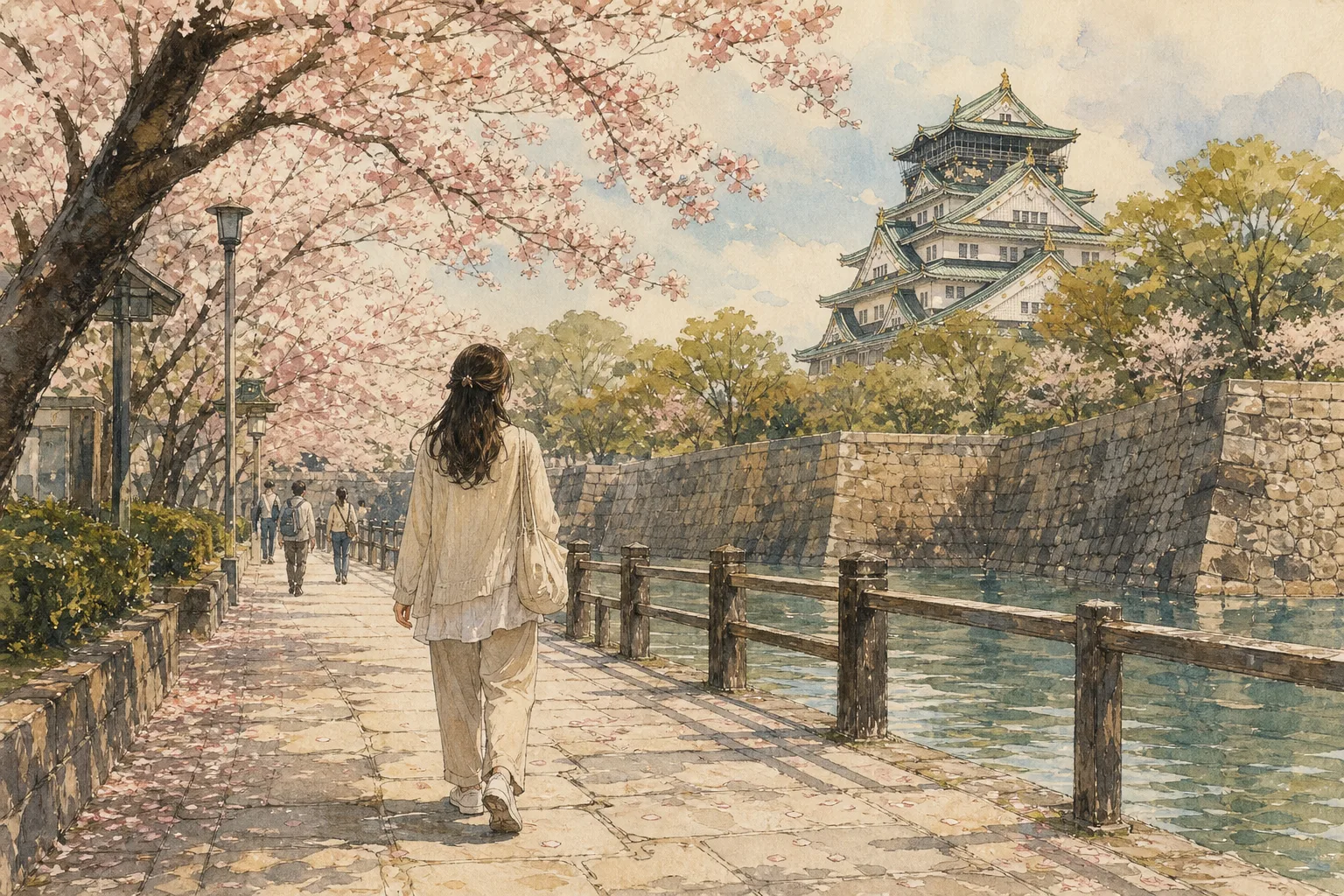
Slow travelers are arguably the best-matched profile for Osaka's quieter identity, because the city has genuine calm areas that reward lingering rather than checklist-hopping. A canal-side park, a riverside walk, or a quiet caf street gives a slow traveler the kind of unhurried afternoon that dense food districts cannot.
For a highly sensitive slow traveler, the daily rhythm matters more than the itinerary. Spending a full morning in one low-stimulation area, then a shorter, planned window in a busier district, then returning to a calm base, keeps sensory load from stacking up the way it does when a day is a continuous string of crowded stops. Slow travel here is not about seeing less of Osaka; it is about spacing out the stimulating parts so they do not compound.
Introverted slow travelers in particular benefit from Osaka's public transit being straightforward enough that quiet neighborhoods are rarely more than a short ride from the center, so "quiet" does not mean "isolated" or "inconvenient."
Best for Low-Stress Travelers
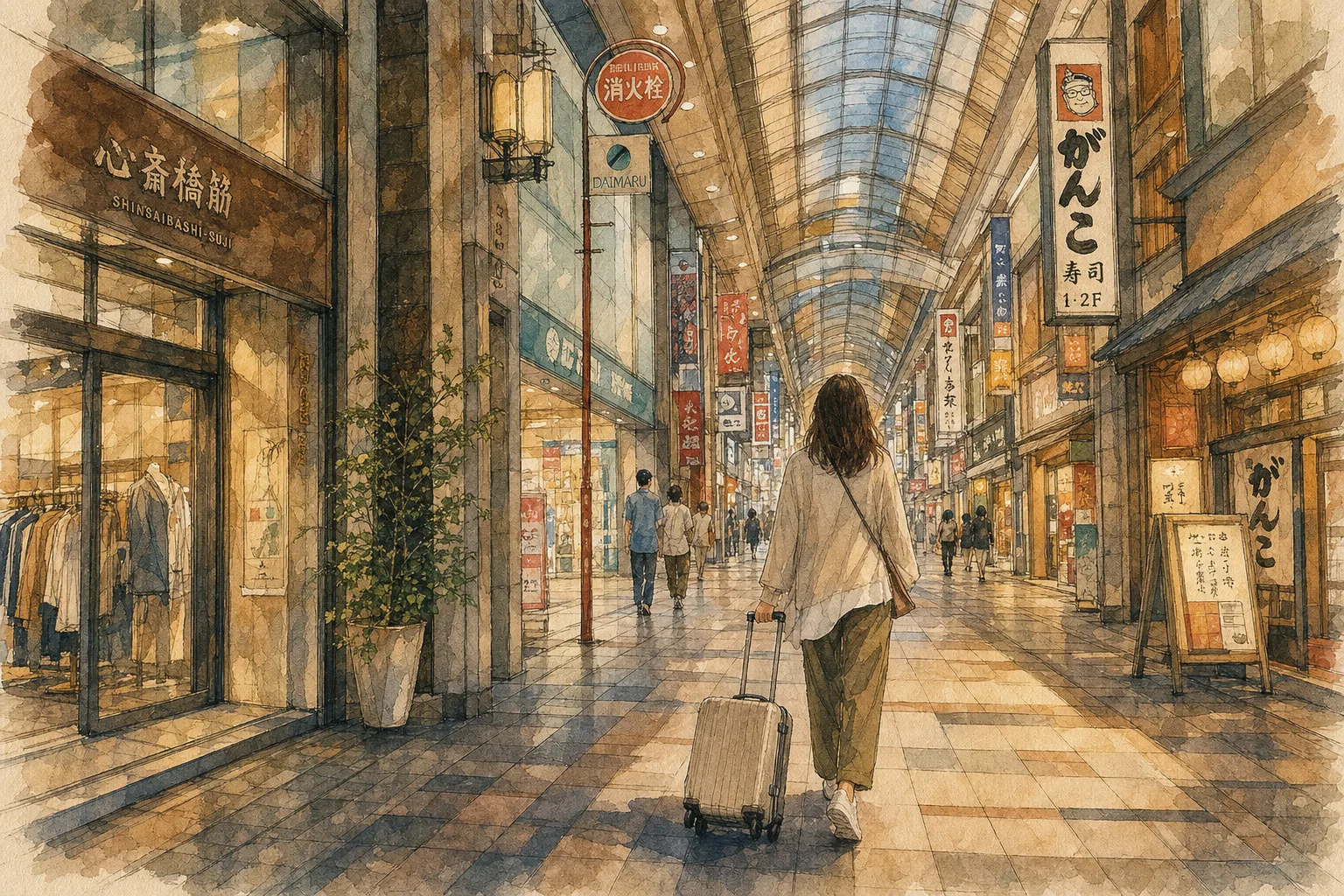
If your travel priority is an easy, businesslike trip with minimal friction, Osaka can work, but only if you actively avoid stacking your itinerary with peak-hour crowd exposure. A low-stress version of Osaka looks different from the version shown in most travel photos: fewer stops per day, earlier starts to beat crowds, and a hotel chosen for calm access rather than proximity to the loudest strip.
This is where highly sensitive and introverted travelers overlap most clearly with the low-stress traveler profile. Both want to avoid decision fatigue and physical overstimulation, and both benefit from the same fix: treat crowd-heavy districts as scheduled, time-boxed visits rather than default hangout spots. A low-stress traveler who tries to "wing it" through Dotonbori at night, assuming they can adjust on the fly, is the person most likely to end the day drained and regretting the choice.
Booking around known crowd patterns (before 6:00 PM or after 9:00 PM for the busiest street-food strip) is a simple, low-effort way to keep a low-stress trip low-stress without giving up the experience entirely.
Common Mismatches
Some travelers assume Osaka will be manageable and are caught off guard; others assume it will be unbearable and skip a city that would have suited them. Both mismatches are avoidable with a clearer picture going in.
- The "I'll just push through it" mismatch. A highly sensitive traveler books a hotel inside the busiest district, assuming willpower will carry them through the noise and crowding every evening. This usually backfires by day two or three, when cumulative sensory fatigue makes even quiet activities feel harder than they should.
- The "one bad photo, one bad verdict" mismatch. A traveler sees images of Dotonbori packed shoulder to shoulder at night and concludes the entire city is like that. In reality, that density is concentrated in a specific strip at specific hours; large parts of Osaka do not look or feel like this at all.
- The introvert-as-total-avoider mismatch. Some introverted travelers overcorrect and avoid all central, lively areas, missing the food and atmosphere that drew them to Osaka in the first place. A short, well-timed visit to a busier district is usually tolerable and often worthwhile; total avoidance can mean leaving with a thinner, less satisfying trip than necessary.
- The slow traveler with a first-timer's itinerary mismatch. A slow traveler who copies a first-time visitor's fast-paced checklist (Dotonbori, then Shinsekai, then a theme park, all in one day) ends up sensory-overloaded not because Osaka doesn't fit them, but because the itinerary pace doesn't fit them.
The disappointment risk in each case is the same: it is rarely Osaka itself that causes regret, it is a mismatch between the traveler's actual sensory limits and the itinerary pace they chose.
Final Match Recommendation
Choose Osaka if you are an introvert, highly sensitive traveler, or slow traveler who is willing to plan around crowd timing, pick a calmer home base, and treat the loudest street-food district as an optional short visit rather than the centerpiece of your trip. Under those conditions, Osaka offers real food, real atmosphere, and enough quiet corners to make it a genuinely comfortable destination, not just a tolerable one.
Do not choose Osaka, or at minimum shorten your stay, if your trip concept depends on being immersed in Dotonbori's peak-hour crowds for multiple nights, if you have no flexibility to shift activities to off-peak hours, or if you know from past trips that even brief exposure to dense, loud environments derails the rest of your day. In that case, a different Japanese city with a lower baseline crowd density, or a slower-paced regional town, is likely to serve you better than trying to force-fit Osaka around a district that was never going to suit you.
FAQ
Is Dotonbori mandatory to see if I visit Osaka? No. Dotonbori is Osaka's most famous street-food district, not a required stop. You can build a full, satisfying Osaka itinerary around quieter neighborhoods and still eat well, just not in that specific strip.
What time is Dotonbori least crowded if I still want to see it? Crowds peak after 6:00 PM. Going before 6:00 PM or after 9:00 PM gives you a noticeably calmer version of the same street, with the neon signs still visible.
Can I eat street food in Osaka without dealing with crowds? Partly. Japanese etiquette expects you to eat street food standing next to the vendor's stall rather than walking with it, so even quiet moments involve pausing in a small cluster of other diners. Choosing off-peak hours or less famous stalls reduces the pressure.
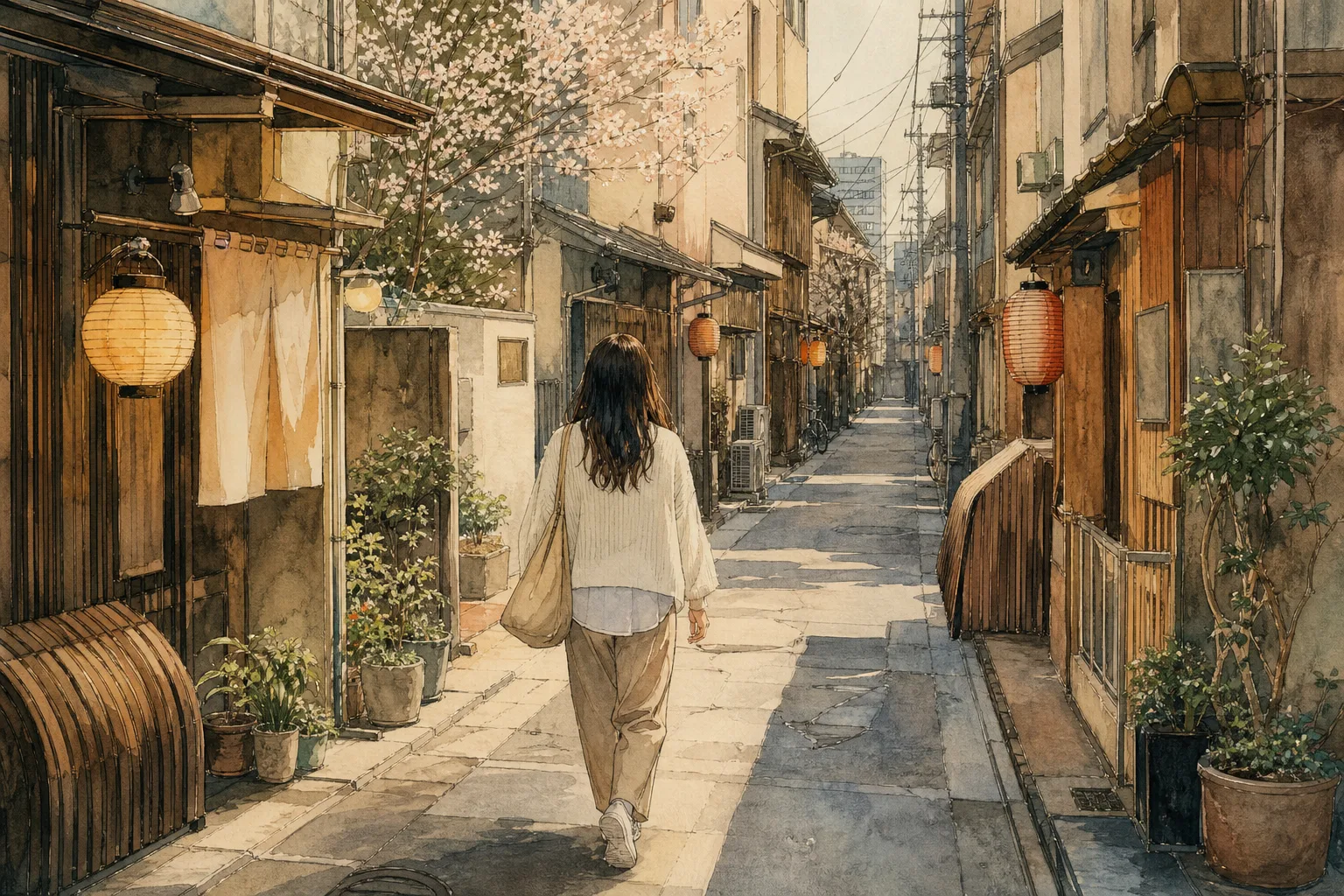
Are there quiet neighborhoods near Dotonbori for a home base? Yes. Areas like Kitahama and Utsubo Park sit a short train or walk from the busy core but feel calmer, which makes them a workable base for sensory-sensitive travelers who still want central access.
Should a highly sensitive person skip Osaka entirely? Not necessarily. The city itself is not uniformly loud or crowded; the reputation comes mostly from a few concentrated districts. A highly sensitive traveler who plans around those pockets rather than avoiding the city altogether often has a fine trip.