travel-decisions
Should You Skip Osaka in Peak Season If You Hate Crowds?
A decision-led guide for crowd-sensitive travelers weighing Osaka in cherry blossom, Golden Week, summer, or November peak. When to skip, when to go anyway.
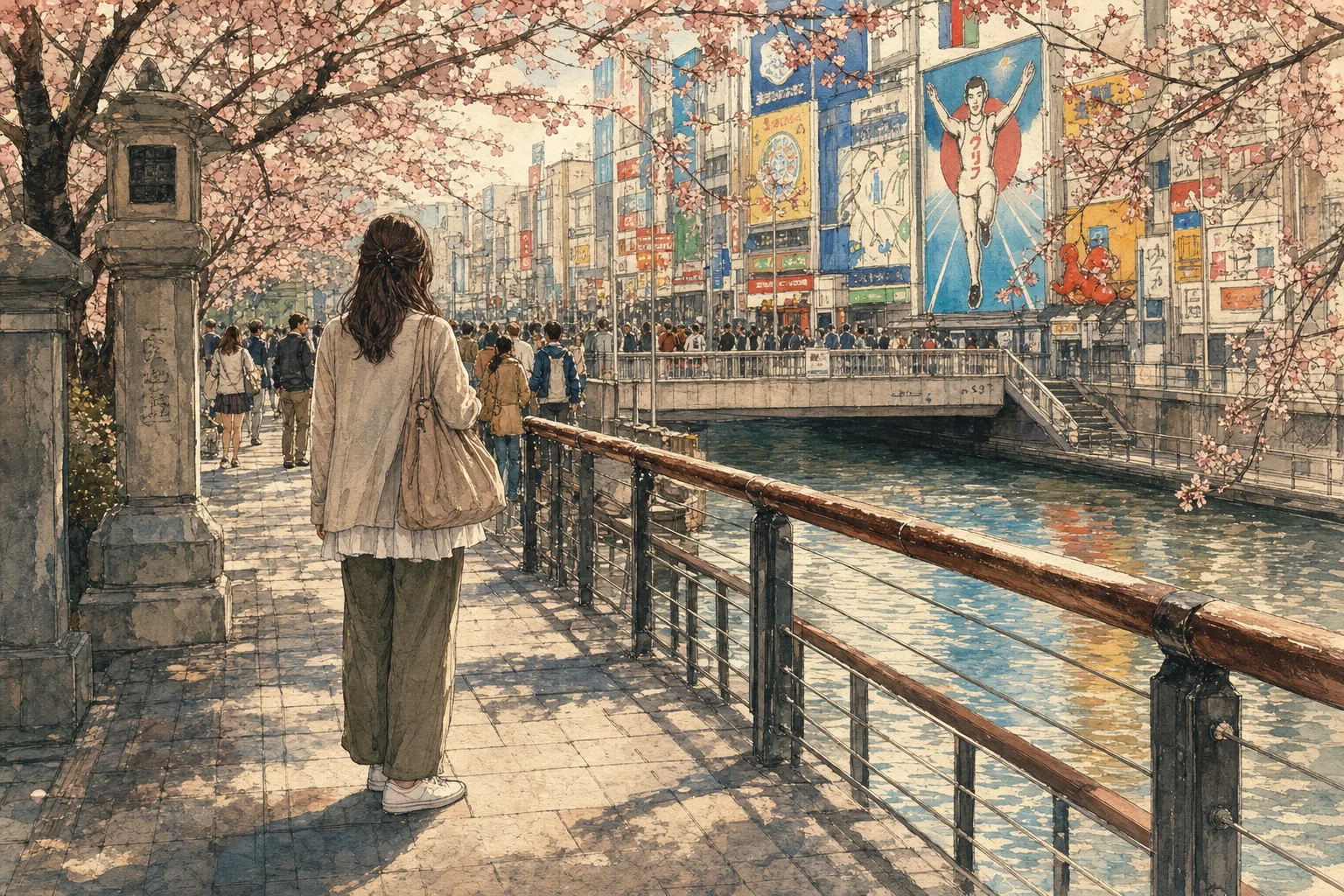
Osaka in peak season is not a single decision. It is four different decisions, because the city has four distinct peak windows: late March to mid-April for cherry blossoms, late April to early May for Golden Week, July and August for summer travel, and November for autumn color. Each one fails crowd-sensitive travelers in a different way, and a few of them are genuinely worth pushing through. Most are not.
If you already know you hate queues, heat, and tightly packed station corridors, the honest question is not "is Osaka still nice in peak season" but "does the version of Osaka I would experience in peak season match the trip I want."
Quick Verdict
Skip Osaka in peak season if you are crowd-sensitive, traveling with low stamina, or want a low-stress trip where you do not have to wake up at 6 AM to enjoy the main streets. Shift to mid-May, June (excluding rainy peak), late September, or early December instead.
Go anyway if you are specifically there for cherry blossoms along Osaka Castle Park or for a fixed event date, and you accept that your days will be planned around early-morning windows, timed entry tickets, and inflated hotel rates.
The two peak weeks worth tolerating are the cherry blossom peak (because the payoff is unique) and parts of November (because temperatures are mild even when streets are dense). Golden Week and August are the two windows crowd-sensitive travelers most often regret.
Who Will Probably Love Osaka in Peak Season Anyway
A few traveler profiles still get a good trip out of peak-season Osaka:
- Travelers who specifically came for hanami and accept that crowds are part of the experience, not a defect.
- High-energy travelers comfortable starting the day at 6:30 AM to walk Dotonbori before the crowds arrive.
- Universal Studios Japan visitors who have already pre-purchased an Area Timed Entry Ticket or Express Pass for Super Nintendo World and the Donkey Kong Country zone, and are not relying on walk-up entry.
- Repeat visitors who already know the back streets, alternate station exits, and which neighborhoods stay calm even when Namba does not.
If you fit one of those profiles, the friction below is manageable. If you do not, it stacks fast.
Who Might Regret It
Peak-season Osaka tends to disappoint these travelers most:
- Low-stress planners who imagined a "relaxed food city" trip. The food is still there, but the queues, the wait for counter seats, and the Umeda Station underground crush are not relaxing.
- First-timers who built the itinerary around Instagram-style empty Dotonbori shots. The real Dotonbori in peak season is shoulder-to-shoulder from late morning until late evening.
- Travelers with knee, foot, or stamina limits. Osaka and Umeda Station can add over 3,000 steps of walking just to transfer between JR, the three subway lines, and the two private rail terminals.
- Anyone who wanted to "decide on the day." Universal Studios' top zones now require timed-entry tickets, and the best Castle Park hanami spots are claimed before noon.
- Budget travelers who did not price in the 30 to 60 percent hotel surcharge plus the new on-site accommodation tax and the higher departure tax from July 2026.
The disappointment pattern is consistent: people come for the atmosphere of Osaka and instead spend their energy managing logistics.
Peak Window Comparison
Not every Osaka peak season is the same kind of bad. Here is the honest tradeoff:
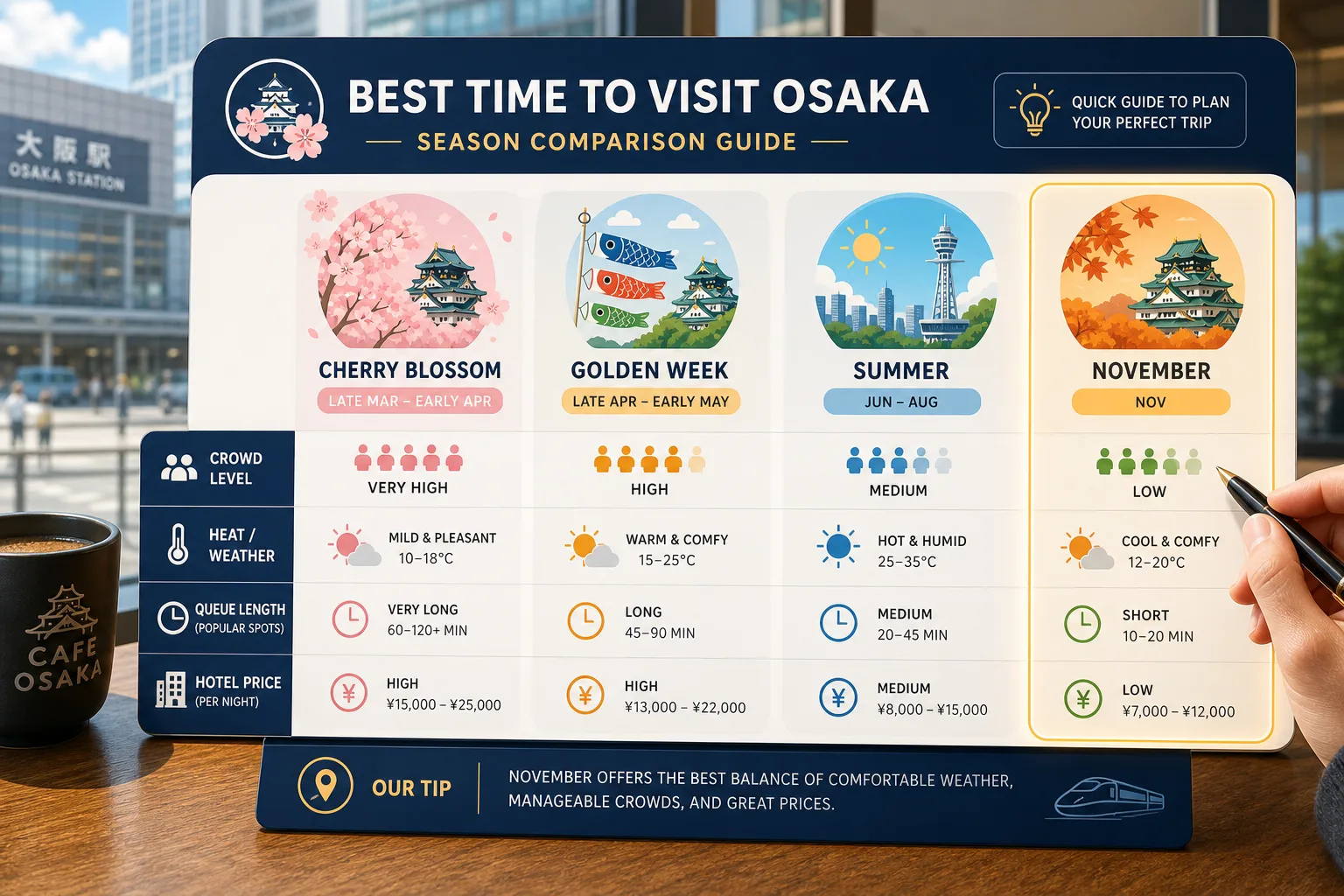
| Peak window | Crowd density | Weather pain | Queue pain | Hotel cost spike | Worth it if... |
|---|---|---|---|---|---|
| Cherry blossom (late Mar to mid-Apr) | Very high | Mild, comfortable | High at Castle Park, Dotonbori | 30 to 60 percent above off-peak | You specifically want hanami |
| Golden Week (late Apr to early May) | Extreme, plus domestic travel | Mild | Highest of the year | Highest of the year | You have no choice on dates |
| Summer (Jul to Aug) | High | Severe heat and humidity | Long, plus shade scarcity | Moderate | You are anchored to USJ or a festival |
| November | High | Cool, comfortable | High at autumn-color spots | 30 to 60 percent above off-peak | You want autumn color and mild walking weather |
If you are crowd-sensitive and the goal is simply "visit Osaka," cherry blossom and November are the only two windows where the payoff usually justifies the friction. Golden Week is almost never worth choosing voluntarily.
Hidden Friction Points Most Guides Skip
The crowd problem in Osaka is not just "many people." It is several overlapping frictions:
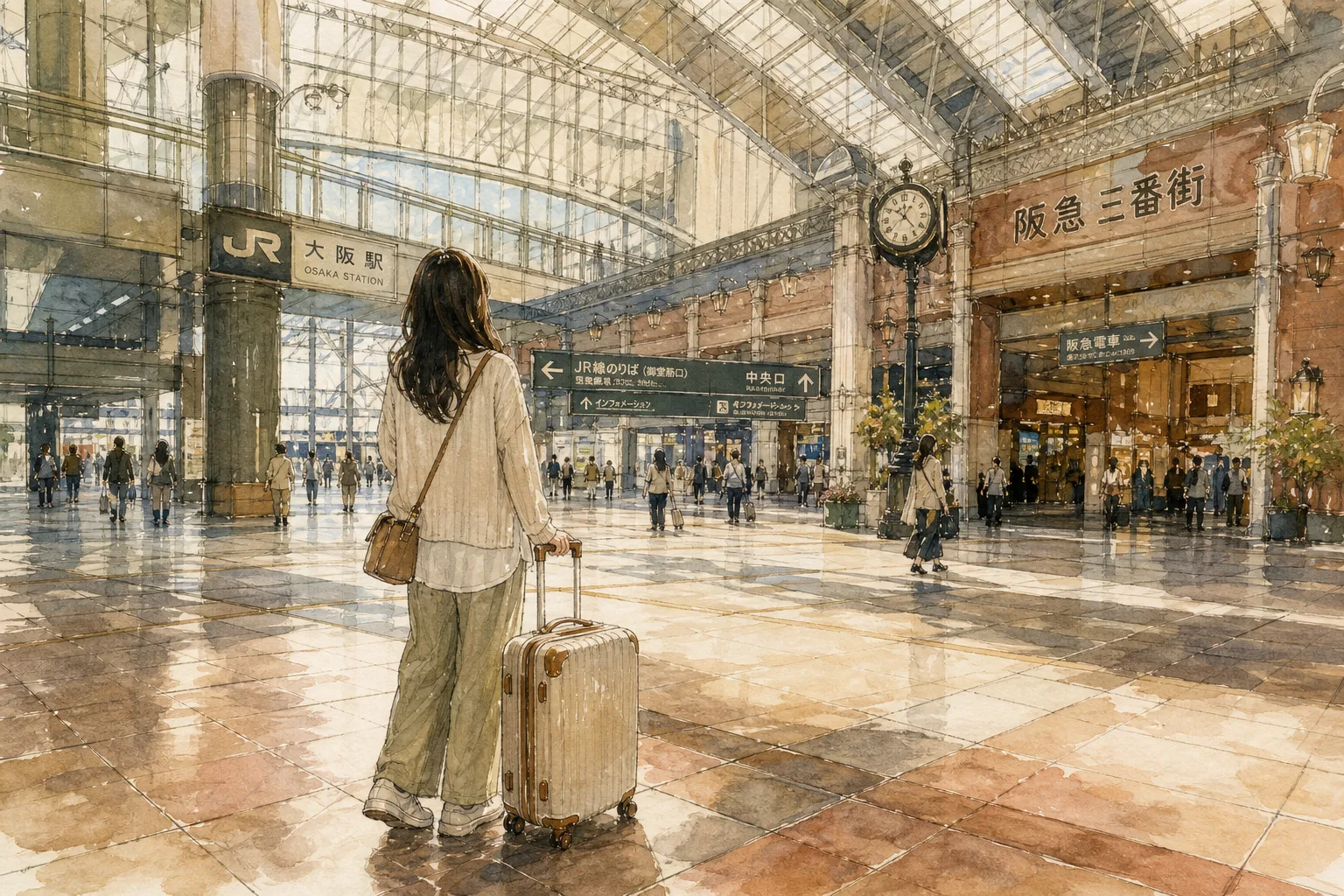
- Station complexity compounds crowd stress. Umeda Station's underground connections between JR, three subway lines, and two private rail terminals can quietly add over 3,000 steps to a transfer, all of it indoors and tightly packed in peak season.
- The walk to landmarks is longer than it looks. From Osakajokoen Station to Osaka Castle's main tower is 1.5 to 2 kilometers, 15 to 20 minutes along largely unshaded paths. From Tanimachi 4-chome Station, it is a 20-minute walk through the Otemon Gate. In July or August heat, that walk alone can end a half day.
- Queues now have hard gates. Super Nintendo World and the Donkey Kong Country zone at USJ require an Area Timed Entry Ticket or pre-purchased Express Pass. Walk-up is not a strategy.
- Dotonbori's "easy access" cuts both ways. It is 3 minutes from Namba Exit 14, 5 to 12 minutes from JR Namba, and 8 minutes from Shinsaibashi Exit 4-B, which is exactly why it overflows. The realistic crowd-free window is 6:30 AM to 10:00 AM.
- Hidden costs stack. Beyond the 30 to 60 percent peak hotel premium, the accommodation tax (200, 400, or 500 yen per night depending on room rate) is collected on-site from June 1, 2026. From July 1, 2026, Japan's international departure tax rises from 1,000 to 3,000 yen, bundled into the ticket. From November 1, 2026, tax-free shopping shifts from instant register discount to an airport refund queue.
Each one is survivable alone. Stacked in a peak week, they exhaust crowd-sensitive travelers within 48 hours.
How to Make Peak-Season Osaka Easier
If you have decided to go anyway, these moves reduce the regret meaningfully:
- Front-load mornings. Walk Dotonbori and Namba Yasaka Shrine between 6:30 AM and 10:00 AM. Treat afternoons as indoor or neighborhood time.
- Pre-book everything that can be pre-booked. Osaka Castle main keep admission (1,200 yen), USJ timed entry, and any popular restaurant that takes reservations.
- Pick a hotel for transit simplicity, not price. A slightly more expensive room on a single line you understand beats a "deal" requiring Umeda transfers.
- Choose one station as your home base and accept you will not see "all of Osaka." Trying to bounce between Umeda, Namba, and the Bay area in peak season is where fatigue compounds.
- Build heat escapes into summer days. Department store basements, Namba Parks, and the Umeda underground are real strategies, not detours.
- Carry cash and a smaller bag. From November 2026, tax-free shopping requires an airport refund queue, so impulse shopping has a different cost profile than before.
Better Alternatives for the Wrong-Fit Reader
If after reading the above you are leaning toward "this is not my trip," realistic alternatives include:
- Shift dates, not destination. Mid-May, June before the rainy peak, late September, and early December all give you the same Osaka with a fraction of the density and lower hotel rates.
- Base in Kobe and day-trip in. Kobe is calmer, hotel rates rise less aggressively, and Osaka is a short train ride for one or two focused days rather than a full-stay commitment.
- Substitute Fukuoka or Kanazawa. Both deliver strong food-and-atmosphere trips with materially lower peak-season crowd pressure than Osaka or Kyoto.
- Keep Osaka but cut its share. Two nights in Osaka plus four nights in a calmer base often beats six nights in Osaka for crowd-sensitive travelers.
Kyoto is not automatically the answer. Its major temples in peak season can be denser than Osaka's busiest streets.
Pre-Booking Self-Checklist
Run through this before you commit. If you cannot honestly check most of these, the peak-season trip is likely to misfire.
- I have confirmed my dates do not fall inside Golden Week unless I am locked in.
- I am willing to start at least two mornings at or before 7:00 AM.
- I have pre-purchased USJ Area Timed Entry or Express Pass if USJ is in the plan.
- My hotel is on a single direct line to where I want to spend most of my time, not requiring an Umeda transfer.
- I have priced in the 30 to 60 percent peak hotel surcharge, the on-site accommodation tax, and the higher departure tax.
- I have a heat plan (or rain plan) for at least one full afternoon.
- I have one backup day with no fixed plan to absorb fatigue.
- I have asked myself honestly whether shifting to mid-May, June, late September, or early December would give me the same trip with less regret.
If three or more of these are uncomfortable, the answer to the title question is probably yes: skip Osaka in peak season, or reshape the trip until it fits.
FAQ
Is Osaka always crowded, or only during peak weeks? Osaka is busy year-round but the painful density is concentrated in late March to mid-April, late April to early May, July and August, and November. Outside those windows, the same neighborhoods feel noticeably looser.
Which Osaka peak season is the worst for crowd-sensitive travelers? Late April to early May (Golden Week) and the cherry blossom peak are the hardest combination of dense crowds, queues, and inflated hotel rates. Summer adds heat and humidity on top of crowds, which is often more punishing than the crowds alone.
Can I still enjoy Dotonbori and Osaka Castle if I hate queues? Yes, but only with timing discipline. Walking Dotonbori and Namba Yasaka Shrine between 6:30 AM and 10:00 AM is the realistic crowd-free window. Osaka Castle's main keep requires committing to the 1,200 yen admission and a 15 to 20 minute unshaded walk, which is harder in summer heat.
Is it cheaper and calmer to skip Osaka and stay in Kyoto or Kobe instead? For crowd-sensitive travelers, basing in Kobe and day-tripping into Osaka often works better than the reverse. Kyoto is calmer in residential pockets but its own peak-season crowds at major temples can be worse than Osaka's.
How much do hotel prices actually jump during peak weeks? Budget hotels that normally run 8,000 to 15,000 yen typically rise 30 to 60 percent during cherry blossom and autumn weeks. Combined with the on-site accommodation tax and the higher departure tax from July 2026, the total cost gap versus shoulder season is meaningful.