travel-decisions
Is Kyoto Worth It in Winter If You Hate Short Daylight And Quiet Evenings?
A friction-first decision guide for travelers weighing Kyoto in winter when short daylight, cold weather, and early closures might break the trip.
Quick Verdict
Kyoto in winter is worth it if you mainly care about quiet temples, low crowds, and clear cold-weather light, and you accept that your day effectively ends around 5 pm. It is not worth it if your idea of a good trip includes long evening walks, lively outdoor streets after dark, or temple-hopping past 4:30 pm.
Choose Kyoto winter if you are a slow traveler, a low-stress planner who likes early dinners, or someone who actively enjoys quiet evenings indoors. Avoid Kyoto winter if you get restless after sunset, dislike planning around closing times, or feel let down when a famous neighborhood looks empty at night. For readers who hate both short daylight and quiet evenings, the honest answer is that Kyoto in winter will probably underdeliver unless you adjust the trip shape on purpose.
The Real Friction Problem
The Kyoto winter problem is not the cold. Daytime temperatures in December through February usually sit between 3 and 10 degrees Celsius, which is manageable with a normal winter coat. The real friction is structural:
- Daylight ends around 4:45 to 5:15 pm in December and January.
- Most temple grounds stop admitting visitors between 4:00 and 4:30 pm.
- Many smaller shops, tea houses, and craft stores close by 5 to 6 pm.
- Outside three or four central districts, streets feel empty by 7 to 8 pm.
- Trains back from outlying areas like Arashiyama or Kurama thin out earlier than in Tokyo, which adds a quiet undertone of last-train pressure.
For travelers who already hate short daylight and quiet evenings, all four pressure points stack at once. You lose useful sightseeing hours, you lose the temple ambience that drew you in, and the evening reward of a buzzing street does not arrive to compensate.
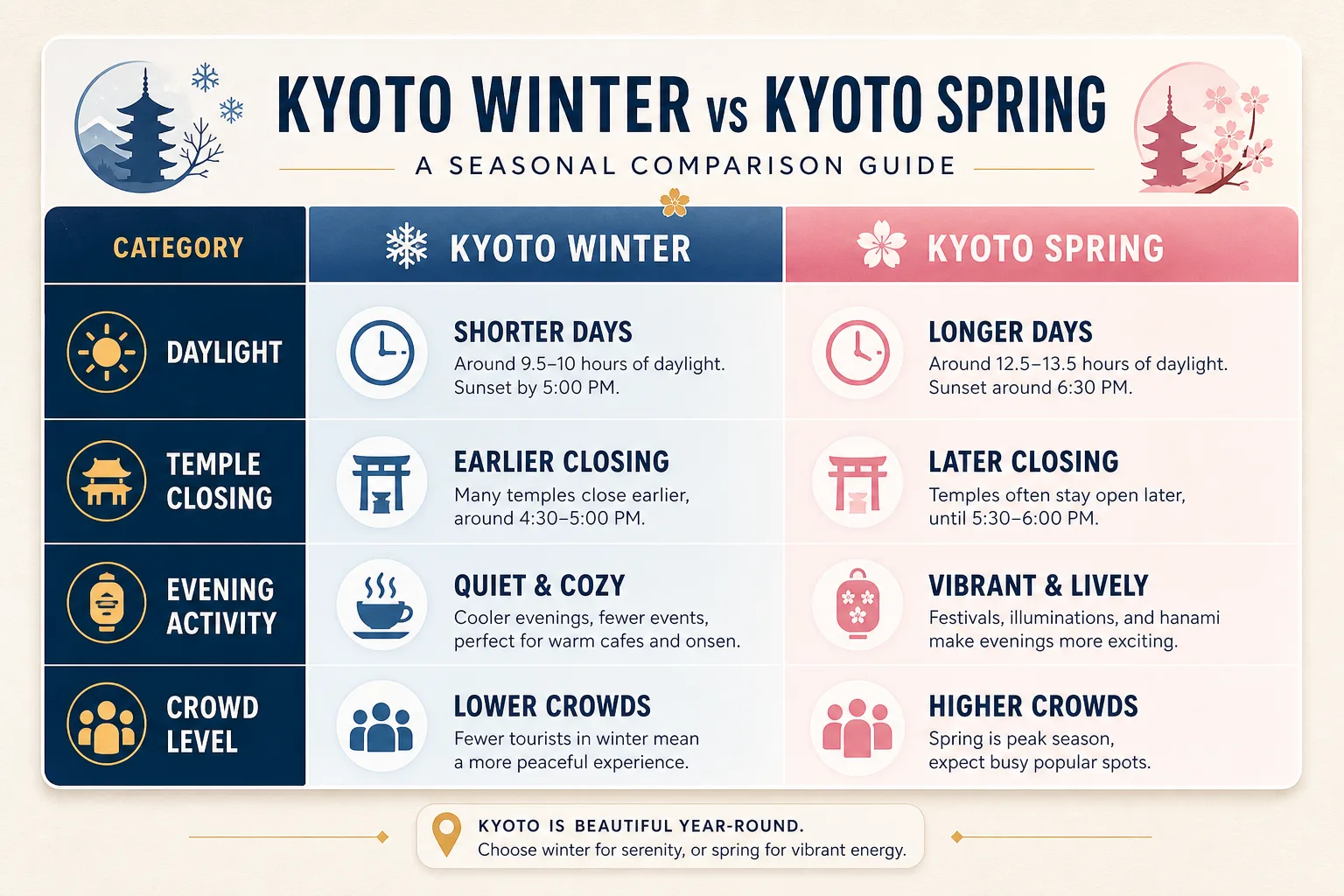
Friction Table
Use this to compare what winter actually delivers against the seasons most people imagine when they picture Kyoto.
| Variable | Winter (Dec to Feb) | Spring (late Mar to Apr) | Autumn (mid Nov) |
|---|---|---|---|
| Useful daylight | About 8.5 hours | About 12 hours | About 10 hours |
| Last temple entry | 4:00 to 4:30 pm | 5:00 to 5:30 pm | 4:30 to 5:00 pm |
| Evening street life | Quiet outside central core | Active citywide until 9 to 10 pm | Active in main districts |
| Crowd level | Low to very low | Very high | High |
| Hotel pricing | Low (except New Year week) | Peak, often double | High |
| Cold or weather risk | Cold, occasional snow, dry | Mild, rain possible | Mild, comfortable |
| Photo light window | Short, ends by 4:30 pm | Long golden window | Long, warm tones |
The pattern is clear: winter trades evening life and daylight for cost and calm. If you do not value the calm, the math does not work in your favor.
Who Will Feel It Most
The travelers who regret Kyoto winter most are not unprepared, they are mismatched.
You will feel the friction most if you:
- Treat sunset as the start of the second half of your day, not the end of the first.
- Like walking through busy streets after dinner to wind down.
- Pack itineraries with 6 to 8 sights per day.
- Travel with someone who gets low-mood in dim weather.
- Came to Kyoto expecting the soft, lantern-lit evening feel often shown in spring or autumn coverage.
You will feel it least if you:
- Plan around long lunches and early dinners.
- Enjoy reading, hotel onsen, or kissaten cafes in the evening.
- Are visiting a second time and do not need to maximize sights.
- Specifically came for snow on temple roofs or off-peak quietness.
If you are reading this article because you already dislike short daylight and quiet evenings, you are almost certainly in the first group. That does not mean you cannot go, but the trip needs to be reshaped, not just packed warmer.
How to Reduce the Friction
If you still want to go, the goal is to shift your day forward and concentrate your evenings in the few districts that stay active.
Practical adjustments that actually work:
- Start sightseeing at 8:00 or 8:30 am. This is the single highest-impact change. It adds two hours of useful light per day compared with a 10 am start.
- Front-load outdoor temples in the morning and use afternoons for covered destinations: Nishiki Market, department-store food halls, Kyoto Railway Museum, or the Kyoto National Museum.
- Book your hotel in Kawaramachi, Gion, Pontocho, or directly around Kyoto Station. These are the only areas where evening quietness is not a serious problem.
- Plan dinner reservations between 6:00 and 7:30 pm. Many smaller restaurants stop seating by 8:30 pm in winter.
- Avoid placing Arashiyama, Ohara, or Kurama on the same day as your latest activity. These get dark and quiet fast.
- Use one evening for a kaiseki dinner or a tea ceremony experience. These reframe quiet evenings as the point rather than the problem.
None of this fixes daylight length. It just stops you fighting it.
Better Alternatives
If after reading the friction table you suspect Kyoto winter is not your fit, here are honest alternatives matched to what you actually want.
- You want Kyoto specifically, just not winter: aim for the first ten days of April for cherry blossoms with long days, or mid-November for autumn color with comfortable evenings. Both are crowded and expensive, but they solve the daylight and evening problem cleanly.
- You want low crowds and quiet temples without the dim evenings: try late May to mid-June. Daylight runs past 7 pm, crowds drop after Golden Week, and evening streets stay lively. Humidity rises by late June.
- You want winter Japan but with more evening energy: Tokyo and Osaka both stay busy past 10 pm year round, with the same short daylight but far more indoor and nighttime options.
- You want a winter cultural trip that genuinely rewards short days: a snow-focused itinerary built around Kanazawa, the Japan Sea coast, or Tohoku leans into winter rather than apologizing for it.
The point is not that Kyoto winter is bad. It is that Kyoto winter rewards a specific temperament, and forcing it on the wrong temperament is the actual regret risk.
Decision Checklist
Run through this before you book. If you answer no to more than two, reconsider the timing.
- I am comfortable starting sightseeing by 8:30 am every day.
- I am willing to stay in Kawaramachi, Gion, Pontocho, or near Kyoto Station, even if the hotel costs more.
- I accept that most temples will be closing by the time I finish a leisurely lunch.
- I have at least one planned indoor or evening experience: kaiseki, tea ceremony, a specific bar, or a museum.
- I am not relying on long evening walks as my main way to enjoy a city.
- My travel companion is also fine with early dinners and quiet nights.
- I am visiting outside December 29 to January 3, when many places close entirely.
- I have a backup indoor plan for at least one cold or rainy day.
A clean yes across this list usually means winter Kyoto will work for you. A pattern of no answers means you are likely the reader the title is asking about, and a different season will protect the trip.
FAQ
Does Kyoto really get quiet at night in winter? Most temples and many neighborhood shops close between 4 and 5 pm, and outside of central Kawaramachi, Gion, and the area around Kyoto Station, streets get notably quiet by 7 to 8 pm. If you enjoy long evening strolls past lit-up storefronts, winter Kyoto can feel underpopulated compared to Tokyo or Osaka.
How short is the daylight in Kyoto winter? In December and January, sunrise is around 7:00 am and sunset falls between roughly 4:45 and 5:15 pm. Useful sightseeing light usually ends by 4:30 pm, which gives you about 8 to 9 productive hours per day if you start by 8:00 am. By mid-February, you gain about 30 extra minutes of evening light.
Is winter cheaper or less crowded enough to be worth it? Mid-January to early February is one of the lowest-demand windows of the year in Kyoto, with easier hotel availability and noticeably thinner crowds at major temples like Kiyomizu-dera and Fushimi Inari. The tradeoff is the daylight and evening quietness, not the cost or the queues. For travelers who value calm over evening energy, the math is favorable. For travelers who do not, the savings rarely compensate.
What is the single best fix if I still want to go in winter? Stay near Kawaramachi, Gion, Pontocho, or Kyoto Station rather than in quieter residential or scenic areas like Arashiyama, Ohara, or northern Higashiyama. Walkable nightlife, dinner options, and late-open cafes are concentrated in those central districts, and being able to walk back from dinner instead of timing a last train removes most of the evening friction.
Are illuminations or winter events enough to fix the quiet evenings? Specific events like the Arashiyama Hanatouro replacement programs, temple winter light-ups, or seasonal illuminations at places like Kodai-ji can add real evening activity, but they are scattered across short date ranges. Check exact dates before booking. Outside event nights, evenings revert to the normal winter quietness, so do not plan the whole trip around them.