city-matchups
Insadong vs Ikseon-dong: Which Traditional Quarter is Less Claustrophobic for Slow-Paced Travelers?
A direct comparison of Insadong and Ikseon-dong for slow-paced travelers, focused on crowd density, narrow alleys, hotel location risk, and walking fatigue rather than general sightseeing appeal.
Author: Trip Persona Editorial Team. Last updated: 2026-09-06. This article contains no paid placements; any tool or quiz links are internal Trip Persona resources, not affiliate links.
Quick Verdict
Pick Insadong. If you walk slowly, dislike being physically bumped, or are traveling as an older couple who wants a traditional-Korea experience without narrow squeezes, Insadong is the correct choice, not a close call. Its main street is wide, largely pedestrianized on weekends, and lined with buildings that absorb crowds instead of trapping them.
Pick Ikseon-dong only if you are a steady, fast-recovering walker who does not mind narrow alleys and does not mind pausing often to let others pass. Its dense hanok alleys photograph beautifully but punish anyone who needs personal space or moves at an unhurried pace.
For introverted travelers, slow walkers, and older couples specifically, Insadong wins on every axis that matters here: alley width, seating pressure, walking-surface predictability, and hotel location safety. Ikseon-dong is not a bad neighborhood. It is the wrong shape for a low-stress, unhurried visit, and it is also the riskier place to sleep if you are rolling a suitcase or sensitive to night noise.
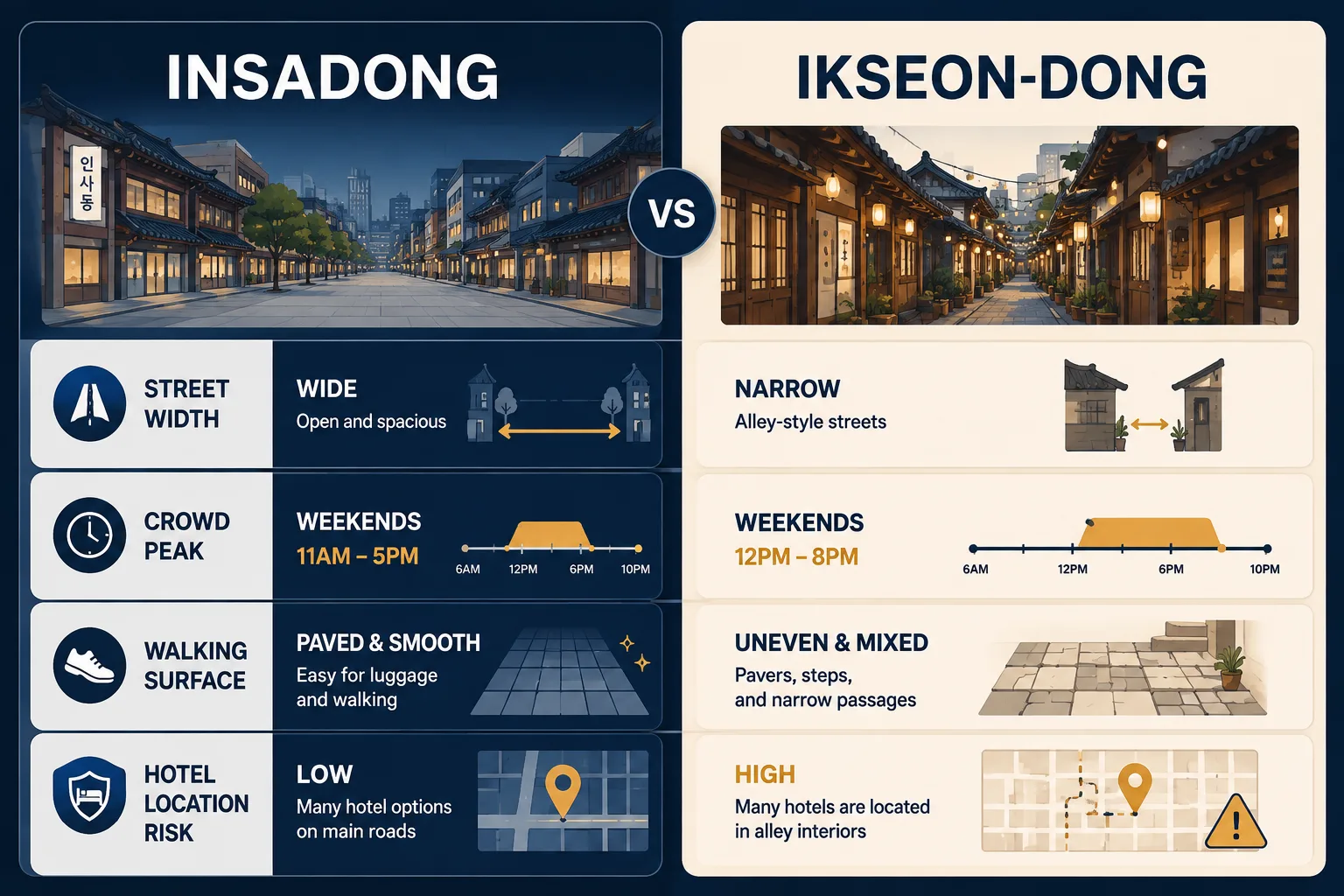 Editorial illustration: A simple side-by-side comparison layout with two labeled columns.
Main Friction Problem
The real question is not which area is prettier. It is which area lets you move at your own pace without being physically herded. Insadong and Ikseon-dong answer that differently because they were built at different scales for different purposes.
Insadong-gil is a single, comparatively wide street that has functioned as an antiques and craft district for decades. It closes to vehicle traffic on Saturdays from 2:00 PM to 10:00 PM and Sundays from 10:00 AM to 10:00 PM. That sounds like it should raise crowding, but the street width absorbs pedestrian volume well, so foot traffic spreads out instead of bottlenecking.
Ikseon-dong is the opposite shape. It packs roughly 110 preserved single-story hanok homes into a dense network of narrow, winding alleys originally built as a residential quarter, not a tourist thoroughfare. When visitor volume rises, there is no width to absorb it. Two people with shopping bags can fill an alley, and a slow walker behind them has nowhere to pass.
Walking fatigue compounds this difference. Insadong's flat, wide street lets a slow walker set their own rhythm and step aside easily to rest. Ikseon-dong's narrow, winding alleys force constant minor course corrections and frequent stopping for oncoming pedestrians. For someone managing joint pain or low stamina, that unpredictability tires you out faster than the raw distance covered.
Friction Table
| Decision variable | Insadong | Ikseon-dong |
|---|---|---|
| Street width | Wide main street, absorbs crowds | Narrow alleys, crowds bottleneck fast |
| Weekend crowd feel | Busy but spread out | Dense and close-contact |
| Quietest visiting window | Weekday mornings, or outside the weekend pedestrian-only hours | Weekday mornings before shops open |
| Peak crowd window | Saturday and Sunday afternoons | After 6:00 PM weekdays, all day weekends |
| Walking surface | Flat, wide pavement | Uneven alley flooring, frequent turns |
| Mobility access | Ssamzigil has a ramp, flat entry, elevator, accessible restrooms | No comparable ramp or elevator infrastructure in the alleys |
| Seating pressure at tea houses | Larger footprints, lower pressure to vacate | Smaller cafes, higher table turnover pressure |
| Nearest station walk | Anguk Station Exit 6, 200m, about 5 minutes, flat | Jongno 3-ga Station Exit 4, 141m, 1 to 2 minutes, flat |
| Hotel location risk if staying inside the quarter | Low; side streets are wider, suitcase-friendly | High; deep-alley hanok stays mean rolling luggage over uneven stone and late-night bar noise from nearby alleys |
Recommendation by Traveler Type
Not every slow-paced traveler has the same constraint. This breaks the decision down by what is actually limiting you, not just a general label.
| Traveler type | Recommended quarter | Why |
|---|---|---|
| Active senior, no mobility aid | Insadong | Wide flat street means less energy spent navigating, more spent enjoying |
| Wheelchair or cane user | Insadong (Ssamzigil specifically) | Only one of the two has a ramp, elevator, and accessible restroom in one complex |
| Introverted traveler, dislikes close contact | Insadong | Street width keeps other visitors at arm's length even on busy days |
| Photo-focused traveler, comfortable with crowds | Ikseon-dong | Dense hanok alleys give the visual density that photos reward |
| Couple wanting a slow tea house sit-down | Insadong | Larger interiors mean less pressure to vacate a table quickly |
| Traveler prioritizing a short, curated photo walk over a full afternoon | Ikseon-dong, weekday morning only | The alley network is compact enough for a 30 to 45 minute loop before crowds build |
| Traveler booking a hotel who wants quiet nights and easy luggage rolling | Insadong or just outside Ikseon-dong's core alleys | Deep-alley hanok stays trade atmosphere for luggage friction and bar noise |
Who Will Feel It Most
The traveler who feels Ikseon-dong's narrowness most acutely is exactly the reader this article is for: someone who walks slowly, prefers not to be jostled, or is visiting with a spouse at a matched, unhurried pace. On a wide street, a slow pace is invisible. In a narrow alley, a slow pace becomes an obstacle other people have to route around, and that social pressure is its own kind of fatigue.
Older travelers and anyone managing joint or balance issues will notice the footing difference before anything else. Ikseon-dong's alley flooring is uneven in places, and the winding layout adds more turns and curb edges, so there is less chance to walk a straight line at a steady pace. Insadong's flat, wide pavement removes that variable almost entirely.
Introverts and anyone sensitive to close physical proximity will notice the crowd contrast most on weekends. Insadong on a Saturday afternoon is busy, but the street width keeps people at arm's length. Ikseon-dong on the same afternoon puts you shoulder to shoulder with other visitors in alleys barely wide enough for two people walking abreast.
Fast-paced, photo-focused travelers are the one group who will actually prefer Ikseon-dong. If your priority is atmospheric photos and you do not mind moving in short bursts between packed alleys, the density that bothers a slow traveler will barely register for you.
How to Reduce the Friction
If Ikseon-dong is still on your list despite the crowding, timing is the single biggest lever you have. The quietest window is weekday mornings before shops open, well ahead of the after-6pm weekday crowd and the all-day weekend crowd. Arriving at opening time on a Tuesday or Wednesday morning changes the experience from a squeeze to a stroll.
In Insadong, crowd management works differently because the street itself does most of the work. If you want to avoid even the spread-out weekend crowd, visit on a weekday, or arrive before the Saturday 2:00 PM and Sunday 10:00 AM pedestrian-only windows begin, when vehicle traffic is still present but foot traffic is lighter.
For walking fatigue specifically, build in a deliberate stop. Ssamzigil in Insadong has a gently sloping ramp that winds upward around an open-air courtyard, plus a flat entryway, elevator access, and accessible restrooms. That makes it a realistic rest point rather than another walking obstacle. Ikseon-dong offers no equivalent structured rest space, so plan your own seated breaks into a cafe before your legs decide for you.
For narrow-space anxiety in Ikseon-dong, treat the visit as a short loop rather than a full afternoon. Thirty to forty-five minutes covers the core alleys. Extending it much longer mostly adds fatigue and repeated crowd contact rather than new scenery, since the alley network is compact by design.
For hotel location specifically, do not book a room deep inside Ikseon-dong's core alley cluster if you are rolling a suitcase or sensitive to noise. Those alleys were built for pedestrians on foot, not luggage wheels on uneven stone, and the bars and cafes nearby stay loud into the evening. A room on a wider street just outside the alley cluster, or near Anguk Station in Insadong, gets you the same walking access without the nightly noise or the wheeled-suitcase struggle.
Better Alternatives
If you are drawn to Ikseon-dong's hanok aesthetic but the alley width is the dealbreaker, Insadong delivers a similar traditional-Korea atmosphere at a more forgiving scale. Its zoning rules keep fast-food franchises, convenience stores, and modern entertainment clubs out of the core area, preserving the same old-Seoul character without the physical squeeze.
If your real priority is a slow, unhurried tea house sit-down rather than alley photography, Insadong is the better redirect outright. Its buildings have more interior space, meaning less pressure to give up a table quickly during busy hours.
If you specifically want the narrow-alley, high-density hanok photo opportunity and crowding is a secondary concern, Ikseon-dong on a quiet weekday morning is still worth the trip. Just do not plan it as your all-day base if you are traveling with a slow-paced companion, and do not book your hotel room inside its core alleys.
If mobility is your primary constraint rather than crowd sensitivity, Insadong is the clearer choice regardless of timing, because Ssamzigil's ramp and elevator access have no real equivalent in Ikseon-dong's alley network.
Decision Checklist
Use this before committing either neighborhood, or a hotel near either one, to your itinerary:
- Are you or your travel companion a slow, unhurried walker? Favor Insadong.
- Does anyone in your group use a cane, wheelchair, or need step-free access? Favor Insadong, specifically Ssamzigil.
- Is your visit during a weekend afternoon? Expect Ikseon-dong's alleys to feel tight; consider a weekday morning instead.
- Do you want a relaxed, seated tea house experience rather than a walking photo tour? Favor Insadong.
- Are you comfortable pausing frequently to let others pass in a narrow space? If not, limit Ikseon-dong to a short weekday-morning visit.
- Are you booking a hotel inside Ikseon-dong's core alleys? Reconsider if you have a rolling suitcase or want a quiet night; pick a wider street or Insadong-side instead.
- Do you plan to visit both? Budget the flat 10 to 15 minute walk between them and a rest stop in between, not a rushed back-to-back visit.
FAQ
Is Insadong or Ikseon-dong more crowded? Ikseon-dong feels more crowded for its size because its alleys are narrow and its footprint is small. Insadong has more total visitors on weekends, but its main street is wide enough to absorb the crowd without forcing close contact.
Can I visit both Insadong and Ikseon-dong in one day without exhausting a slow walker? Yes. The two areas are 550 to 800 meters apart, a flat 10 to 15 minute walk. A realistic plan is Insadong in the morning, a rest, then a short pass through Ikseon-dong in the early afternoon before its evening crowd builds.
Is Ikseon-dong wheelchair or cane friendly? Not particularly. Its alleys are narrow and the flooring is uneven in places, so a cane or wheelchair user will move slower and may need to backtrack. Insadong, especially the Ssamzigil complex with its ramp and elevator, is the easier option for mobility needs.
What time should I visit Ikseon-dong to avoid crowds? Weekday mornings before shops open are the quietest window. Ikseon-dong gets busiest after 6:00 PM on weekdays and all day on Saturdays and Sundays, so avoid those windows if crowding is your main concern.
Where should I book a hotel if I want to be near both quarters without the noise? Book near Anguk Station or along the wider streets just outside the core Ikseon-dong alley cluster. That puts you within the flat, 10-to-15-minute walk between both quarters while keeping your actual sleeping location on a street wide enough for a suitcase and quiet enough to sleep through.
Which quarter is better for a slow-paced tea house visit? Insadong is the more reliable choice for an unhurried tea house sit-down, since its wider street and larger building footprints mean less pressure to free up a table quickly. Ikseon-dong's tea houses and cafes tend to be smaller and busier, which works against a slow, lingering visit.