where-to-stay
Should You Stay in Ueno or Shinjuku on a First Tokyo Trip?
A friction-first comparison of Ueno and Shinjuku for first-time Tokyo visitors, covering airport access, station complexity, family practicality, and noise.
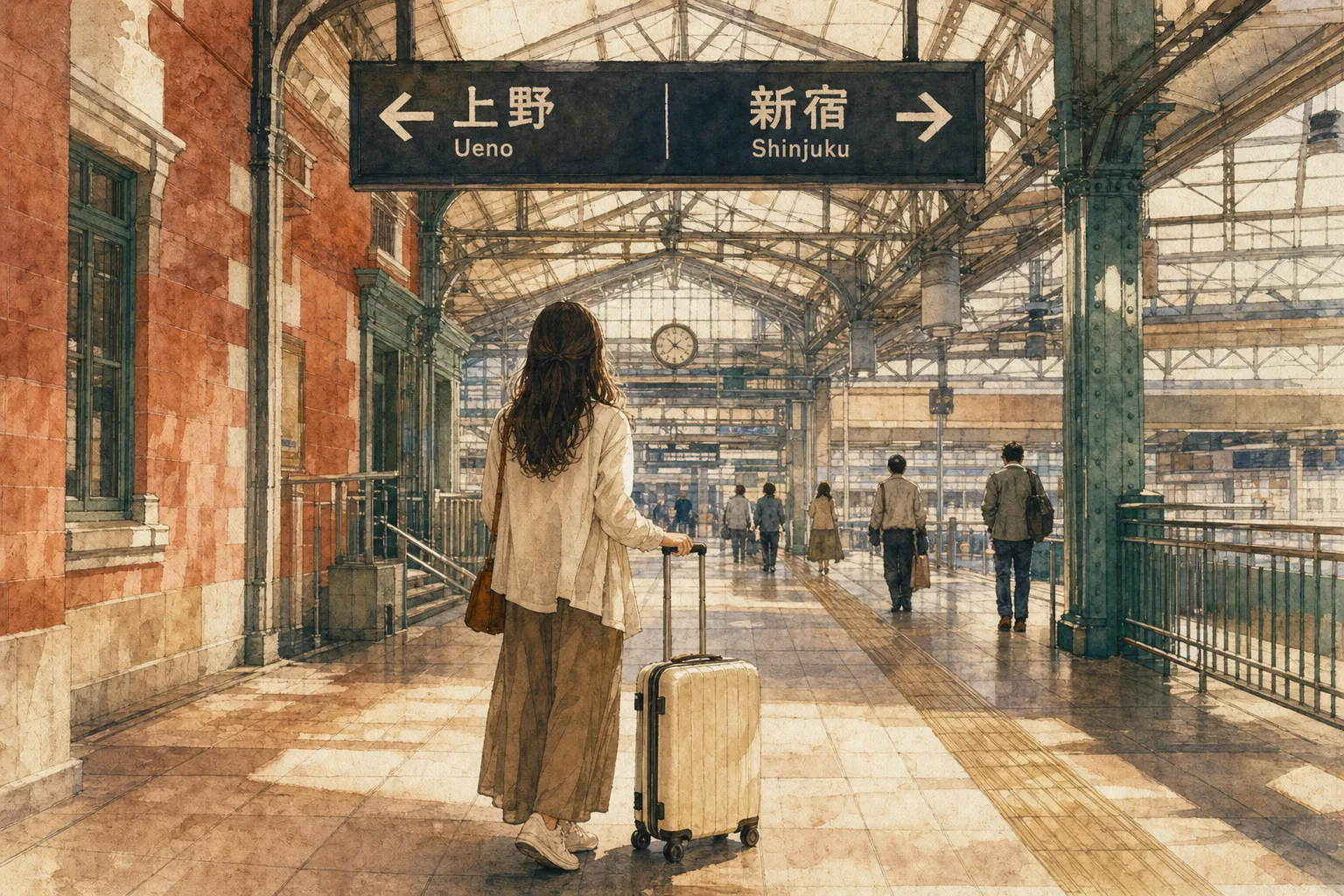
Most first-time Tokyo visitors pick between Ueno and Shinjuku based on a vibe they saw online. That is the wrong filter. Your hotel base mostly decides three things: how rough your arrival day feels, how well you sleep, and how much you spend per night. Sightseeing distance barely changes between these two on the Yamanote Line.
This guide compares Ueno and Shinjuku by the friction you will actually feel, not by which one photographs better.
Quick Verdict
Stay in Ueno if: you are arriving at Narita, you want a quieter base, you are traveling with kids or older parents, you want to save roughly 40 to 50 percent on hotel cost, or you want a low-stress first 48 hours in Tokyo.
Stay in Shinjuku if: you are arriving at Haneda, your trip is heavily west-side (Shibuya, Harajuku, Shinjuku nightlife, day trips on the Odakyu or Chuo lines), you want walkable late-night food and bars, and you are comfortable learning a complex station.
Avoid both if: you want a calm, low-tourist neighborhood feel. In that case, look at Kuramae, Yanaka, or quieter parts of Nihonbashi instead.
The honest summary: Ueno is the safer default for a first trip. Shinjuku is the better choice only when its specific strengths match your itinerary.
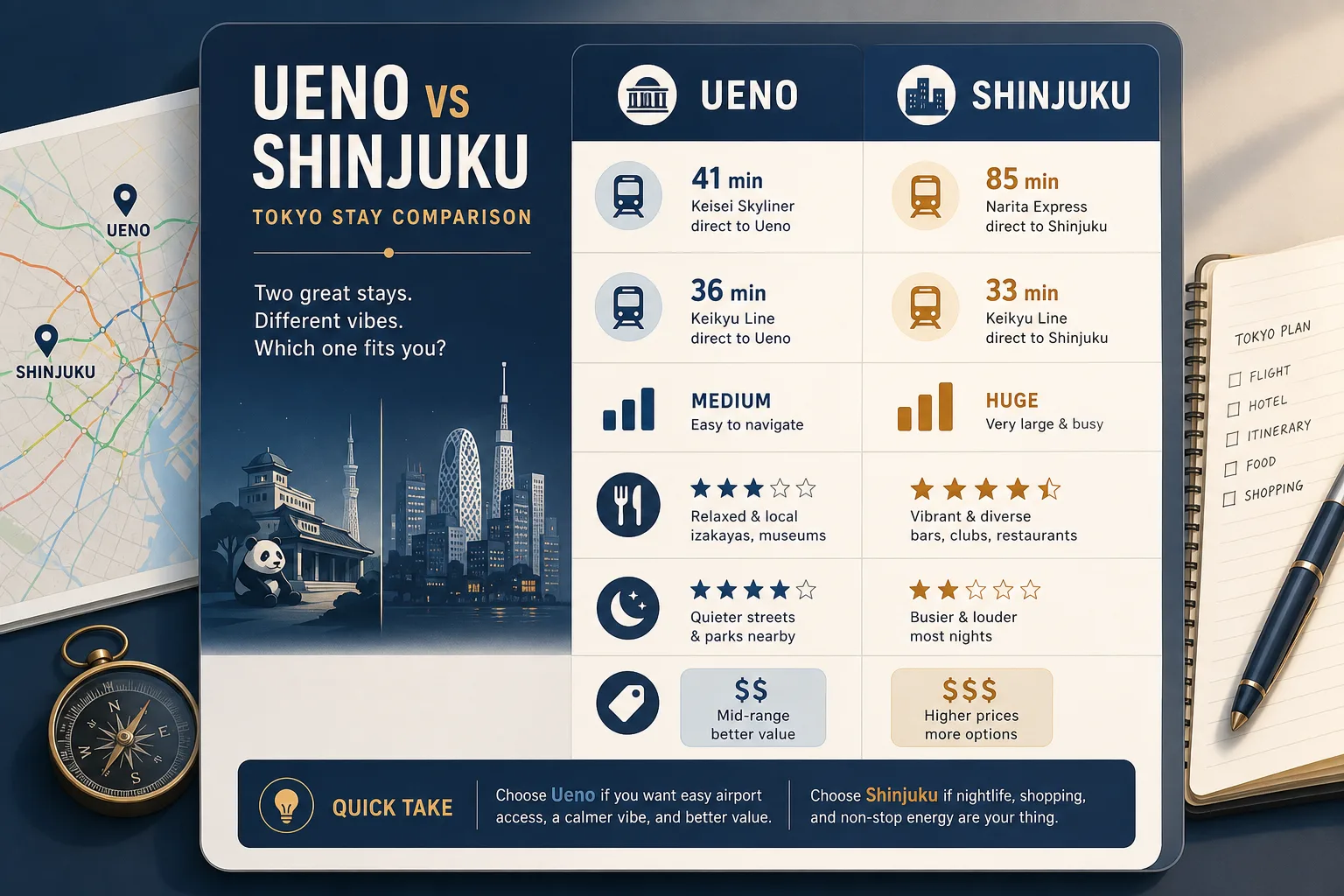 An infographic comparing Ueno and Shinjuku across various categories like travel time, scale, dining, and budget, set alongside a map and notepad.
The Real Friction Problem
The Ueno vs Shinjuku decision usually breaks down across four friction points. None of them are about which area is "more authentic."
1. Airport access. Narita and Haneda are not interchangeable. From Narita, Ueno is dramatically faster and cheaper to reach. The Keisei Skyliner runs to Keisei Ueno Station in 41 to 43 minutes for 2,520 to 2,580 yen one-way. To Shinjuku, the JR Narita Express takes 75 to 80 minutes for 3,250 to 3,330 yen (foreign passport holders can buy a 5,200 yen round-trip). From Haneda, the math flips: a direct Airport Limousine Bus reaches Busta Shinjuku and major Shinjuku hotels in 45 to 80 minutes for 1,400 yen, which is much friendlier with luggage than transferring through the train system to Ueno.
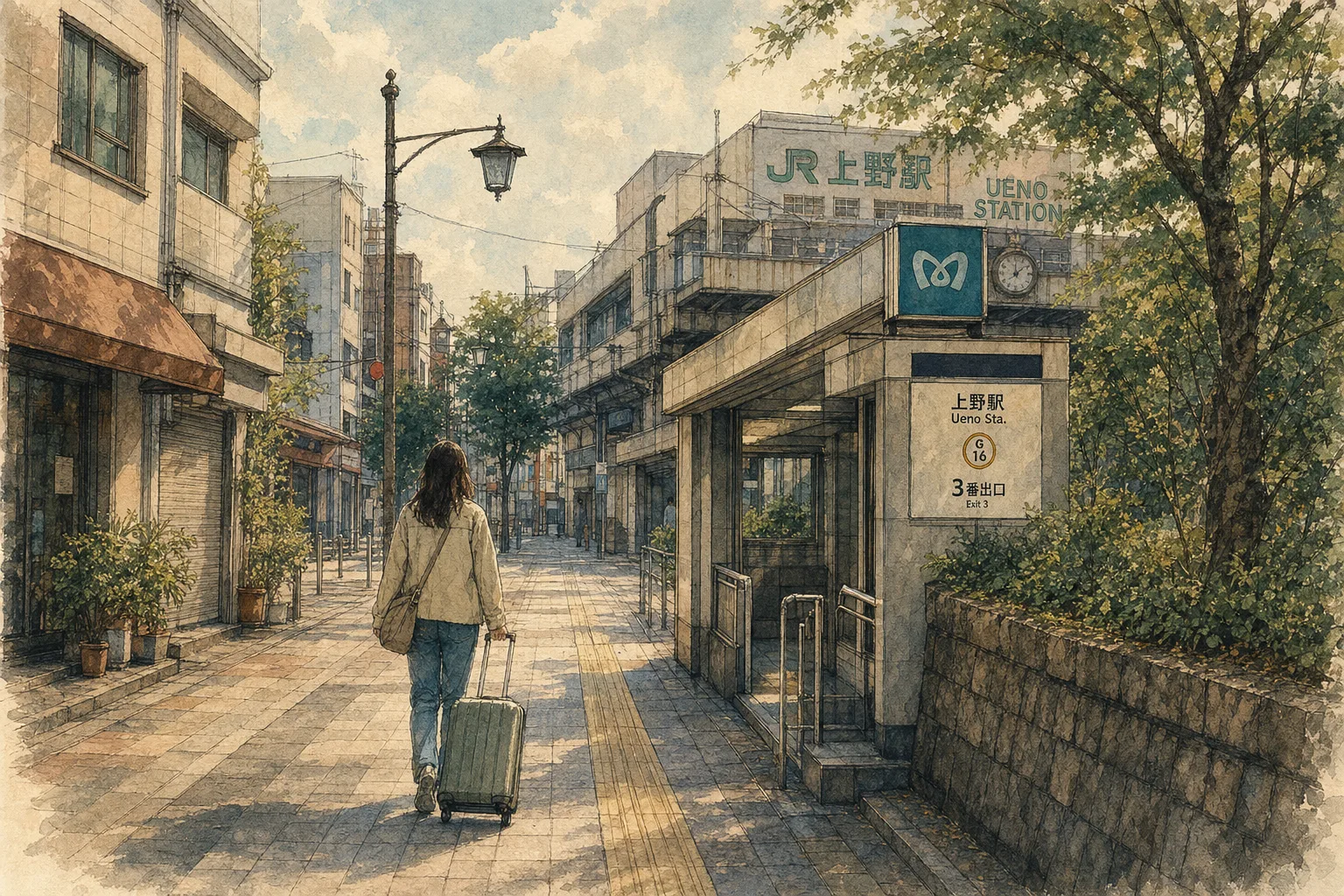
2. Station complexity. Shinjuku Station handles 3 to 3.5 million passengers daily with up to 53 platforms and more than 200 exits. On day one, with jet lag and a suitcase, that is genuinely hard. Ueno's JR section has 4 main ticket gates and 9 exits, which you can map mentally in a single afternoon.
3. Family and quiet-sleep practicality. Ueno wraps up earlier. Most local drinking spots around Ameyoko and Okachimachi close down by 11 PM to midnight. Shinjuku, especially near Kabukicho roughly 800 meters (a 10-minute walk) north of the station, runs loud well past midnight. Quiet sleep in Shinjuku is possible but requires careful hotel selection.
4. Nightlife vs calm tradeoff. If late-night bars, izakaya hopping, and 2 AM ramen are central to your trip, Shinjuku is unmatched. If they are not, you are paying a premium (about 16,000 yen per night more) for noise you do not want.
Friction Table
| Friction Factor | Ueno | Shinjuku |
|---|---|---|
| Narita access | Skyliner, 41 to 43 min, ~2,520 to 2,580 yen | Narita Express, 75 to 80 min, ~3,250 to 3,330 yen |
| Haneda access | Train transfer required, more steps with luggage | Direct Limousine Bus, 45 to 80 min, 1,400 yen |
| Station size | 4 main JR gates, 9 exits | Up to 53 platforms, 200+ exits |
| Late-night noise | Mostly quiet after 11 PM to midnight | Loud near Kabukicho until early morning |
| Family friendliness | Strong (parks, museums, calmer streets) | Mixed (depends heavily on hotel location) |
| Average hotel price | Roughly 40 to 50% less | Roughly 16,000 yen more per night |
| Signature anchors | Ueno Park (under 1-min walk from JR Park Exit), Ameyoko (3-min walk, 100m from Hirokoji Exit) | Tokyo Metropolitan Government Building observation decks (free, 10 to 15-min underground walk), Shinjuku Gyoen (about 500 yen, ~1km / 10-min walk from Southeast Exit) |
| Best for | Narita arrivals, families, budget-conscious first-timers | Haneda arrivals, west-side itineraries, nightlife |
Who Will Feel the Friction Most
First-time visitors arriving at Narita on an evening flight. You will feel Shinjuku's friction hardest here. After a long flight, the 75 to 80 minute Narita Express plus navigating 200+ exits with a suitcase is the worst possible introduction to Tokyo. Ueno cuts that to about 41 to 43 minutes plus a short walk.
Families with young kids or older parents. Shinjuku Station's scale and the crowds around Kabukicho are real obstacles with strollers or slower walkers. Ueno's park, museums, and shorter station walks are noticeably easier.
Nightlife-led travelers on a short trip. This is the one group that genuinely benefits from Shinjuku. Walking back to your hotel from Golden Gai or Kabukicho at 1 AM is a different experience than train-hopping back to Ueno after the last train.
Budget travelers. That ~16,000 yen per night gap is real. Over 5 nights, you are looking at roughly 80,000 yen, which is a serious chunk of a first-trip budget.
How to Reduce the Friction
If you have already half-decided, here is how to soften the weak side of each area.
If you pick Ueno but arrive at Haneda: take the Keikyu Line to Asakusa or Shinagawa, then transfer. Or just take a taxi if you are arriving late, tired, or with multiple bags. The premium is worth it once.
If you pick Shinjuku but worry about the station: book a hotel within a 5-minute walk of one specific exit (New South, South, or West are easier than East). Learn that one exit on day one and ignore the rest for 48 hours.
If you pick Shinjuku but want quiet sleep: avoid hotels north or east of the station near Kabukicho. Look at the west side near the government buildings, or one stop south near Yoyogi or Sendagaya. Both put you a few minutes from the station without the late-night noise.
If you pick Ueno but want a nightlife evening: the Yamanote Line to Shinjuku or Shibuya takes about 25 to 30 minutes. Plan one or two late nights and book a capsule hotel or take a taxi back. It is still cheaper than basing in Shinjuku all week.
If you pick Ueno but want west-side day trips: anything via the Odakyu or Chuo lines (Hakone, Kawaguchiko, Mitaka for Ghibli) is easier from Shinjuku. If half your trip is west-side day trips, this tilts the call toward Shinjuku.
Better Alternatives if Neither Fits
Some first-timers should not stay in either area.
- Want traditional and calm with east-side access? Look at Asakusa or Kuramae. Cheaper than Shinjuku, quieter than Ueno, and still close to Skytree and old Tokyo.
- Want central and connected without the chaos? Tokyo Station / Marunouchi or Nihonbashi are excellent for Shinkansen day trips and have a calmer evening feel.
- Want neighborhood character with no nightlife noise? Yanaka (near Nippori) or Kagurazaka lean residential and are easy first-timer surprises.
- Want west-side energy without Shinjuku's station? Shibuya is louder but more compact. Ebisu is calmer with the same train access.
Shinjuku and Ueno are the popular picks because they are easy to recommend, not because they are always the best fit.
Decision Checklist
Before you book, run through this:
- Which airport are you using on arrival? (Narita favors Ueno, Haneda favors Shinjuku)
- What time does your flight land? (Late arrivals magnify station-complexity pain)
- Is more than half your itinerary west of Shinjuku? (If yes, lean Shinjuku)
- Are you traveling with kids, parents, or anyone who walks slowly? (Lean Ueno)
- Do you have 2+ planned late nights of bars or live music? (Lean Shinjuku)
- Is your hotel budget tight? (Ueno saves roughly 16,000 yen per night)
- Can you tolerate one stressful navigation day in exchange for week-long convenience? (If yes, Shinjuku is workable)
- Did you check the hotel's exact distance from a named station exit, not just "near the station"?
- Did you check whether the hotel is on the Kabukicho side or the quieter side of Shinjuku?
If you are checking more boxes on the Ueno side, do not let Shinjuku's reputation override that.
FAQ
Is Ueno or Shinjuku closer to most first-time Tokyo sights? Shinjuku is closer to west-side experiences like the Tokyo Metropolitan Government Building observation decks and Shinjuku Gyoen. Ueno is closer to east-side anchors like Ueno Park, museums, Asakusa, and Akihabara. On the Yamanote Line, the gap is roughly 15 to 25 minutes per direction, so airport access and sleep usually matter more than sightseeing distance.
Which area is better if I land at Narita instead of Haneda? Ueno, clearly. The Keisei Skyliner reaches Keisei Ueno in 41 to 43 minutes for about 2,520 to 2,580 yen. The Narita Express to Shinjuku is 75 to 80 minutes and 3,250 to 3,330 yen, though foreign passport holders can buy a 5,200 yen round-trip. With jet lag and luggage, that difference is bigger than it looks on paper.
Is Shinjuku Station really that hard to navigate? On day one, yes. It handles 3 to 3.5 million passengers daily with up to 53 platforms and 200+ exits. Ueno's JR section has 4 main gates and 9 exits, which is far easier when you are tired. Once you memorize one or two exits near your hotel, Shinjuku becomes manageable, but the first 48 hours are the friction.
Will Shinjuku be too noisy for families or light sleepers? It depends on where. Kabukicho is about a 10-minute walk north of the station and stays loud late. Hotels on the west side near the government buildings, or quieter pockets near Yoyogi or Shinjuku Gyoenmae, are much calmer. Ueno is more uniformly quiet, since most spots around Ameyoko and Okachimachi close by 11 PM to midnight.
Is Ueno cheaper than Shinjuku for similar hotel quality? Usually yes, by about 16,000 yen per night, or roughly 40 to 50 percent. Over a 5-night trip that adds up to enough to fund several good meals or a day trip, which is worth weighing against Shinjuku's specific strengths.
Can I split my stay between Ueno and Shinjuku? Yes, and for some itineraries it is the smart move. A common pattern is 2 to 3 nights in Ueno on arrival (Narita-friendly, calmer recovery from jet lag), then 2 to 3 nights in Shinjuku before flying out of Haneda. The downside is one mid-trip hotel change with luggage, so it only pays off if your itinerary genuinely splits east and west.