travel-decisions
Is Haedong Yonggungsa Temple Worth the Multi-Transfer Commute and Weekend Crowd Crush?
A decision-focused look at whether Haedong Yonggungsa Temple's transit friction and weekend crowds are worth it, and who should skip it.
Quick Verdict
Haedong Yonggungsa is worth the trip if you value coastal scenery over convenience. It is not worth it if you are tight on time or drained by crowds.
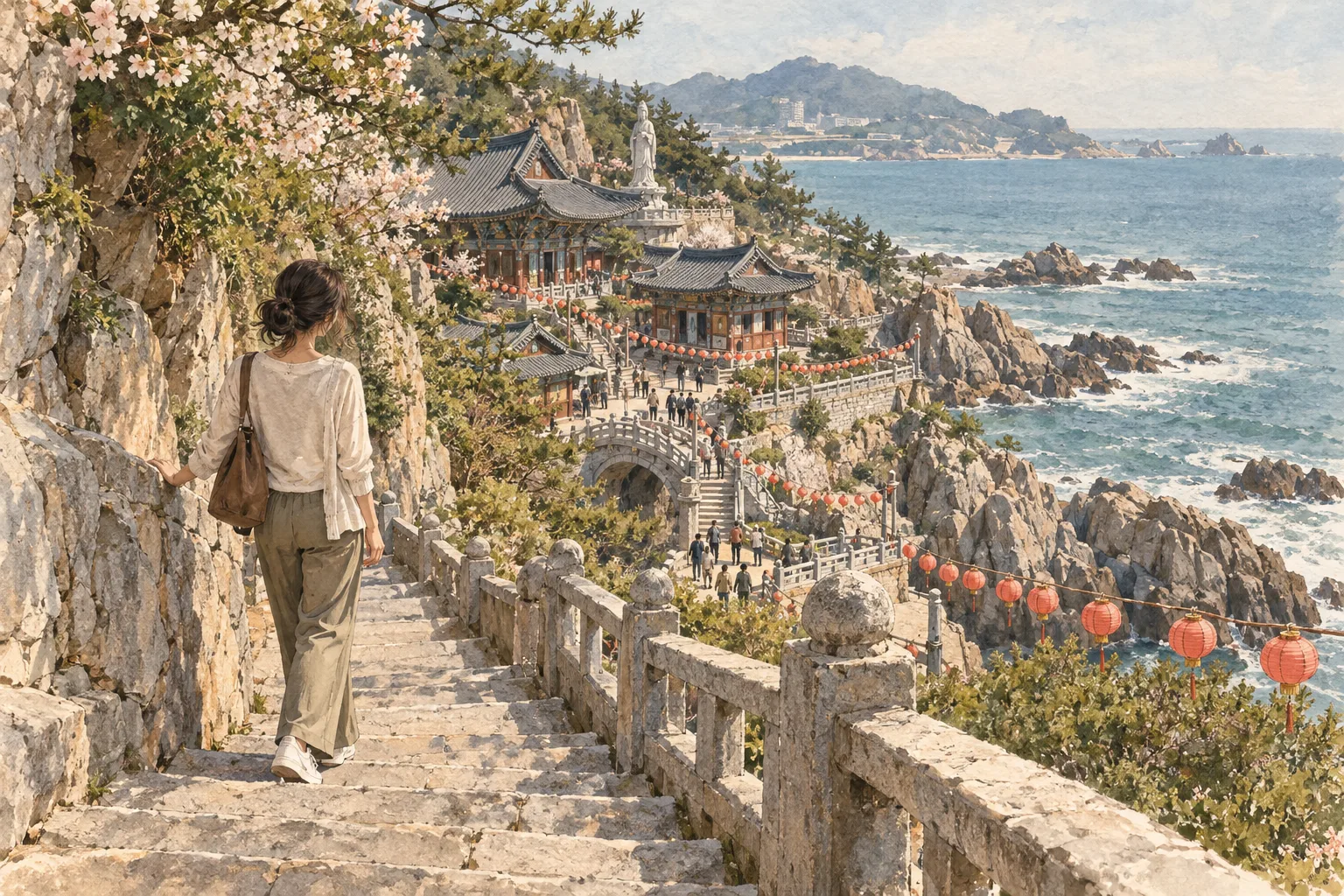
The temple sits in Gijang County, well outside central Busan, and reaching it always involves either a bus transfer, a taxi fare, or a long uphill walk. Once there, the payoff is a genuinely striking cliffside temple, but the descent to see it means a steep 108-step staircase shared with everyone else who arrived at the same time you did. On weekends, that staircase and the narrow bridge below it become the trip's real bottleneck, not the scenery.
Choose this temple if you are a slower-paced traveler with a flexible morning, someone who enjoys the journey as much as the destination, or a photographer willing to trade an hour of transit for a coastal view most temples in Korea cannot match. Skip it, or at least postpone it, if you are on a single-day Busan itinerary already packed with Haeundae Beach and Gamcheon Culture Village, if you are traveling with someone who struggles with stairs, or if a crowded, slow-moving line is close to your personal limit. The short version: it rewards patience, and it punishes tight schedules.
 Editorial illustration: A simple flat-lay style comparison layout on a table surface showing three labeled cards for 'Bus 181'.
Main Friction Problem
The friction here is not the temple itself. It is everything around it: getting there, standing in it, and getting back.
Time pressure starts before you leave your hotel. Haedong Yonggungsa is not a quick stop you fold into a busy Haeundae afternoon. The fastest bus route from Haeundae Station takes 30 to 35 minutes each way, and that is before you add the walk from the bus stop to the temple entrance. A taxi cuts travel time to about 20 minutes each way in normal traffic, but that savings comes at a real cost, and traffic on weekends is rarely "normal." Round trip, plus time at the temple itself, this is realistically a half-day commitment, not a 90-minute detour.
Crowds concentrate at the one place you cannot avoid: the 108-step staircase and the bridge that leads to the main prayer halls. This is a narrow, single-file bottleneck. On weekends and Korean holidays, foot traffic backs up here in both directions, since people descending to see the temple and people climbing back up share the same tight staircase. There are no ticket gates and no entry limits, since admission is free, so nothing regulates how many people are on the stairs at once.
Transit and station complexity is the quieter friction point most guides skip. Unlike a subway trip with a single clear line, reaching this temple usually means a bus-to-walk combination: bus to a stop, then a further 10 to 15 minute walk up a paved incline from the nearest stop to the entrance. If you are coming from Osiria Station instead, you trade the bus wait for a 30-minute uphill walk directly from the station exit. Either way, you are doing meaningful walking beyond the vehicle leg, which is not obvious until you are already partway there.
Friction Table
The three realistic ways to reach the temple all trade time, cost, and physical effort differently. None of them is free of friction.
| Route | Time (one way) | Cost (one way) | Main tradeoff |
|---|---|---|---|
| Bus 181 from Haeundae Station | 30 to 35 minutes, plus a 10 to 15 minute walk from the stop | 1,550 to 1,700 KRW | Cheapest option, but adds a walk and depends on bus frequency and traffic |
| Taxi from Haeundae Beach | About 20 minutes in normal traffic | 10,000 to 18,000 KRW | Fastest and most flexible, but costs more and traffic on weekends erodes the time savings |
| Walk from Osiria Station (Exit 1) | About 30 minutes, uphill | Free (aside from transit to Osiria) | No wait for a bus or taxi, but sustained uphill walking is hard on low-stamina or older travelers |
The pattern across all three: there is no route that is fast, cheap, and low-effort at the same time. You are always giving up one of the three.
Who Will Feel It Most
Older travelers and anyone with knee or joint sensitivity will feel the friction hardest, not on the way there, but on the way back up the 108 steps. The staircase is steep and uneven by design, since it was carved into the coastal rock rather than built as a standard tourist path. Climbing it once is manageable for most people. Climbing it while dodging a weekend crowd, on legs already tired from a bus transfer and a 10 to 15 minute walk in, is a different experience.
Time-pressed travelers on a single-day Busan itinerary will feel it differently: as opportunity cost. A half-day round trip to Gijang County is a half-day not spent at Haeundae Beach, Gamcheon Culture Village, or Busan's central markets. If your trip is one day or less, this temple competes directly with your other priorities, and it usually loses on efficiency.
Slower-paced and atmosphere-led travelers tend to feel the least friction. If you are not measuring the day by how many sights you checked off, the bus ride, the coastal walk, and even the crowd at the staircase become part of the experience rather than an obstacle to it.
How to Reduce the Friction
None of this friction disappears completely, but each piece can be reduced with the right timing and route choice.
To reduce time pressure, treat this as a half-day trip and build your Busan itinerary around that fact rather than trying to squeeze it into leftover hours. Pair it with one other Gijang-area stop rather than trying to combine it with destinations on the opposite side of the city.
To reduce crowd exposure, go early on a weekday. The temple opens at 4:30 AM and stays open until 7:20 PM with last admission at 6:50 PM, so there is a wide window to work with. Weekday mornings before roughly 9:00 AM are consistently calmer than weekend afternoons, when the staircase and bridge see the heaviest foot traffic.
To reduce transit and station friction, decide your route before you leave the hotel rather than deciding at the bus stop. If you are prioritizing cost, take Bus 181 and budget the extra walk from the stop. If you are prioritizing time and are comfortable with the fare, take a taxi, but expect weekend traffic to cut into the time advantage. If you are already near Osiria Station, the walk from Exit 1 removes bus uncertainty entirely, at the cost of a sustained uphill 30 minutes.
One more practical note: if you are hoping to catch sunrise here, public buses will not get you there in time. That plan only works with a taxi or private car arranged in advance.
Better Alternatives
If the transit and crowd friction described above sounds like more than your trip can absorb, there are better-fitting choices than forcing the visit.
If you want a coastal temple experience without the multi-transfer commute, consider treating central Busan's more accessible sights, like Gamcheon Culture Village or the Haeundae waterfront itself, as your primary destination and leaving Haedong Yonggungsa for a future trip with more flexible time. If you are specifically drawn to the visual of a cliffside temple but are highly crowd-sensitive, a weekday early-morning visit is a genuinely different experience from a weekend one, and it may be worth rearranging your schedule rather than skipping the temple entirely. If your main constraint is stairs and mobility rather than time, a taxi that drops you as close to the entrance as parking allows will minimize walking distance, though it will not remove the 108-step descent to the main halls, which has no alternate route.
If none of these adjustments fit your trip, it is reasonable to simply skip it this visit. A rushed, crowded version of Haedong Yonggungsa is not a better memory than not going at all.
Decision Checklist
Use this before you commit the half-day to Gijang County.
- Do you have at least 2 to 3 hours of flexible time, including transit, walking, and time at the temple itself?
- Is your visit on a weekday, or are you prepared for weekend staircase and bridge crowding?
- Have you chosen your route in advance: Bus 181, taxi, or the walk from Osiria Station?
- If traveling with older relatives, have you accounted for the 108-step staircase in both directions?
- If you want sunrise, have you arranged a taxi or private car, since buses will not run early enough?
- Have you checked the parking cost if you are driving, since it is 2,000 KRW for the first 20 minutes with additional charges after?
- Are you comfortable entering through side doors only, since the central doors are reserved for monks?
If most of these are checked, the visit fits your trip. If several are unchecked, especially the time and crowd items, reconsider the timing before you go.
FAQ
Is Haedong Yonggungsa Temple worth visiting if I only have one day in Busan? It depends on your pace. If your one day already includes Haeundae Beach and Gamcheon Culture Village, adding a round trip of roughly 1 to 1.5 hours each way will crowd out everything else. If the temple is your single priority for the day, it is worth it.
How do I avoid the worst crowds at Haedong Yonggungsa? Arrive on a weekday morning, ideally before 9:00 AM. Weekend afternoons and Korean public holidays bring the heaviest foot traffic on the staircase and bridge, where there is no way to pass quickly.
Can I visit Haedong Yonggungsa for sunrise? Only by taxi or private car. Public buses do not start early enough to get you there for sunrise, so this plan only works if you are comfortable arranging a taxi in the dark.
Is the walk from Osiria Station a good alternative to the bus? It works if you are already near Osiria Station and comfortable with a 30-minute uphill walk. It removes the transfer wait but replaces it with sustained uphill walking, which is a tougher tradeoff for older or low-stamina travelers than for others.
Do I need to budget extra time for the 108 steps back up? Yes. The staircase is steep and uneven, and it is the main bottleneck when the temple is busy. Budget extra time for the climb back up, especially if you are visiting with older relatives or anyone with knee or joint concerns.