where-to-stay
Gwangalli vs Haeundae: Which Beach Base Offers Lower Nighttime Noise and Crowd Stress?
A hotel-location risk comparison for Gwangalli and Haeundae in Busan, focused on which beach base actually keeps nighttime noise and crowd stress lower.
Quick Answer
Choose Gwangalli if you want a short walk to a lively, compact strip and can tolerate road noise from a request-a-quiet-room angle. Choose Haeundae if you want more physical distance from noise sources and are willing to walk slightly further or pay more to get it.
Quiet seekers and mature travelers who dislike unpredictable street noise generally do better in Haeundae, specifically its west end near Dongbaek Island or its east end near LCT. Skip both areas' central strips if a fully calm night matters more to you than being steps from restaurants. This is a base decision, not a scenery decision: both beaches look similar in photos, but they behave very differently after 9pm.
Do not choose either as a party base if you are a light sleeper hoping the room will simply block out the street. Neither area is a resort compound; both put you inside an active neighborhood.
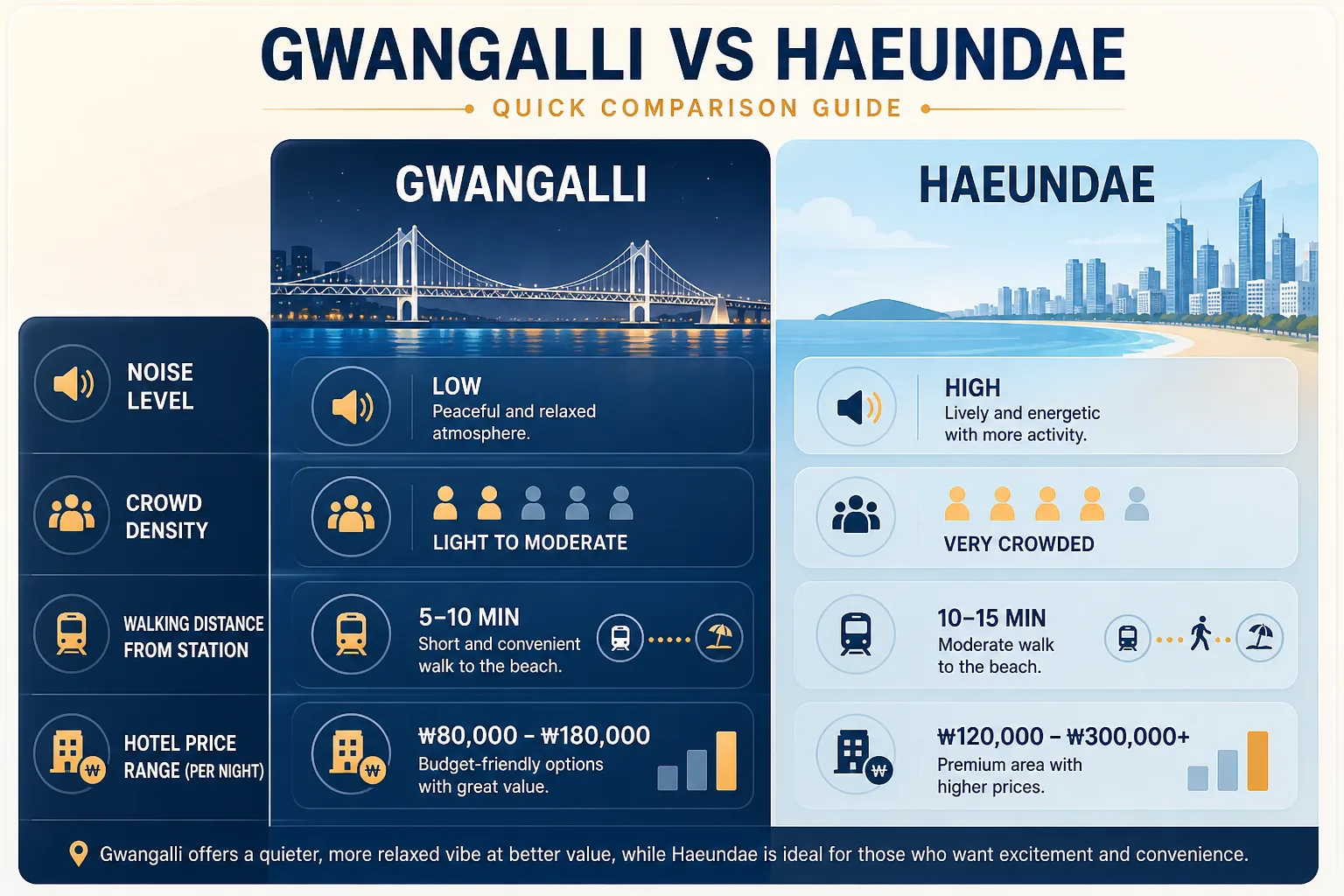 Editorial illustration: A simple side-by-side comparison layout with two labeled columns.
Hotel Location Risk Summary
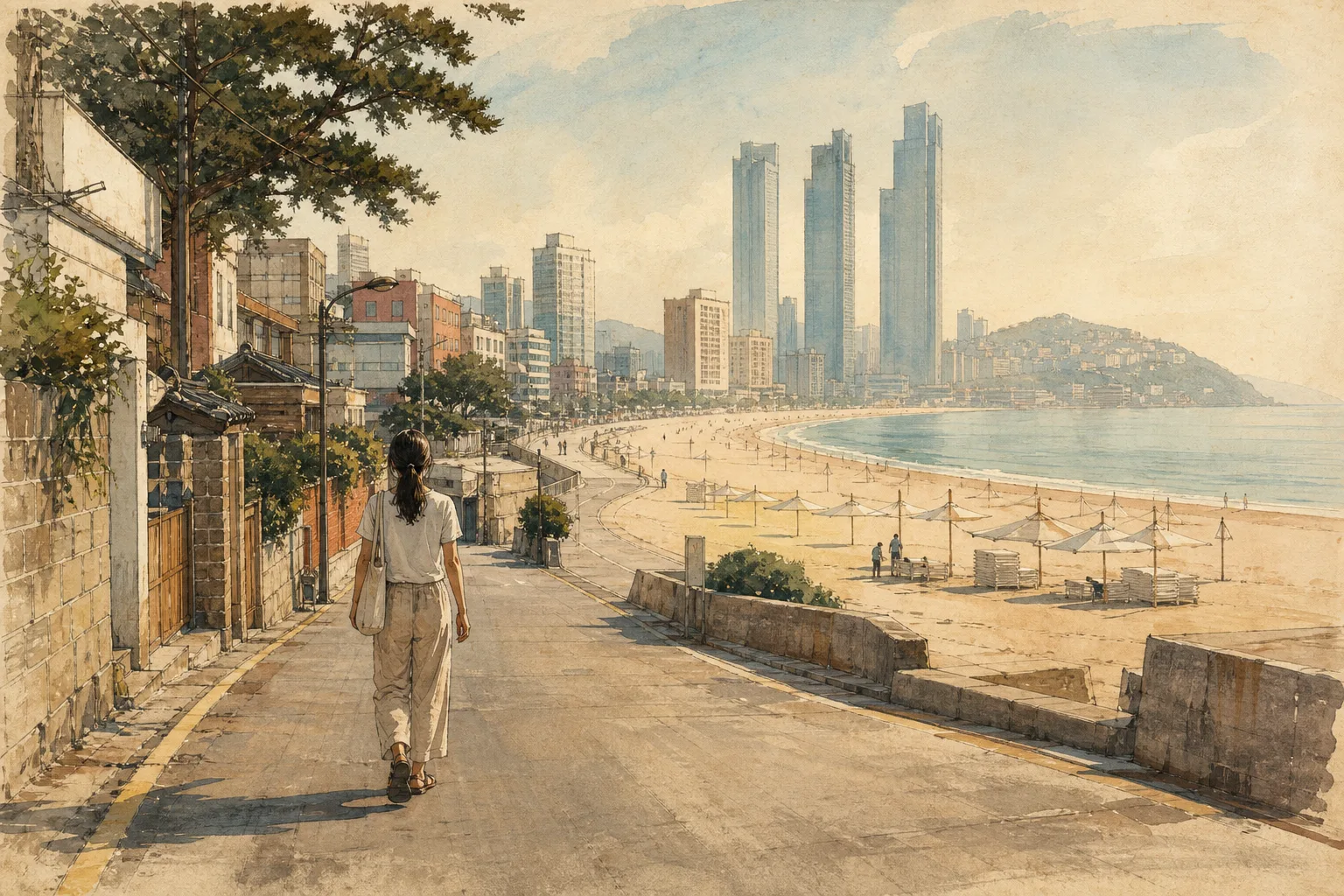
The main risk in Gwangalli is road noise, not beach noise. Almost every major oceanfront hotel, including Kent Hotel Gwangalli, Hotel Aqua Palace, Homers Hotel, and Gwangalli Gray 193, sits directly on Gwanganhaebyeon-ro, a busy double-way road that runs between the hotel row and the sand. That means your room's ocean view often comes with a traffic corridor underneath it.
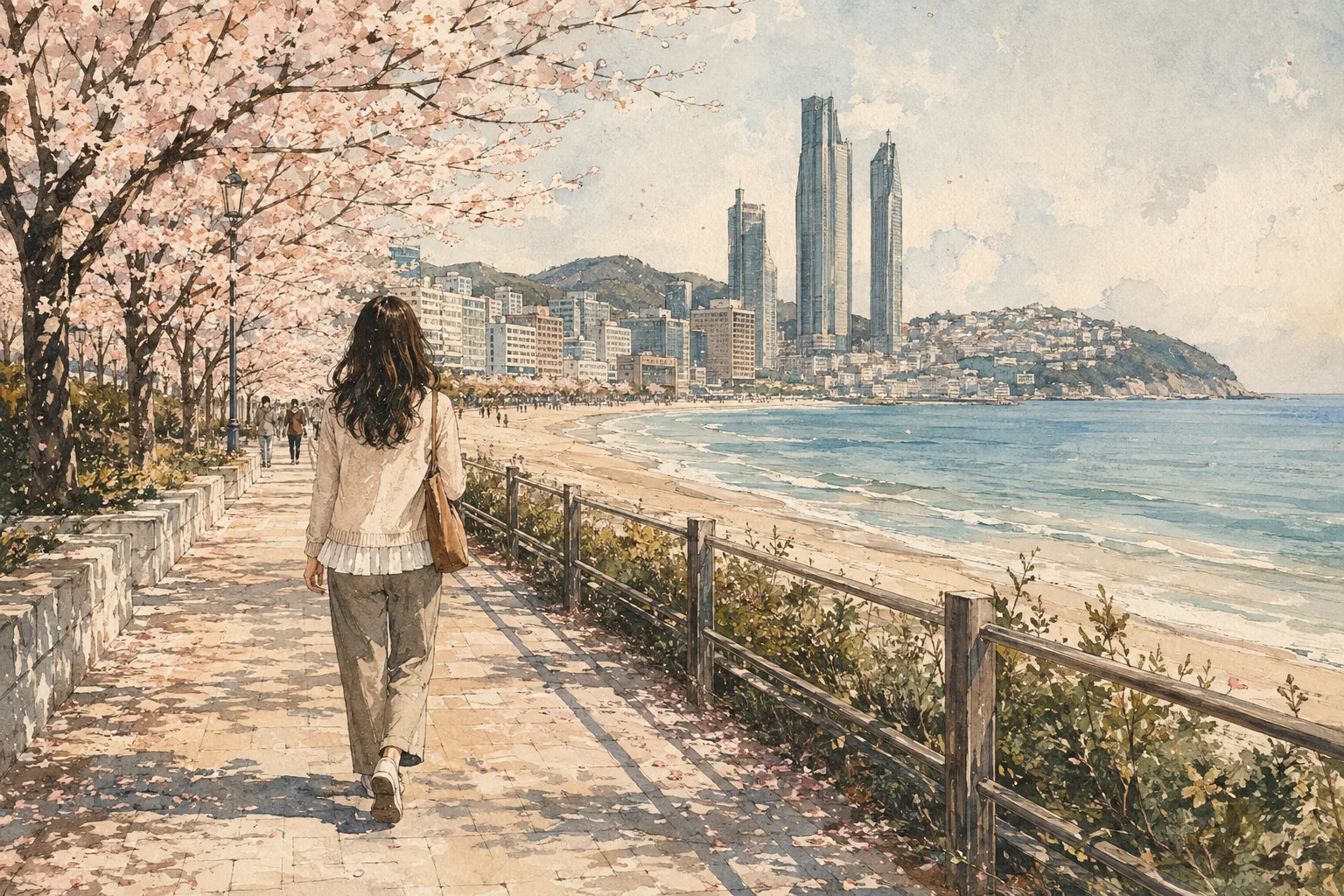
Haeundae's risk is different: it is crowd density in the central blocks, not a single noisy road. The beach itself is 1.5 kilometers long and 30 to 50 meters wide, which is enough room to physically separate yourself from the loudest section if you pick the right end. The tradeoff is that quieter ends require either a longer walk or a higher room rate.
Transit practicality favors Haeundae slightly for anyone managing luggage. Haeundae Station's Exit 3 or 5 leads to a flat, roughly 700-meter walk down Gunam-ro, a straightforward boulevard. Gwangalli's walk from Gwangan Station or Geumnyeonsan Station is shorter on paper, at 670 to 890 meters, but it runs through narrower neighborhood streets rather than one clear boulevard.
Best Areas at a Glance
Both beaches offer the same core promise, a walkable coastal base in Busan, but they deliver it with different noise and crowd profiles. The table below compares the variables that actually change your night, not just your daytime photos.
| Variable | Gwangalli | Haeundae |
|---|---|---|
| Main noise source | Traffic on Gwanganhaebyeon-ro, right between hotels and beach | Foot traffic and bar noise concentrated in central blocks |
| Crowd spread | Denser, shorter shoreline concentrates people | 1.5 km length spreads crowds across a wider strip |
| Station walk | 670 to 890 m through neighborhood streets (Gwangan or Geumnyeonsan Station) | Flat 700 m boulevard walk from Haeundae Station |
| Quietest sub-area | Southern third toward Namcheon-dong, mostly short-term rentals | West end near Dongbaek Island, or far east end near LCT |
| Typical mid-range price | 130,000 to 190,000 won per night | 150,000 to 300,000 won per night |
| Weekly recurring noise event | Drone show most Saturdays at set evening times | No single recurring event, but nightly bar-strip noise in center |
The pattern is consistent: Gwangalli trades a shorter commute for more road noise, and Haeundae trades a longer commute for more room to escape it.
Best Area by Traveler Type
Quiet seekers should default to Haeundae's west end near Dongbaek Island. That stretch sits on forested, virtually traffic-free ground, which is a rare combination for a beachfront location in a major Korean city. The Westin Josun Busan occupies this position, and the quiet comes from geography, not just hotel construction.
Mature travelers weighing joint pain or fatigue should also lean Haeundae, mainly because of the walk. The flat 700-meter boulevard from Haeundae Station is more predictable underfoot than Gwangalli's shorter but narrower neighborhood route. A flat, well-lit path matters more than a slightly shorter distance when you are moving slowly or pulling a suitcase over uneven pavement.
If you still prefer Gwangalli for its atmosphere, aim for the southern third of the beach near Namcheon-dong. That stretch is primarily residential, dominated by short-term rental apartments rather than the hotel row on the main road. You give up some of the restaurant density in exchange for distance from Gwanganhaebyeon-ro traffic.
Neither traveler type should default to the center of either beach purely because it is the most photographed stretch. The most Instagrammed block is usually also the loudest one.
Areas to Be Careful With
The specific disappointment risk in Gwangalli is booking an oceanfront room expecting beach sounds and getting traffic sounds instead. Because the hotel row sits on Gwanganhaebyeon-ro, a sea view does not guarantee a quiet view. Travelers who assume "beachfront" means "away from the road" are the ones who end up disappointed here.
In Haeundae, the mismatch pattern is different: travelers pick a central hotel for convenience, then are surprised by how much foot and bar noise carries at night. The beach's length works in your favor only if you actually use it to pick a distant sub-area. Staying in the middle just because it is closest to the station cancels out Haeundae's main noise advantage.
A second Gwangalli-specific risk applies to Saturday visitors. The Gwangalli M Drone Light Show runs most Saturday nights, using 1,100 to 1,500 drones for about 10 minutes, at 20:00 and 22:00 from March through September and 19:00 and 21:00 from October through February. Even if you skip the show, viewing crowds gather on the main strip before and after each screening, adding foot traffic near hotel entrances.
For walking logistics in either area, do not rely on Google Maps. It is known to be unreliable for walking directions in South Korea. Naver Map, KakaoMap, or Kakao T for taxis are the workable local alternatives, and using the wrong app can add unplanned detours through the noisier parts of either strip.
Budget vs Convenience Tradeoff
Gwangalli is the lower-cost, higher-noise-risk option. Mid-range hotels there run roughly 130,000 to 190,000 won a night, and the tradeoff for that price is a location right on a busy road. If budget is your main constraint and you can request a room facing away from the street, Gwangalli still works.
Haeundae spans a wider price range because it spans a wider quality range. Mid-range hotels run about 150,000 to 300,000 won a night, while 5-star luxury properties run 400,000 to 700,000 won or more. The higher end includes properties like Signiel Busan, which occupies floors 3 through 19 of the 101-story LCT Landmark Tower at the beach's east end, and the Westin Josun Busan at the quiet west end. Paying for one of these specific positions buys genuine noise insulation, not just a brand name.
The practical rule: in Gwangalli, you pay less but need to actively manage room placement within a single busy strip. In Haeundae, you pay more at the edges to buy distance, but paying more for a central Haeundae room does not solve the noise problem the way it does at the edges.
Hotel Location Checklist
Use this before booking either area, not after.
- Confirm which road or path sits between your hotel and the beach, not just the stated distance to the water
- Ask the hotel directly whether your room faces the main street or the ocean side, since "sea view" listings do not guarantee a quiet-side room
- Check whether your stay includes a Saturday night if considering Gwangalli, and plan around the two nightly drone show time slots
- Map your walk from the nearest station in Naver Map or KakaoMap before you travel, not Google Maps
- For Haeundae, pick a specific sub-area (west end near Dongbaek Island, or east end near LCT) rather than "Haeundae" as a whole
- For Gwangalli, decide whether you want the main hotel strip on Gwanganhaebyeon-ro or the quieter southern third near Namcheon-dong
- If mobility or luggage is a concern, weight the flat Haeundae boulevard walk over a shorter but narrower Gwangalli route
Final Recommendation
Choose Haeundae's west or east end if minimizing nighttime noise and crowd stress is your top priority. The extra room length gives you a real buffer that Gwangalli's shorter strip cannot match, and specific properties there are built into naturally quieter ground or structures. This is the safer default for quiet seekers and mature travelers.
Choose Gwangalli only if you accept the tradeoff of lower price and shorter walk in exchange for road noise on the main strip, or if you specifically target the quieter southern third near Namcheon-dong. Do not choose central Gwangalli or central Haeundae expecting a quiet night just because the beach itself looks calm in photos. The beach view and the noise level are two separate variables, and treating them as the same thing is the most common source of location regret in this comparison.
FAQ
Is Gwangalli quieter than Haeundae at night? Not automatically. Gwangalli's main hotel strip sits directly on a busy double-way road, so traffic and foot noise carry into rooms facing the street. Haeundae is louder in raw volume near its central blocks, but its length gives you more room to pick a quieter end away from the noise.
Which beach has fewer crowds, Gwangalli or Haeundae? Haeundae has a larger footprint at 1.5 kilometers long, which spreads crowds out more than Gwangalli's shorter shoreline. Gwangalli can feel denser in the evening because its main strip concentrates restaurants, bars, and the weekend drone show viewing crowd into a smaller stretch.
Where should a light sleeper stay near Haeundae Beach? Look at the west end near Dongbaek Island or the far east end near LCT, rather than the central blocks facing Gunam-ro. The west end is on forested, largely traffic-free ground, and the east end sits inside a large tower structure that buffers street-level noise.
Is Gwangalli or Haeundae better for older travelers or mobility concerns? Haeundae generally has an edge because the walk from the station is a flat 700 meters on a straightforward boulevard. Gwangalli's walk from Gwangan Station is shorter in some cases but runs through narrower neighborhood streets, which can matter more if you are pulling luggage or moving slowly.
Does the Gwangalli drone show make the area noisier at night? Yes, on Saturdays. The show runs at two set times each night, drawing viewing crowds to the beachfront both before and after each screening, which adds foot traffic and noise to the main strip even if you are not attending.