where-to-stay
Hongdae vs Myeongdong: Which Base Has the Lowest Hassle Factor for First-Timers?
A friction-first comparison of Hongdae and Myeongdong for first-time Seoul travelers, covering airport transfer ease, night noise, and luggage-heavy walking.
Quick Answer
If you want the short version: Hongdae is the lower-hassle base for first-timers who want cheaper rooms and don't mind picking a quiet block carefully. Myeongdong is the lower-hassle base for first-timers who want predictable quiet nights and are willing to pay more and deal with daytime crowds.
Choose Hongdae if you:
- Want to save 20 to 40 percent on lodging versus an equivalent Myeongdong hotel
- Are flying into Incheon and want the simplest possible airport transfer (a direct train, no transfer)
- Can tolerate some sidewalk energy in exchange for lower cost, and are willing to book a few streets away from the loudest club cluster
Choose Myeongdong if you:
- Prioritize a guaranteed quiet night over saving money
- Plan to walk to historic sights like Gyeongbokgung Palace or Namdaemun Market rather than relying on transit
- Don't mind threading through tourist crowds and food carts on foot in the early evening
Do not choose Hongdae if you are highly noise-sensitive and unwilling to research your hotel's exact block relative to the nightlife core. Do not choose Myeongdong if you are on a tight budget or if you specifically want to be near Hongdae's cafe and live-music scene, since the neighborhoods serve different trip styles, not just different price points.
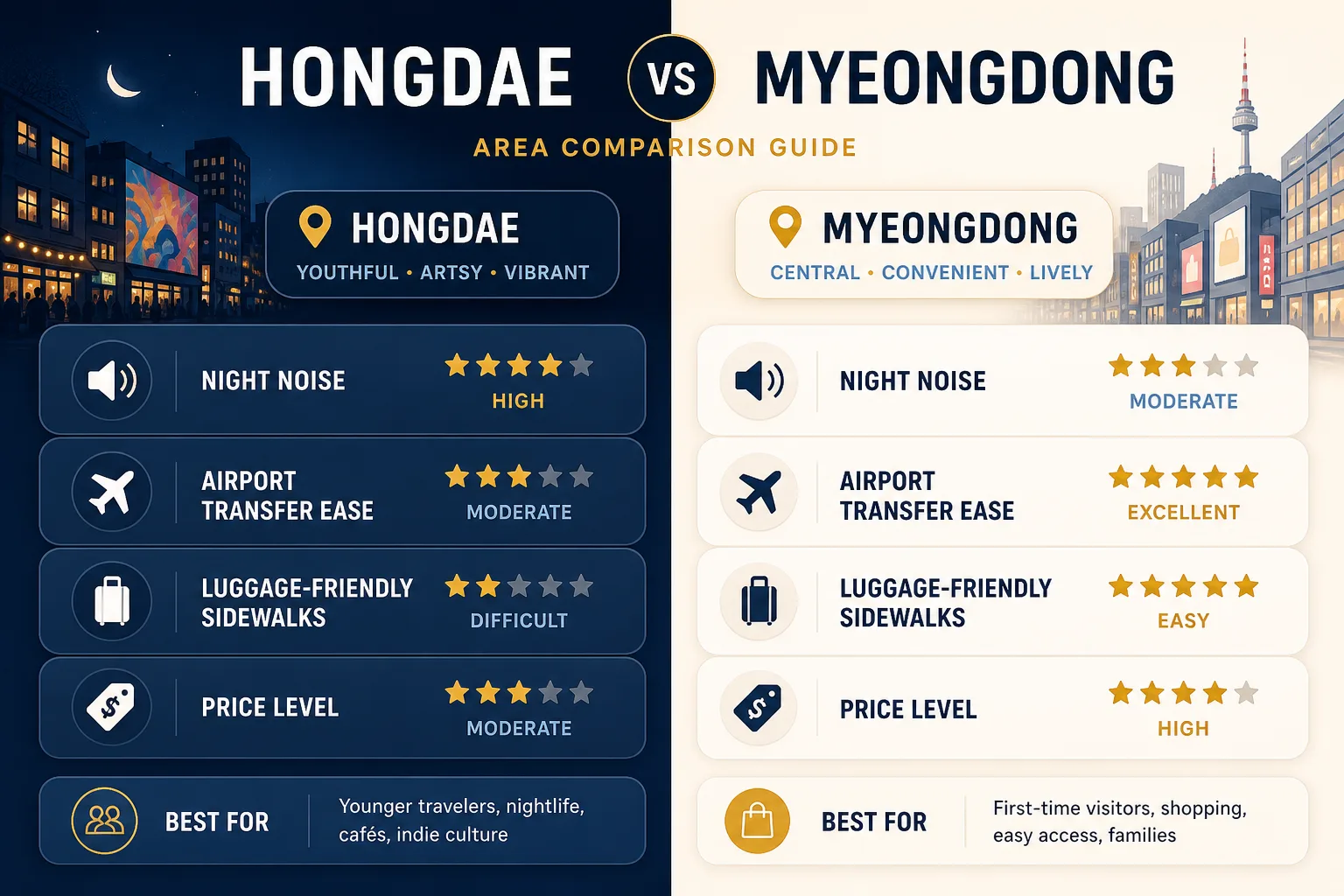 Editorial illustration: A simple side-by-side comparison layout with two columns labeled Hongdae and Myeongdong.
Hotel Location Risk Summary
The core risk in this decision is not "which neighborhood is better." Both are established, safe, well-connected areas. The real risk is picking a specific hotel address inside the wrong sub-zone of the right neighborhood, and only discovering the mismatch after check-in.
In Hongdae, the risk is noise. The area immediately south and west of Exit 9, often called the Hongdae Core, carries club and bar bass until 2 to 4 a.m. A hotel listing that says "Hongdae" could be two minutes from that noise or a comfortable ten-minute walk away, and most booking sites won't tell you which. The practical fix is to check the hotel's exact address against the core nightlife blocks, not just the neighborhood label.
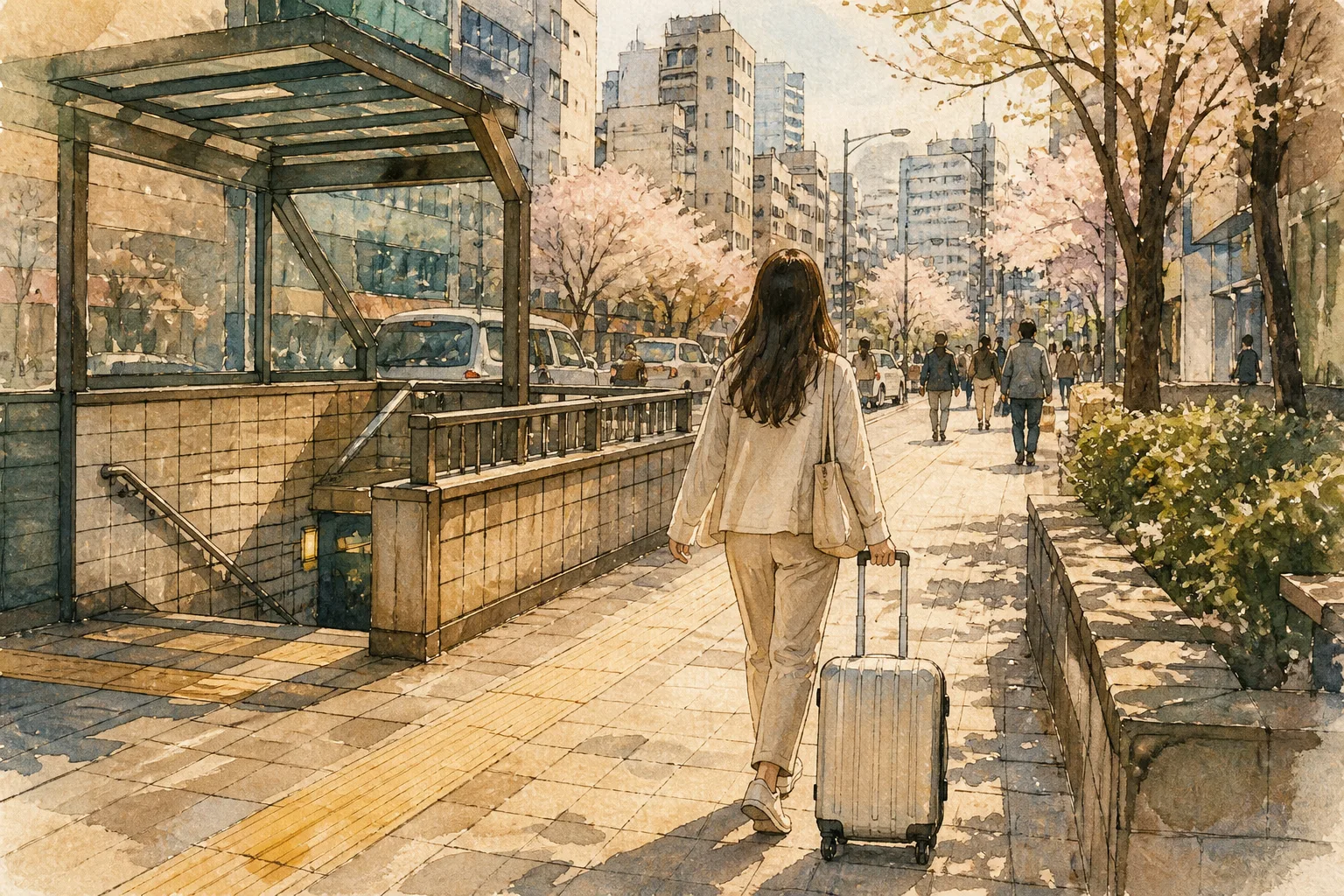
In Myeongdong, the risk is different: daytime and early-evening crowd density rather than nighttime noise. After 4 p.m., Myeongdong's main streets fill with tourist foot traffic and street-food carts, which makes dragging a wheeled suitcase through the area genuinely difficult. If your flight lands in the afternoon and your hotel is deep in the shopping core, your first hour in Seoul could be spent weaving through crowds with luggage rather than resting.
On transit practicality, the two areas diverge sharply. Hongdae's Hongik University Station has a direct AREX All-Stop connection from Incheon Airport, arriving in 50 to 55 minutes with zero transfers. Myeongdong has no direct AREX line at all: you ride to Seoul Station, work through a transfer that starts at basement level B7, then ride Line 4 for two more stops. For a jet-lagged first-timer with bags, that extra transfer is a real source of friction, even though the total time difference is modest.
Best Areas at a Glance
| Factor | Hongdae | Myeongdong |
|---|---|---|
| Airport transfer | Direct AREX All-Stop to Hongik Univ. Station, 50 to 55 min, no transfer | No direct AREX; transfer at Seoul Station (B7) plus 2 stops on Line 4 |
| Night noise | Loud near the Exit 9 "Hongdae Core" until 2 to 4 a.m.; quieter a few blocks out | Quiet overnight; shops and food carts close by 10 to 11 p.m. |
| Daytime sidewalk crowding | Busy but generally walkable with luggage | Heavy tourist and food-cart crowding after 4 p.m., harder with bags |
| Step-free station access | Exits 3 and 4 have escalators/elevators; Exit 9 is stairs-only | Only Exit 7 has an escalator; Exits 4, 5, 6, 8, 9, 10 are stairs-only |
| Walking distance to major sights | Gyeongbokgung or Bukchon: about 30 min by subway, usually with a transfer | Namdaemun Market ~10 min walk; Insadong ~15 min walk; Gyeongbokgung ~20 min walk |
| Lodging cost | 20 to 40 percent cheaper for equivalent categories | Higher price for equivalent categories |
| Best suited for | Budget-conscious first-timers, nightlife-tolerant travelers | Quiet-night seekers, sightseeing-on-foot travelers |
The honest tradeoff: Hongdae wins on cost and airport simplicity, Myeongdong wins on quiet nights and walkable sightseeing. Neither wins on both.
Best Area by Traveler Type
First-time travelers with no strong nightlife preference. Myeongdong is usually the safer default. It sits within easy walking distance of Namdaemun Market, Insadong, and Gyeongbokgung Palace, so a first visit can lean on foot traffic instead of learning the subway system under jet lag. The cost is a slightly more complex airport transfer and navigating crowds on foot in the evening.
Nightlife-avoidant couples. Also lean Myeongdong, specifically because the neighborhood's stores and street vendors wind down by 10 to 11 p.m., producing a genuinely quiet overnight. A couple choosing Hongdae instead should book at least several streets from the Exit 9 core and verify the exact address, since "Hongdae" as a label spans both loud and quiet blocks.
Heavy-bag, pack-heavy travelers. This is the traveler type where the calculus flips. Hongdae's direct AREX connection removes an entire transfer step compared to Myeongdong's Seoul Station changeover, which matters more than usual when you're hauling large suitcases. Within Hongdae, book near Exit 3 or 4 for escalator and elevator access rather than the stairs-only Exit 9. If Myeongdong is still the pick for other reasons, target a hotel near Exit 7, the only escalator-equipped exit, and plan arrival for before 4 p.m. to avoid the worst of the sidewalk crowding.
Areas to Be Careful With
The mismatch that causes the most regret in Hongdae: booking a hotel that is technically "in Hongdae" but sits inside or adjacent to the Exit 9 nightlife core, then being surprised by bass through the walls until 2 to 4 a.m. This happens most often to travelers who booked on price alone without checking the address relative to the club cluster. If you are a light sleeper, this is the single most avoidable mistake in this comparison.
The mismatch in Myeongdong runs the opposite direction: travelers expect a "calm, walkable shopping district" and instead land mid-afternoon with luggage into a wall of tourist foot traffic and street-food carts. The neighborhood is quiet at night but genuinely congested by day, and dragging a suitcase through that congestion is its own kind of hassle, even without any noise problem.
A second, more logistics-driven risk applies to both areas: assuming any station exit works the same. At Hongik University Station, only Exits 3 and 4 have escalators and elevators, while the main Exit 9 is stairs-only. At Myeongdong Station, only Exit 7 has an escalator, and six other exits are stairs-only. A hotel that looks close on a map can still mean hauling bags up multiple flights if you exit the wrong way. Confirm your walking route and exit before booking, not after arrival.
Finally, starting in 2026, airport limousine bus passengers must buy a physical ticket at a kiosk or counter with a credit card rather than paying on board. This affects both routes equally (Route 6002 to Hongdae; Routes 6015 and 6001 to Myeongdong) at the same fare, but it is a process change worth knowing before you land, so you are not caught unprepared trying to board with cash.
Budget vs Convenience Tradeoff
The price gap between these two areas is not marginal. Hongdae lodging runs roughly 20 to 40 percent cheaper than an equivalent category room in Myeongdong. For a multi-night stay, that difference can fund a meal budget or an extra activity for the whole trip.
What you're paying for in Myeongdong is not luxury, it's convenience and quiet: closer walking access to Namdaemun Market, Insadong, and Gyeongbokgung Palace, plus a night environment that goes quiet on a predictable schedule. What you're paying for in Hongdae, effectively, is a lower price in exchange for needing to be more deliberate about which block you book on, and accepting a subway ride (usually with a transfer) to reach the historic core of the city.
Neither tradeoff is objectively better. A traveler who plans to spend most days sightseeing on foot gets real, usable value from Myeongdong's location. A traveler who plans to explore more broadly by subway anyway, and who wants to keep the airport transfer simple, gets more value from Hongdae's lower price and direct train link. The decision comes down to whether you would rather pay for proximity to landmarks or pay less and manage logistics yourself.
Hotel Location Checklist
Before booking in either neighborhood, confirm:
- Exact hotel address checked against a map, not just the neighborhood name on the listing
- For Hongdae: distance from the Exit 9 nightlife core, not just distance from the station
- For Myeongdong: distance from the main shopping strip, since quiet nights don't offset a noisy, crowded daytime walk to your hotel
- Which station exit is closest to the hotel, and whether that exit has stairs only or an escalator/elevator
- Arrival time versus Myeongdong's afternoon crowd buildup, if that's your chosen base
- Airport transfer method decided in advance: AREX All-Stop (Hongdae direct, or Myeongdong via Seoul Station transfer) versus airport limousine bus (same fare either destination)
- If taking the limousine bus in 2026 or later, a physical ticket purchase plan at the airport kiosk or counter, since on-board cash payment is no longer available
- Realistic walking distance from the hotel to your top 1 to 2 planned sights, especially if choosing Myeongdong for its walkability
Final Recommendation
For most first-time Seoul travelers who have not stated a strong nightlife preference, Myeongdong carries the lower overall hassle factor: quieter nights on a predictable schedule, and walking access to several major sights without relying on transit while jet-lagged. The cost is a more complex airport transfer and daytime sidewalk crowding.
Choose Hongdae instead if budget is a real constraint, if you want the simplest possible airport transfer via the direct AREX train, or if you're traveling with heavy luggage and want to minimize transfers on arrival day. Just be deliberate about which block you book on, since the difference between a quiet Hongdae stay and a loud one often comes down to a few streets.
Do not choose Hongdae if you are highly noise-sensitive and unwilling to double-check your hotel's exact location relative to the nightlife core. Do not choose Myeongdong if minimizing cost matters more than proximity to landmarks, or if avoiding a subway transfer on arrival day is your top priority.
FAQ
Is Hongdae too loud for a first-time Seoul trip? Only if your hotel sits in the core cluster south and west of Exit 9, where club and bar bass carries until 2 to 4 a.m. Hongdae blocks even a few streets away from that core, or near the quieter Exits 3 and 4 side, are noticeably calmer. If you are noise-sensitive, check your exact hotel address against the core nightlife blocks before booking, not just the neighborhood name.
Is Myeongdong actually quiet at night? Yes, in the sense that matters for sleep. Myeongdong's retail stores and street food carts close by 10 to 11 p.m., so the overnight hours are quiet. The tradeoff is daytime and early evening, when tourist crowds and food carts fill the sidewalks, which is a different kind of hassle than nightlife noise.
Which area is easier to reach from Incheon Airport? Hongdae, if you take the AREX All-Stop train, which runs directly to Hongik University Station in 50 to 55 minutes with no transfer. Myeongdong has no direct AREX connection: you ride AREX to Seoul Station, navigate a transfer from basement level B7, then take Line 4 for two stops. Both areas are also served by airport limousine buses at the same fare, which is the simpler option if you want to avoid the subway transfer entirely.
Which base is better for a traveler with a bad back or heavy luggage? Neither station is fully step-free, so check exits carefully either way. At Hongik University Station, the main Exit 9 is stairs-only, but Exits 3 and 4 have escalators and elevators. At Myeongdong Station, only Exit 7 has an escalator; Exits 4, 5, 6, 8, 9, and 10 are stairs-only. Book a hotel near the elevator-equipped exit in either neighborhood, and confirm the exact walking route before you go.
Is Hongdae or Myeongdong cheaper? Hongdae, generally by 20 to 40 percent for equivalent hotel categories. If budget is your primary constraint and you can tolerate some night noise by choosing carefully within the neighborhood, Hongdae stretches your money further. If a quiet night matters more than the discount, that price gap is the cost of choosing Myeongdong instead.