where-to-stay
Gangnam vs Gangbuk: Which Side of the Han River Saves You the Most Daily Travel Fatigue?
A decision-first comparison of staying in Gangnam versus Gangbuk in Seoul, focused on real commute time, transit crowding, and which side matches your itinerary.
Quick Answer
If your itinerary is built around Gyeongbokgung Palace, Bukchon Hanok Village, Insadong, and Myeongdong, stay in Gangbuk. Those sights sit close together north of the river, and Myeongdong to Gyeongbokgung is only a 15 to 20 minute subway ride or a 30 to 40 minute walk. You will spend your time sightseeing instead of commuting.
If your itinerary is built around Gangnam-style shopping streets, COEX, Apgujeong, or a business trip near Gangnam Station, stay in Gangnam. Trying to reverse-commute into Gangnam every day from a Gangbuk hotel adds a 30 to 45 minute river crossing each way, which stacks up fast over a multi-day trip.
Choose Gangbuk if: this is your first trip to Seoul, your list is palace- and old-town-heavy, or you are traveling with kids or limited walking stamina and want short hops between sights.
Do not choose Gangbuk if: your main reason for visiting is Gangnam-area shopping, entertainment, or a business meeting schedule, since you would be commuting against your own itinerary every day.
Choose Gangnam if: you are a return visitor who has already covered the historic core, or your trip is shopping- or business-focused with most stops south of the river.
Do not choose Gangnam if: this is a first visit and most of your must-see list (palaces, hanok villages, traditional markets) sits in Gangbuk, because you would be paying a river-crossing tax on almost every outing.
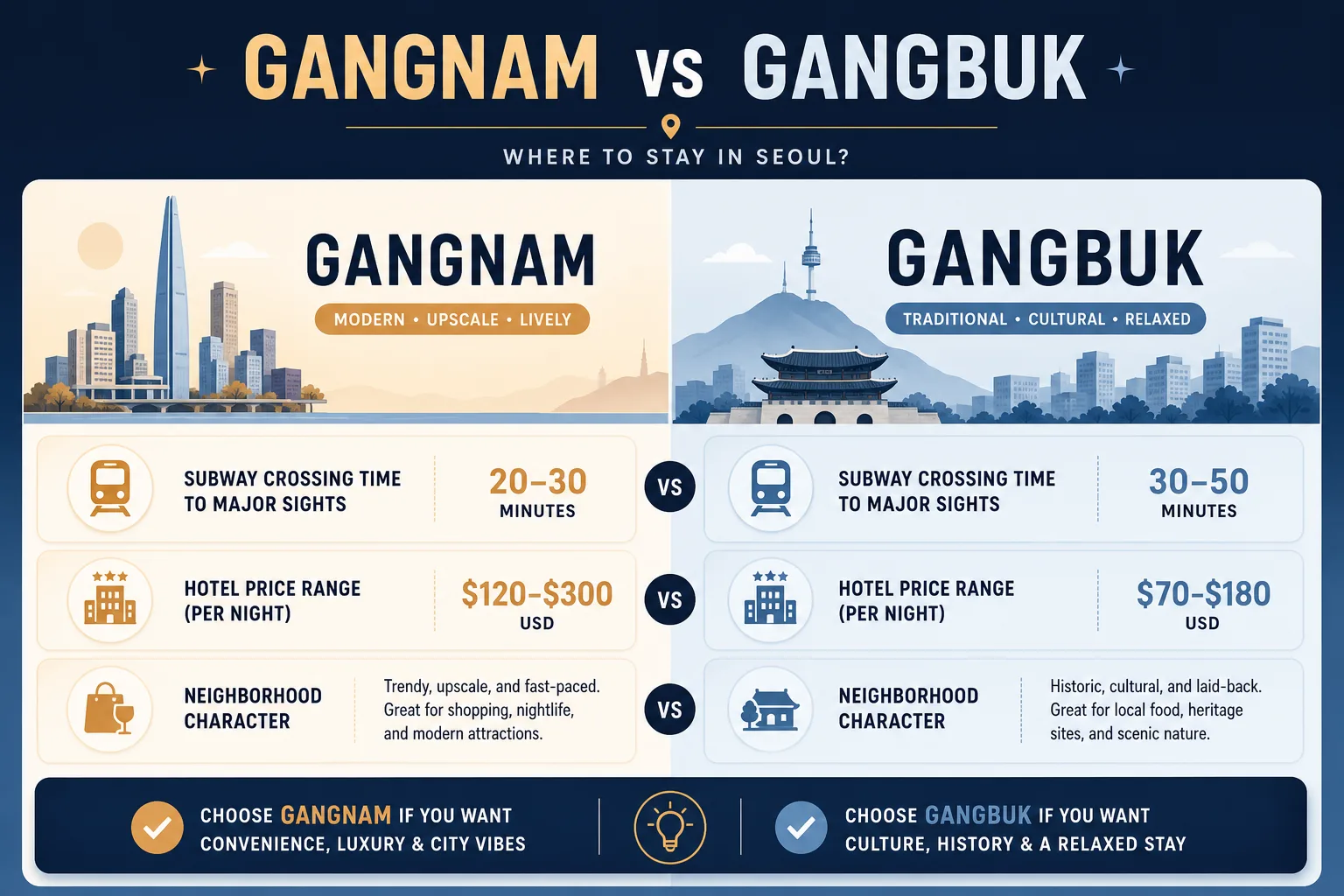 Editorial illustration: A clean side-by-side comparison layout with two labeled columns.
Hotel Location Risk Summary
The single biggest hotel-location risk in Seoul is not neighborhood safety or noise, it is picking the wrong side of the Han River relative to where your itinerary actually lives. Seoul is not compact the way some single-district cities are: Gangnam and Gangbuk function almost like two different cities connected by a river crossing that takes real time, especially at the wrong hour.
Here is the practical risk breakdown:
- Rush-hour tax: If your hotel is on the opposite bank from your daily plans, you are committing to a 30 to 45 minute subway ride each way during peak hours (7:30 to 9:00 AM, 5:30 to 7:30 PM), with Tuesday mornings and Friday evenings the most crowded.
- Capacity risk, not just time risk: Line 2 and Line 9, the two lines most likely to carry you across the river, can exceed 200 percent passenger capacity at peak times. That is not a comfortable ride with luggage or children, it is standing-room-only crowding.
- Walking practicality within the same side is strong: Once you are on the correct side, distances are forgiving. Myeongdong to Gyeongbokgung is a comfortable 30 to 40 minute walk (about 3 to 4 km) if you want to skip transit, and Myeongdong to Insadong is just a 15 to 25 minute walk or 1 to 2 subway stops.
- The mismatch compounds daily: A single wrong-side booking is not a one-time inconvenience. It repeats every single day of your trip, at the two worst times of day for transit crowding.
The practical takeaway: treat "which side of the river" as the first filter in your hotel search, before you compare star ratings or room photos.
Best Areas at a Glance
| Area | Side of River | Best For | Typical Hotel Price Range (2026) | River-Crossing Risk |
|---|---|---|---|---|
| Myeongdong | Gangbuk | First-timers, shopping plus palace access, central walkable base | ~110,000 to 160,000 won/night (midrange) | Low if your plans stay north |
| Insadong / Jongno | Gangbuk | Traditional culture, hanok atmosphere, palace-adjacent stays | Comparable to or slightly below Myeongdong | Low if your plans stay north |
| Gangnam Station area | Gangnam | Shopping, business travel, nightlife, return visitors | ~120,000 to 180,000 won/night (midrange) | High if palaces/old town are on your list |
| Apgujeong / COEX | Gangnam | Upscale shopping, K-pop/entertainment interest, longer stays | Generally at or above Gangnam Station pricing | High if palaces/old town are on your list |
| Seongsu | Gangbuk (east) | Trendy cafes, design shops, atmosphere-first travelers | Mid to upper-mid | Growing congestion risk locally (see below) |
The real decision variable here is not which area has nicer hotels. At equivalent quality tiers, Gangnam runs about 10 to 20 percent more expensive than Gangbuk, but that premium buys you nothing if your itinerary is palace-heavy. The concrete tradeoff is: pay more and stay in Gangnam only if your daily plans are actually in Gangnam. Otherwise you are paying a price premium and a time tax at the same time.
One area-specific caution inside Gangbuk itself: Seongsu has grown fast, with daily ridership climbing from about 58,499 in 2021 to over 99,000 in late 2025, and evening rush-hour queues at street level reaching up to 50 meters. It is still on the correct side of the river for old-town itineraries, but do not assume "Gangbuk" automatically means low-crowd; check the specific station, not just the side.
Best Area by Traveler Type
Time-poor travelers (short trips, business travelers, anyone who cannot afford to lose an hour a day to transit): Pick whichever side holds the majority of your scheduled stops and book there without compromise. If more than 60 percent of your itinerary is Gangbuk sights, do not split the difference by staying "in the middle" near the river; there is no efficient middle. The walking distances within one side (Myeongdong to Gyeongbokgung, Myeongdong to Insadong) are short enough to absorb on foot, but a cross-river trip during rush hour is not.
Efficient itinerary planners (people who map out routes in advance): Build your day-by-day plan first, tally which side each stop falls on, and let the tally decide your hotel, not the other way around. If your plan is roughly split, consider structuring the trip so Gangbuk days come first and Gangnam days come last (or vice versa), then book two shorter stays instead of one long stay that forces daily crossings.
Return visitors: If you have already done the palace circuit and Myeongdong shopping on a prior trip, Gangnam becomes a legitimate primary base, especially for shopping-focused or business-focused return trips. The 10 to 20 percent price premium is easier to justify when you are not also fighting the river for sightseeing access.
Across all three traveler types, the same two constraints apply: walking within a side is practical and fast, while transit across the side during peak windows is the main fatigue source. Plan your base around minimizing river crossings, not around minimizing walking distance.
Areas to Be Careful With
The most common regret pattern is booking a Gangnam hotel because of brand recognition or shopping reputation, then realizing the actual wishlist (palaces, hanok villages, traditional markets, Myeongdong street food) is almost entirely in Gangbuk. This traveler ends up doing the 30 to 45 minute rush-hour crossing on Line 2, at over 200 percent capacity, with a day pack or shopping bags, both directions, most days of the trip.
The reverse pattern also happens: a traveler with a Gangnam-heavy itinerary (COEX, Apgujeong shopping, an entertainment agency tour, or business meetings) books a cheaper or more "atmospheric" Gangbuk hotel for the old-town feel, then spends the trip commuting into Gangnam anyway and never really uses the neighborhood they paid for.
Specific disappointment risks to watch for:
- Booking near a station that looks central on a map but requires a transfer-heavy route to your actual daily stops, adding time even within the "correct" side.
- Assuming any Gangbuk address is automatically low-crowd; fast-growing areas like Seongsu now carry real peak-hour congestion of their own.
- Underestimating luggage friction on a 200-percent-capacity train; this is manageable for a single transfer but genuinely unpleasant twice a day for a week.
- Choosing a hotel based on nightlife reputation (common in Gangnam) when the traveler's actual days are quiet, palace- and museum-focused (a Gangbuk pattern).
If you are unsure which pattern you fit, list your planned stops for each day before booking. If the list splits close to evenly, treat that as a signal to consider a split stay rather than a single side.
Budget vs Convenience Tradeoff
The budget-versus-convenience tradeoff here is unusually direct because the numbers point in a consistent direction: Gangbuk is both cheaper and, for most first-time itineraries, more convenient, since it holds the highest concentration of first-visit landmarks.
Where Gangnam's higher price becomes worth paying:
- Your itinerary is genuinely centered on Gangnam-side shopping, entertainment, or business, so the premium buys real convenience rather than just a different area.
- You value the ultra-modern, high-rise character of Gangnam over Gangbuk's older, denser streetscape, and that atmosphere is part of what you are paying for.
- You are on a return trip and have already absorbed the transit cost of seeing Gangbuk's landmarks on a prior visit.
Where Gangbuk's lower price and shorter distances win outright:
- First-time trips with a palace-and-old-town-heavy list, where Gangnam's premium would be paid for hotel quality you barely use, since you are out sightseeing on the other side of the river most of the day.
- Any trip where daily transit fatigue (not money) is the main risk to trip enjoyment, since avoiding the river crossing has value beyond the won amount.
- Budget-conscious trips where the 10 to 20 percent Gangnam premium is better spent on food, admission fees, or a nicer room in Gangbuk instead.
A useful gut check: if you would pay the Gangnam premium regardless of your itinerary just for the neighborhood's reputation, that is brand preference, not a convenience decision. Separate the two before you book.
Hotel Location Checklist
Use this before finalizing any Seoul hotel booking:
- List every planned sightseeing stop and mark it Gangnam or Gangbuk.
- Count the split; if one side holds 60 percent or more of stops, book there.
- If the split is close to even, price out a 2-hotel split stay instead of one base.
- Check whether your check-in/check-out days include a full sightseeing day on the far side of the river; if so, expect at least one rush-hour crossing regardless of your base.
- Confirm your hotel's nearest station and whether it sits on Line 2 or Line 9, both of which see over 200 percent capacity at peak times.
- Note your arrival and return times against rush-hour windows (7:30 to 9:00 AM, 5:30 to 7:30 PM) to avoid a first-impression crush with luggage.
- If traveling with kids, older family members, or anyone with limited stamina, weight the walking-distance-within-a-side factor more heavily than price.
- Compare the actual price gap for your specific dates; the 10 to 20 percent Gangnam premium is a general pattern, not a guarantee for every hotel pair.
- Decide in advance whether you will use a Climate Card or per-ride Tmoney fares, since a multi-day unlimited pass can change how you weigh extra crossings.
Final Recommendation
Choose Gangbuk if you are a first-time visitor, your itinerary leans toward palaces, hanok villages, traditional markets, and central shopping in Myeongdong, or you are traveling with anyone sensitive to walking distance and transit crowding. The landmarks that define most first Seoul trips sit close together north of the river, and the walking connections between them (Myeongdong to Gyeongbokgung, Myeongdong to Insadong) are short enough to use instead of transit.
Choose Gangnam if you are a return visitor, your trip is shopping-, entertainment-, or business-focused with most stops south of the river, or the modern, high-rise character of the district is itself part of what you want from the trip. Accept the 10 to 20 percent price premium as the cost of staying where your itinerary actually is, not as a discretionary splurge.
Do not choose either side by reputation alone. Do not book Gangnam for a palace-heavy first trip, and do not book Gangbuk for a shopping- or business-heavy return trip. In both mismatch cases, you will pay for a 30 to 45 minute rush-hour crossing, at over 200 percent train capacity, on nearly every day of your stay. If your list is genuinely split, a two-hotel stay is a legitimate answer, not a compromise.
FAQ
Is Gangnam or Gangbuk better for a first-time visit to Seoul? For most first-time visitors, Gangbuk is the better base because Gyeongbokgung Palace, Insadong, Myeongdong, and Bukchon Hanok Village are all clustered north of the river within a short subway ride or walk of each other. Gangnam only makes sense as a first-time base if shopping, K-pop entertainment districts, or a specific business trip is the main reason for the visit.
How long does it actually take to cross the Han River during rush hour? Crossing the river on public transit typically takes 30 to 45 minutes during rush hour, which runs from about 7:30 to 9:00 AM and 5:30 to 7:30 PM, with Tuesday mornings and Friday evenings being the most congested. If your hotel is on the opposite side of the river from your daily sightseeing, expect this crossing to happen twice a day.
Is Gangnam more expensive than Gangbuk for hotels? Yes. At equivalent quality tiers, Gangnam hotels run roughly 10 to 20 percent more than comparable Gangbuk hotels. As a reference point, 2026 midrange hotels average about 110,000 to 160,000 won per night in Myeongdong versus about 120,000 to 180,000 won per night in Gangnam.
Can I split my stay between Gangnam and Gangbuk? Yes, and for trips of 5 nights or longer this is often the lowest-regret option. A common pattern is 2 to 3 nights in Gangbuk to cover palace and old-town sightseeing, then 2 to 3 nights in Gangnam for shopping, nightlife, or business, avoiding the daily river crossing entirely in exchange for one extra hotel checkout and check-in.
Does Line 2 crowding actually matter if I am only staying a few days? It matters more than most short-trip guides admit. Line 2 and Line 9 can exceed 200 percent passenger capacity during peak hours, and stations like Seongsu have seen street-level queues up to 50 meters during evening rush. If your itinerary forces you onto Line 2 during commute windows with luggage or tired kids, a 3-day trip can feel more draining than a 10-day trip with a smarter base.