travel-decisions
Is Seoul a Bad Fit If Your Flight Arrives Late at Night?
A late-night landing in Seoul is not automatically a disaster, but it can turn into one if you pick the wrong hotel base or trust the wrong transfer. Here is how to decide before you book.
A flight lands in Seoul at 11:40pm. The traveler has a hotel booked, a rough idea of the neighborhood, and no real plan for the next ninety minutes. That gap, between wheels-down and actually being asleep, is where most late-arrival regret in Seoul actually happens. It is rarely the city itself that causes the problem. It is the assumption that a late landing works the same way a daytime landing does.
Seoul is not a bad fit for late arrivals in general. It is a bad fit for late arrivals that were planned like daytime arrivals. The transit system that makes Seoul so easy to move around during the day mostly shuts down at night, and the backup options carry real time and cost tradeoffs. This article works through who can handle that tradeoff comfortably, who is likely to regret it, and what to change if a late landing is unavoidable.
Quick Verdict
A late-night arrival in Seoul is manageable for travelers who plan the transfer and hotel location around the cutoff times, and genuinely risky for travelers who do not.
Choose Seoul as planned if: you can commit to one clear transfer option before you land (train if the timing works, night bus, or taxi with a known cost), and you have booked a hotel within easy reach of a direct line or the night bus's drop-off point.
Reconsider your plan if: you are landing after the last AREX train with no backup arranged, you booked the cheapest hotel without checking its distance from a station, or you are counting on Gimpo Airport as a fallback for a genuinely late landing.
The city is not the risk. The gap between landing time and last-train time is the risk, and it is entirely something you can plan around before you leave home.
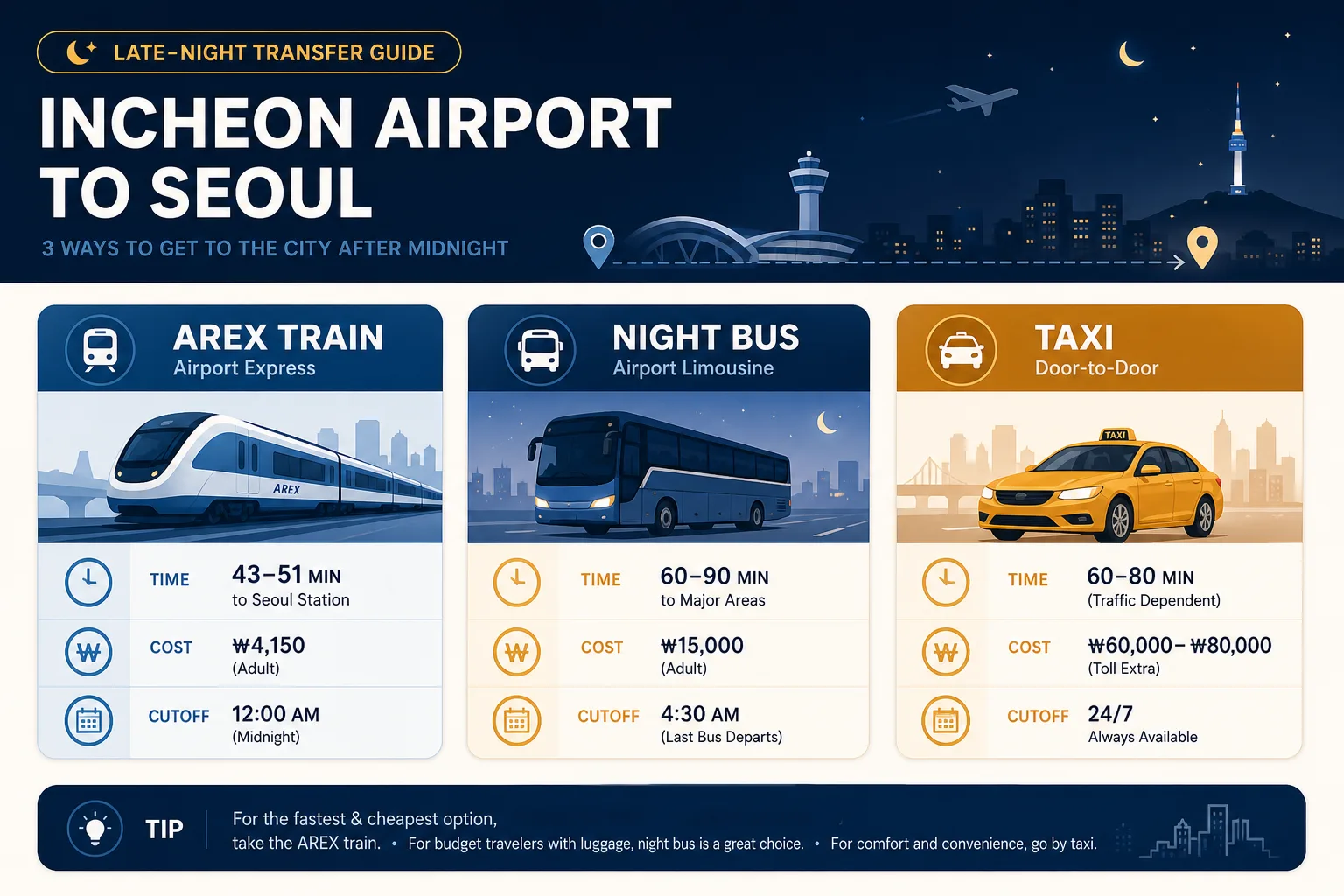 Editorial illustration: A simple comparison layout showing three late-night transfer options from Incheon Airport to Seoul.
Who Will Probably Love It
Seoul rewards travelers who like a plan more than they like flexibility. If you are the type who checks the last train time before checking the weather, a late landing is barely a hiccup. You already know the AREX Express last departs at 22:48 from Terminal 1 and 22:40 from Terminal 2, so you either book a flight that beats that clock or you accept the night bus and taxi as the real plan, not a backup.
First-time visitors who read one arrival guide and actually follow it also do fine. The friction in Seoul's late-night system is almost entirely a knowledge gap, not a logistics gap. Once you know the N6002 night bus costs 17,000 won and takes about 45 minutes from Terminal 1 to Hongdae, or that a taxi runs 70,000 to 100,000 won with a 40 percent surcharge after 23:00, the decision becomes simple arithmetic rather than a scramble at 1am with a dead phone battery.
Low-stress planners who are willing to pay a premium for certainty are the best match here. Booking a taxi in advance, or picking a hotel two minutes from an exit instead of the cheapest option a fifteen-minute walk away, removes almost all of the risk that makes late arrivals stressful in the first place.
Who Might Regret It
The traveler most likely to regret a late Seoul landing is the one who assumes the city's excellent daytime transit means excellent transit at all hours. It does not. Someone who lands at 11:50pm expecting to hop on a train the way they would at 3pm is the person standing in an empty station wondering what happened.
Budget travelers who book the cheapest hotel without checking its walk distance from a station are a second common regret pattern. A listing that looks fine on a map at normal zoom can turn into a fifteen-minute walk with luggage, alone, on unfamiliar streets, after a full day of travel. That is a very different experience than the same walk at 2pm.
A third pattern is travelers who treat Gimpo as an equivalent backup to Incheon. It is not. Gimpo shuts down entirely between 23:00 and 05:00, so anyone landing there in that window has no airport-based options at all, only what they can arrange from outside. Anyone who has not double-checked which airport they are actually flying into, and what that airport does at night, is at real risk of a bad first hour in Korea.
Mistake / Consequence Table
| Decision variable | Common mistake | Likely consequence |
|---|---|---|
| Which airport you land at | Assuming Gimpo works like Incheon for late flights | Gimpo closes 23:00 to 05:00; a late landing there leaves you stranded with no on-site transit or airport services |
| Transfer choice | Planning to "just catch the train" without checking the schedule | Last AREX Express leaves 22:48 (T1) / 22:40 (T2); miss it and you are choosing between a slower All-Stop train, a night bus, or a taxi with no warning |
| Hotel distance from transit | Booking the cheapest listing without checking walk distance | An extra 10 to 15 minutes of walking with luggage at midnight, often alone, in an unfamiliar area |
| Payment for transit | Assuming the Climate Card or a T-Money card works for everything | Climate Card is not accepted on airport buses at all, and T-Money top-ups need physical cash even though the card itself can be bought with a foreign card |
| Cost expectation | Budgeting a daytime taxi fare | A 40 percent surcharge applies from 23:00 to 02:00, pushing a 70,000 to 100,000 won ride noticeably higher |
| SIM or connectivity | Planning to sort out a SIM card the next morning | SK Telecom counters near Gate 13 (T1) and Gate 7 (T2) are open 24/7, so this is solvable on arrival, but only if you know to look for it |
Hidden Friction Points
The late arrival itself is the most visible friction point, but it is rarely the one that ruins the night. The real risk sits in the gaps between the visible plan.
Late arrival risk is mostly about the clock, not the city. Landing at 22:30 versus landing at 23:30 can be the difference between a normal train ride and a 45-minute night bus, purely because of a one-hour difference in flight time. Check your scheduled landing time against the 22:48 and 23:38 AREX cutoffs before you book, not after.
Airport transfer stress compounds quickly once the train is off the table. The night bus network was quietly restructured in 2025, with the N6001 route permanently closed and only N6002 (to Hongdae) remaining as the main overnight option. A traveler who researched night buses even a year ago may be working from outdated information without realizing it.
Hotel location risk is the friction point most travelers underestimate. During the day, an extra ten-minute walk from a subway exit is a minor inconvenience. At midnight, tired, with a suitcase, in an area with fewer people around, it changes the entire feel of arrival night. In Hongdae specifically, the difference between a hotel like Mercure Ambassador, a 2-to-3 minute walk from Exit 9, and something ten minutes further out is not a rounding error, it is the difference between arriving and being done versus arriving and still having a task ahead of you.
First-night fatigue is the friction that turns all of the above into an actual bad experience. Long-haul travelers landing at night are often 15-plus hours into their travel day. Every extra decision, every unexpected line, every moment of not knowing where to go costs more at that point than it would on any other night of the trip. The goal is not to eliminate friction entirely, it is to make sure none of it requires a decision you have not already made.
How to Make It Easier
None of these friction points require avoiding Seoul. They require deciding things in advance instead of at the airport.
- Check your scheduled landing time against the AREX cutoffs (22:48 Express / 23:38 All-Stop from Terminal 1, slightly earlier from Terminal 2) before booking the flight, not after landing.
- If you will miss the last train, decide now between the N6002 night bus (about 17,000 won, roughly 45 minutes to Hongdae) and a taxi (70,000 to 100,000 won plus a 40 percent surcharge after 23:00), rather than deciding in the arrivals hall.
- Bring some Korean Won cash, or plan to withdraw it on arrival, since T-Money top-ups require physical cash even though the card itself can be purchased with a foreign card.
- Book a hotel by walk distance from a station exit first, price second. A short, well-lit walk from an exit is worth more than a marginally cheaper room further away.
- If you want data on arrival, get an eSIM before you fly or plan to stop at the 24/7 SK Telecom counter near Gate 13 (Terminal 1) or Gate 7 (Terminal 2) rather than assuming you will sort it out "somewhere."
- Double-check which airport your flight actually uses. If it is Gimpo and your landing time falls between 23:00 and 05:00, treat that as a scheduling problem to fix, not a detail to manage on the ground.
Better Alternatives
If your flight schedule truly cannot avoid a very late Gimpo landing, or you know you will land well after every transit cutoff with no appetite for arranging a night bus or taxi, there are a few adjustments worth considering before ruling Seoul out entirely.
The simplest fix is often not avoiding Seoul but shifting the flight. If you have any flexibility, a landing before 22:00 removes almost all of this article's friction points at once, since it leaves a comfortable margin before the last train cutoffs.
If the flight time is fixed, booking one night at an airport-area hotel near Incheon or Gimpo before moving into Seoul the next morning is a reasonable alternative to a stressful midnight transfer, especially for travelers who are more fatigue-sensitive or traveling with family. It costs an extra night but removes the late-transfer decision entirely.
For travelers who specifically dislike unpredictability, a pre-booked private transfer removes the uncertainty of taxi availability and surge pricing, at a cost premium over a standard taxi. This suits low-stress planners more than budget-focused travelers, who are usually better served by simply timing the flight around the train schedule instead.
Self-Checklist
Before booking a late-arriving flight into Seoul, confirm:
- I know which airport my flight lands at, Incheon or Gimpo, and I have checked whether that airport operates at my landing time.
- I have compared my scheduled landing time against the AREX last-train cutoffs (22:48 / 22:40 Express, 23:38 / 23:32 All-Stop).
- If I will miss the last train, I have already decided between the N6002 night bus and a taxi, including the approximate cost.
- I have Korean Won cash available, or a plan to get it, for T-Money top-ups and any cash-only situations.
- My hotel is within an easy, well-lit walk of a station exit or within the night bus drop-off area, not just the cheapest listing on the map.
- I have a connectivity plan (eSIM before departure or a known 24/7 SIM counter) so I am not navigating blind.
- I have accepted that a late landing will cost more, in money or in planning effort, than a daytime one, and budgeted accordingly.
FAQ
Is it a bad idea to book a flight that lands in Seoul after midnight? Not automatically. It becomes a problem if you also pick a hotel far from a subway line, plan to rely on the last train, or assume Gimpo works the same way as Incheon. Landing late is manageable if the rest of the plan is built around it.
Can I take the subway from Incheon Airport if I land late at night? Only if you land early enough to catch it. The last AREX Express train leaves at 22:48 from Terminal 1 and 22:40 from Terminal 2, and the last All-Stop train leaves at 23:38 from Terminal 1 and 23:32 from Terminal 2. Anything later means a night bus or taxi.
Is Gimpo Airport a good option for a late arrival instead of Incheon? Not for a true late-night landing. Gimpo shuts down entirely between 23:00 and 05:00, so a flight scheduled to land in that window is not a safe bet there at all.
How much should I expect to pay for a taxi from Incheon Airport at night? Standard fares to central Seoul typically run about 70,000 to 100,000 won. Between 23:00 and 02:00, a 40 percent late-night surcharge applies on top of that, so budget toward the higher end if you are landing in that window.
What is the safest hotel location choice if I know I will arrive late? Pick a hotel within a short, well-lit walk of an exit on a direct AREX or subway line, or within the drop-off radius of the night bus route, rather than the cheapest listing further out. A few minutes of walk time matters much more at midnight than at 2pm.