travel-decisions
Is Tokyo a Bad Fit for Travelers Who Want to Walk Everywhere?
Tokyo rewards neighborhood walking but punishes citywide walking. Here is how to decide if it matches your travel style before you book.

Tokyo is one of the most walkable cities in the world at the block level and one of the least walkable at the city level. That contradiction is the whole story for travelers who want to walk everywhere.
Quick Verdict
Tokyo is a strong fit if you treat it as a city of walkable neighborhoods linked by short train rides. It is a weak fit if your definition of walkability is the Paris or Rome model, where you stroll out of your hotel in the morning and chain districts together on foot until dinner.
- Choose Tokyo if you want deep, slow, repeat walks inside specific neighborhoods.
- Reconsider Tokyo if you refuse to use the subway, or if your trip will fail emotionally the moment you have to tap a transit card.
The honest answer to "is Tokyo walkable like European cities" is: yes inside a neighborhood, no across the city.
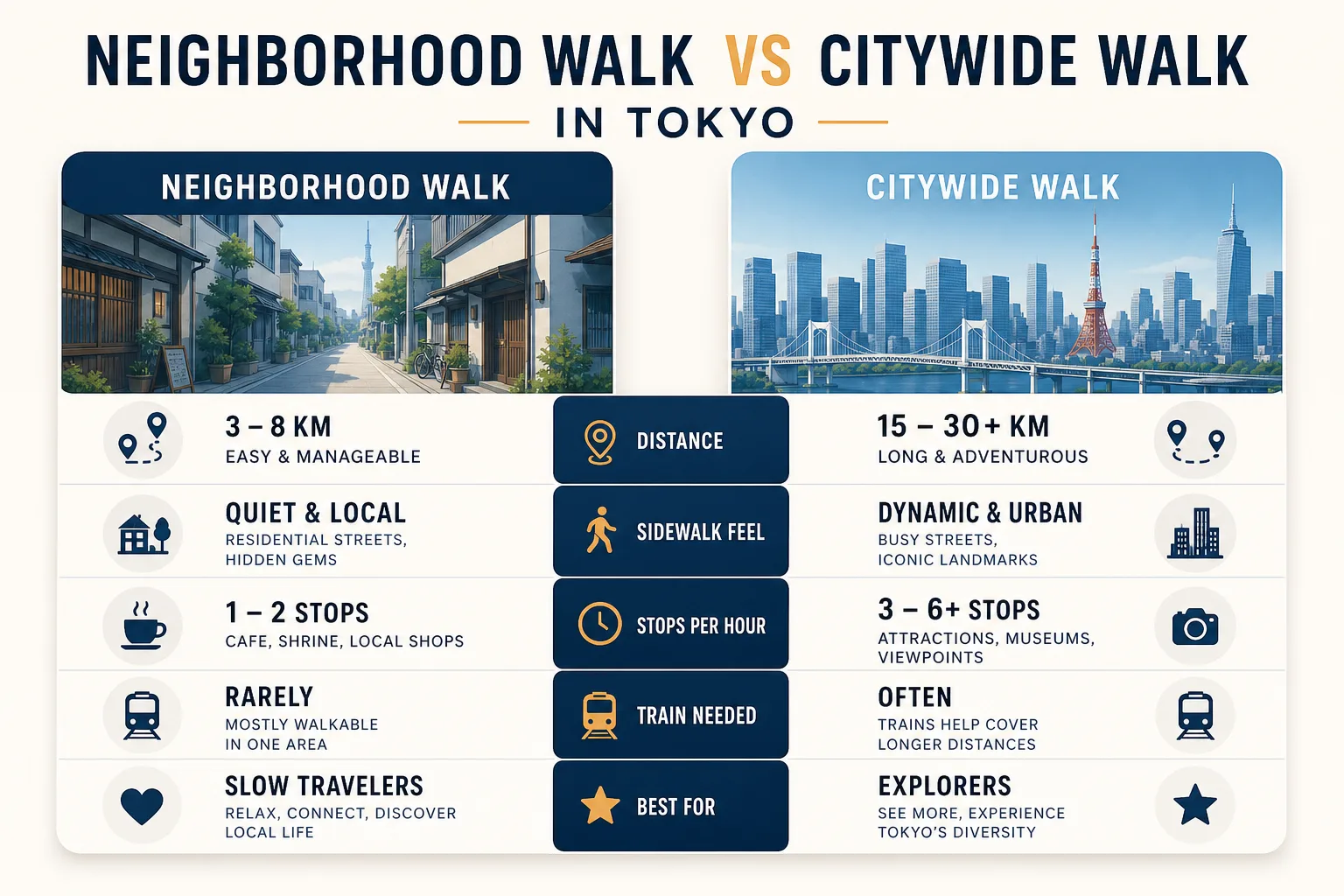 An infographic comparing Neighborhood Walk versus Citywide Walk in Tokyo, highlighting differences in distance, atmosphere, and transit.
Best for First-Time Visitors Who Walk
First-time visitors usually arrive with a Google Maps list that spans Shibuya, Asakusa, Shinjuku, Ginza, and Tokyo Station. On a map these look close. On foot they are not. Asakusa to Shibuya is roughly two and a half hours of walking through stretches that are not visually rewarding.
If you are a walking-first first-time visitor:
- Pick three or four neighborhoods, not ten landmarks.
- Use the subway only to jump between them.
- Plan two to three hours of continuous walking inside each one.
This is the version of Tokyo that feels freeing rather than frustrating.
Best for Couples Who Want a Slow Stroll
Couples who loved walking Paris together usually want the same rhythm in Tokyo: coffee, stroll, lunch, stroll, drink, dinner, stroll home. Tokyo can absolutely deliver this, but only inside the right base.
Neighborhoods like Kagurazaka, Yanaka, and the Nakameguro to Daikanyama corridor support a full day of low-friction couple walking. Staying in Shinjuku or near Tokyo Station and trying to recreate that rhythm usually fails because the immediate area is built for commuters, not strollers.
Best for Slow Travelers
Slow travelers tend to do well in Tokyo because the city rewards the second and third visit to the same street. A backstreet in Yanaka looks different at 9 a.m., 3 p.m., and 7 p.m. If your idea of slow travel is sitting in one neighborhood for three days and walking it in layers, Tokyo is excellent.
The mismatch shows up when slow travel is confused with "no transit ever." Tokyo's slowness lives inside districts, not between them.
Best for Low-Stress Travelers
The subway is the stress variable. If train navigation drains you, the friction of getting between walkable districts can cancel out the calm of walking inside them. Two practical fixes:
- Stay inside a walkable district instead of next to a giant interchange like Shinjuku or Tokyo Station.
- Plan only one train transfer per day, ideally off-peak.
Low-stress walking-first travel in Tokyo is possible, but only if the itinerary respects that the trains are non-negotiable.
Traveler Type Table
The core decision variable is not "walkable or not." It is which kind of walking you want.
| Traveler type | Neighborhood walking in Tokyo | Citywide walking in Tokyo | Real fit |
|---|---|---|---|
| Walking-first, Paris-style | Excellent | Poor | Mixed, needs mindset shift |
| Slow traveler, one base | Excellent | Not needed | Strong fit |
| City wanderer, no plan | Excellent inside a district | Frustrating across districts | Strong if base is chosen well |
| First-time visitor with landmark list | Good in pockets | Poor, long dead zones | Weak unless list is trimmed |
| Low-stress traveler, avoids transit | Excellent | Poor | Weak fit |
| Couple wanting all-day stroll | Excellent in 4 to 5 districts | Poor | Strong if based in the right area |
Neighborhood walk and citywide walk are two different products. Tokyo sells one of them very well.
Common Mismatches
The travelers who leave Tokyo disappointed about walking usually share a few patterns:
- They booked a hotel next to a major station instead of inside a walkable neighborhood.
- They built a daily plan that crossed three or more districts on foot.
- They visited in July or August and assumed they could just walk through it.
- They expected the gaps between famous areas to look like central Paris and were surprised by the long stretches of office blocks, elevated roads, and arterial streets.
- They refused to use the subway on principle, which compressed their experience into whatever happened to be near their hotel.
None of these are Tokyo's fault. They are expectation mismatches. The risk is not that the trip is bad, it is that the traveler keeps comparing it to a city it was never trying to be.
Final Match Recommendation
Tokyo is a strong fit for walking-first travelers who are willing to redefine walking as "deep neighborhood time" rather than "continuous citywide motion." It is a weak fit for travelers whose identity is tied to never touching transit, or whose mental model of a walkable city is fixed to compact European centers.
Practical version:
- Strong fit: slow travelers, couples picking one base, repeat visitors, anyone happy to walk three hours inside one district.
- Weak fit: travelers who want one unbroken stroll from morning coffee to evening dinner across multiple famous areas without ever boarding a train.
If you fall in the second group, Tokyo is not bad, it is just not what you are picturing. Kyoto, Kanazawa, or a smaller European city will serve that specific instinct better.
FAQ
Is Tokyo walkable like Paris or Rome? Not in the same way. Inside a single neighborhood Tokyo is as walkable as anywhere in Europe. Across the city it is not, because the distances and the texture of the in-between areas break the stroll.
How many kilometers a day is realistic in Tokyo on foot? Twelve to eighteen kilometers a day is comfortable for most walking-first travelers if you split it across two or three neighborhoods with subway hops in between. Trying to do that distance in one continuous line usually means walking through dead zones.
Is it worth visiting Tokyo if I hate using the subway? Yes, but shorten the trip and pick one walkable base. Three days inside Yanaka and Nezu is a better experience than a week of fighting the map across the whole city.
When is the best season for walking-first travelers in Tokyo? Late March to mid-May, and mid-October to early December. Summer is too humid for long walks for most visitors, and midwinter cuts daylight short.