travel-decisions
Is Busan Worth It in Summer If You Hate Heat And Crowds?
A direct verdict on whether Busan's summer beach season is worth the heat, humidity, and crowds for heat-sensitive travelers, with a friction breakdown and practical alternatives.
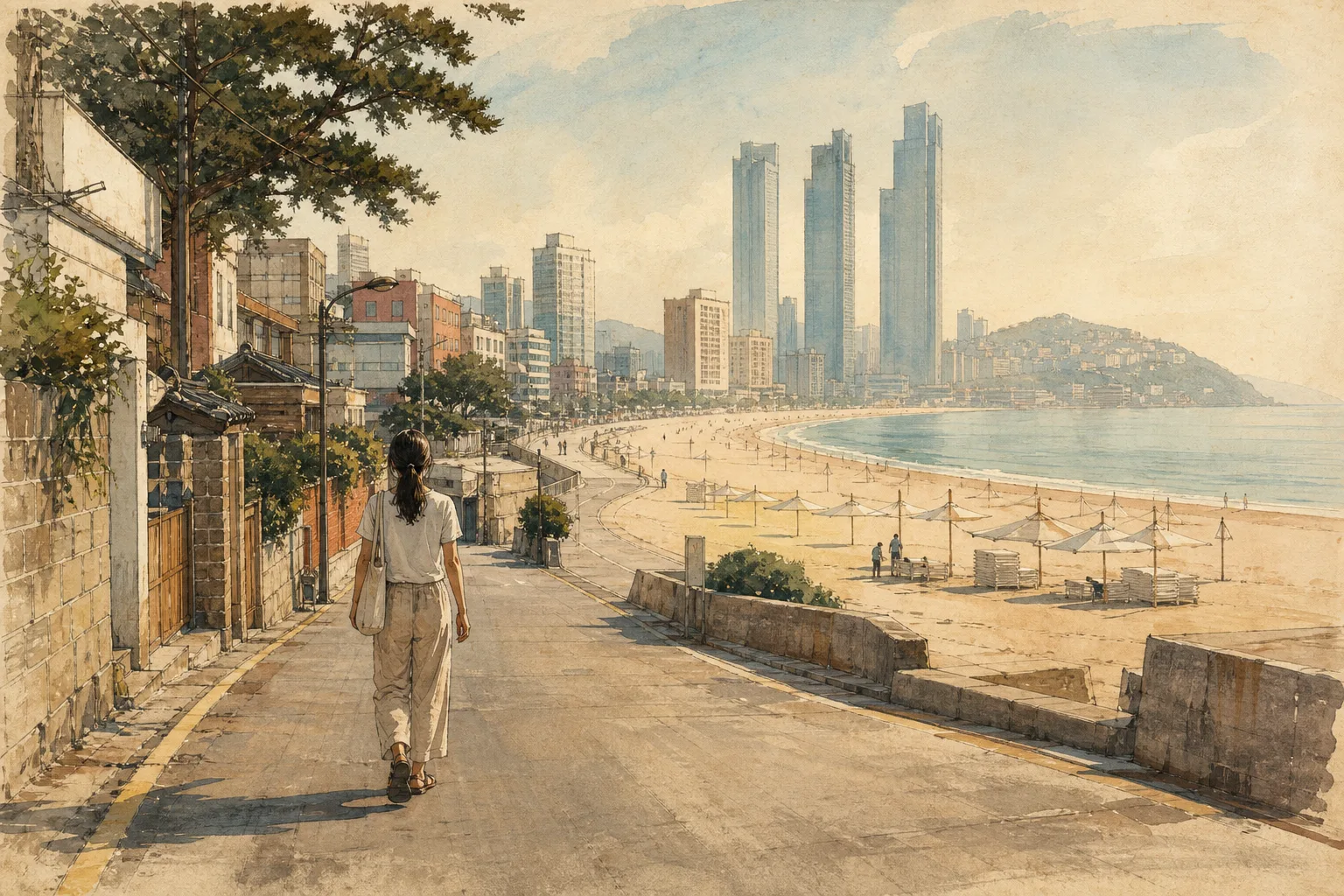
Quick Verdict
Busan in summer is worth it if you can tolerate humid heat for short stretches, you are willing to build your day around beach hours instead of fighting them, and you book accommodation early enough to avoid panic pricing. It is not worth it, at least not in July or August, if you are heat-sensitive, crowd-averse, or trying to keep costs predictable.
Choose summer Busan if:
- You specifically want the beach culture: swimming, the Gwangalli drone show, night markets, and the energy of a full coastal city in season.
- You can adjust your schedule around early mornings and evenings, resting through the hottest midday hours.
- You book hotels months ahead and are not trying to hit the cheapest possible rate.
Avoid summer Busan, or shift your dates, if:
- You have low heat tolerance and humid air makes you feel drained rather than just warm.
- Crowded beaches, packed subway platforms, and full restaurants during peak hours feel like a cost rather than part of the experience.
- Your trip depends on a tight budget, since summer hotel pricing works against that.
The honest middle ground: late June or early September gives you a meaningfully softer version of Busan summer without fully giving up the season.
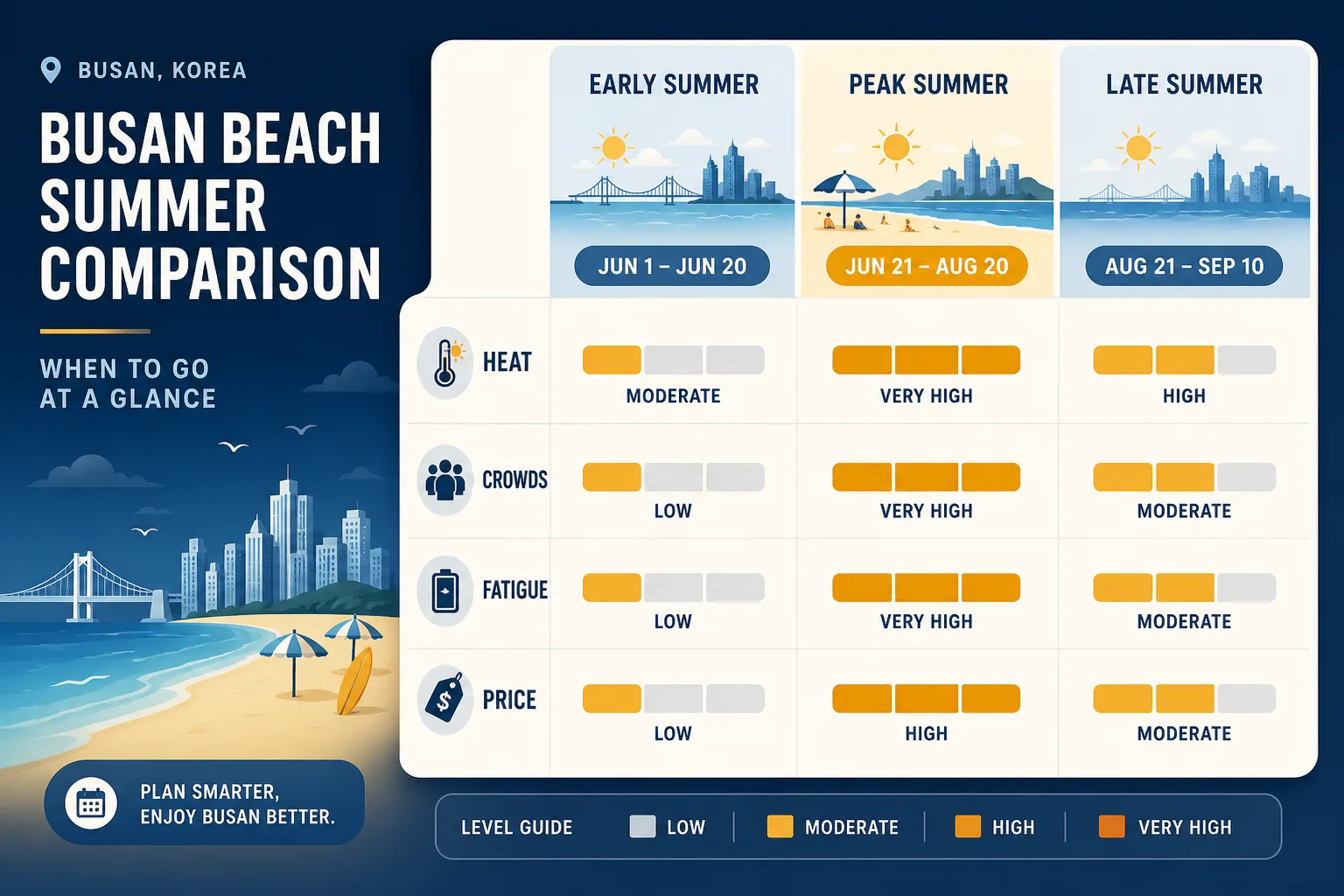 Editorial illustration: A simple comparison chart layout with four labeled rows -- heat.
The Main Friction: Heat, Crowds, Fatigue, and Price All Peak Together
Busan's summer problem is not any single factor. It is that heat, crowds, fatigue, and price pressure all rise at the same time, so there is no obvious escape valve once you are on the ground.
Heat. July is Busan's most humid month, averaging 88 percent relative humidity. That number matters more than the raw temperature reading. Humid heat slows you down on foot, makes shaded rest stops necessary rather than optional, and turns a normal walking itinerary into something that needs breaks built in. On July 29, 2026, Busan hit 38.8C in Geumjeong-gu, its highest reading in 122 years, which is an extreme case but shows the ceiling this season can reach.
Crowds. Haeundae Beach runs its official 2026 swimming season from June 26 to September 15, and Gwangalli Beach runs July 1 to August 31. Within those windows, especially on weekends, both beaches and the neighborhoods around them fill up fast. Crowding is not limited to the sand: subway cars, beachfront cafes, and evening market streets absorb the same surge.
Fatigue. Heat and crowds compound each other physically. Standing in a packed subway car in humid air, then walking several blocks to a beach entrance, adds up faster in summer than in a mild-season trip. Even short walks, like the 700-meter route from Gwangan Station to Gwangalli Beach, feel longer when humidity is high and you are also navigating foot traffic.
Price pressure. During major summer events, overall hotel rates in Busan can average around 433,999 KRW (roughly $300 or more) per night, and beach-adjacent hotels often double or triple their normal rates. This is the friction point most likely to catch travelers off guard, since it is easy to underestimate how much beach-season demand shifts the market.
None of these four points is disqualifying on its own. Together, they are what make summer Busan a genuinely different trip than spring or autumn Busan, not just a hotter version of the same one.
Friction Table: How the Four Pressure Points Shift Across Summer
| Timing window | Heat / humidity | Crowd level | Physical fatigue risk | Price pressure | |
|---|---|---|---|---|---|
| Late June (beach season just opened) | Warm, humidity rising | Moderate, still building | Manageable with breaks | Moderate, pre-peak | |
| Mid-July to mid-August (peak) | High, often 88% humidity, occasional record extremes | High to very high on weekends | High, especially midday | Highest, 300+ USD/night common near beaches | |
| Late August to early September | Still warm, humidity easing slightly | Declining, Gwangalli season ends Aug 31 | Moderate | Easing, but still above shoulder season | |
| Early morning any summer day | Same heat, but before peak sun | Noticeably lower until roughly mid-morning | Lower | No change (time of day does not affect nightly rate) |
The table makes the core tradeoff explicit: there is no summer window where all four factors are low at once. Late June and early September are the closest to a balanced compromise, while mid-July through mid-August stacks every friction point at its worst simultaneously.
Who Will Feel This Most
Not every traveler experiences Busan summer the same way. The friction lands hardest on specific profiles.
- Heat-sensitive travelers who also want a full daily itinerary. If your trip style is to see several neighborhoods in one day, humid heat will force a slower pace whether you plan for it or not. Travelers who accept a lighter daily plan feel this far less.
- First-time visitors expecting a typical "beach holiday" pace. Someone new to Busan may not anticipate how much the crowd and heat combination changes the rhythm of a beach day compared to a cooler-climate coastal trip elsewhere.
- Budget-conscious travelers booking close to their travel dates. Late bookers absorb the worst of the price pressure, since beach-adjacent inventory sells out first and at the highest markup.
- Travelers who dislike dense human proximity. Packed subway cars, full beach sand, and busy night markets are a normal part of Busan summer. If this kind of density genuinely drains you rather than just mildly annoys you, summer is the hardest season to visit comfortably.
By contrast, travelers who prioritize atmosphere over efficiency, who can shift meals and activities to avoid midday heat, and who book early tend to report a far more manageable version of the same season.
How to Reduce Each Friction Point
You cannot remove Busan's summer friction entirely, but each of the four points has a practical lever.
For heat: Plan outdoor blocks for early morning or after 5pm, and build in an indoor midday option. Spa Land Centum City is one such option, with entry tickets running 15,000 to 20,000 KRW for 4 hours (extendable to 6 hours with a minimum in-facility spend of 10,000 KRW). If you arrive before the attached department store opens at 11am, use the spa's dedicated street entrance rather than assuming mall access.
For crowds: Front-load beach time into the first hour or two after sunrise. Both Haeundae Beach (a flat 709-meter, 5 to 8 minute walk from Haeundae Station) and Gwangalli Beach (700 meters, 10 to 13 minutes from Gwangan Station) are close enough to the subway that an early visit does not require an early wake-up sacrifice on top of everything else.
For fatigue: Treat one beach visit and one additional activity as a realistic daily ceiling in peak summer, rather than the two-to-three-stop days that work fine in spring or autumn. If you want a lower-effort way to see the coastline, the Haeundae Blueline Park Sky Capsules move at 4 km/h over a 2km route between Mipo and Cheongsapo, taking about 30 minutes, though they require booking weeks in advance and will not solve a same-week fatigue problem.
For price pressure: Book accommodation as early as possible, and consider staying a few subway stops away from Haeundae or Gwangalli rather than directly on the beachfront. The price gap between beachfront and a short subway ride away widens considerably in peak weeks, and the extra travel time is usually only a few minutes longer than walking from a beachfront hotel through crowds.
Better Alternatives If Summer Busan Is the Wrong Fit
If the friction table above points toward "avoid," you have real alternatives rather than just "don't go."
- Shift to late spring instead. Cooler temperatures and lower humidity remove most of the heat friction, and crowd density is generally lighter outside of cherry blossom weekends.
- Shift to early autumn. Once Gwangalli's swim season ends on August 31 and the peak heat breaks, Busan becomes noticeably easier to walk through, though some beach-specific programming winds down with the season.
- Keep summer dates but change the destination emphasis. If your dates are fixed for other reasons, consider treating this as a city-and-culture trip rather than a beach trip, leaning on markets, indoor attractions, and evening programming like the Gwangalli M Drone Light Show, which runs twice every Saturday night at 20:00 and 22:00 from March through September.
- Split the difference with a late-June or early-September date. As the friction table shows, these windows are not friction-free, but they avoid the worst overlap of heat, crowds, and price that defines mid-July through mid-August.
The right alternative depends on why you were considering Busan in the first place. If the beach itself was the draw, shifting your dates matters more than changing your itinerary. If Busan's general food and neighborhood culture was the draw, keeping your dates and reshaping your daily plan may be enough.
Decision Checklist Before You Book
Use this list to turn the analysis above into an actual go or no-go decision.
- I can tolerate outdoor heat and humidity for at least 1 to 2 hours without needing extended indoor recovery.
- I am comfortable with crowded beaches, packed transit, and full restaurants during peak hours.
- My itinerary can flex around early morning and evening activity blocks, with a lighter midday plan.
- I am booking accommodation well in advance, not within the final few weeks before travel.
- I have a realistic budget that accounts for beach-adjacent hotel rates roughly doubling or tripling in peak weeks, or I am willing to stay a few stops away by subway.
- If any of the above are unchecked, I have considered shifting to late June, early September, or a different season entirely.
If you checked most or all of these, summer Busan is a reasonable choice for you. If you left several unchecked, the friction points identified above are likely to define your trip more than the destination itself will.
FAQ
Is Busan too hot to visit in July and August? It can be. Busan's July humidity averages 88 percent, and in late July 2026 the city recorded its highest temperature in 122 years at 38.8C. Heat itself is manageable for short outdoor stretches, but the combination of heat and humidity across a full walking day is what wears down heat-sensitive travelers. If you cannot tolerate humid heat for more than an hour or two outdoors, treat July and August as a caution zone rather than an outright block.
What is the best time to visit Busan to avoid both heat and crowds? Late June, right as the Haeundae swimming season opens on June 26, tends to offer a shorter gap between comfortable temperatures and full crowd density. Early September, after Gwangalli's swim season ends on August 31 but before autumn cools things down, is another option, though some beach infrastructure and events wind down by then.
Are Busan hotel prices really that much higher in summer? Yes, during peak summer weeks. Overall hotel rates in Busan can average around 433,999 KRW (roughly $300 or more) per night during major summer events, and beach-adjacent properties often double or triple their normal rates. Staying even a few subway stops away from Haeundae or Gwangalli usually cuts this pressure significantly.
Can I still enjoy Busan in summer if I avoid the beaches? Largely yes. Indoor and shaded options like Spa Land Centum City, covered markets, and museum-style attractions reduce direct heat exposure. The tradeoff is that skipping the beaches removes a large part of what makes Busan distinct in summer, so this works better as a partial strategy than a full replacement for the beach experience.
Is early morning really enough to avoid Busan's summer crowds? It helps but does not eliminate the problem. Arriving at Haeundae or Gwangalli before roughly 9am generally means thinner crowds and softer light, but by late morning both beaches fill in quickly during the official swimming season windows. Treat early morning as a partial fix, not a guarantee of a quiet day.