travel-decisions
Is Busan Worth It During the July Monsoon If You Only Have Outdoor Plans?
If your Busan trip is built around beaches, cable cars, and coastal walks, July's monsoon rain can wreck the plan. Here's an honest, decision-first look at who should go anyway and who should reschedule.
Strong Opening
If your Busan itinerary is a list of beach days, cable car rides, and cliffside photo stops, July is the month most likely to take that plan apart. This is not a scare tactic. It is a scheduling problem: Busan's wettest month arrives with the exact conditions that shut down outdoor infrastructure, and outdoor-heavy trips have no backup plan built in.
The honest version of the tradeoff looks like this. July gives you warm water, long daylight hours, and the energy of Busan's peak beach season. In exchange, you get the highest accommodation prices of the year, a real chance of losing outdoor access on any given day, and weather that can turn a "quick walk to the skywalk" into a wasted afternoon. None of that means skip Busan. It means an outdoor-only itinerary needs a second plan, and this article is about building that plan before you land, not after your first rained-out day.
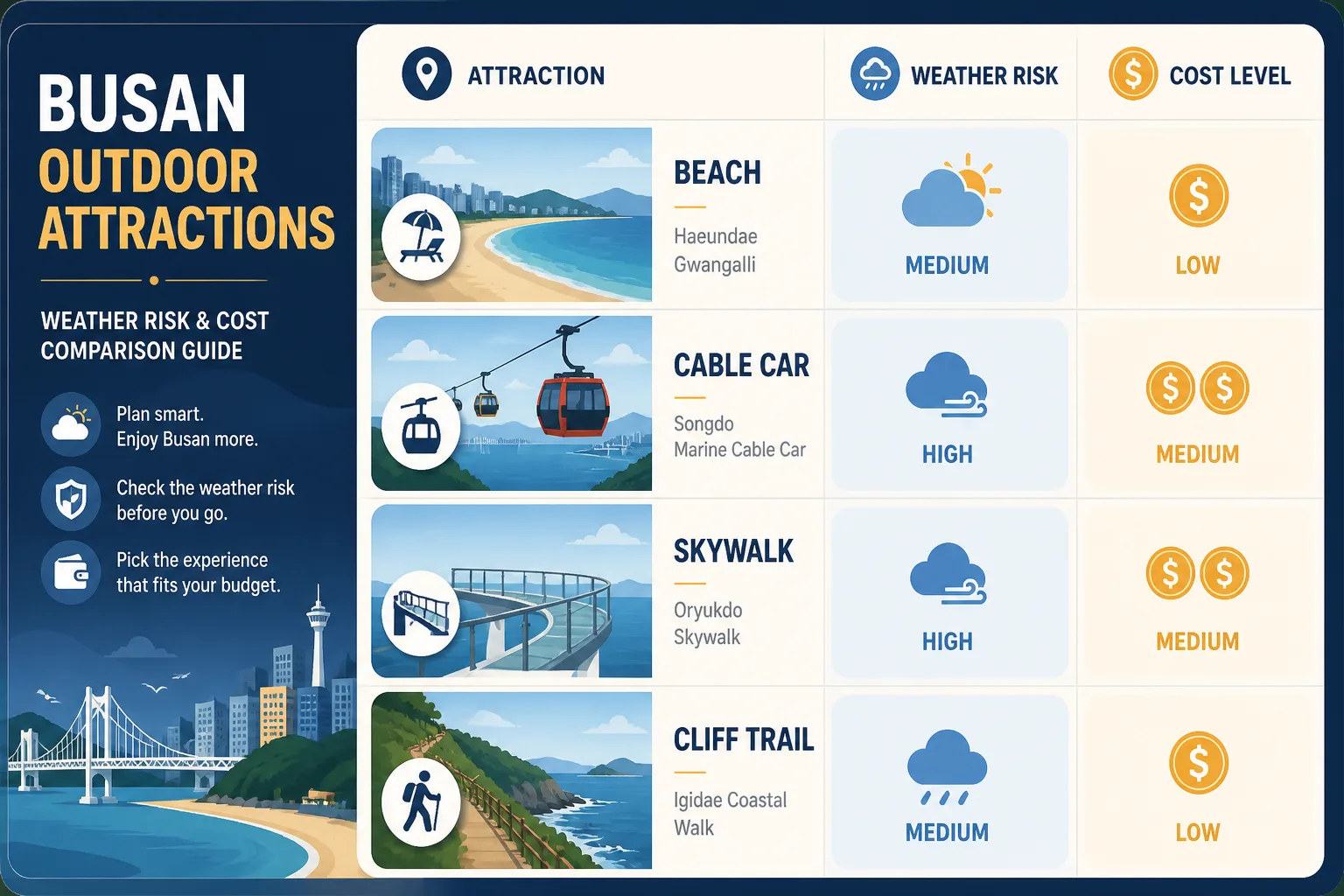 Editorial illustration: A simple comparison table graphic listing Busan outdoor attractions such as beach.
Quick Verdict
Go ahead and book July if: your schedule is genuinely flexible, you can shift beach and cable car days around a rolling forecast, you are comfortable treating half your trip as indoor backup, and you are not paying peak-season prices to sit in a hotel room watching rain.
Reschedule or restructure if: every day of your trip is pre-booked around a single outdoor activity (one beach day, one cable car slot, one skywalk visit), you have no slack days to absorb a washout, or your main goal is ocean-view photography that depends on clear skies rather than "it's technically visible."
The clearest signal either way is your ratio of fixed-time bookings to free time. A trip with two or three pre-timed outdoor tickets and otherwise open days can absorb a rainy morning. A trip where every slot is locked in advance has no room to adapt, and that is where July regret tends to concentrate.
Who Will Probably Love It
Travelers who do well with a July Busan trip tend to share a few traits. They are comfortable improvising a day around a live forecast rather than a fixed script. They are willing to treat the beach as one part of the trip rather than the whole point, filling gaps with markets, cafes, or indoor culture stops without feeling like the trip failed. They are also often traveling on a schedule that overlaps with school break timing anyway, so July was never really optional for them.
Photographers who specifically want the moody, storm-light coastline (heavy clouds over the ocean, dramatic overcast seascapes) can also do well here, since that look is genuinely easier to get in July than in a clear-sky month. The key difference from a disappointed traveler is expectation: they came for atmosphere, not for a guaranteed blue-sky postcard shot.
Budget is the other quiet factor. If cost is not your main constraint and you are booking July because of fixed vacation dates from work or school, the smarter move is not avoiding Busan, it's building slack into the schedule rather than filling every hour.
Who Might Regret It
The clearest regret pattern is the traveler who planned an outdoor-only Busan trip around a small number of high-value experiences and pre-booked them tightly. A cable car ticket for day two, a skywalk visit for day three, one beach day sandwiched in between, and nothing else penciled in. If day two brings high winds and the cable car suspends operations, there is often no slot left to rebook it before departure, since tickets for popular rides like the Blueline Park sky capsule need to be booked weeks ahead during summer demand.
The second pattern is the photographer or beach-seeker chasing a specific visual: clear turquoise water, an unobstructed skywalk view, a clean horizon shot from a cliff trail. July's average of only about 5.5 hours of daily sunshine, combined with heavy humidity haze, means that exact shot is a smaller window than it looks from a spring itinerary. Expecting to recreate a bright, clear-sky photo you saw online is the single most common source of disappointment in trip feedback for this season.
The third pattern is safety-adjacent: travelers who assume a scenic hillside trail or cliffside village will be accessible the way it would be in April. During active landslide or flooding alerts, those areas can be restricted with little notice, and pushing past a closure or wet-slope warning to get the shot is where genuine risk creeps in.
Mistake / Consequence Table
| Decision variable | If you plan around it anyway | Realistic consequence |
|---|---|---|
| One fixed beach day, no backup | Book a single beach day mid-trip | Swimming may be banned that day due to rain, waves, or rip currents; you get a walk, not a swim |
| Tight cable car / skywalk window | Book Songdo Cable Car or Oryukdo Skywalk for one specific afternoon | Either can suspend for wind, rain, or storms with no guaranteed rebooking slot |
| Taejongdae Danubi Train on a rainy Monday | Plan the train ride without checking day or forecast | Closed on Mondays regardless of weather, and does not run in rain either way; expect the steep 1-hour walking loop instead |
| Chasing a clear-sky ocean photo | Build the trip around one signature outdoor shot | Roughly 5.5 hours of average daily sunshine in July makes a guaranteed clear frame unlikely on any single day |
| Booking July for the lowest price | Assume summer means cheaper rooms | July double rooms average around $236 USD a night versus about $145 USD in September, the opposite of the usual price logic |
| Hillside or cliff trail access | Assume trails are open like in spring | Landslide and flooding alerts can restrict mountain and steep-slope access with little warning |
Hidden Friction Points
Weather tradeoffs. The friction is not just "it might rain." It is that Busan's outdoor infrastructure is built to shut down fast and without much notice. High winds alone, with no rain at all, can suspend the Songdo Sea Cable Car. A single downpour, even a short one, can trigger a temporary beach swimming ban that lasts the rest of the day. If your itinerary treats these as guaranteed rather than weather-dependent, you are planning against the season instead of with it.
Expectation mismatch. Most Busan outdoor photos and itinerary guides are shot and written for spring or clear autumn days. Bringing that mental image into July, then measuring your actual trip against it, is where disappointment comes from. The honest baseline for July is hazy skies, shorter useful daylight for photography, and a real chance that your one "must-see" outdoor stop is closed or fogged over on the day you visit.
Safety. Rip currents and high waves are the most common reason a beach closes even when it isn't actively storming, and swimming bans exist because conditions can turn dangerous quickly after heavy rain upstream. Landslide and flooding alerts on hillside and mountain routes are issued for real slope-stability reasons, not as a formality. Treating either as a suggestion rather than a hard stop is the actual safety risk here, more than the rain itself.
How to Make It Easier
None of this means avoiding Busan in July. It means shifting from a fixed itinerary to a flexible one.
- Book only 1 to 2 fixed-time outdoor tickets for the whole trip, and keep everything else loosely scheduled so a rainy morning does not collapse the day.
- Check the forecast the night before and pick your beach or cable car day the morning of, rather than locking it in weeks ahead.
- Treat Haeundae Beach and similar spots as flexible-hours stops (9 AM to 6 PM swimming window) rather than all-day plans, since a closure is usually hours-long, not the whole day.
- Have one indoor or covered backup ready for each outdoor day: a market, a cafe strip, or an indoor cultural stop within a short subway ride of your hotel.
- If your one non-negotiable outdoor stop is the skywalk, cable car, or Danubi Train, build in a spare day near the end of your trip specifically to retry it if the first attempt gets weathered out.
- Budget for July's higher room prices going in, rather than being surprised that summer costs more than a shoulder-season trip would.
Better Alternatives
If your itinerary is genuinely outdoor-only, non-negotiable on timing within your trip, and cannot absorb a lost day, July in Busan is a harder sell than the season's popularity suggests. A few honest alternatives:
- Shift to late September or October. Typical seasonal patterns bring calmer weather and notably lower accommodation prices (closer to the roughly $145 USD average double-room rate seen in September) than July's peak pricing, while still keeping most outdoor attractions comfortable to visit.
- Keep July dates but rebuild the itinerary as mixed, not outdoor-only. Pair each planned beach or cable car day with a genuine indoor alternative (museums, covered markets, indoor culture spots) so a weather loss becomes a swap, not a gap.
- If the trip is fixed to July and outdoor-only, consider a shorter, lower-stakes visit. A 2 to 3 day stop focused on flexible, walkable areas rather than ticketed weather-dependent attractions reduces how much of your trip is exposed to a single bad-weather day.
Self-Checklist
Run through this before you finalize a July, outdoor-focused Busan trip:
- Fewer than half of my planned activities are locked to a specific date and time
- I have at least one full spare day in the trip that isn't pre-booked to anything
- I've priced accommodation at July rates, not shoulder-season rates, and it still fits my budget
- I have an indoor or covered backup plan for at least one outdoor day
- I'm comfortable with hazy, overcast photos as a realistic outcome, not just clear-sky shots
- I know that beach swimming bans and skywalk/cable car closures are weather-triggered, not rare exceptions
- If my one must-do stop (cable car, skywalk, or a specific beach day) gets weathered out, I have a plan B within the same trip
If you checked most of these, July can work. If you checked fewer than half, the itinerary needs rework before booking, not after arrival.
FAQ
Is Busan too rainy in July for a beach trip? July is Busan's wettest month, with 10 to 14 rainy days and 233 to 327 mm of rain typically falling across the month, often concentrated in heavy early-to-mid-July downpours. That does not mean every day is a washout, but a trip built entirely around beach time has a real chance of losing multiple days to closures or downpours, especially if your visit falls in that early-to-mid-July window.
Are Busan beaches closed when it rains? Public beach swimming is limited to set hours between 9 AM and 6 PM even in good weather, and it is banned outright during high waves, rip currents, or right after heavy rain. In a heavy monsoon stretch, that can mean no swimming access for a day or more at a time, even though the beach itself stays open for walking.
Do Busan's cable cars and skywalks close during monsoon season? Yes, and this is one of the biggest planning traps. The Oryukdo Skywalk closes during any rain, high winds, snow, or severe weather. The Songdo Sea Cable Car suspends service in severe weather or high winds. The Taejongdae Danubi Train does not run during rain and is closed on Mondays regardless of weather, forcing a steep one-hour walk instead.
Is it safe to hike or visit cliffside spots in Busan during July? Heavy monsoon rain periodically triggers municipal landslide and flooding alerts in Busan, which can restrict access to mountain trails and steep hillside slopes. If you are planning cliffside walks, coastal trails, or hillside villages, treat any active alert as a hard no rather than a minor inconvenience, since these closures exist for real slope-stability reasons.
Should I just move my Busan trip to a different month instead? If your itinerary is at least 70 percent outdoor and you cannot build in flexible days, shifting to late September or October generally gives you calmer weather and lower accommodation prices than July, based on typical seasonal patterns. If your dates are fixed and cannot move, the better fix is usually restructuring the itinerary rather than canceling outright.