city-matchups
Rome vs Venice for a Short 2 to 3 Day Trip: Which Feels Easier Day to Day?
A friction-first comparison of Rome and Venice for a 2 to 3 day trip, focused on arrival, walking, crowds, and fatigue so low-stress travelers can decide fast.
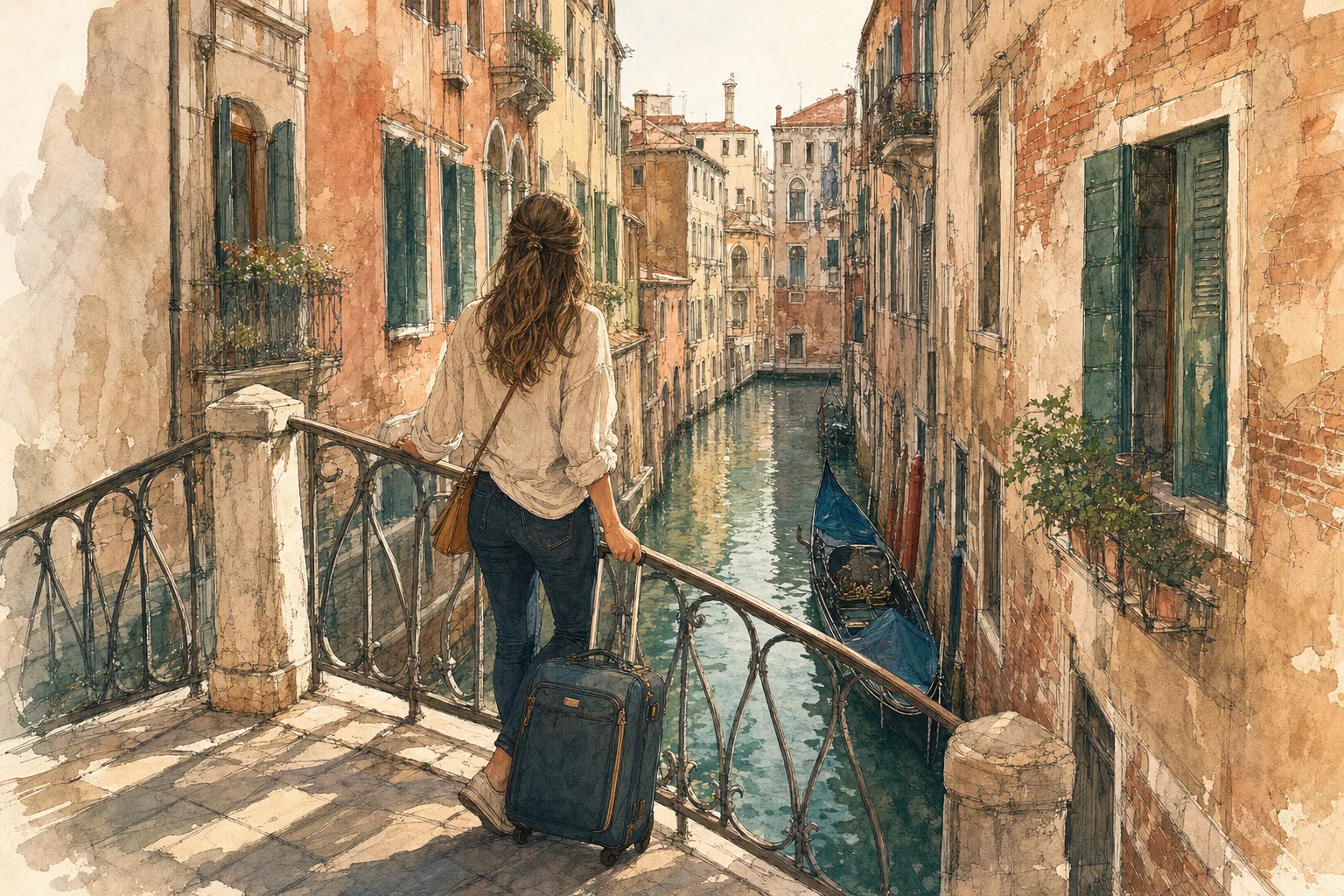
If you have only 2 or 3 days and you want the trip to feel easy, not impressive, the choice between Rome and Venice is less about culture and more about logistics. This guide leads with friction: arrival, walking, crowds, and end-of-day fatigue.
Quick Verdict
For a short 2 to 3 day trip optimized for ease, choose Venice if you have 2 days and Rome if you have 3.
- Choose Venice if: you want a compact, car-free city, you can handle stairs on bridges, you have light luggage, and you want maximum scenery per walking minute.
- Choose Rome if: you have heavier luggage, mobility concerns, or 3 full days to spread out, and you are comfortable using buses, metro, and longer walks between sights.
- Skip both for now if: you have less than 48 hours on the ground after travel time, or your trip falls during peak August heat in Rome or peak Carnival crowds in Venice.
The rest of this article is the math behind that verdict.
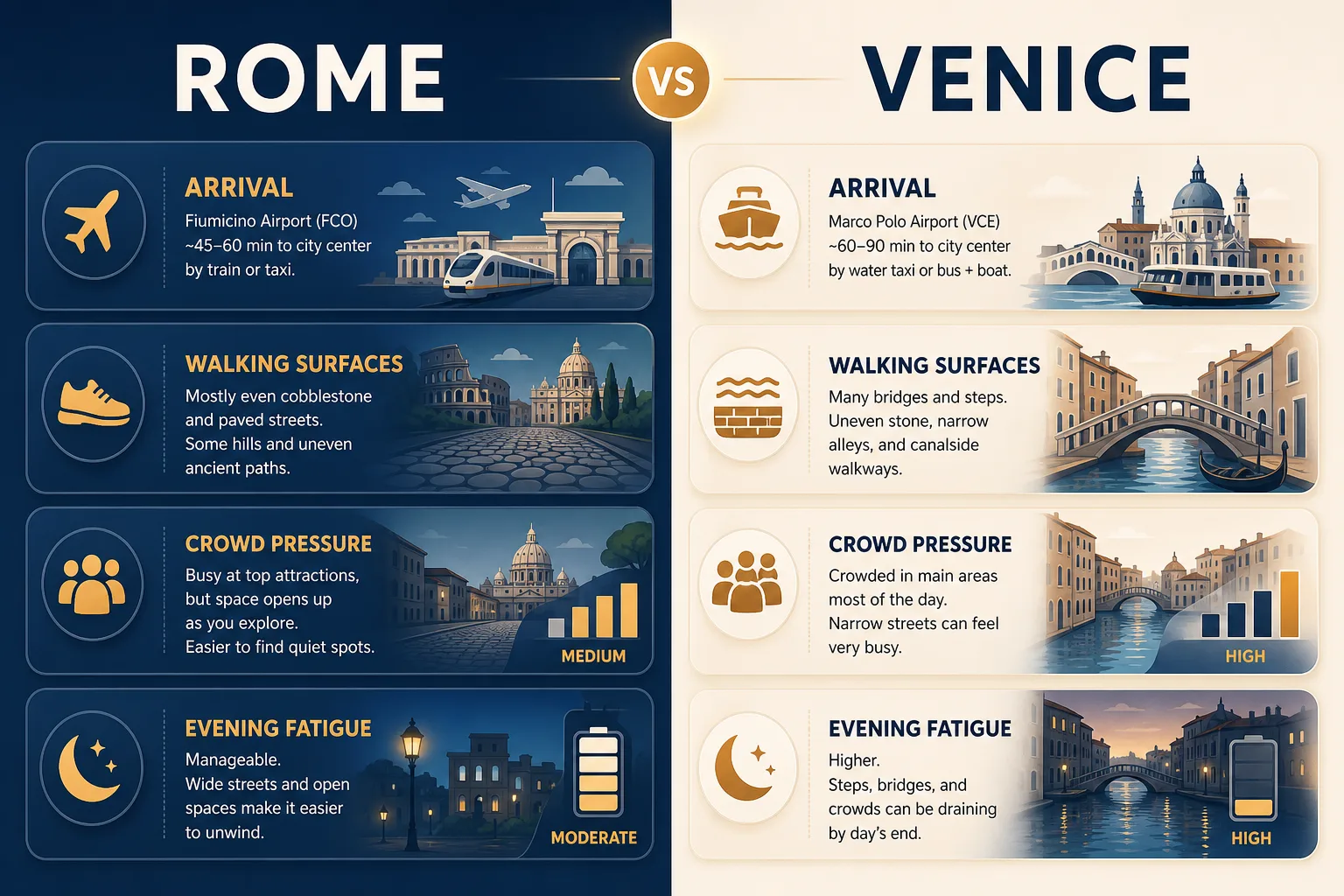 A side-by-side infographic comparing Rome and Venice across categories like arrival, walking surfaces, crowd pressure, and evening fatigue.
The Main Friction Problem
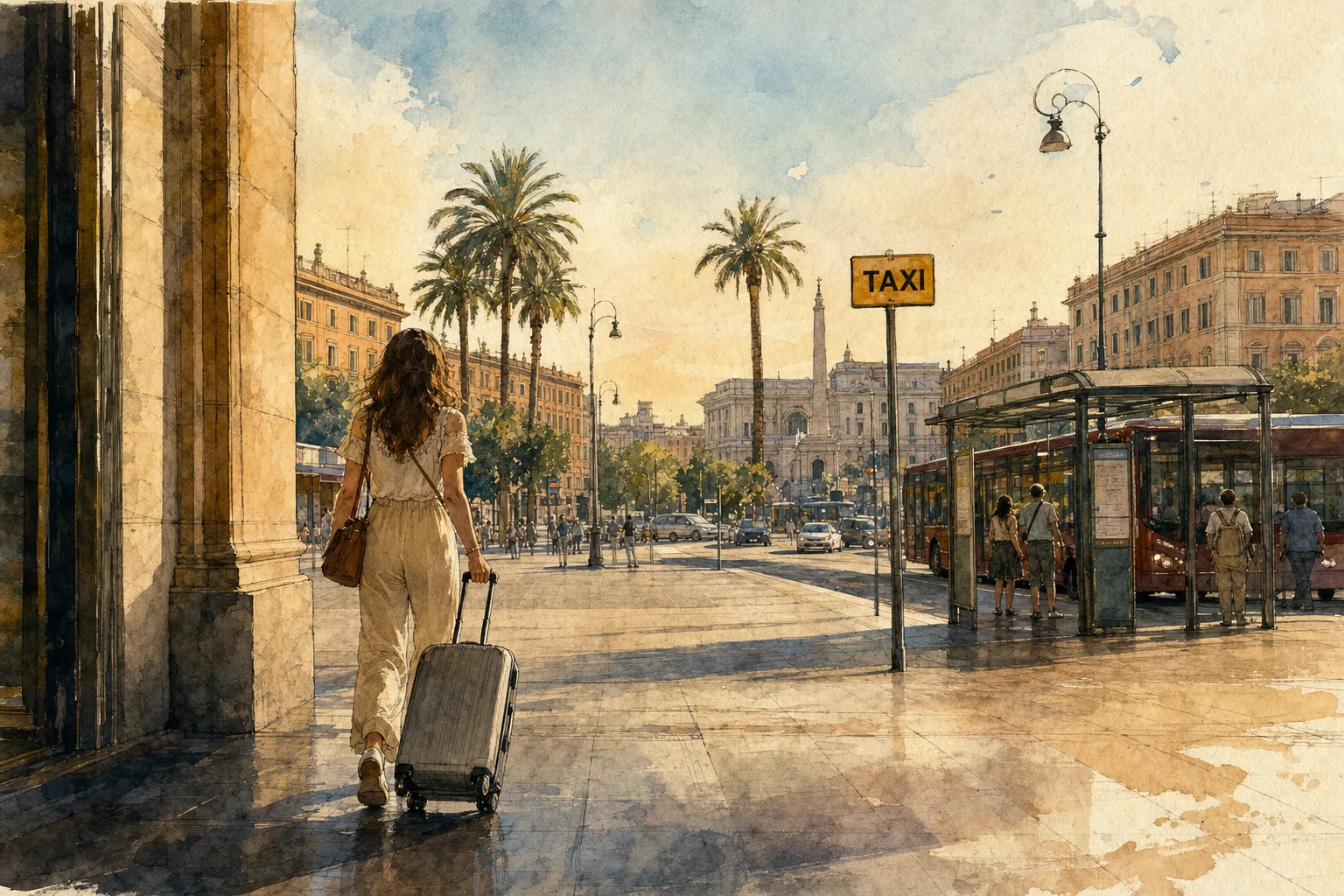
The headline difference is simple: Rome is a big city you cross with transit, Venice is a small city you cross with your legs.
That single fact drives almost every daily decision.
In Rome, friction shows up as distance. The Colosseum to the Trevi Fountain is 1.6 km, about 20 to 25 minutes on foot. Trevi to Vatican City is another 3 km, roughly 40 to 45 minutes. You will either walk a lot or use the bus and metro, where a single ticket is 1.50 euro for 100 minutes and contactless Tap and Go caps at 8.50 euro a day after six taps.
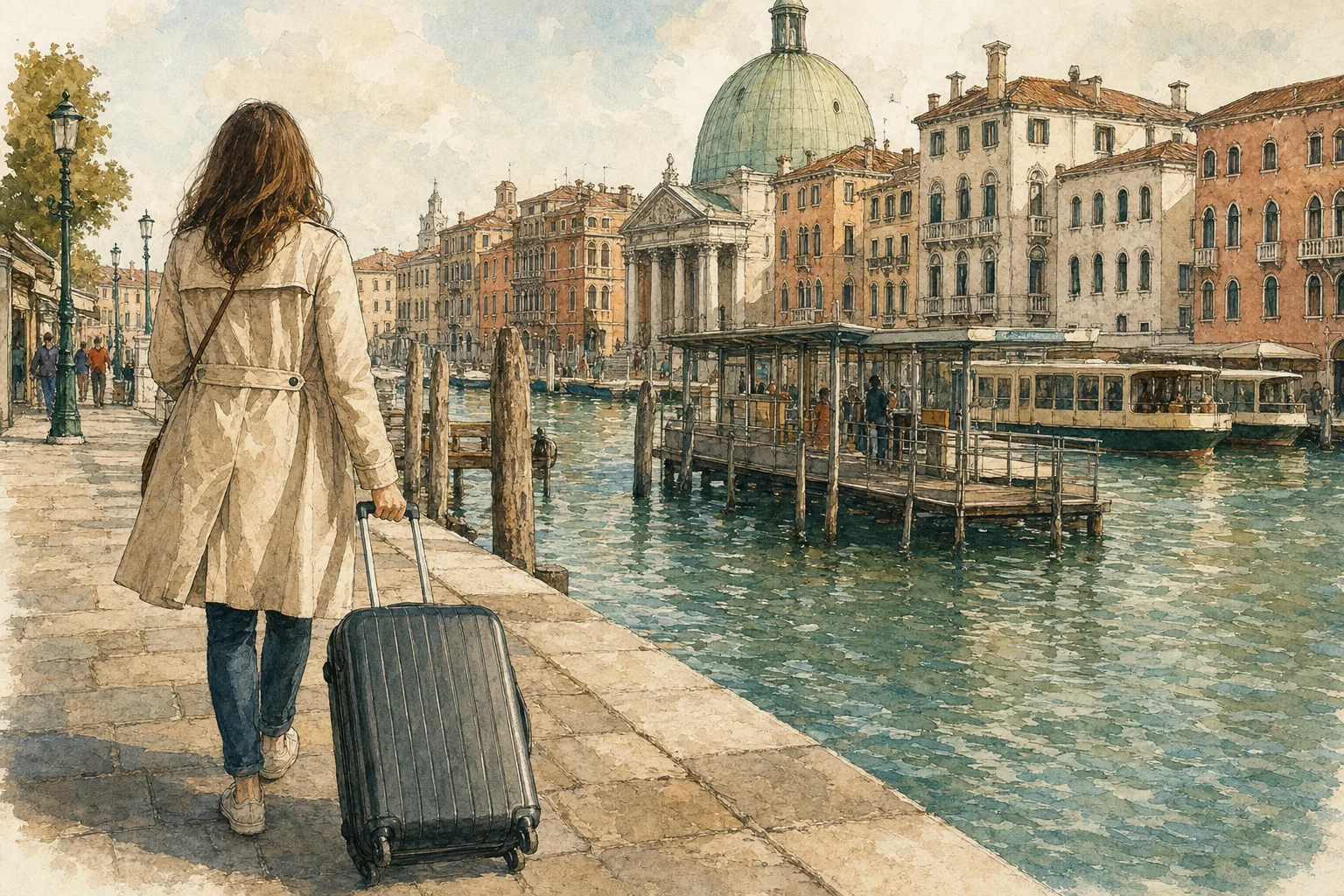
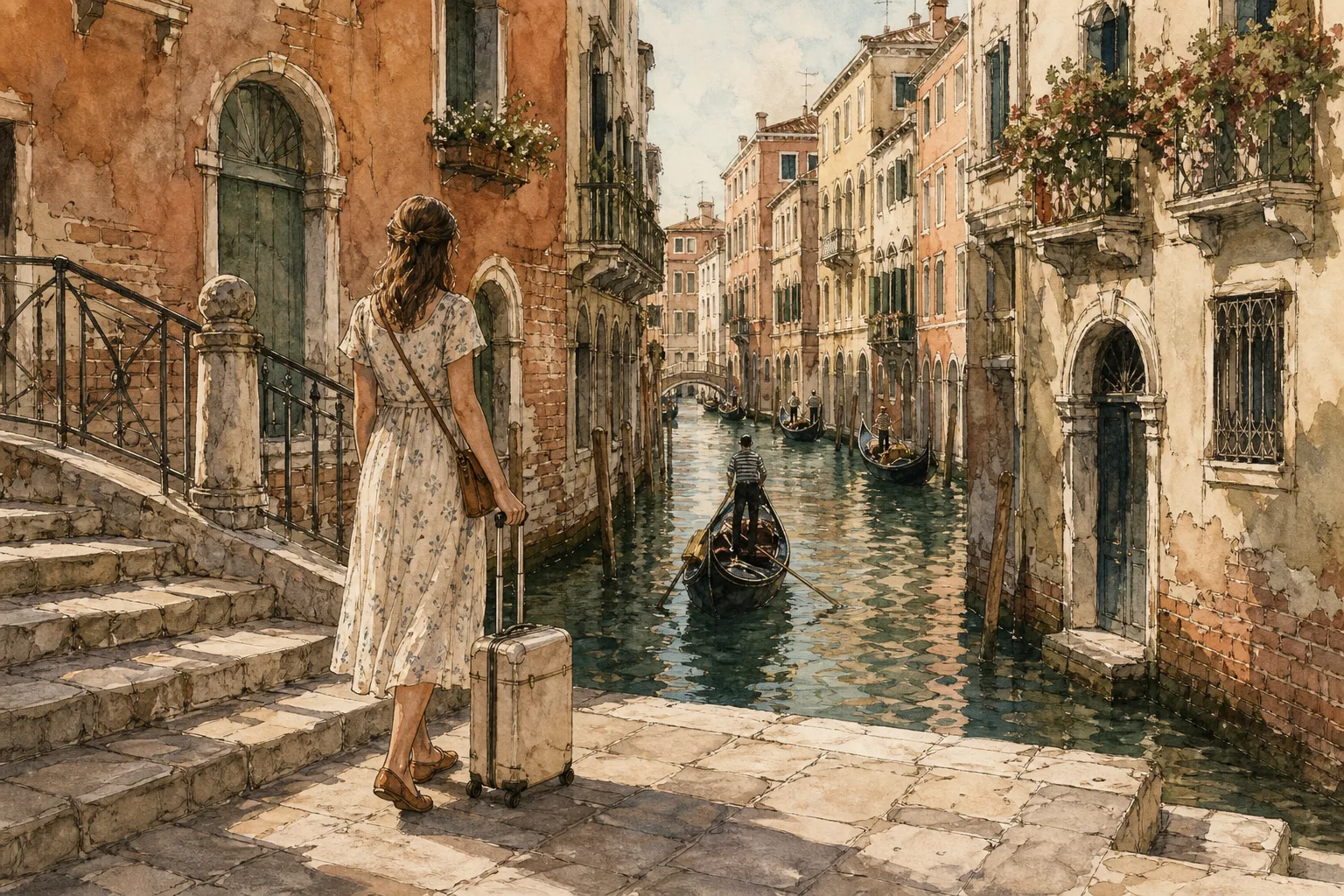
In Venice, friction shows up as stairs and luggage. The historic center is completely free of cars, scooters, and even bicycles, and it contains over 400 stepped bridges. Walking from Santa Lucia station to the Rialto Bridge is only 1.3 to 1.7 km, but you cross several bridges with a bag in hand. The vaporetto helps, but a single 75-minute ticket is 9.50 euro and a 24-hour pass is 25 euro, which is steep compared to Rome's transit.
Arrival sets the tone. From Fiumicino, the Leonardo Express runs every 15 to 30 minutes, takes 32 minutes to Roma Termini, and costs 14 euro one way. From Venice Marco Polo, you have three realistic options: the express bus to Piazzale Roma at 8 euro and 20 to 30 minutes (the last point wheeled vehicles reach), the Alilaguna water bus at 18 euro and about an hour to Rialto or San Marco, or a shared water taxi at around 37 euro per person. After any of those, you still have to walk to the hotel.
Friction Table
This is the comparison most short-trip travelers actually need:
| Friction factor | Rome | Venice |
|---|---|---|
| Airport to city | Leonardo Express, 32 min, 14 euro, every 15 to 30 min | Bus to Piazzale Roma 8 euro / Alilaguna 18 euro / shared water taxi ~37 euro pp |
| Last-mile to hotel | Taxi or short flat walk from Termini | Walk with luggage over stepped bridges |
| Walking surfaces | Mostly flat, some cobblestones | Flat stretches broken by 400+ stepped bridges |
| Transit cost (1 day) | 8.50 euro daily cap (Tap and Go) | 25 euro for 24-hour vaporetto pass |
| Distance between top sights | 1.6 to 3 km between majors | Mostly under 1 km, often connected |
| Crowd pressure | Spread across many sites | Concentrated on a few choke points (Rialto, San Marco) |
| Evening fatigue | High if you over-schedule | High if you keep crossing bridges with bags |
| Hotel cost (3 star center) | Generally lower than Venice | 185 to 278 euro per night average |
| Access fee | None | 5 to 10 euro for peak-day visitors, free for overnight guests with QR |
The table also explains the recommendation by traveler type:
| Traveler type | Better pick | Why |
|---|---|---|
| First-time visitor with 3 days | Rome | More variety, manageable with transit cap |
| First-time visitor with 2 days | Venice | Fits the city's natural scale |
| Older traveler or stairs-averse | Rome | Far fewer step climbs in daily routine |
| Light packer chasing atmosphere | Venice | Walking is the point |
| Photography-driven traveler | Venice | Higher scene density per block |
| Food-and-neighborhoods traveler | Rome | More varied districts in walking range |
Who Will Feel the Friction Most
Two groups should think hardest before choosing Venice for a short trip:
-
Travelers with checked luggage or roller bags. From the moment you leave Piazzale Roma or Santa Lucia, you are responsible for lifting that bag over bridges. There is no Uber to your door. A private water taxi to a hotel dock can cost around 150 euro, which solves the problem but reshapes the budget.
-
Travelers with knee, hip, or balance issues. The bridges are not optional. Even short routes within San Marco involve multiple step climbs. Rome has cobblestones and the occasional staircase, but it does not require constant elevation changes.
Two groups should think hardest before choosing Rome for a short trip:
-
Travelers who want a slow, low-decision day. Rome rewards planning. Without it, you can lose an hour walking between things you did not realize were far apart. Venice rewards wandering because almost everything is close.
-
Travelers with only 2 nights on the ground. Rome's payoff scales with time. Two nights in Rome usually means rushed mornings, skipped neighborhoods, and a tired final day.
How to Reduce the Friction
If you choose Venice:
- Pack one carry-on per person. Hard rule, not a suggestion.
- Book a hotel within a 10-minute walk of a vaporetto stop, ideally Rialto, San Marco, or Accademia.
- Buy the 24-hour vaporetto pass on day one and use the Alilaguna from the airport so you only handle your bag at two stops.
- If you arrive during a designated peak day in 2026, register your overnight stay online before you arrive and save the bypass QR code to your phone. Skipping this risks a fine of 50 to 300 euro.
- Do San Marco and Rialto early (before 10 am) or late (after 6 pm) when day trippers are not there.
If you choose Rome:
- Take the Leonardo Express, not a taxi from Fiumicino. It is faster than traffic.
- Use contactless Tap and Go from day one. The daily cap of 8.50 euro after six taps removes the need to think about tickets.
- Base yourself between Termini and the historic center, or near Piazza Navona, so most evenings end with a flat walk home.
- Group sights by neighborhood, not by fame. Doing Colosseum and Forum on one day and Vatican on another beats zigzagging.
- Build a 2-hour midday rest into every day. Roman fatigue is cumulative.
If you are unsure how much friction you actually tolerate, the Travel Personality Quiz can help calibrate whether you lean toward density (Venice) or variety (Rome).
Better Alternatives
If neither city fits cleanly, two redirects are worth considering:
- Florence for 2 to 3 days. Smaller and flatter than Rome, far less luggage friction than Venice, with a walkable historic core. Strong fit for first-time visitors who want low-stress sightseeing.
- Bologna as a base. Flat porticoes give shelter from sun and rain, the train station puts both Florence and Venice within day-trip reach, and hotel prices are typically below central Venice.
If you are anchored on Rome or Venice specifically and the friction still feels high, extending to 4 nights in Rome or splitting 2 nights Venice plus 2 nights Verona usually resolves the tension better than picking the other city.
Decision Checklist
Run this before you book:
- I know how many nights I actually have on the ground after flights.
- I have checked the weight and number of bags I will be carrying.
- I have confirmed whether anyone in the group struggles with stairs.
- I have priced a 3-star central hotel for my dates and compared it to my budget.
- If Venice, I have checked whether my dates fall on a peak access-fee day and registered for the overnight bypass QR if needed.
- If Rome, I have planned at least one rest break per day.
- I have decided which 2 or 3 sights are non-negotiable and confirmed they are open on my dates.
- I have a Plan B for one rainy or extra-hot day.
If three or more items are unchecked, you are not ready to book yet.
Related Tools
These are the Trip Persona tools most relevant to this decision:
- Travel Personality Quiz to see whether your style maps closer to dense walking (Venice) or layered neighborhoods (Rome).
- Travel Budget Calculator for comparing a night-by-night cost difference between the two cities.
- Hotel Location Checklist to check whether your hotel exit puts you within walking distance of your first day's main stops.
FAQ
Is Rome or Venice easier with a suitcase? Rome is easier. You can roll luggage from Roma Termini straight into most central hotels on flat pavement. Venice has over 400 stepped bridges in its historic center and no cars, so the last stretch from the vaporetto stop to your hotel usually means lifting your bag up and down steps.
Can I see the main sights of either city in 2 to 3 days? Venice fits a 2 day trip much more comfortably. Rome's top sights are spread across longer walks, so 3 days is the realistic minimum, and even then you are choosing between the Colosseum area, the Vatican, and the historic center rather than doing all three deeply.
Which city is better for older travelers or anyone who tires easily? Rome, if you base near the historic center and use buses or the daily fare cap. The bridges, lack of seating in transit, and constant step climbing in Venice add up fast. Rome's flat walks and frequent cafe stops are kinder to a slower pace.
Do I have to pay the Venice access fee for a short trip? Only day trippers pay it, and only on designated peak days between April 3 and July 26, 2026, from 8:30 am to 4:00 pm. The fee is 5 euro if booked 4 or more days ahead, 10 euro last minute. If you sleep in Venice you are exempt, but you still must register online for a bypass QR code or risk a fine of 50 to 300 euro.
Is Venice worth it for just one night? Yes, more than Rome is for one night. Venice rewards short stays because the magic concentrates after the day trippers leave around 5 pm and returns at dawn. Rome's payoff comes from layering neighborhoods over several days, which a single night cannot deliver.