travel-decisions
Is Madrid a Bad Fit If Your Flight Arrives Late at Night?
A decision-focused guide for travelers landing in Madrid after dark: when it works, when it backfires, and how to avoid a wrecked first night.
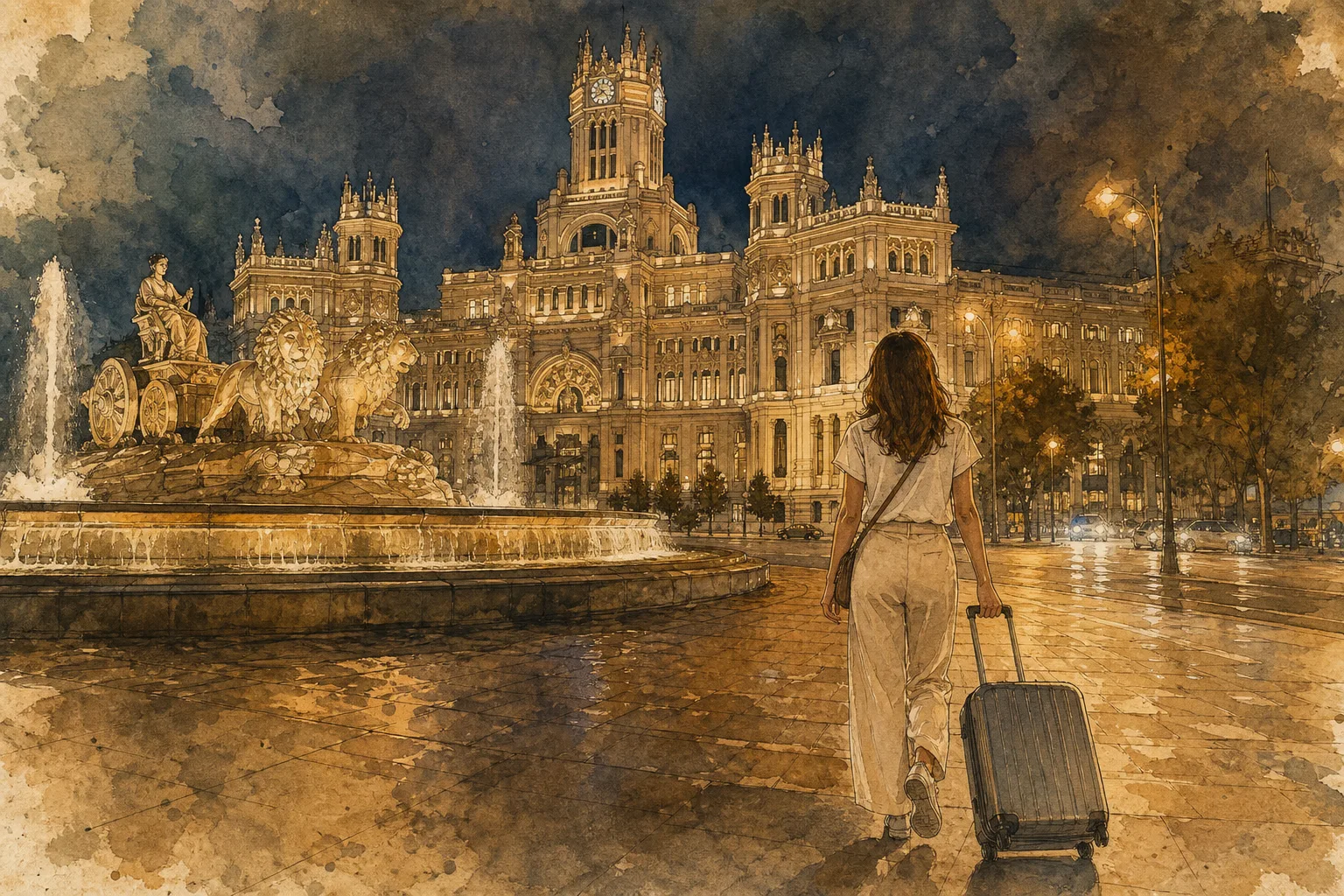
A late landing changes the question. Madrid in daylight is one thing; Madrid at 12:40 AM, with a suitcase, a dead phone battery and a hotel pin you have not actually looked at on a map, is another. The decision is not really "is Madrid a good city." It is "is Madrid a good city to land in after dark, for the kind of traveler I am, with the flight time I actually booked."
This guide answers that narrower question. It assumes you already like the idea of Madrid and are trying to avoid a bad first night: a stressful transfer, a hotel that turns out to be a fifteen-minute drag from any open door, or a wasted next morning spent sleeping off the arrival.
Quick Verdict
For most travelers landing at Madrid-Barajas before roughly 1 AM, Madrid is a fine late-night arrival city. The Airport Express Bus runs 24 hours, the city center is unusually awake compared to other European capitals, and the flat 33 euro taxi rate inside the M30 ring removes meter anxiety.
It becomes a bad fit in three specific cases:
- You land after 1:30 AM and refuse to take a taxi, because the metro is closed and the Cercanias train from T4 has stopped.
- You have booked a hotel that is "cheap and central on the map" but actually sits on a quiet side street with no 24-hour reception.
- You are a low-stamina or older traveler with heavy luggage and a connection to a non-central neighborhood, where the transfer alone will eat your first morning.
If none of those describe you, Madrid is one of the more forgiving late arrivals in Europe.
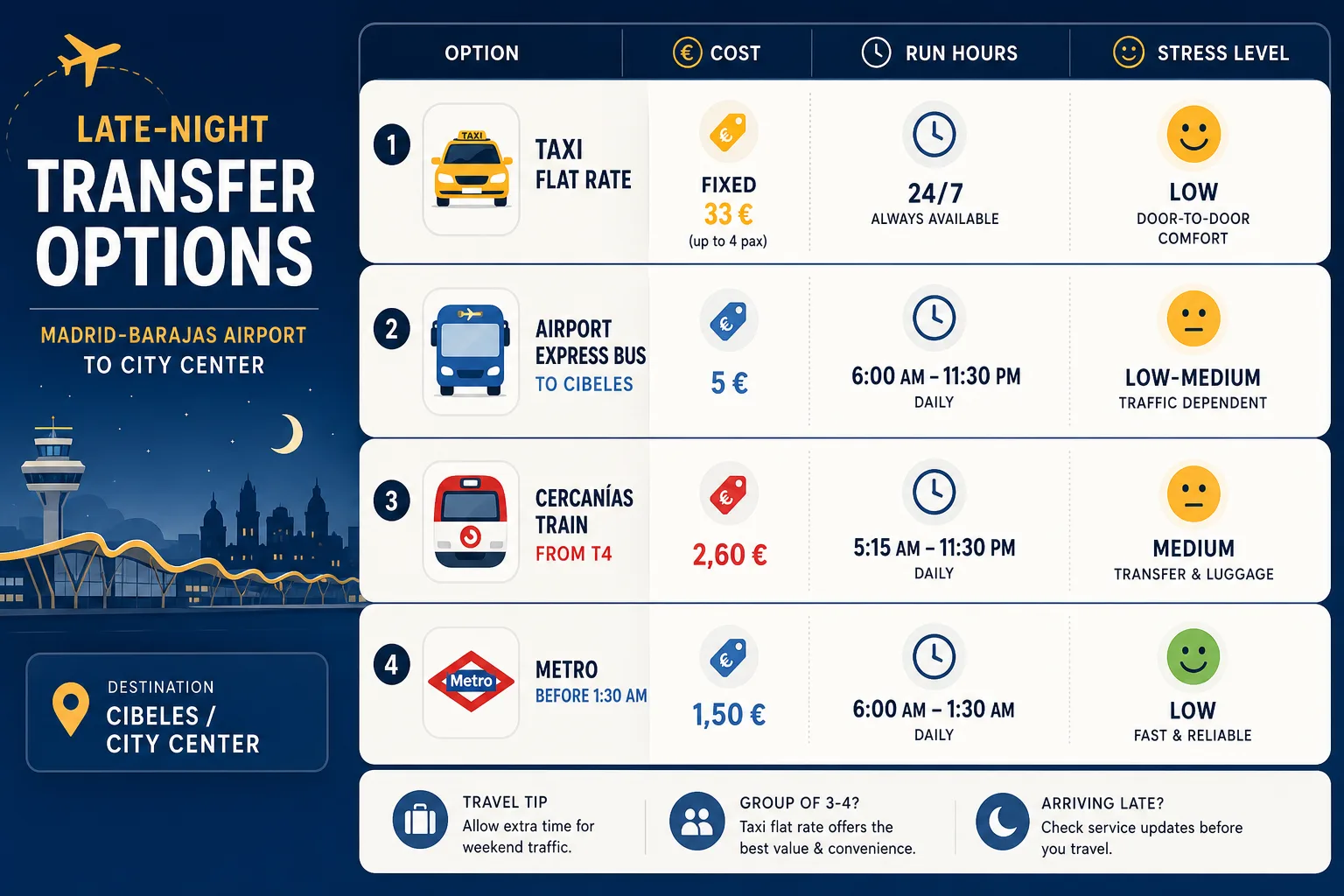 Infographic comparing four late-night transfer options from Madrid-Barajas Airport to the city center: Taxi, Airport Express Bus, Cercanías Train, and Metro, with details on cost, run hours, and stress level.
Who Will Probably Love It
You will likely be glad you picked Madrid as a late-night landing if you fit one of these patterns:
- First-time visitors who want momentum. The center is genuinely alive past midnight. Walking from a taxi to a hotel near Sol or Gran Via at 1 AM does not feel like sneaking through a closed city.
- Low-stress planners who pre-book a flat-rate transfer. The fixed 33 euro taxi rate plus a hotel inside the M30 ring removes almost every variable that usually ruins a late arrival.
- Atmosphere-first travelers. Late Madrid has its own texture: lit fountains, open terraces in summer, people still eating. If that is the trip you came for, you get a free preview on night one instead of a sterile airport hotel.
- Travelers arriving in summer. From June to August the night air is warm, which removes one of the silent stress factors of late arrivals in colder European cities.
Who Might Regret It
Madrid late at night quietly punishes a few specific traveler patterns. If you recognize yourself here, the regret risk is real and worth taking seriously.
- Travelers who refuse taxis on principle. After 1:30 AM the metro is shut and the Cercanias is finished. You are choosing between the Airport Express Bus to Plaza de Cibeles and a taxi. If your hotel is not within a short, lit walk of Cibeles, the bus stops being convenient.
- Wheeled-luggage solo travelers booked into Lavapies side streets or blocks deep off Atocha. Violent crime is not the issue; pickpocketing pressure and quiet streets with closed shutters are. Dragging a suitcase through that at 2 AM is the textbook bad first impression.
- Older or mobility-aware travelers with a transfer that involves stairs. The metro before 1:30 AM is cheap but has stairs and changes. After hours, only the bus and taxi are realistic, and the bus still ends with a walk from Cibeles.
- People who booked a "deal" hotel without checking 24-hour reception. Arriving at a locked lobby with a keycode that did not arrive is the most common Madrid late-night regret, and it has nothing to do with the city itself.
The disappointment risk is rarely Madrid. It is the gap between the hotel pin on a map and what that street actually looks like at 1:45 AM.
Mistake / Consequence Table
These are the real variables for a late-night Madrid arrival, not generic city facts.
| Decision you are about to make | What can go wrong | Better move |
|---|---|---|
| Take the metro because it is "always cheapest" | Metro closes at 1:30 AM; if your flight is late you are stranded at T2 | Check your scheduled landing plus 60 minutes of immigration and bag wait; only metro if you clear customs before about 12:45 AM |
| Plan on the Cercanias train from T4 | Cercanias runs roughly 6 AM to midnight only, and only from T4 | Use it only for daytime arrivals or if you land before 11 PM and are at T4 |
| Take the Airport Express Bus to Atocha | At night (11:30 PM to 6 AM) the express bus terminates at Plaza de Cibeles, not Atocha | If your hotel is near Atocha, plan to walk from Cibeles or take a taxi from Cibeles for the last leg |
| Book the cheapest "central" hotel | Quiet side street, no 24-hour reception, no open cafe nearby | Filter for 24-hour reception and a main street address in Sol, Huertas, Malasana, Chueca, La Latina, Salamanca, Chamberi or Retiro |
| Plan a 9 AM activity for day one | First-night fatigue plus a 1 AM check-in wrecks it | Book nothing before 11 AM on day one; treat the morning as buffer, not itinerary |
Hidden Friction Points
Most "Madrid was a bad idea" stories trace back to four frictions that are invisible at booking time.
Late arrival risk. Madrid-Barajas is a large airport with four terminals. A scheduled 11:40 PM landing routinely becomes a 12:30 AM exit from the terminal after taxi, immigration and baggage. That single hour pushes you past the metro cutoff and past the last Cercanias.
Airport transfer stress. The airport sits roughly 15 to 19 kilometers from Sol or Atocha. That is close enough that any option works in theory and far enough that a wrong choice (wrong terminal for Cercanias, wrong bus stop, wrong metro line at the wrong hour) costs you 45 minutes you do not have at 1 AM.
Hotel location risk. Central Madrid is small and walkable, but "central on a map" hides which corner you are on. A hotel two blocks off Gran Via on a main street is a different arrival than a hotel two blocks off Gran Via on a vendor-heavy side alley. The map does not show you which one you booked.
First-night fatigue. Late arrival plus a long transfer plus a 1:30 AM check-in plus summer heat compounds. The hidden cost is not the night; it is the next morning. Travelers who plan a museum slot for 9 AM on day one almost always skip it, then resent the booking.
How to Make It Easier
You can shrink almost all of the friction above with five concrete moves.
- Pre-decide your transfer before you board. If your scheduled landing is before 11:30 PM and you are not exhausted, the metro before 1:30 AM is the cheapest option at 4.50 to 5.00 euros (plus a 2.50 euro Multi card the first time). If your landing is later, default to the flat 33 euro taxi inside the M30 ring or the 5.10 euro Airport Express Bus to Cibeles.
- Pick the right bus stop for your hotel. The night Airport Express runs between T1, T2, T4 and Plaza de Cibeles only. If your hotel is closer to Atocha, factor in a 15 to 20 minute walk or a short taxi from Cibeles.
- Filter hotels by three checks, not by price. Twenty-four-hour reception, main-street address, and walking distance to a well-lit plaza. Sol and Huertas, Malasana, Chueca, La Latina, Salamanca, Chamberi and Retiro all meet these bars.
- Build a fatigue buffer into day one. Nothing booked before 11 AM. Lunch reservation, not breakfast. Save big museums for day two.
- Carry small cash and a charged phone. Taxis take card, but a dead phone with no offline map turns a 15-minute taxi ride into a wrong-address argument at 1 AM.
Better Alternatives
If after reading the above Madrid still feels like the wrong fit for your specific late landing, the better moves are usually not "different city" but "different shape of arrival."
- Switch to an earlier flight, even at higher cost. A 6 PM landing in Madrid is a different city than a 12:30 AM landing. If you are a low-stress planner, the fare difference is often the cheapest stress reduction available.
- Book an airport-area hotel for night one only. If you land after 1:30 AM and have an early next-day train onward, sleeping near MAD and taking the morning Cercanias from T4 into Atocha can be calmer than dragging into the center at 2 AM.
- Start the trip somewhere with a quieter late-night arrival pattern. If your itinerary is flexible and your late flight is a fixed constraint, smaller cities with shorter airport-to-hotel transfers can absorb a late arrival with less first-night cost, and Madrid can become a daytime arrival mid-trip.
- Reverse your itinerary. If Madrid was meant to be your first stop because it was the cheapest flight in, but you are landing at midnight, consider flying into your second city instead and ending the trip in Madrid with a morning departure.
The point is not that Madrid is wrong. The point is that a late-night landing into a city you do not know yet is a tax, and there are ways to not pay it.
Self-Checklist
Run this before you confirm the booking. If you cannot answer yes to most of these, you are likely to regret the late arrival.
- My scheduled landing plus 60 minutes (taxi, immigration, baggage) puts me at the terminal exit before the transfer option I plan to use shuts down.
- I know which terminal I land at, and whether my planned transfer (metro, Cercanias, bus, taxi) actually serves that terminal at that hour.
- My hotel has 24-hour reception confirmed, not just "check-in until late."
- My hotel address is on a main street in one of: Sol and Huertas, Malasana, Chueca, La Latina, Salamanca, Chamberi or Retiro.
- If I am taking the night Airport Express Bus, my hotel is within an acceptable walk of Plaza de Cibeles, or I have budgeted a short taxi from Cibeles.
- I have nothing booked before 11 AM on day one.
- My phone will arrive charged, with an offline map of central Madrid downloaded.
- I have small cash and a card that works abroad, in case one fails at 1 AM.
- I have read my hotel cancellation policy in case my flight is rerouted or badly delayed.
FAQ
Is it safe to arrive in Madrid late at night as a first-time visitor? Yes, broadly. Madrid is considered one of Europe's safest major cities and the center stays busy until 5 or 6 AM on weekend nights, which contributes to the sense of security. The real risk is petty theft in crowded transit areas like Sol, Atocha and Gran Via, not violent crime. Keep your bag closed and in front of you on the metro and on the airport bus and you remove most of the risk.
What is the cheapest way to get from Madrid-Barajas to the center after midnight? The Airport Express Bus (Line 203 / N27 Expres Aeropuerto) runs 24 hours a day, 365 days a year, costs 5.10 euros and at night takes you to Plaza de Cibeles. After 1:30 AM the metro is closed and the Cercanias train from T4 has finished for the day, so the express bus or a taxi are the realistic options.
Should I book a hotel near the airport for one night instead? Only if your flight lands after roughly 1 AM and your next-day plan does not need to be central, or if you are simply too exhausted to face any transfer. For most late arrivals before 1 AM, a hotel near Sol, Gran Via or Atocha is a better use of your trip because you wake up already in the city you came to see.
Is the fixed taxi rate from the airport really worth it late at night? For most late arrivals, yes. From January 1, 2026, there is a flat 33 euro taxi rate between Madrid-Barajas and any address inside the M30 ring road, including luggage and with no late-night or holiday surcharges. Split between two travelers it is close to the bus on a per-person basis, and it removes the walk from Cibeles to your hotel at 1 AM.
Which neighborhoods should I avoid booking for a late-night first night? Avoid Lavapies side streets after 4 AM, the immediate blocks around Atocha station for pickpocketing reasons, and quiet side streets off Gran Via where pushy street vendors cluster. None of these are dangerous in a violent sense; they are just rough places to arrive with luggage. Sol and Huertas, Malasana, Chueca, La Latina, Salamanca, Chamberi and Retiro are the safer-feeling, easier-to-roll-into options.
Will jet lag plus a late arrival ruin my first full day? Often, yes, if you do not plan for it. The fix is structural, not heroic: nothing scheduled before 11 AM, a lunch reservation instead of a breakfast plan, and the heavier museum or day-trip slot pushed to day two. Treat the morning after a late arrival as buffer, and Madrid stops being a bad late-night fit.