travel-decisions
Is Florence Worth It If You Want to Enjoy It More Comfortably?
A traveler-fit breakdown of whether Florence rewards comfort-focused visitors, and which travel styles get the most value from a slower, easier trip.
Quick Verdict
Florence is worth it for comfort-focused travelers, but the right answer depends on neighborhood, pace, and season. The city itself is small and walkable, which works in your favor once you stop trying to see everything from a base in the busiest streets. Choose Florence if you want atmosphere, good food, and a slower rhythm more than efficient sightseeing, and if you can visit outside the busiest months or accept managing peak-hour crowds around the core sights. Skip it, or at least rethink the plan, if you need a quiet, low-crowd experience during the busy season with no flexibility on timing.
Choose Florence if you are a couple or relaxed-pace traveler who values a few unhurried days over a packed itinerary. Avoid the default historic-center hotel-and-landmark plan in peak season if crowd fatigue is a dealbreaker and you cannot shift your dates. The gap between those two outcomes usually comes down to where you sleep, when you move through the busiest streets, and which months you travel in, not whether Florence itself is a good idea.
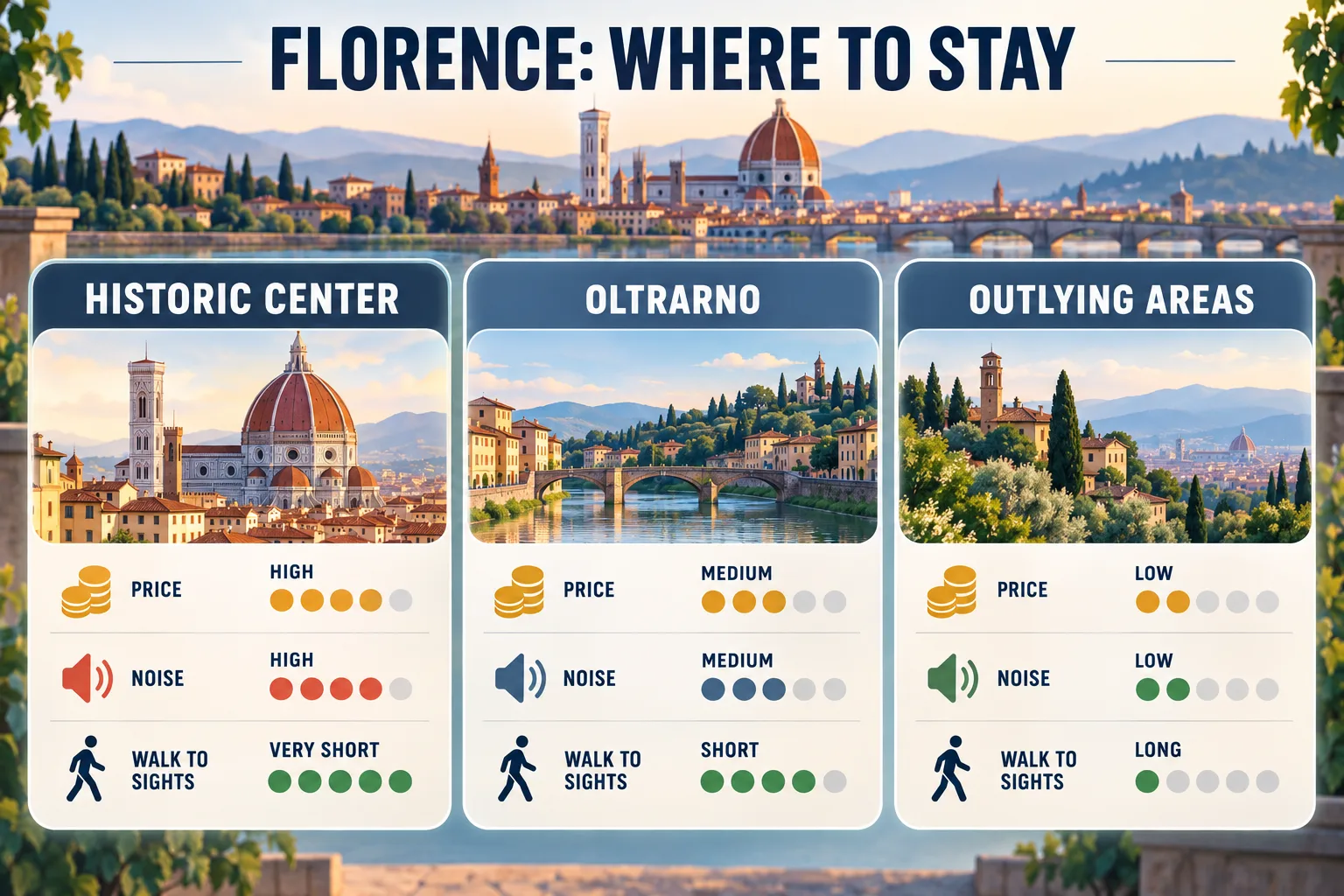 Editorial illustration: A simple visual comparison layout with labeled sections showing Florence neighborhood options side by side: historic center.
Traveler Type Table
The real decision in Florence is not "should I go," it is "how do I structure the trip so comfort wins over convenience." These are the variables that actually separate a good trip from a frustrating one.
| Traveler type | Best base area | Main tradeoff | Comfort payoff |
|---|---|---|---|
| Travelers seeking comfort | Oltrarno | Slightly more walking to the Duomo side | Quieter streets, local dining, calmer mornings |
| Couples | Oltrarno or San Niccolo | Fewer landmark hotels nearby | Better evening atmosphere, less transactional feel |
| Relaxed-pace travelers | Outlying neighborhoods | 20 to 40 minutes further from center | 30 to 50 percent lower accommodation cost |
| First-time bargain hunters | Historic center | Highest room rates, most noise | Fastest access, least comfort per euro |
The pattern is consistent: the historic center buys you proximity, not comfort. Comfort in Florence is bought with distance from the loudest streets and, if your dates are flexible, with timing your visit for the quieter months.
Best for First-Time Visitors
First-time visitors do best in Florence when they resist the urge to book inside the historic center just because it looks convenient on a map. The city is compact enough, about 4 km across and 1 km north to south, that a room in Oltrarno or a nearby outlying district still puts every major sight within an hour's walk. That tradeoff matters most for comfort-focused travelers and couples who would rather arrive at the Uffizi relaxed than save fifteen minutes of walking.
Relaxed-pace first-timers benefit the most from this choice because their itinerary already has slack built in. They are not trying to hit six sights before lunch, so a slightly longer walk from a quieter base costs them little. First-time visitors chasing a tight checklist during the busy spring-to-summer season will feel the crowd pressure most, since that is when the core sights are most congested.
Best for Couples
Couples get the best version of Florence by treating it as a place to slow down, not a place to check boxes. A quiet evening in Oltrarno, with fewer tour groups and more neighborhood restaurants, delivers the atmosphere most couples are actually looking for. That same evening spent near Ponte Vecchio during peak hours in peak season delivers crowd noise instead.
Comfort-seeking couples should prioritize a hotel with genuine quiet over one with a landmark view, since landmark-adjacent rooms in the historic center often cost significantly more without matching comfort. Relaxed-pace couples benefit further by building in unscheduled time rather than packing each day with sights, since Florence's charm shows up more in lingering than in movement. Couples who need constant activity and variety may find the pace mismatched, which is a fit issue worth naming honestly.
Best for Slow Travelers
Slow travelers are arguably the best-matched group for Florence, because the city rewards repetition and familiarity over novelty. Returning to the same cafe, walking the same Oltrarno street at different times of day, and letting one neighborhood become familiar all work better here than in cities built for constant movement. Comfort-focused slow travelers should pick a base and stay put rather than shifting hotels mid-trip to chase different areas.
Couples traveling at a slow pace get a compounding benefit: fewer transitions mean fewer decision points and less friction overall. Relaxed-pace travelers with flexible dates get an additional advantage by choosing the November-to-February window, when the core sights see far fewer daytime visitors than in the spring-to-summer peak. Slow travelers who still feel obligated to "see everything" undercut this advantage, since rushing a slow-travel mindset just imports the checklist problem into a city built to resist it.
Best for Low-Stress Travelers
Low-stress travelers benefit from Florence's compact size, since a smaller city means fewer logistics decisions and less transit planning overall. The ZTL restriction on the historic center, where visitors cannot park without specific permits, actually simplifies things for travelers arriving by train or without a car: it removes a decision rather than adding one. Comfort-focused low-stress travelers should treat this as a reason to skip renting a car for the Florence portion of a trip entirely.
Couples and relaxed-pace travelers who want a low-stress home base should note the newer restrictions on short-term rentals, including the ban on self-check-in lockboxes in the historic center. That change generally means more in-person check-ins and slightly less flexible arrival windows, which matters if your comfort depends on predictable logistics. A low-stress traveler who books a rental expecting silent, flexible self-check-in should confirm the check-in process directly with the host before travel, and if flexible dates are an option, targeting the November-to-February window reduces overall friction from crowds as well.
Common Mismatches
The most common regret pattern is expecting Florence to feel quiet or uncrowded during a spring or summer visit. The area around the Duomo, Ponte Vecchio, and Uffizi experiences extremely high pedestrian congestion from 9 AM to 7 PM in that season. Travelers who picture calm medieval streets and arrive in June to shoulder-to-shoulder crowds will feel an expectation mismatch that no itinerary tweak fully solves, though shifting the trip to November through February would have solved much of it.
A second mismatch shows up around hotel value. Paying historic-center rates, typically 250 to 500 euros a night for a mid-range room, does not automatically buy a better experience. It often buys proximity to the loudest, most crowded streets, which is the opposite of what comfort-focused travelers actually want. Travelers who equate a higher price with a better trip in Florence are the ones most likely to feel shortchanged afterward.
A third mismatch is chasing generic "trendy" districts because they photograph well, rather than choosing a neighborhood that matches your actual pace. San Niccolo, east of Oltrarno along the hillside toward Piazzale Michelangelo, offers a quieter, more residential feel that suits slow travelers better than a district chosen for social-media appeal alone. Matching the neighborhood, and where possible the season, to your travel style is what prevents this mismatch.
Quick self-check before booking:
- I am choosing a neighborhood based on noise and pace, not just proximity to landmarks
- I know whether I am traveling in peak season (spring to summer) or the quieter window (November to February), and I have adjusted my crowd expectations accordingly
- I am comfortable paying less by staying outside the historic center
- I have confirmed check-in logistics if booking a short-term rental
- My itinerary has slack for slow mornings or unscheduled time
Final Match Recommendation
Choose Florence if you are a couple, a slow traveler, or a comfort-focused visitor willing to base yourself in Oltrarno, San Niccolo, or a nearby outlying neighborhood. These travelers get genuine atmosphere, manageable costs, and a pace the city is actually built to support. The tradeoff, slightly more walking or a short tram ride, is small compared to the comfort gained, and it shrinks further if you can travel between November and February.
Do not choose the default historic-center, peak-season plan if your idea of comfort includes quiet streets and low daytime crowd density with no room to adjust dates or hours. That specific combination, peak season plus core sights plus rigid timing, is where Florence consistently disappoints comfort-focused travelers. If your dates are flexible, shifting toward the quieter winter months or simply timing landmark visits outside 9 AM to 7 PM turns a weak match into a strong one; if neither is possible, treat the mismatch as real rather than something a bigger budget can fix.
FAQ
Is Florence worth it if I hate crowds? It depends heavily on when and where you go, not whether you go at all. The area around the Duomo, Ponte Vecchio, and Uffizi gets extremely congested from 9 AM to 7 PM during the busy season. Visiting from November through February, or staying in Oltrarno and timing landmark visits outside peak hours, keeps the crowd exposure far more manageable.
Is Florence too expensive for a comfortable trip? Only if you insist on the historic center. Mid-range hotel rooms there run roughly 250 to 500 euros a night, but outlying neighborhoods cost 30 to 50 percent less for a short walk or tram ride in. Comfort does not require paying historic-center rates.
Should I stay in the historic center or somewhere quieter? For most comfort-focused travelers, quieter wins. Florence is small enough, about 4 km wide and 1 km north to south, that any well-chosen area keeps you within an hour's walk of everything, so you are not trading access for peace.
Is Florence a good fit for a slow-paced couples trip? Yes, if you set the pace deliberately. Florence rewards lingering over meals and neighborhoods more than it rewards rushing between sights, which suits couples who want fewer stops done well rather than a full checklist.
Does visiting in winter actually make Florence more comfortable? Yes, meaningfully. The daytime congestion around the Duomo, Ponte Vecchio, and Uffizi is tied to peak season and peak hours, not a fixed feature of the city. Visiting between November and February brings noticeably thinner crowds, which changes the comfort calculation even if you keep the same historic-center itinerary.
What kind of traveler regrets choosing Florence? Travelers expecting a quiet, undiscovered city in peak season are usually disappointed. Florence's core sights draw dense daytime crowds from spring through early autumn, so anyone visiting in that window while picturing empty piazzas will feel the gap between expectation and reality.