travel-decisions
Is Florence Worth It for Couples Who Want Beauty, Food, and a Slower Italy Trip?
A traveler-fit decision guide for couples weighing Florence as their slow, food-led Italy base instead of a busier Rome or Venice trip.
Quick Verdict
Florence is a strong fit for couples who want beauty, food, and a slower Italy trip, and a weak fit for couples who measure a trip by landmark count, nightlife, or constant motion.
Choose Florence as your main base if you want to walk a compact historic center, eat long Tuscan lunches, see a few extraordinary works of art instead of dozens, and take one calm day trip into Chianti or Siena. Skip Florence as the centerpiece if you want late-night energy, a different neighborhood every evening, or a Rome-scale list of must-sees. In that case, Florence works better as a two-night stop than a five-night base.
The decision is mostly about pace, not about whether Florence is good. It is good. The question is whether your version of a trip rewards slowness.
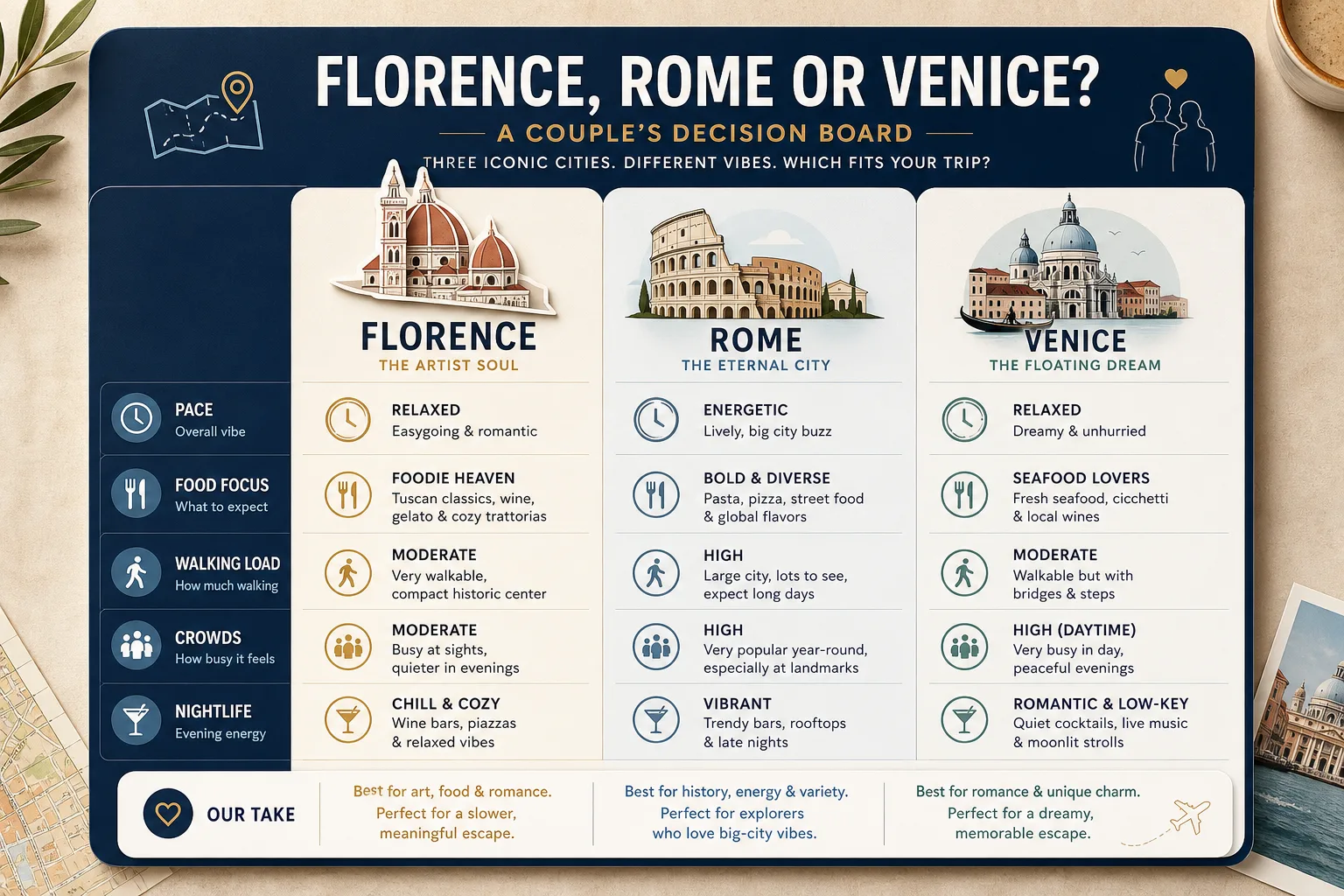 A decision board infographic comparing Florence, Rome, and Venice across travel metrics like pace, food focus, walking load, crowds, and nightlife.
Best for First-Time Visitors to Italy
First-time couples often assume they need Rome, Florence, and Venice in one trip. Florence quietly argues against that. The historic center is small enough to absorb on foot in a single weekend, which means you actually feel like you saw a place instead of sprinting through it.
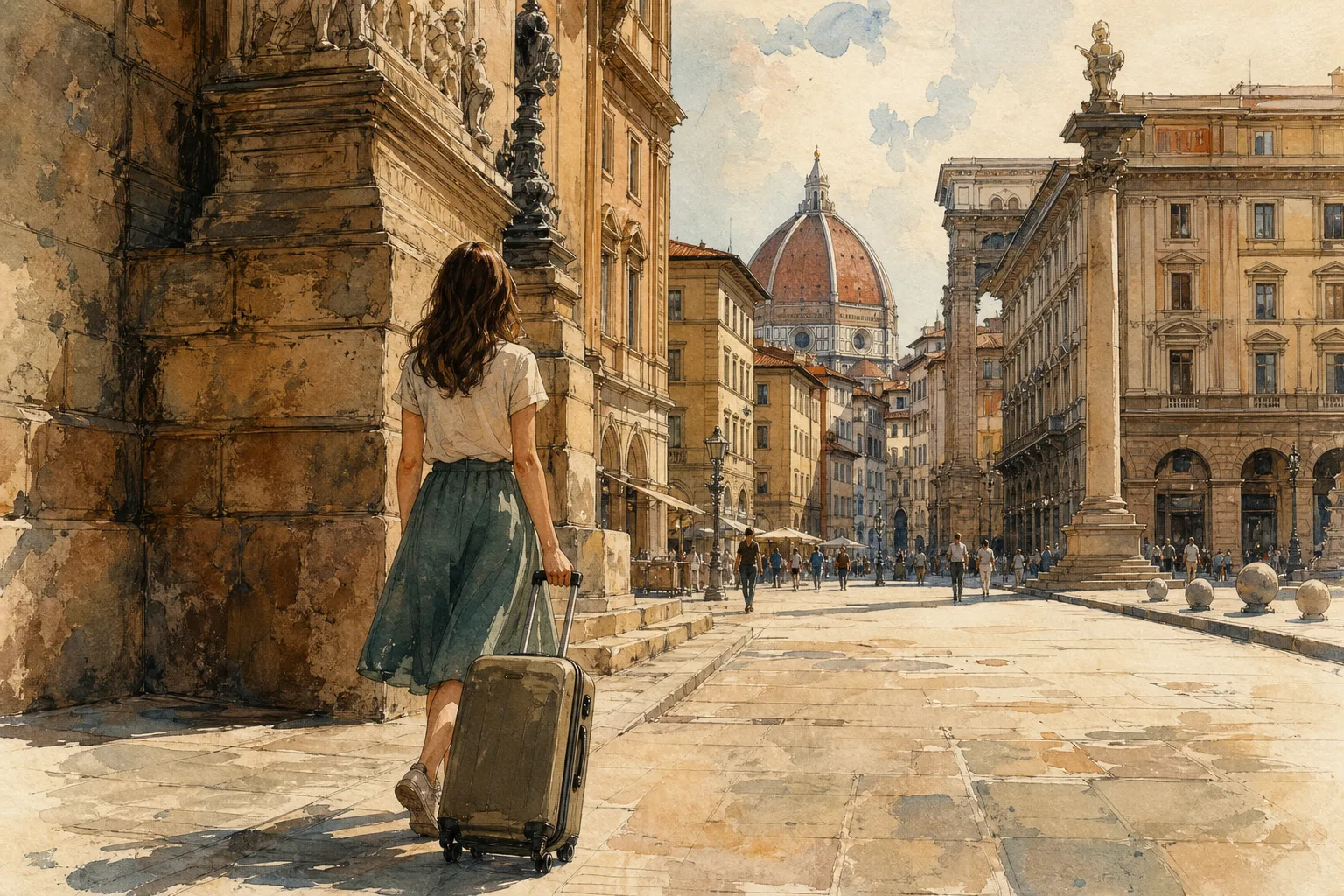
A continuous orientation walk through the center is about 2.2 miles and takes around 70 minutes at a steady pace, short enough to repeat in different moods: morning coffee, late afternoon light, after dinner. From Firenze Santa Maria Novella, the Duomo is roughly a 10-minute walk (about 750 meters). The Piazza della Signoria is about an 18-minute walk from the Duomo, and the Ponte Vecchio about 17 minutes. The "must-see" backbone is genuinely walkable.
For a first Italy trip, this matters: you spend your energy on the trip, not on logistics.
Best for Couples
Florence suits couples who treat travel as shared time rather than a checklist. The center is small enough that you do not need a plan for every hour. You can decide over breakfast whether today is a museum morning or a market morning, and the city absorbs either choice without forcing a long commute between sights.
What couples typically enjoy here:
- Long lunches with wine that do not feel rushed.
- Walking the same few streets at different times of day.
- Splitting a museum day so one of you can rest while the other lingers.
- A half-day in Chianti or Siena by regional bus, which leaves from the station on Via Caterina da Siena 17, near the main train station.
What couples sometimes regret:
- Booking too many ticketed sights in one day.
- Staying outside the historic center to save money, then losing the walk-home feeling that makes Florence Florence.
Best for Slow Travelers
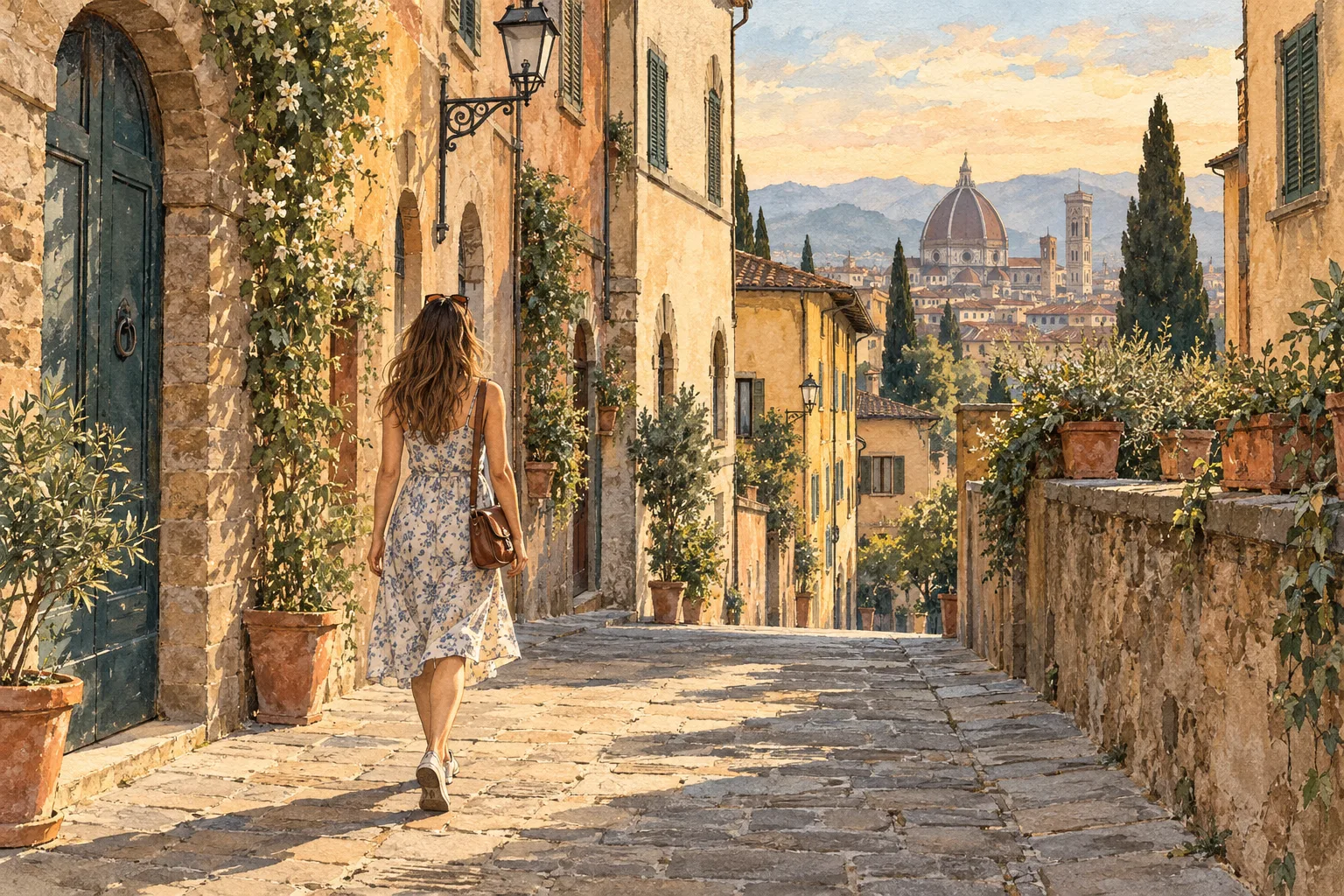
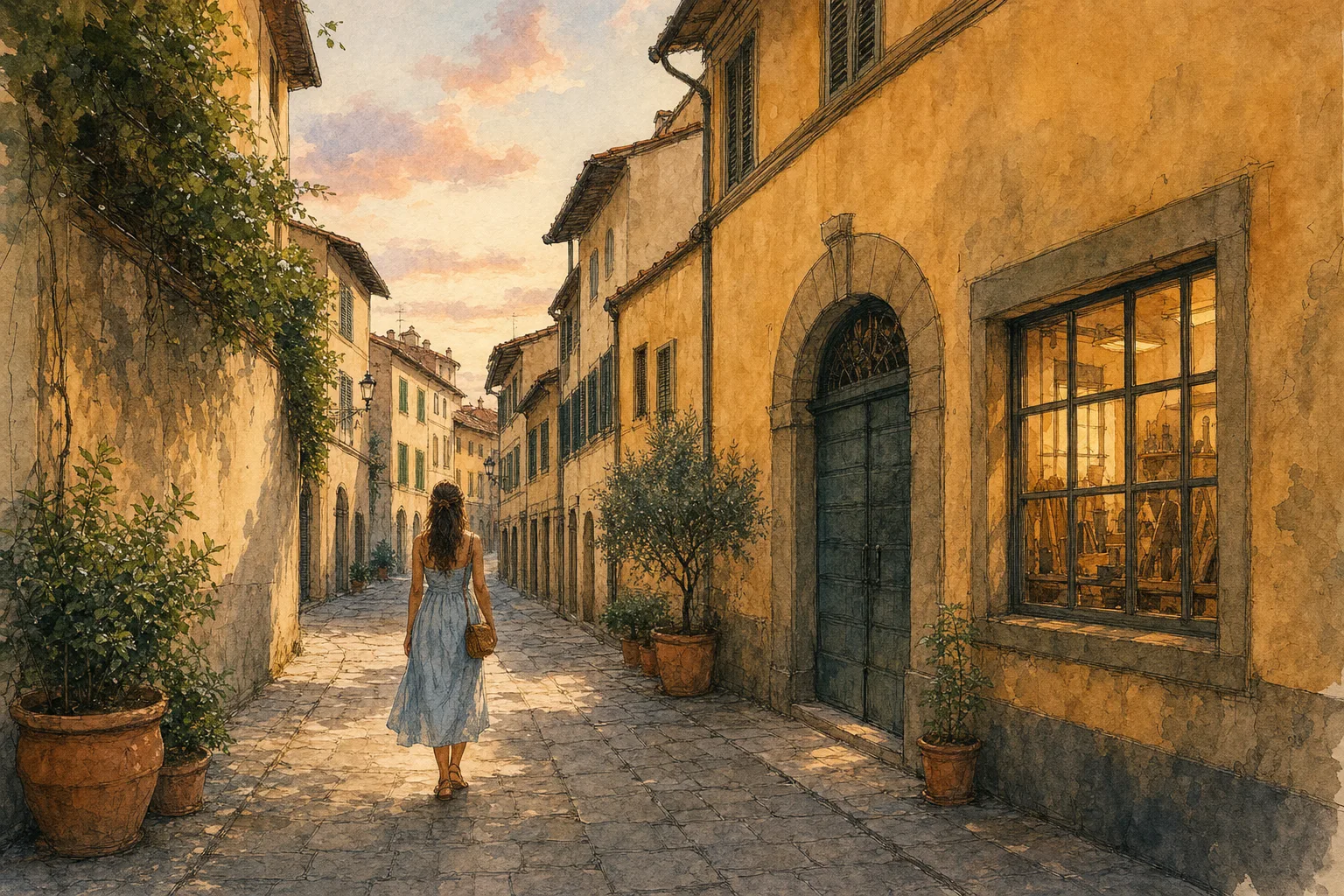
If your idea of a good trip is staying put, Florence is among the easiest Italian cities to slow down in. The center is compact, the food culture rewards repetition (you can return to the same trattoria twice and the second visit will be better), and a single neighborhood like Santo Spirito (Oltrarno, south of the river) or San Niccolo (quiet, residential, near the city gates) can carry several days without feeling thin.
A workable slow rhythm for a couple here:
- One anchor sight per day, not three.
- One sit-down meal per day that is allowed to take two hours.
- One quiet block of time with no plan, usually late afternoon.
Florence does not punish this. Rome and Venice can, because both reward more movement and more ground covered.
Best for Low-Stress Travelers
Florence is one of the lower-friction Italian bases, but it is not effortless. The good news first: Florence Peretola Airport (FLR) connects to the city by tram line T2, with a stop at Via Alamanni close to the main station, which removes most arrival stress. Santa Maria Novella station has a luggage office near Platform 16, which makes a same-day arrival or departure manageable without dragging bags through the center. Restrooms near Platform 5 require a 1 euro payment, which is worth knowing before you need them.
The friction to plan around is mostly crowd timing. Peak season runs June through August, and queues at the Uffizi and Accademia stretch noticeably; both should be booked with timed entry in advance. January and February are the least crowded, and February is often the cheapest month for hotels, with rates that can run roughly 34 percent below high season. November is quiet but has the most rainy days, which matters for a city you experience mostly on foot.
A low-stress couple's version of Florence usually looks like this: shoulder-season dates, hotel inside the historic walking core, two timed-entry museums booked in advance, and the rest unscheduled.
A sample 3-day plan for couples
| Day | Morning | Afternoon | Evening |
|---|---|---|---|
| Day 1 | Arrive via T2 tram, drop bags, walk Duomo loop | Coffee in Piazza della Repubblica, slow walk to Ponte Vecchio | Early dinner in Santo Spirito |
| Day 2 | Timed Uffizi entry (first slot) | Long lunch near Piazza Santa Croce, rest at hotel | Sunset at Piazzale Michelangelo, light dinner in San Niccolo |
| Day 3 | Regional bus to Chianti or Siena from Via Caterina da Siena 17 | Wine tasting, late return | Casual trattoria dinner near the hotel |
Traveler Type Table
The decision is not Florence versus Italy. It is Florence versus Rome or Venice for the same week.
| Decision variable | Florence | Rome | Venice |
|---|---|---|---|
| Walking load | Compact, mostly flat center, about 2.2 miles for a full orientation loop | Long distances between major sights, often 30 plus minutes between anchors | Compact but stair- and bridge-heavy, hard with luggage |
| Food focus | Tuscan trattoria depth, Chianti wine, market lunches at Sant'Ambrogio or Mercato Centrale | Broadest range, strong Roman classics in Testaccio and Trastevere | Narrower, seafood-led, fewer late options |
| Crowd pressure (peak) | High at Uffizi and Accademia, calmer in Oltrarno | High across many sights and transit | Very high in San Marco core, day-tripper waves |
| Nightlife | Limited, mostly wine bars closing by midnight | Strong: Trastevere, Monti, Pigneto run late | Very limited after 11 pm |
| Best stay length for couples | 3 to 4 nights as a base | 4 to 5 nights | 2 to 3 nights |
| Day-trip ease | Easy (Chianti, Siena, Lucca by bus or regional rail) | Medium (Orvieto, Tivoli) | Limited beyond the lagoon |
| Slow, food-led couple fit | Strong: compact, repeatable, wine-rich | Medium: rewarding but logistics-heavy | Strong but narrow; thin after 3 days |
If your ideal couple's day is a long lunch, a museum, a walk, and an early dinner with wine, the Florence column is the honest answer. If it is three landmarks, a rooftop bar, and a late dinner, the Rome column is.
Common Mismatches
Florence disappoints specific kinds of travelers in specific ways. Naming them up front prevents the regret.
- Couples wanting big-city evening energy. Florence quiets down earlier than Rome or Milan. If late nightlife is part of how you connect on a trip, Rome's Trastevere or Monti, both walkable neighborhoods with bars open past 1 am, will serve that need far better. Rome is about 1.5 hours from Florence by high-speed train.
- Couples chasing contemporary tasting menus. Florence is deep on traditional Tuscan cooking, less so on modernist cuisine. Milan's Brera and Porta Nuova districts have a denser contemporary fine-dining scene, and Milan is about 1 hour 50 minutes from Florence by direct high-speed train.
- Travelers who measure a trip in landmark count. The Uffizi, Accademia, Duomo, and Ponte Vecchio are the obvious anchors. After that the city shifts to atmosphere. If that shift reads as "running out of things to do," the fit is wrong, and Rome's higher landmark density is the better booking.
- Museum-heavy planners. Two major museums back-to-back is a real way to ruin a Florence day. Pace matters more than access.
- Outdoor-dining romantics with very specific expectations. Beginning in early 2026, outdoor dining is banned on 60 streets within the UNESCO-protected historic center, including Ponte Vecchio, Piazzale degli Uffizi, Via Roma, and Via Maggio, under a municipal ordinance protecting the historic core. You can still eat outside in much of the city, especially in Santo Spirito and around Sant'Ambrogio, but a table directly on the Ponte Vecchio is no longer the reality.
- Anyone treating Florence as a half-day stop between Rome and Venice. That version is the most common regret. You see the queue, not the city.
Final Match Recommendation
Choose Florence as the centerpiece of your Italy trip if:
- You want a single base for most of the week.
- Food and wine are a real part of how you enjoy travel, not a side note.
- You prefer one or two anchor sights per day and unstructured time around them.
- You are comfortable in shoulder season (late March to May, or September to early November) when crowds and prices are calmer.
Choose differently if:
- You want a different city or neighborhood every two days. Rome or a Rome plus Naples pairing will serve that better.
- Nightlife matters as much as historic atmosphere. Book Rome (Trastevere, Monti) as your base instead.
- Contemporary tasting menus are central to the trip. Add or substitute Milan.
- You are trying to fit three Italian cities into seven days. In that case, Florence becomes a two-night stop, not a base, and the slow version of the trip is not the version you are taking.
For couples who want beauty, food, and a slower Italy trip, Florence is one of the most direct matches in the country. The risk is not the city. The risk is booking it like it is Rome.
FAQ
The frequently asked questions for this decision are answered in the FAQ block attached to this article.