travel-decisions
Who Might Regret Florence If They Expect Big-City Nightlife and Constant Variety?
Florence is small, quiet after dinner, and not built for big-city nightlife. Here is who will regret it, what the real friction looks like, and where to go instead.
Strong Opening
Florence is one of the easiest cities in Italy to fall for during the day and one of the easiest to resent after dinner. The art is dense, the streets are walkable, and the food is genuinely good. But if you are picking Florence because you want a city that pulses at night, switches energy every evening, and keeps offering new neighborhoods to discover for a week straight, you are aiming a nightlife-shaped expectation at a Renaissance-shaped city.
This is not a "Florence is boring" piece. It is a fit check. The wrong-fit reader here is specific: someone whose trip rhythm depends on big-city nightlife, late-night variety, and constant new scenes. If that is you, the regret usually shows up on night two, not night one.
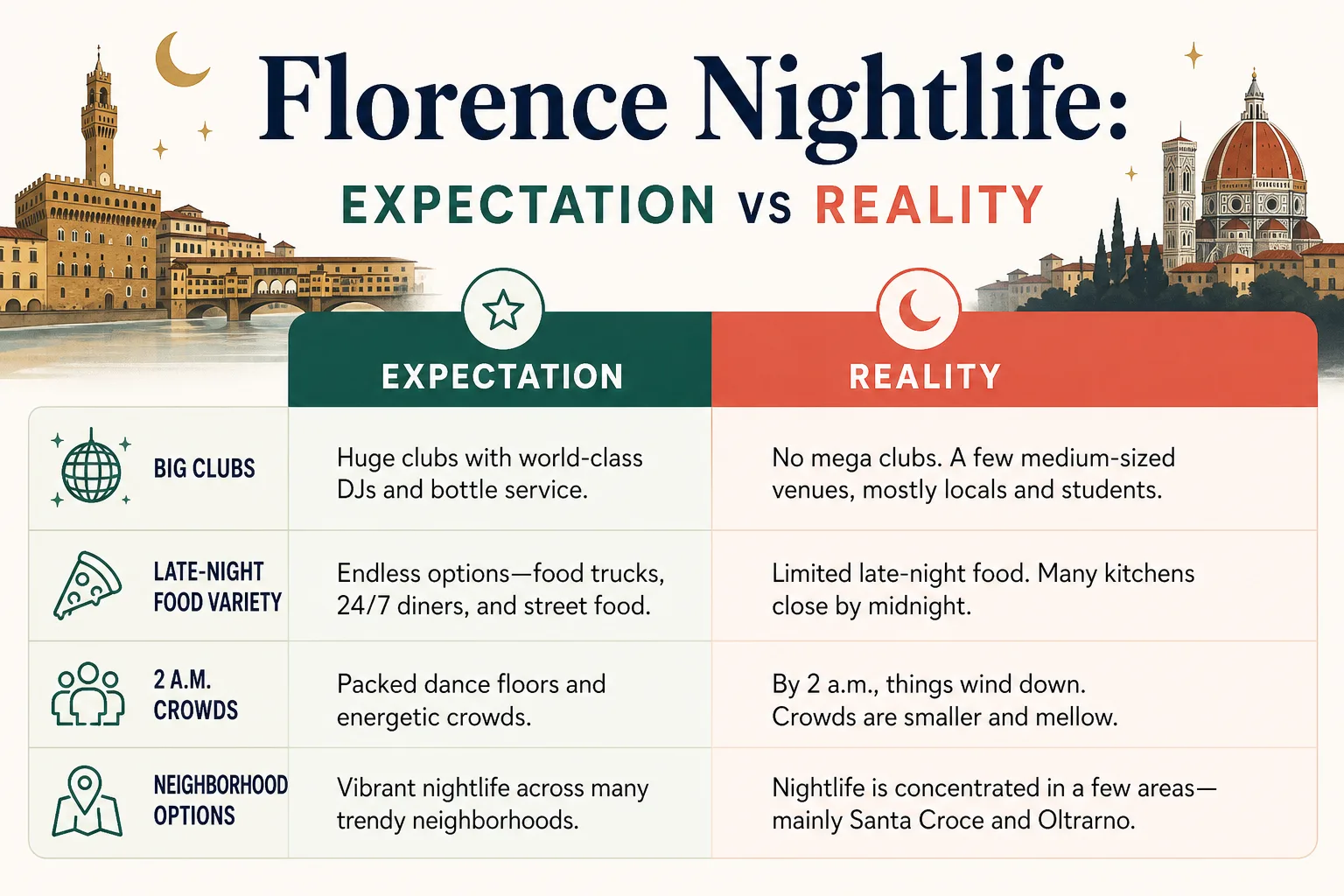 An infographic detailing the expectation versus reality of Florence's nightlife scene, highlighting clubs, food, crowds, and locations.
Quick Verdict
Choose Florence if you want art, food, walkable beauty, and slow evenings on a piazza. Skip Florence as your main base if your trip rhythm depends on big clubs, late-night variety, multiple distinct nightlife neighborhoods, or post-midnight energy every night.
Concretely:
- Good fit: 2 to 4 nights of art, food, day trips into Tuscany, and one or two relaxed evenings out.
- Bad fit: 5 to 7 nights expecting Rome-level or Milan-level nightlife variety.
- Mixed fit: travelers who want one quiet city plus a louder one. Pair Florence with Rome, Milan, or Naples instead of making it the main base.
Who Will Probably Love It
Florence rewards travelers whose decision is led by atmosphere, art, and food rather than urban energy.
- First-time Italy visitors who want a manageable, walkable city.
- Culture and food-led travelers chasing museums, churches, markets, and Tuscan cooking.
- Slow travelers who want to sit at the same bar two evenings in a row and feel local.
- Couples who treat dinner and a walk along the Arno as the night's main event.
- Style and photo-led travelers who care about golden-hour light on the Duomo more than 2 a.m. dancing.
If you read that list and felt nothing pull, keep going. The regret risk is real.
Who Might Regret It
You are at high regret risk if any of these describe your trip rhythm:
- You normally plan trips around clubs, DJ sets, or live music circuits.
- You want a different nightlife neighborhood every evening for a week.
- You are used to cities where dinner starts at 10 and the night peaks at 1 or 2.
- You picture "European city" as Berlin, Madrid, Lisbon, or even Rome at full volume.
- You are staying 5 plus nights with no day trips planned.
- You are traveling with a group whose main reason for the trip is going out.
The specific disappointment is not that Florence has zero nightlife. It is that the nightlife footprint is small and repeats fast. The most active late-night corridor is concentrated around Via dei Benci and Piazza Sant Ambrogio in Santa Croce, which is mostly student-friendly pubs, casual restaurants, and cocktail spots. By night three you will recognize the same bars, and by night four you will start resenting them.
Mistake and Consequence Table
| Mistake | What you assumed | What actually happens | Consequence |
|---|---|---|---|
| Booking 6 plus nights in Florence as the main base | Big Italian city equals big nightlife | Compact historic center, one main late corridor in Santa Croce | Boredom and overpaying for nights you do not enjoy |
| Planning dinner-by-aperitivo every night | Free buffet with a drink | Mostly crisps, nuts, olives; upgraded plates cost extra | Hungry and overspending versus just booking dinner |
| Choosing a hotel deep in the UNESCO core for "energy" | Historic center stays loud late | Streets quiet down, alfresco setups restricted on 120 plus streets and piazzas | You paid a premium for a museum-quiet street |
| Expecting big clubs inside the city on summer weekends | Locals party where you are staying | Many locals drive about 1.5 hours to Versilia coast discos (Forte dei Marmi, Viareggio) | You stay in town for a scene that has physically left town |
| Eating on the steps near the Uffizi at 9 p.m. | Casual street picnic | Street eating banned on Via de Neri, Via della Ninna, Piazzale degli Uffizi, Piazza del Grano during 12 to 15 and 18 to 22 | Fines from 150 to 500 euro |
| Last-minute short-term rental booking | Plenty of Airbnb-style options | New short-term rentals banned in the UNESCO historic core (unless registered before end of 2024) and across nine residential neighborhoods | Fewer real options, higher prices, more hotel-only inventory |
Hidden Friction Points
These are the things nightlife-led travelers usually do not factor in until they are already there.
Expectation mismatch. Florence is marketed with Renaissance art and Tuscan food, but many first-timers still pattern-match it to "big European city" and expect the nightlife to scale with the fame. It does not. Fame here is about density of art per square meter, not nightlife per square meter.
Quiet evenings by design. Tour guides cannot use loudspeakers in the historic center. Outdoor alfresco dining setups, including tables, barriers, and umbrellas, are banned or heavily restricted on more than 120 historic streets and piazzas. The city has actively chosen calmer streets. That is a feature for slow travelers and a friction point for variety seekers.
Limited variety after night two. Because the late-night zone is mostly one corridor in Santa Croce, you cycle through the same options quickly. There is no equivalent of Trastevere plus Testaccio plus Pigneto the way Rome offers. There is largely one neighborhood with momentum after midnight.
Hotel cost stacking. Florence's overnight tourist tax is 5.50 euro per person per night for private holiday rentals and 3.50 to 8.00 euro per person per night for standard hotels, applicable for up to 7 consecutive nights, with children under 12 exempt. If you are extending your stay because you assumed nightlife would carry you, the per-night math gets worse.
Self-check-in friction. Physical key lockboxes attached to exterior walls or railings in the historic center are banned. Combined with the short-term rental restrictions, late-arriving travelers should not assume a casual "grab the keys and head out" arrival.
How to Make It Easier
If you have already decided on Florence and want to reduce the regret risk, do these instead of fighting the city.
- Cap Florence at 3 nights as a main stop, and use the extra days for Rome, Bologna, or Milan.
- Stay near Santa Croce, specifically within walking distance of Via dei Benci or Piazza Sant Ambrogio, if going out matters to you.
- Book actual dinners and treat aperitivo as a drink with snacks, not a free meal.
- Plan one Tuscan day trip (Siena, Lucca, or a wine area) so the evenings feel earned rather than empty.
- If you are traveling in February, lean into the off season: it is historically the cheapest month to book accommodation in Florence, with rates dropping by up to 34 percent compared to peak high-season rates. Quieter nights hurt less when the trip is cheap.
- Eat on terraces and inside, not on banned steps. Avoid Via de Neri, Via della Ninna, Piazzale degli Uffizi, and Piazza del Grano during 12 to 15 and 18 to 22.
- Confirm with your hotel or host how late check-in actually works, since lockbox shortcuts are restricted in the historic center.
Better Alternatives
If the regret signals in this article are landing too hard, swap your base. You can still day-trip to Florence in 1.5 to 2 hours by train from any of these.
- Rome. The right answer for most variety seekers. Trastevere, Testaccio, Pigneto, Monti, and the center each offer a different night. You will not run out of neighborhoods.
- Milan. The right answer if you want a real club and live-music circuit, design bars, and a genuinely urban late-night feel. Navigli and Porta Romana carry the evenings.
- Naples. The right answer if you want loud, chaotic, late, cheap, and unfiltered. Pizza at midnight is not a stunt there.
- Bologna. A smart middle option. Smaller than Rome or Milan, larger nightlife footprint than Florence, strong student energy, very food-led.
- Florence as a side trip. Keep your base in Rome or Bologna and visit Florence for 1 to 2 days. You get the art without losing your evenings.
Self-Checklist
Run this before you confirm Florence as your main base.
- I want art and food more than I want clubs this trip.
- I am okay with my evening corridor mostly being Santa Croce.
- I am not planning more than 3 to 4 nights here as a main base.
- I have at least one day trip planned (Siena, Lucca, Tuscan wine, or Bologna).
- I have budgeted for real dinners, not aperitivo as dinner.
- My hotel is in or next to Santa Croce if going out matters to me.
- I have factored in the per-person nightly tourist tax for the full stay.
- I have confirmed late check-in works without relying on an exterior lockbox.
- I am okay eating on a terrace or inside, not on historic steps near the Uffizi.
- If I cannot tick at least 6 of these, I am picking Rome, Milan, Naples, or Bologna as my base and treating Florence as a day trip.
FAQ
Is Florence dead at night? No, but it is calm. Streets quiet noticeably after dinner outside Santa Croce. The historic core is intentionally calmer because of restrictions on loudspeakers, alfresco setups on 120 plus streets and piazzas, and street eating during peak meal hours. If "calm after 10" reads as dead to you, that is your answer.
How many nights is Florence really worth for a nightlife-focused traveler? Two, maybe three. Beyond that you are paying tourist tax and hotel rates for evenings you will not enjoy. Use the saved nights in Rome or Milan.
Can I club-hop in Florence on a summer weekend? Not in the big-city sense. On hot summer weekend nights, many locals drive about 1.5 hours to Versilia coast discos in towns like Forte dei Marmi and Viareggio. That is a structural sign that the city does not host a major weekend club scene in summer; the scene relocates.
Will a short-term rental fix the nightlife problem by putting me in the action? Probably not, and your options are narrower than they used to be. New short-term tourist rentals are banned in Florence's UNESCO-listed historic center, unless registered before the end of 2024, and across nine residential neighborhoods outside the center. You should plan around hotels and registered properties, and prioritize being walkable to Santa Croce rather than chasing a "party rental."
Is February a smart time to go if I want quiet anyway? Yes. February is historically the cheapest month to book accommodation in Florence, with rates dropping by up to 34 percent compared to peak high-season rates. The city is naturally quieter, which is fine for art and food-led travel, and bad for anyone still expecting peak-summer energy.
Is the food scene varied enough to carry the trip even without nightlife? For food-led travelers, yes. For variety-led travelers who want a different vibe every evening, the food alone will not be enough by night four. Plan day trips so the evenings are recovery, not the main event.