travel-decisions
Is Venice Worth It in Peak Season If You Hate Crowds?
An honest call on whether Venice in July or August is worth it for crowd-sensitive travelers, with specific friction points, tactics, and alternatives.
You booked August. Or your partner did. Or it is the only week your kids are off school. Now you are reading every "Venice is ruined" thread on the internet and wondering if you just bought a ticket to a sweaty, expensive mistake.
The honest answer is more specific than yes or no. Venice in peak season punishes a particular kind of trip: midday arrivals, hotels near San Marco, no plan for heat, no understanding of when day-trippers leave. It rewards a different kind of trip almost shockingly well. This piece is about deciding which one you are about to take.
Quick Verdict
Venice in July or August is worth it if you can do three things: stay overnight inside the historic center for at least two nights, accept that 11:00 AM to 5:00 PM is mostly unusable outdoors, and skip San Marco as a base.
It is not worth it if you are day-tripping in from the mainland, locked into a San Marco hotel because it "felt iconic," or expecting the romantic empty-canal photos you saw online. Those photos were taken at 6:30 AM in November.
If you cannot shift any of those constraints, shifting your dates to late September or early October will give you a meaningfully better trip for the same money.
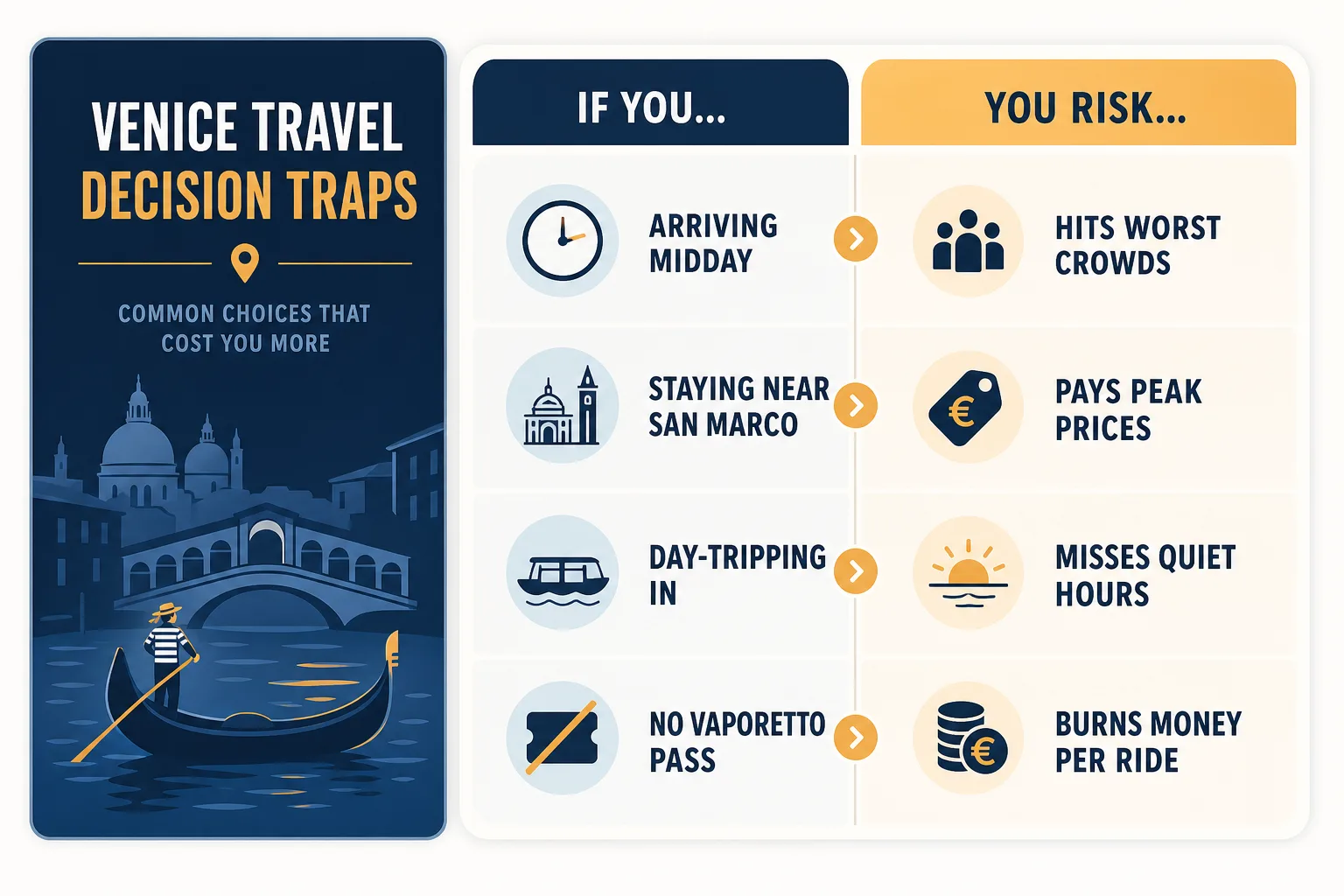 An infographic detailing Venice travel mistakes and their corresponding risks.
Who Will Probably Love It Anyway
- Travelers who naturally wake early and are happy to be out at 6:30 AM with a coffee.
- People staying two or more nights in Cannaregio, Dorsoduro, Castello, or Giudecca.
- Anyone who treats midday as siesta time: long lunches, museums, a nap, a quiet spritz indoors.
- Travelers who like water more than monuments and plan to use the vaporetto network to reach Burano, Torcello, or the Lido instead of grinding through San Marco a third time.
- Repeat visitors who have already done the headline sights and just want to wander.
If three or more of those describe you, peak-season Venice is genuinely good. The early and late hours feel almost private, and the city you read about in books is still there, just compressed into narrower time windows.
Who Might Regret It
- Day-trippers arriving by train or cruise at 10:30 AM and leaving at 5:00 PM. You will see Venice exclusively during its worst hours and pay an access fee for the privilege.
- People who hate heat. July and August averages run 28 to 31 degrees Celsius with regular spikes past 40, and there is very little shade on the main routes.
- Travelers who booked a "Venice hotel" that is actually in Mestre on the mainland. You will commute into the worst crowd hours and back out before the city empties.
- Anyone whose mental image of Venice is empty bridges and gondolas drifting past. Peak season is the opposite of that image from roughly 10:00 AM to 7:00 PM.
- First-time visitors with one full day only. You cannot get the quiet version of Venice in a single daytime visit in August. It does not exist on that schedule.
The specific regret pattern is predictable: arrive midday, queue at San Marco in 33-degree heat, get pushed across the Rialto Bridge, pay 35 euros for a mediocre lunch, leave thinking the city is overrated. None of that is Venice's fault. All of it is avoidable.
Mistake and Consequence Table
| Common decision | What it actually costs you in peak season |
|---|---|
| Arriving by train at 11:00 AM and leaving at 5:00 PM | You experience only the densest hours, pay the 5 to 10 euro access fee on active days, and miss every quiet window. |
| Booking a hotel right on San Marco | Mid-range rates of 200 to 500+ euros per night, plus you are wading through the thickest crowds to reach your own door. |
| Walking Piazzale Roma to San Marco at midday | A 30 to 40 minute walk stretches past an hour in peak congestion, mostly through chokepoints with no shade. |
| Buying single vaporetto tickets at 9.50 euros each | Three rides already costs more than a 24-hour pass at 25 euros, and you will hesitate to use the boats you should be using. |
| Treating the gondola as the headline experience | 90 euros for 30 daytime minutes, often through the most boat-clogged stretches; the magic is in the quiet side canals at off-hours, not the queue at the Rialto stand. |
| Skipping the overnight exemption QR code | Day-trippers pay the fee, miss the early and late hours, and never see the version of Venice worth the trip. |
Hidden Friction Points Most Guides Skip
The Mercerie is the bottleneck, not the bridges. Walking from San Marco to the Rialto Bridge takes 10 to 15 minutes when empty and roughly 30 minutes in peak crowds, not because the distance changed but because the Mercerie shopping street between them is barely wide enough for two people in places. There is no parallel route that is meaningfully better. If your hotel is on the wrong side of this corridor, you cross it every day.
Day-tripper waves are predictable. Cruise passengers and bus tours mostly enter between 9:30 and 11:00 AM and leave between 4:00 and 6:00 PM. The 2026 access fee window of 8:30 AM to 4:00 PM is essentially the city telling you when it expects to be overwhelmed. Treat that window as your indoor and outer-island time, not your sightseeing time.
Heat is a hard constraint, not a vibe. With highs of 28 to 31 Celsius and heatwaves past 40, and almost no greenery in the historic center, midday outdoors is genuinely punishing. The reflective stone, the lack of breeze in narrow calli, and the smell from low canals on hot afternoons are real. Plan around it the way you would plan around rain in Scotland.
The access fee is a logistics tax, not a crowd filter. It is 5 euros if you book at least four days ahead, 10 within three days, and a 50 to 300 euro fine if you skip it on an active day without the right QR code. It does not reduce the crowds. Overnight guests in the historic center are exempt but still must register on cda.ve.it for the free QR code.
"Going anyway" versus "shifting dates" is a real tradeoff. Late September delivers most of what you want from June through August at roughly the same prices but with noticeably thinner crowds and tolerable heat. If your dates are flexible by even two weeks, that shift does more for your trip than any tactic in this article.
How to Make It Easier If You Are Going
The single highest-leverage decision is where you sleep. Get that right and almost everything else gets easier.
- Base in Cannaregio or Dorsoduro, not San Marco. Cannaregio rates run roughly 15 to 25 percent lower than San Marco, and you wake up in a neighborhood where Venetians actually buy groceries. Castello east of San Marco and Giudecca across the water are the other strong options.
- Stay at least two nights. One night means you arrive tired and leave during the worst window. Two nights gives you one full early morning and one proper evening, which is where the trip happens.
- Register for the exemption QR code at cda.ve.it. Free, takes a few minutes, prevents a 50 to 300 euro fine on active fee days.
- Buy a multi-day vaporetto pass on arrival. 25 euros for 24 hours, 35 for 48, 45 for 72. Travelers aged 6 to 29 should use the Rolling Venice pass at 27 euros for three days. Single tickets at 9.50 euros each will quietly destroy your budget and your willingness to use the boats.
- Front-load your San Marco and Rialto time before 9:00 AM. Vaporetto Line 2 takes 20 to 30 minutes from Piazzale Roma, Line 1 takes about 40 minutes with stops. Both are pleasant before the day-trippers arrive.
- Use 11:00 AM to 5:00 PM for indoor museums, long lunches, a hotel break, or the outer islands. Burano and Torcello stay much calmer than the central sestieri in peak hours.
- Walk the side canals after dinner. This is when the city you came for actually shows up. Quiet, cooler, almost empty bridges from about 9:30 PM onward.
Not sure whether you are wired for early-mornings-and-side-canals travel or for sleeping in and accepting the crowds? The Trip Persona travel personality quiz is a faster honesty check than another forum thread.
Better Alternatives If You Are the Wrong Fit
If reading the friction section made you tired, redirect rather than force it.
- Shift two to four weeks later. Late September into early October in Venice keeps warm weather, drops the heatwaves, thins the day-tripper crowds noticeably, and lowers hotel rates. Same city, different trip.
- Swap to a Veneto base and day-trip in. Padua and Treviso are both reachable in under an hour by train, have real hotel inventory at lower prices, and let you spend evenings somewhere unhurried. You still get a Venice day, but it is not the whole trip.
- Trade Venice for the lakes. Lake Como, Lake Garda, and Lake Maggiore are also peak-season busy but offer water, shade, and breeze that the historic center cannot match in August.
- Pick a different Italian coastal city. Trieste in particular is underrated in summer, cooler than Venice, and has a fraction of the tourist density.
None of these are "settling." They are honest matches for travelers who would otherwise spend two days angry at a city that was never going to be quiet for them.
Self-Checklist Before You Commit
Run through this list before you finalize anything. If you cannot answer yes to most of the first block, you are setting up for the regret pattern.
- I am staying at least two nights inside the historic center, not in Mestre.
- My hotel is in Cannaregio, Dorsoduro, Castello, or Giudecca, not on San Marco.
- I have registered for the free exemption QR code at cda.ve.it.
- I am willing to be out the door by 7:00 AM at least one morning.
- I have an indoor or outer-island plan for the 11:00 AM to 5:00 PM window.
- I have priced a multi-day vaporetto pass instead of single tickets.
- I have checked whether my dates fall on a fee-active day (Fridays through Sundays April 3 to July 26 in 2026, plus April 27 to 30 and June 1 to 7).
- I am not expecting empty-canal photos during daylight hours.
- If heat above 30 degrees Celsius would ruin my trip, I have an air-conditioned base and a flexible itinerary.
Need a second pass on the hotel piece specifically? The hotel location checklist walks through walking distance, noise, and chokepoint exposure in a way that maps directly to Venice's geography.
FAQ
Is Venice actually worse than other European cities in peak season? Yes, in one specific way: Venice has no real bypass routes. Rome or Paris let you sidestep crowded chokepoints; in Venice the Mercerie between Rialto and San Marco is the only practical path for most people, and it stays packed from late morning to early evening. The total visitor numbers may not exceed Rome, but the density per square meter on the main route is harder to escape.
When during the day is peak-season Venice tolerable? Roughly before 9:00 AM and after 7:00 PM. Day-tripper boats and trains unload from late morning, and the access fee window itself runs 8:30 AM to 4:00 PM on its active days, which tells you exactly when the city expects the worst pressure. Overnight guests can walk San Marco at sunrise and again after dinner with a completely different feel.
Is it worth paying the Venice access fee as a day-tripper if I hate crowds? Probably not. The fee is 5 to 10 euros and it does not reduce crowds, it just lets you enter on busy days. If you are crowd-sensitive, the better move is to book an overnight stay, register on cda.ve.it for the free exemption QR code, and use the early and late hours that day-trippers cannot.
Should I just skip Venice and go somewhere else in July or August? Skip it if your only available days are weekends in July, you cannot stay overnight inside the historic center, and heat above 30 degrees Celsius ruins your trip. Go anyway if you can stay two nights in Cannaregio or Dorsoduro, walk early, and accept that midday is a write-off you spend indoors or on a quieter island.
Is a gondola ride worth 90 euros in peak season? Only at a time and place that escapes the main boat traffic. A 30-minute daytime ride at 90 euros for up to five passengers is fine value if you share it and route it through quieter side canals away from the Rialto. Booking the 110-euro evening ride after 7:00 PM also lands you in much calmer water. A midday gondola through the busiest stretch is where the regret comes from, not the price itself.